Margaret Carlson asks Bubba to stay the hell out of the race next time:
Bill Clinton is now beloved — achieving a comeback no one thought possible. If he meddles in his wife’s 2016 campaign the way he did in 2008, he could lose his hard-won halo. If she lets him meddle, she will go down with him.
He will always loom. What didn’t drive them apart made their marriage stronger. But one thing he hasn’t learned is how to stand by his woman without standing in her way, blocking our view.
So thank you, Bill, for all you’ve done. Now for all womankind, and for the sake of the TBD at the end of Hillary’s Twitter profile, could you go where no man has gone before, except perhaps Denis Thatcher, and take one step back and to the side?
She can’t do this with you.
That’s great advice. Hillary finally broke through as her own candidate and politician – when she ran for Senate. The fact she got the seat because she was First Lady was the only blemish, but her campaign for the presidency truly broke her out of the politics-through-marriage paradigm. Now it seems that Bill is already prepping for her candidacy, by joining with McCain against Obama on Syria. But Bill is not, it seems to me, a good judge of the future. I don’t think a future Democratic candidate will come from the interventionist, pro-military right. I think it will come from the non-interventionist left. Could Hillary manage that? I think she’s far too Establishment. And stuck in the mindset of the 1990s.
What is the qualification for being “working class“? I work as support staff in a mid-sized for our city law firm. In the last month of pregnancy, I developed gestational hypertension, a potential precursor to preeclampsia, high blood pressure, edema in my limbs, etc. But I couldn’t slow down my work production or take any time off without having it docked when I would need it most, during my maternity leave. In Connecticut, the law requires 6 weeks unpaidleave for a regular delivery and 8 weeks unpaid for a C -section. You can use your accrued vacation time to soften the blow of losing your income for 6 or 8 weeks, unless of course you had to use it beforehand because you were sick during pregnancy. It wasn’t until my healthcare provider mandated bed rest (after a night in the hospital being monitored) that my own, self-pay, short-term disability insurance kicked in. Thank goodness for that money.
This isn’t an issue that just impacts “low income” women. The Republicans in power put far greater value on the life of an embryo or a fetus than they do a newborn and its mother. Pop it out, plop it in daycare and get back to work.
Another also shares a personal perspective and then highlights a dilemma for the GOP:
I practice law in a very red state that is getting redder by the election cycle. My practice focuses on civil litigation of all types. I typically have full weeks and work a few hours each weekend, unless I’m in trial, in which case I’m usually pulling 15 to 16 hour workdays. My wife is an attorney as well, who has been a member of the State bar association for 12 years, and has had her own practice for 10. She handles criminal matters of all types in both state and federal courts. In her office, it is just her and a receptionist/legal assistant. We are expecting our second child in October. There will be no maternity leave for her.
She gets no break on her rent from her landlord. Her clients will still have court dates and trial dates. About 30% of our local bench is female, and about 50% of them recognize that they may have to continue hearings/trials for my wife. We have been INCREDIBLY fortunate in that her first pregnancy (though miserable) went smoothly with only a minor complication at delivery. We have been INCREDIBLY lucky so far in this pregnancy that she has gutted out the Braxton Hicks and early relentless vomiting, and hasn’t had anything more severe. The conundrum arises at delivery.
She is lucky that I am a member of the bar and can appear if necessary to continue matters or advocate for her clients at an uncomplicated hearing or sentencing. However, she will have clients get arrested, violated on probation and the like, and they will face penalties requiring her special skill set and relationship with the prosecutors. If I were not an attorney, there is no way she could have a child and keep her business afloat, because to get other attorneys (competitors) to “cover” her for a few weeks requires her to compensate them, making paying her own staff and bills impossible.
As more and more women are entrepreneurs and own their own business, the question arises: should government step in to provide assistance to female small business owners with children to give the equivalent of the maternity leave mandated by the FMLA and other acts? Should a bar association such as my states’s have something in place to help fund the attorney’s practice to allow maternity leave for solo practitioners?
It’s a fascinating conundrum for those who advocate for women’s rights, as well as for those who champion entrepreneurship. Many of those (i.e. GOP voices) who advocate for job creators and entrepreneurs and rugged individualism are also the same voices championing the need to support family values and the need to support moms bonding with their newborns. What do you do when the two are a mutually exclusive? I do not perceive this problem to be unique to my household or my profession, and I expect as more women become breadwinners and entrepreneurs and business owners, it is a problem that will grow.
As an aside, I was first row above the first base dugout for Mississippi State’s game Monday night versus Indiana. Those are some scruffy-looking fellas. But the beards seem to be working, as they are 2-0 in the College World Series and progressing towards a championship game.
Howard French worries that American misperceptions of the situation in Africa are giving the Chinese a big advantage:
I have spent the last few years working on a book about China’s relationship with the continent, and could not have been more struck by the differences in attitude in the United States and China toward Africa. More than a million Chinese have moved to Africa in the last decade, largely because they see the continent as an arena of almost limitless opportunity. … Americans, meanwhile, despite their far deeper historical associations with the continent, including 13 percent of the population that traces its ancestry to Africa, cling to deeply engrained attitudes toward this part of the world, as a place of war, of misery, of strife, etc.
He lays the blame primarily on the press:
[T]he American media are long overdue for a re-set in terms of the ways they habitually frame African coverage. This should start with a repudiation of the way that African events are denied specificity. Things are routinely said to take place “in Africa,” or “across Africa” instead of in actual countries or places with real names. The eternal pretext is to “make it easier” for the reader, who can’t be bothered with too many unfamiliar names. This kind of factual looseness, though, is not practiced toward any other part of the world, and bespeaks a casual and persistent ghettoization of Africa.
Another example of this is the fact that virtually no American news organization offers business coverage of Africa. Return on investment in Africa is among the highest in the world. Trade with each region of the continent is booming. And recently, big U.S. companies like Walmart, IBM and Google, to name the most prominent examples, have been expanding their presence in Africa. But because the media speaks mainly in terms of conflict and aid, the general public has no perception of the growing opportunities on the continent, unlike the large numbers of Chinese newcomers.
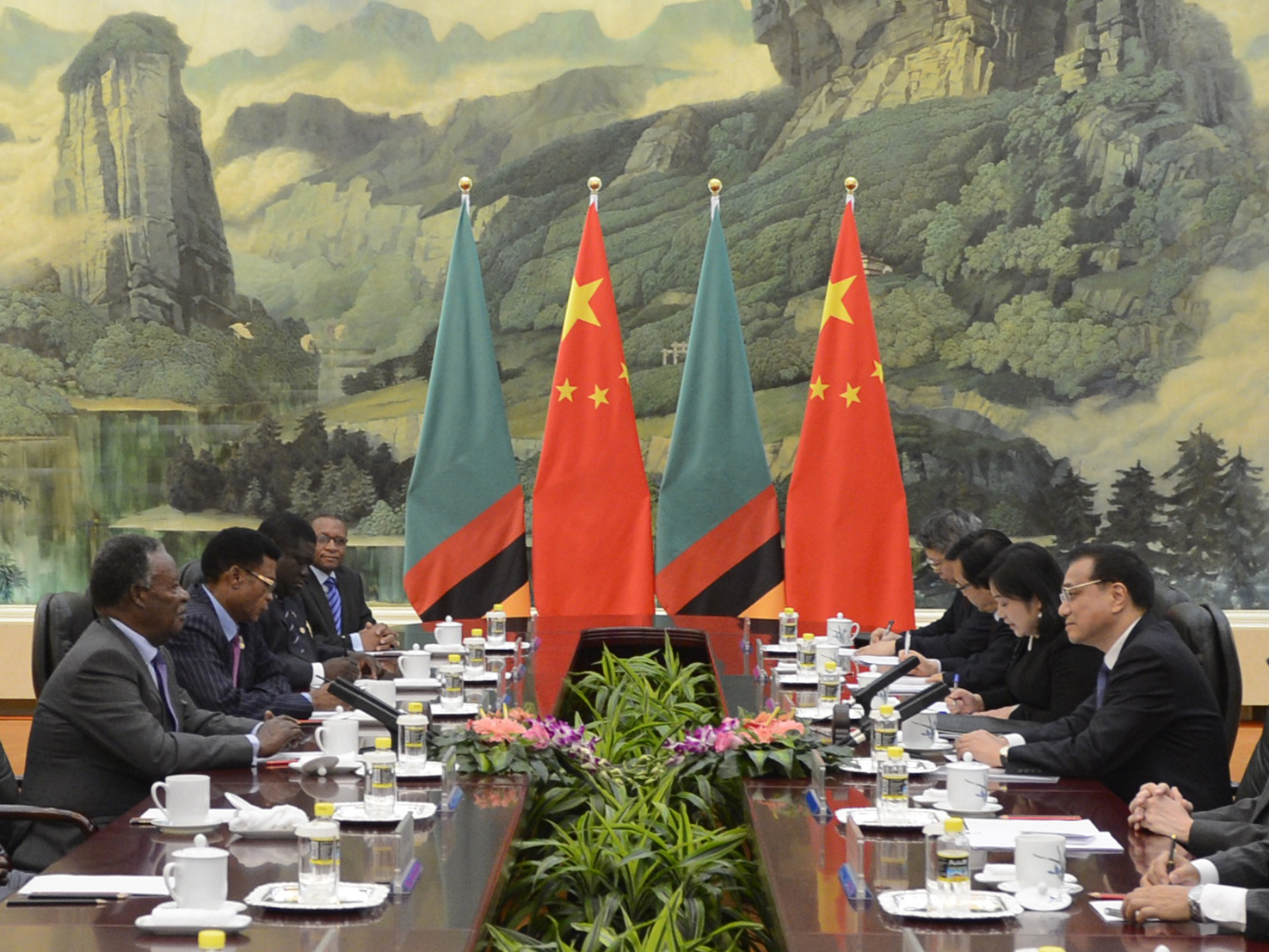
(Photo: Chinese Premier Li Keqiang speaks with Zambia’s President Michael Sata during a meeting at the Great Hall of the People in Beijing, China on April 10, 2013. By Yoshsuke Mizuno – Pool/Getty Images)
Now that the “maker movement” of 3-D printers and laser cutters is in full swing, Clive Thompson wants to see a “fixer movement” catch up:
In the 20th century, U.S. firms aggressively promoted planned obsolescence, designing things to break. Buying new was our patriotic duty: “We need things consumed, burned up, worn out, replaced, and discarded at an ever increasing pace,” marketer Victor Lebow wrote in 1955. … Today e-waste has become one of the fastest-growing categories of refuse. We chucked out 2.4 million tons of it in 2010 and recycled just 27 percent. And “recycling” often means shipping electronics overseas, where the toxic parts pollute developing countries. It’s a mess. A fixer movement could break this century-old system. …
[T]he ecosytem for fixing has never been better. YouTube has plenty of how-to-fix-it videos; sites like iFixit sell parts and post repair guides for tech new and old. Better yet, the advent of cheap 3-D printers makes new types of repairs possible. In Chicago, Ally Brisbin runs a repair night at her cafè9 and says, “My boyfriend brings in his MakerBot, so if you need a part he can print it.”
Alan Jacobs has also noticed the decline in repair that followed the tech boom:
Thompson focuses on repairing and restoring electronics, especially computers — but he begins by talking about a toaster oven. Maybe that’s where we should start, those of us who’d like to be better fixers: with mechanical things, machines that are electrically simple — or barely electrical at all, like lawn mowers. But as Thompson notes, to do any of this is to work against the grain of modern manufacturing culture. Consider what the electronification of automobile engines has done to the great American tradition of tinkering under the hood. Repair has become unAmerican.
Brazilian readers continue to inform us on the situation as good as any blogger:
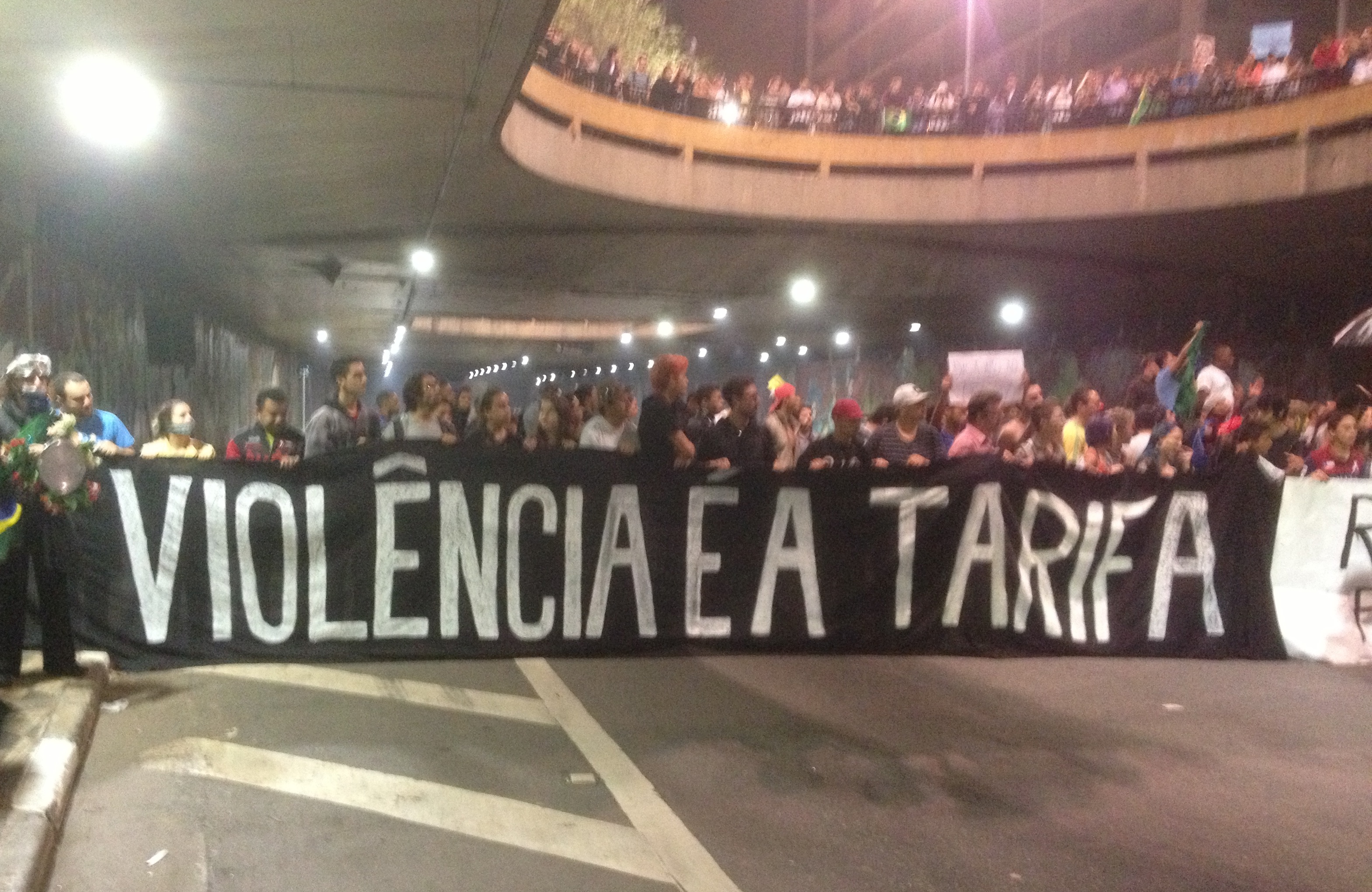
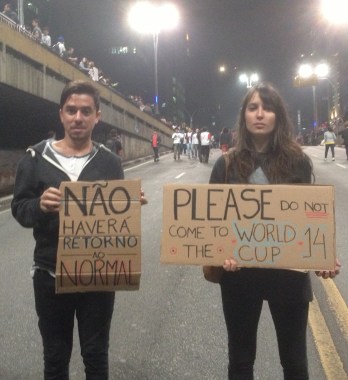
I live in Sao Paulo and here are some photos I took last night. One thing of note for your readers is that, as usual, the media is focusing on the violence of the protests. The vast, vast majority of the protesters are not violent at all. In fact, a common chant of the protesters is “Sem Violencia,” or without violence. Take a look at the photo that says “Violência é a tarifa” (violence is the fare). Reuters cropped the photo so it only showed the word “Violência,” and then selected largely photos of protesters doing mischief and burning things. Oh well, confirming our ideas about “dangerous Latin America” always sells ad space. Never mind trying to figure out what a place like Brazil is really about.
The protests are more than just calling for a 9 cents (US) fare reduction. Brazil has a lot of very serious problems that need to be addressed. But at times during the protests I have been to, I don’t know … while I’m delighted to see everyone out on the streets (especially on Mondaynight), I couldn’t shake the feeling of worry. Where’s the plan? You can’t just hold up a sign that says “End corruption.” Who wants corruption? Who doesn’t want better schools? The call for reducing the transport fares is a good start, I suppose, but 9 cents does not really fix the problem. What about the fact that the system needs to be expanded further?
I guess I am worried that the government will cave on this fare hike and then say, nope, sorry no money to improve schools. No money to improve health care. Of course, this response is ridiculous, as they have plenty of money. It’s just being directed into the politicians’ pockets.
Another:
I may be biased, but this reader is uninformed. They’re right that Dilma herself is not the issue here. Where they’re wrong is that this is just people feeling the economic squeeze. Things have not gotten that bad here economically, at least not yet. And they definitely haven’t tanked on the level that Argentina has recently. No, the point is corruption. The point is that it doesn’t seem to matter who the president is because nothing ever gets done.
There are two long-term problems here that are inspiring most of this.
The first is that despite being the world’s sixth largest economy, and having higher tax rates than most of the developed world, the money simply seems to disappear. Brazil has famously received tons of money to build stadiums and infrastructure for the World Cup next year. The Brazilian government proudly announced renovations of Maracanã stadium in Rio de Janeiro – the largest stadium in the world – as well as plans to build state-of-the-art new stadiums for the event. It’s since been announced that most of these projects will be NOT ready in time. And not only will they not even be ready on time, but the metro line extensions, the highway expansions, and all of the other promised infrastructure to relieve up to four hours of commuting some Brazilians suffer through each day – none of it is getting done any time soon.
Some Brazilian publications have dug into these projects and found – you guessed it – insanely errant spending. Invoices for 500 new gates for a stadium that only needs ten. Paying tens of thousands of Reais for bathroom mirrors that should only cost a few hundred. Somewhere along the way, a lot of money is ending up in someone’s pocket.
The second ongoing issue here is the cash-for-votes corruption that went on under the previous administration, or as it’s called here, mensalão. Back in December, 25 high-ranking politicians and government officials were found guilty by the supreme court of money-laundering, fraud, and using government funds inappropriately.
Well, of course, these 25 officials aren’t actually serving any time. In fact, the government is pushing through PEC 37, a notorious bill that basically removes all investigative powers of the district attorneys and puts it in the hands of the Federal Policia, who are famously corrupt here. This is akin to Nixon getting caught for Watergate and instead of resigning, pushing through a constitutional amendment to remove the impeaching powers of Congress.
As for Bolsa Familia, yes, it has raised many people out of poverty here. But it’s by no means universally celebrated. In fact, in my time here it’s the most contentious and divisive political issue I’ve heard Brazilians speak of. As a gringo, I don’t pretend to come down on one side or the other. Some say it saved millions of lives. Other say that it’s free money to poor people for not working and is pulling the economy down. From what I can tell, it’s probably done a lot of good but it’s not sustainable and is causing as many economic problems as it solves.
Look, I’m no economist, but tell me if this makes any sense. You have a country with a massive poor and unemployed population. You also have a country with a terrible lack of infrastructure. What is the OBVIOUS SOLUTION HERE? Pay the poor people to build the infrastructure. Ta-da! You now have a thriving and functioning economy. Yet, the government gives money to the poor people whether they work or not, they tax the middle class to high heaven and pocket tons of the money while providing no new infrastructure. You would be pissed too.
And finally, for the record, let’s not all trip over each other talking about how important football/the World Cup is for Brazilian pride. Brazilians have known this was going to be a disaster since Day One. I arrived here a year and a half ago, have been all over the country, and everywhere I go, every Brazilian has told me this was a disaster waiting to happen. I’ve honestly met more Brazilians who are considering leaving the country for the World Cup than ones who are going to try to go. They knew this was coming. All of them. From my girlfriend’s CEO all the way down to the janitor at my gym, they all knew this was going to happen, just perhaps not this soon or not on such a scale.
There were more protests in Rio and São Paulo [on Tuesday] night. Monday’s was very peaceful here in São Paulo, but last night the police came out and started exploding tear gas to disperse everyone. There’s another big protest scheduled for Saturday that looks to draw 100k+ here in SP again. I imagine there will be a lot more between now and then as well.
By the way, here is a beautiful video a professional photographer made of the events in Rio:
Elijah Solomon Hurwitz talks with drone pilots about the monotony of their work:
Though strikes on suspected terrorists and the resultingcivilian casualties get the headlines, the lion’s share of remote piloting consists of quieter, more shadowy work: hour after hour of ISR—intelligence, surveillance, and reconnaissance. Sitting in ergonomic chairs in ground control stations—essentially souped-up shipping containers—RPA operators coordinate with ground intel to identify human targets, then track them with high-powered zoom lenses and sophisticated sensors. (A nine-camera sensor nicknamed Gorgon Stare is capable of streaming full video with enough resolution to discern facial expressions.)
“It might be little things like a group of kids throwing rocks at goats, or at each other, or an old man startled by a barking dog,” says Mike. “You get a sense of daily life. I’ve been on the same shift for a month and you learn the patterns. Like, I’ll know at 5 a.m. this guy is gonna go outside and take a shit. I’ve seen a lot of dudes take shits.”
Sascha-Dominik Bachmann considers the moral aspects of drone warfare:
Keith Shurtleff, the US Army Chaplain and military ethics teacher, aptly summarized this concern “that as war becomes safer and easier, as soldiers are removed from the horrors of war and see the enemy not as humans but as blips on a screen, there is very real danger of losing the deterrent that such horrors provide.”
At lunch with my closest high school friend today, Larkin’s poetry came up. He’s not a chap prone to strong emotion and yet he told me the poems had such an emotional effect on him he couldn’t even drive near Chichester without welling up in tears at the very thought of “An Arundel Tomb“. His father, on the other hand, brushed Larkin off as rubbish for the longest time until the poet’s last poem was published – after a long period of silence – and he accidentally read it. It was Aubade. His father was stunned. “That’s how I feel every morning,” he said.
The most popular post of the day was about whether Millennial voters give a damn about PRISM. The second most popular was a dissection of the most horrifying piece of crap written by a politician since … well probably last week, but still. The most popular post of the last three months remains my screed against one of Peggy Noonan’s columns.
Michael O’Loughlin tours DePaul, the nation’s largest Catholic university and the first to offer a minor in gay and lesbian studies:
Part of the reason in creating the minor was to explore challenging subjects in an academic setting, explained the Rev. James Halstead, the chair of DePaul’s religious studies department. A priest for more than 36 years, Halstead said that the president’s office asked that the minor include a religious, philosophical, or ethical component.
Halstead believes that Catholic universities are precisely the places where great moral questions should be debated. “The obligation of a teacher is to maintain a classroom ethos and atmosphere in which all points of views can be respectfully heard,” he said. Students may dismiss the bishops’ teaching on homosexuality as erroneous, but his job as a professor, he said, involves offering an explanation of texts, not indoctrinating his students.
When I asked what he thought about the critics who questioned DePaul’s Catholic identity because of the minor and various LGBT student groups, Halstead lamented …. “To measure the Catholic identity of a university by asking if it has a LGBT program or not, Jesus, help us all. Do people really think that’s at the heart of Catholic Christianity? To me, it’s just not.”
Instead, he wishes that Catholic schools were judged on how well students answer the “deep questions” such as where they come from and what it means to be human, all in the search for truth. “Truth really is a process of emerging, in goodness and beauty, friendship and love,” he said. “Rational people can figure this stuff out. Reason, enriched by faith, is going to reveal truth.”
O’Loughlin also gets a great quote from another Catholic academic and priest, Paul Crowley:
What the world really needs to hear, and what we so deeply need to hear, is a message of loving mercy and inclusion, rather than judgment. The language of “objective disorder” has proved to be very problematic, to say the least. On one level, all that LGBT people in the Catholic Church are asking for is an affirmation of who they are as human beings, people whom God loves. If you say anything like this in church, people come up to you and say, ‘Thank you Father for being so courageous!’ Well, it’s not courageous, it’s just the Gospel!
I remember going to Notre Dame for the first ever talk there about homosexuality in its history.
The LGBT group was not allowed to put up posters or publicly advertize the event, and when they did, the group was abolished by the faculty. A broader student body had to sponsor the talk. But it was one of the more riveting evenings of my life: the auditorium so full they had to add another one with a video feed. I spoke about natural law arguments about homosexuality and based my critique on agreement with that church doctrine arguendo. The place jumped at the chance to discuss this; a couple of priests even came out in the question-and-answer session. No one was uncivil; no one was attacking the church. I felt and feel I am defending the church when I point out that its doctrines on homosexuality make no sense on their own terms or are uniquely designed to target one group in society in ways the church would never do with any other. We have ceased to be Christians on this issue. Or rather stopped believing in the core notion best summed up by: “In essential things, unity. In doubtful things, liberty. In all things, charity.”
I believe in dialogue – not yelling – on this. And one of the greatest injuries inflicted on the church by the last Pope was his shutting down of even any discourse on the subject – and several others. The most intellectual of Popes enforced anti-intellectualism with a relentlessness that bordered on hysteria. I hope that’s over now – because reason can help faith and can bring the whole church family closer together. And that combination – of faith and reason – is what keeps Catholicism alive.
A white lion roars in a cage at a house where more than 200 live wild animals including 14 white lions were discovered last week, on the outskirts of Bangkok on June 19, 2013. Police said the lions were believed to have been brought into the country using permits for sales to zoos, but instead offered to private buyers. Thailand has a reputation as a hub of international wildlife smuggling to feed strong demand in Asia for unusual pets and traditional medicines made from animal parts. By Christophe Archambault/AFP/Getty Images.

 Who doesn’t want better schools? The call for reducing the transport fares is a good start, I suppose, but 9 cents does not really fix the problem. What about the fact that the system needs to be expanded further?


 The Dish