What The NSA Can Do

Obama spelled it out in his interview with Charlie Rose:

Michael Crowley thinks the administration has finally found its voice on the surveillance leaks:

Speaking with Charlie Rose, Obama portrayed himself–as he did in his recent address on his drone and detention policies–as copiously working to strike a balance. “[W]e don’t have to sacrifice our freedom in order to achieve security. That’s a false choice,” Obama told Rose. “And so every program that we engage in, what I’ve said is, ‘Let’s examine and make sure that we’re making the right tradeoffs.’” Obama also clarified key points that may be lost on people who only follow the surveillance debate casually–namely that “if you are a U.S. person, the NSA cannot listen to your telephone calls, and the NSA cannot target your emails,” as he put it. A longtime critic of fear-mongering about terrorism, Obama was tonally measured about the threat.

Michael Tomasky found the interview “fascinating” but argues that Obama was too equivocating in his defense of NSA surveillance:

He supports these programs, and he ordered them, and he ought to just come out with a guns-blazing, f–k you ACLU, smackdown defense of the whole thing. Maybe an interview isn’t the place for that, and a speech or address is. He owns the program, so he might as well really own it.

More than that, I’d imagine he has interesting thoughts on national security and civil liberties, and it would be nice if we could hear our president go into some detail on questions like this instead of speaking in guarded and defensive soundbites. Even so, the comments were illuminating in that they show that Obama is of no frame of mind to change the current policy a whit.

Frank James reminds us that as much as Obama would like to make it seem otherwise, this conversation was forced upon him:

From the reasonable, matter-of-fact way the president put it, you would have thought that such a discussion had been part of Obama’s plan for his second term all along. But, of course, it wasn’t. The Obama administration didn’t exactly initiate this discussion. Instead, it was thrust upon him. Indeed, whether you view Edward Snowden, the leaker of the NSA surveillance programs, as a hero or traitor, he’s likely the only reason Obama is now forced to call for such a discussion about NSA surveillance. …

Presidents often see national security as requiring aggressive actions — frequently at odds with civil liberties — which they, of course, would rather not discuss openly. Once leaks force a public debate, presidents are compelled to speak to the nation’s concerns and sometimes to the global public beyond the U.S. But it certainly isn’t part of their plan.


Behind Every Man Of Steel

Matt Zoller Seitz picks up on the “striking and curious” absence of fleshed-out female characters in the new movie:

Lois is an important character, but only for how she furthers Clark/Superman’s attempts to understand himself and claim his destiny; she’s ultimately much less of a fully-realized, freestanding human being than the kooky, narcissistic Lois Lane played by Margot Kidder in the Reeve films, or even Kate Bosworth’s Lois in “Superman Returns,” a melancholy figure defined by her capacity to move on after the hero’s abrupt departure from Earth. Adams’ Lois is tough and smart but has no personality, only drive, and she’s not as integral to the action as she seems to be on first glance … females exist, for the most part, to be saved, or to have things explained to them.

Alyssa confesses she’s had enough of the standard superhero romance:

If we’re going to be clobbered with two or three superhero movies a year into infinity, as seems to be the case, we are desperately in need of new narrative frameworks for stories about these characters. Just as it’s gotten exhausting and poisonous for superheroes and their antagonists to destroy enormous swaths of cities without facing any apparent moral or legal consequences for the mass death and property damage they’re causing, it’s exhausting to see their interactions with women be essentially the same time after time, without any growth or sense of what a settled relationship between a superhero and a human with her own interests might look like. It was what made Tony and Pepper’s argument over the hideous giant rabbit he got her for Christmas in Iron Man 3 simultaneously so appealing and sad: it was an actual conversation about their relationship, and one that revealed that Tony knows precisely nothing about the live-in girlfriend who is running his company.

Recent Dish on Man Of Steel here. Recent Dish on the Hollywood’s problems with female protagonists here, here, and here.

Ask Josh Barro Anything: How Can We Solve Climate Change?

A good question, hence the, well, watch for yourself:

Relatedly, John Kerry writes today that he is committed to keeping climate change in the foreground “because it’s critical to the survival of our civilization, and that means it’s a critical mission for [him] as our country’s top diplomat”:

By keeping the pressure on each other to take ambitious action and replicating this effort around the world, [China and America] will create a virtuous cycle to address the climate challenge the right way: together. In a more collaborative environment, I am absolutely confident we will find the solutions and push the curve of discovery. We can do it without jeopardizing our economies — in fact, we will grow them. And the United States will be working not just with China, but around the globe. Next I will be traveling to India, where once again climate change and energy will be vital to the conversation.

Josh Barro is currently the Politics Editor at Business Insider. He has previously written for Bloomberg View, and before that was a Senior Fellow at the Manhattan Institute. Previous Dish on Chait’s recent profile of Barro here and here. Watch Josh’s previous answers here. Our full Ask Anything archive is here.

Do Mascots Need Modernizing? Ctd

A reader writes:

I find the whole controversy about mascots and team names to be a little ridiculous. While I can FightingWhitesunderstand the hurt feelings, as a white guy, I am probably the last person who should tell other people how to feel. But what gives power to these issues are Native Americans reaction to them. An intramural team in Northern Colorado picked an intentionally insulting name to prove a point (the Fighting Whites) and it backfired. I personally thought it was hilarious, and was going to order one of the shirts, but they were sold out! I never did follow up, but apparently they are still for sale. The best thing they could do is probably ignore the whole issue.

Another has a very different perspective:

Thank you for bringing attention to the mascot issue – it’s wonderful to hear opinions aired on both sides that are measured and reasonable, as opposed to the comments one encounters in the various articles in the Washington Post and other places that have covered this controversy.

First, a bit of a reveal.  I’m actually one of the plaintiffs in the Blackhorse v. Pro Football Inc. case that was recently heard in the from the Trademark Trial and Appeals Board, so I’ve staked out my position on this issue. I wanted to touch on an aspect of the debate that hasn’t quite been aired out yet, and that’s more of a personal reflection. I spent much of my childhood growing up on an Indian reservation and am a member of a federally recognized tribe and have family in two other tribes through my father.

I was raised by both parents to be proud of my background, and I participate in a wide variety of cultural and religious activities. Spending much of my time on the reservation or places where Native people are more common than most places (the Mountain West and Oklahoma), I was in a bubble. I was certainly exposed to attitudes and stereotypes about Indians growing up, but these attitudes were easily dismissed because the people who held them were clearly bigots. When I left the reservation for school, however, I was exposed to a much more insidious perception. Most people haven’t met a Native person, and even those who have tend to have little idea that the person they’re interacting with is Native. Most people’s ideas of what Native people represent are shaped by popular culture. And much of what is spewed out by popular culture is wrong, disrespectful and sometimes plainly racist.

In school I was often asked about where my feathers were, where I kept my “Indian costume,” why my hair wasn’t long, and if I lived in a tipi. I was asked to “talk Indian”, and when I competed in sports people would call out to me on the field with “Indian” whoops taken from the chants of the Redskins and bad Spaghetti Westerns.

At first, this didn’t bother me much, as my identity of who I was and where I came from is pretty strong. Clearly it bothers me a lot more now that I’m older as it has become clear that these questions come from Indians’ lack of control with regard to their own image and identity. And pop culture shapes Native youths’ perceptions of themselves and where they come from. I can’t think of any other culture that the American majority culture gets to explicitly exploit and slap on the side of a product to sell something more than Native people. The Land O’ Lakes lady, the logo on the side of the Redskins’ helmets, and pretty soon Johnny Depp with a dead bird on his head are what many people are going to think of when they think “Indian.”

Nothing illustrated this to me more than my own son who just finished the 1st grade in a place dominated mostly by Redskins fans. My son is a kid of the world – his roots come from my family’s three different tribes, my grandmother’s Okie-Irish heritage, and his mom’s mix of Korean, African American and Wampanoag. If you asked him “what he was” he would probably tell you a bit about all sides of his family and self-identify as Native as we’ve raised him as best we could far from the reservation in our family traditions and cultural heritage. When his friends ask him why he doesn’t look like the Redskin logo, he struggled to answer. He then started wondering why momma didn’t look like the lady on the side of the butter container. He’s bothered that when his hair grows long it isn’t straight like daddy’s, but is curly like his mom’s. The effects of mainstream culture that thinks it has a good idea of what an Indian looks like and does have already started to plant seeds of doubt as to his own authenticity, and this is something he’ll struggle with much of his life until he comes to terms with his identity.

These are major issues, but as a parent I’m glad I get to set him and his friends straight and equip him with the tools to live a world that materializes and misappropriates almost everything about our culture. But why do we tolerate this materialization and misappropriation of Native culture to the extent that we do? There a lot of good reasons to fight alongside Amanda Blackhorse in the Blackhorse v. Pro Football Inc. case, and your readers have aired out a lot of them. But for me the fight is personal, represented by own experience and perhaps most importantly by the experience my son and his children will have.

Thanks for the chance to air this out. I’m a long-time reader who rarely gets to air anything out with any kind of authority. Also – good job on putting more “read more” stories out there – my frustration at being unable to follow the mascot thread inspired me to sign up for my monthly subscription, and given how much I read the Dish, I would have given more but I am a poor graduate student at the moment so my $1.99 a month will have to suffice until this degree pays off.

Give To The Dish By Giving The Dish

gift-dish-blue

A reader wrote last month:

I want to give more money to the Dish, but I can’t. I e-mailed a few months back that I want to give more money on a bi-monthly basis or so, but your current configuration won’t let me since I’m already a subscriber. You have been on fire today (as you are most days, but today is especially good), so I was ready to slap down another $150 [the minimum price is $19.99], but I can’t. Can you help, if you’re even reading this, which I suspect you aren’t since I suspect you’ve all blackballed me since I was a tad rough on your lit editor a short while back and that you all just discard my e-mails immediately without reading. But still, CAN YOU HELP ME GIVE YOU MORE MONEY?

We take no reader emails personally. If I did, I would have jumped off a bridge a long long time ago. But the short answer is: you bet. And by far the best way to do it (apart from re-subscribing next year) is to give a Dish subscription to a friend, family member or co-worker you think would enjoy it. It can be a great spur to conversation, debate or just sharing jokes and silly videos.

Simply click here to buy a gift subscription for a friend, family member or co-worker – a gift that will simultaneously support the Dish. It only takes a minute. And unlike your initial subscription, you can buy as many gift subscriptions as you like using the same email address. Or you can buy one big gift for someone by setting your own price. Remember, the gift subscriptions are not auto-renewing, so you don’t have to worry about being billed again a year from now. Another reader wrote in April:

I am a subscriber, and have enjoyed your blog for years.  My main disagreement with you was your support of President Bush’s mobilization to a war that helped break our national economy and brought us to today. Your recent mea culpa in regards to beating the drums of war back in ’02 and ’03 seems quite sincere.  I want to let you know that in the most agreeable way: by donating/increasing my subscription cost for this year.  However, much to my surprise, I can find no button to push that would allow such a payment or donation. Would it not be logical, much like a tip jar at a cash register, to have a way for happy readers to reward the work you do with a quick tip?

We have never liked the idea of having the tip jar, since Dish Publishing LLC is a business and not a charity. But by gifting the Dish, you are both increasing your support to the Dish and spreading the Dishness more widely – to other readers and potential future subscribers. We want to broaden our readership, which will ensure our survival, and you are easily the best marketers we have and the only ones we can afford. Another reader wrote in May:

As I looked at your conversion rates and projected revenue for the year, it occurred to me that the enthusiastic early subscribers (like me!) would be very likely to add to their subscription fees if provided a clear message about what would be gained by the Dish. I can imagine an update note being sent to subscribers at the half-way point to their subscription anniversary, a sort of soft-sell pitch for an additional contribution to afford XYZ for the site. I am planning to add another $20 to my subscription at the six-month point. I’ll bet other early subscribers would as well.

I am actually planning to start a fortnightly newsletter this summer in the near future – one that will feature a series of conversational podcasts between me and some fascinating people (well-known and not), and a few original, commissioned long-form pieces. We’re going to call this section “Deep Dish”. We hope it’s a way of thanking our subscribers and giving them something more on top of full access to the Dish itself. If you still haven’t subscribed yourself, [tinypass_offer text=”click here”]. And drop us an email after doing so; we are always happy to hear from new subscribers.

Quote For The Day II

“First, this is a personal liberty issue and has to do with the most important personal decision that any human makes. I believe that, as weddingaisleAmericans, our freedoms come from God and not government, and include the rights enumerated in the Declaration of Independence: life, liberty and the pursuit of happiness. What could be more important to the pursuit of happiness than the right to choose your spouse without asking a Washington politician for permission? If there is one belief that unifies most Alaskans – our true north – it is less government and more freedom. We don’t want the government in our pockets or our bedrooms; we certainly don’t need it in our families.

Secondly, civil marriage also touches the foundation of our national culture: safe, healthy families and robust community life. In so many ways, sound families are the foundation of our society.  Any efforts or opportunity to expand the civil bonds and rights to anyone that wants to build a stable, happy household should be promoted,” – Senator Lisa Murkowski (R-AK), making the conservative case for marriage equality.

What’s A Bisexual Anyway? Ctd

A male reader quotes another:

“(What I haven’t ever encountered was a guy claiming to be bi, but apparently exclusively interested in men.)” Actually, “bi” was often shorthand for something else in the old “men seeking men” section of the Village Voice personals. Guys used “bi” and/or “masc” to differentiate from “fem” men (which had its own large following). “Bi” implied they pass for straight and/or were turned off by femininity in other men and themselves. It was a physical description that didn’t pertain to sexual practices because this personals section was exclusively about dude-on-dude action.

Personally, I liked the idea of dating bi men even if he really wasn’t, and I liked dating married men even if they were a little fem. They just had to be a bear.

Another has a long and dramatic story:

One of your readers in response to the original letter wrote that he has never met a bisexual man who only plays around with men.  I am as close to that as I think anybody is going to find. Growing up, my animal attraction was definitely more directed at other males, but I developed deep crushes on girls and women as well.  At 17, I had my first girlfriend and we were together until I was 21.  Our sex life was satisfying (to me anyway, she had problems achieving orgasm from intercourse out of fear of pregnancy).  However, I also had many male obsessions, any one of which I would have acted on if the situation arose – or more accurately, if the other guy had been extremely aggressive.

To that point, my only sexual encounter had been as a 16-year old at a choral convention of which my high school was one of only two invited.  The rest of the groups were from colleges across the country.  I relentlessly stared at this guy, not because I thought he was so attractive (there were others way more attractive) but because he was obviously gay.  We eventually struck up a conversation and he asked me if I wanted to go to his room “to talk.”  When there, he made a big move, which surprisingly, shocked me.  But we messed around and then I went out to dinner and a show with my class, embarrassed and humiliated.

I continued dating women but developed a crush on a co-worker who prided himself on being the “first” for a lot of straight guys.  I still identified as straight and aside from saying things like “I wouldn’t push Sting out of bed”, I never let on.  We wound up in an extremely unhealthy relationship that lasted for two years on and off.

After it was over and I had recovered my sanity and self-esteem, I embarked on a period of dating women and sleeping around with men.

I told myself I was attracted to men but emotionally I was better off with a woman and I suspected I would never be happy with either completely.  Surprisingly, I subsequently met a woman at the gym with whom I fell deeply in love.  In two months we were married and in two years we had two children.  I was 99% faithful as she seemed to help me put it all together.  She was beautiful and wild and fun and raunchy and more importantly when I told her about my attraction to men and about my ex-boyfriend, her response was, “Cool!” Maybe twice in the first six years I had a little dalliance with a guy when she was out of town but it was nothing she probably wouldn’t have forgiven.

Seven years into my marriage, my wife was diagnosed as clinically depressed (she wasn’t, she was bipolar) and she was put on medication which made her worse and which also amplified the effects of alcohol (up to that point alcohol had no effect on her in any way, she could drink 20 shots and remain as sober as the moment she started) and she started to get drunk regularly.  Our marriage started to fall apart and I started to sleep with men any chance I could get.  The more unhappy we were, the gayer I became.  We resembled a miserable married couple except for my secret.  I still believed however, that emotionally I was meant for women and truthfully, I still loved my wife very much.

At eleven years of marriage, I met a man online and fell madly in love.  Three weeks later I left my wife and he left his boyfriend of 14 years.  A messy divorce followed.  This man and I are still together 13 years later and we have been married for ten (in Ottawa in 2003).  We regularly play outside the relationship together (although much less lately) and it’s always been with other men.  We’ve joked about certain women we could have fun with (he has had his moments with women through the years), but it’s talk and nothing more.  I’m very happy and I’m not tempted by women.  However, I still do find certain women extremely sexually attractive and I would have no problem following through if the situation arose.

If I’m honest with myself I never really stopped being in love with my wife.  I don’t have much to do with her anymore except when it comes to our beautiful children, but she really was and is someone very special to me. But for a number of reasons it wasn’t right.

I identified as bisexual for years after I left her but the truth is despite my obvious ability to have relationships and sex with men and women, I am gay.  And while I’m sure you didn’t realize or expected this to go here, I really don’t believe there are bisexual men (as previously discussed, the fluidity of most women’s sexuality is way more complicated); men who can live life like a blank slate and where ever they wind up is fine with them.  There is a correct choice for each person regardless of what titillates them or what they can do in the moment.

Your initial reader isn’t bisexual if his letter is honest.  He’s a straight man who’s turned on by “dirty”.  Despite 11 years of a mostly happy marriage in which my wife and I had a fulfilling sexual relationship until the day I left her, I could not completely be who I am with her.  With my husband, I can.  While many may disagree with me and that’s fine, I don’t find bisexuals threatening because I don’t believe in them.  However, I’m as close to a bisexual man who only fools around with men as you are likely to find.

Another:

I feel vindicated by my earlier email to you by that fact that every letter you have posted is from a “bisexual” woman. You won’t find any truly bisexual men. Your initial reader is either titillated by the taboo of it all or he is a closeted gay man who is in denial. I know from personal experience, and so does every other gay man who finds women attractive in some way. It isn’t surprising to me that you appear to have very few men who would openly discuss their bisexuality.

Read the whole Dish thread on bisexuality here.

An English Midsummer Evening

photo-1

I was on my way to dinner last night and took a tour through Hyde Park. It’s the week of the longest days here, and it brought so much back to me. You remember the constant rain, the dark winter days, the sun going down around 4 pm, the horrifying imprisonment of Christmas, the condensation-drenched windows inside the the cigarette-smoke-filled bus I would take each day home from school.

You forget the glorious summers, when I would be woken up at 5 am by a dawn chorus of birdsong more deafening than any alarm clock, and the early sun would flood the bedroom I shared with my brother and sister. My mum simply threw us out of the house each day and asked merely that we return by sunset. And sunset could be 10.30 pm.

I could stay out late in the woods, reading or writing (yes, I was a nerd), or playing with my small band of friends in our various camps, or photoplay impromptu tennis with my brother on the street outside our house, pretending we were the willowy British underdogs at Wimbledon, until the light faded and made it impossible. We were rarely interrupted, since our road was a dead end, and we were almost the last house on the block, which ended in fields and woods. Maybe it was because of the dreary dark winters that these summer nights held such charm; maybe it’s because the HIV ban kept me distant from my home country for so long that these late summer nights have had such a Proustian impact on me – but you can see where Shakespeare’s dream came from.

And as I looked at the wild grasses, and daisies, and chestnut trees and hazy, setting sun in the park, it was hard to believe I was in central London. But Hyde Park is big enough to lose yourself in and see nothing of the city anywhere. No office towers, no New York pressure. Just fields of grass. I could have been in Wiltshire or Sussex, where I grew up.

You think you change and adapt, but it’s uncanny how this flash of old summers came back instantly to me, how deeply I missed it, and how wonderful this little sceptered island can be at this time of year.

The Anti-Quagmire President, Ctd

Obama acknowledges the danger of getting sucked deeper and deeper into a conflict:

Jeffrey Goldberg also reports that last week John Kerry pushed for US airstrikes on Syrian airfields, only to be rebuked (mercifully) by the Pentagon:

At a principals meeting in the White House situation room, Secretary of State John Kerry began arguing, vociferously, for immediate U.S. airstrikes against airfields under the control of Bashar al-Assad’s Syrian regime — specifically, those fields it has used to launch chemical weapons raids against rebel forces.

It was at this point that the current chairman of the Joint Chiefs of Staff, the usually mild-mannered Army General Martin Dempsey, spoke up, loudly. According to several sources, Dempsey threw a series of brushback pitches at Kerry, demanding to know just exactly what the post-strike plan would be and pointing out that the State Department didn’t fully grasp the complexity of such an operation.

Dempsey informed Kerry that the Air Force could not simply drop a few bombs, or fire a few missiles, at targets inside Syria: To be safe, the U.S. would have to neutralize Syria’s integrated air-defense system, an operation that would require 700 or more sorties. At a time when the U.S. military is exhausted, and when sequestration is ripping into the Pentagon budget, Dempsey is said to have argued that a demand by the State Department for precipitous military action in a murky civil war wasn’t welcome.

If this is true, it reveals again how John Kerry is still trapped in the mindset of his generation. Even Kerry – Vietnam vet – is arguing for exactly the kind of small intervention that metastasized into the Vietnam disaster. And remember he backed the Iraq War as well, however ludicrously he tried to spin it in 2004. Meanwhile, Hussein Ibish objects to the comparison of Syria to the quagmire in Iraq:

The Iraq war was about unilaterally engineered American regime change. The intervention in Syria will be about helping Syrians themselves ensure regime change on their own or come to the point where they can actually negotiate a new post-dictatorship modus vivendi.

Rather than a long-term occupation, as in Iraq, this will involve major aid to specific rebel groups, including arms and other materiel intelligence, command-and-control assistance, no-fly zones, and possibly a real confrontation with the Syrian Air Force and air defenses. But what it will not mean is American “boots on the ground.” As in Libya, the ‘Pottery Barn’ rules (“you break it, you own it”) will and should not apply in Syria. We can help Syrians get out of the mess they are in, but we cannot and should not dictate their future.

Ibish’s arguments – among them, that my opposition to intervention in Syria or Iran is based on some kind of crude non-interventionism – evaporate upon close inspection.

On Iran, I simply don’t believe their nuclear capacity is a real threat to the US. They have more than 200 Israeli nuclear warheads pointed right at them and would benefit much more from keeping their arsenal just on the brink of becoming operational (like Japan) than doing something crazy. More to the point, if our goal is eventual rapprochement with Iran’s people who support the nuclear program, then making this issue the non-negotiable element is to alienate the very future generation we will need. On Syria, whether we have boots on the ground seems largely irrelevant to me. Any attempt seriously to arm the Sunni Jihadists would require exactly what Ibish says – and what he describes is a huge military operation, as the generals told Kerry. We have no idea where that might lead, but if we succeed in changing the dynamic of the civil war, we very much will own the result. And that result could be a massacre of Alawites and Christians in Syria, unpredictable reactions from Iran and Russia, and involvement of the US in the Sunni-Shia regional war.

And please, if we have learned anything at this point it is that the word “Syrians” confuses as much as it clarifies. The reality is a country at war with itself, splintered by sectarian passions and history’s endless grudges and now recent atrocities requiring revenge. I’m with the president in the interview above – and much less worried that we might actually slip into another clusterfuck in the Middle East than I was before I heard him explain the strong limits he has placed on the operation.

More Dish on intervention in Syria here, here, here, and here.

Americans Are Saner Than Their Government

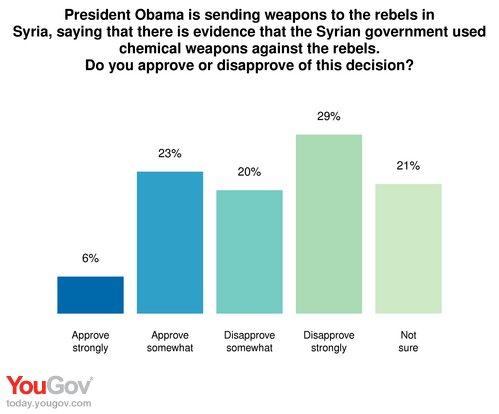
A plurality of Americans disagree with Obama’s decision to arm Syria’s rebels:

Obama Syria

That’s 49 percent disapproval vs 29 percent approval, with a fifth having the courage to say they haven’t a clue (probably the most honest answer to the survey.) Another finding:

Only 13% think there should have been earlier action by the U.S. government; more than three times as many think the U.S. either should have waited to act on behalf of the rebels (8% of sample), or that the President should not take any action in support of the Syrian rebels at all (33% of sample).