Gabe says, “There have been many phone conversations in many movies over the years, but it is widely agreed that this is the very best one”:
Month: June 2013
What’s A Bisexual Anyway? Ctd
A reader writes:
The only thing that surprised me about your reader’s letter (though it shouldn’t have) was that it came from a man. I have always believed, and almost all of my female friends agree, that women are, by their very nature, “bisexual” (unless they are gay), and that it is the rare woman who is 100% heterosexual. Women frequently have very intimate relationships with their female friends, and society generally does not think of those relationships as “sexual” ones. Yet, for most women, as studies generally show, intercourse and orgasm are not the most important aspects of sexual satisfaction. Rather, the emotional aspects of a relationship and the cuddling, holding, spooning aspect of physically intimacy with a partner are as important, if not more so. Couple that with the fact that the distance between a friendly hug and a sexual hug is not far, and the former can easily become the later.
To a large extent, I believe that the only reason that most women do not acknowledge their attractions to their girl friends or act on them is that it would be inconsistent with perceived notions of who we should and should not be attracted to, and a pervasive skepticism at the notion that someone can truly be sexually attracted to members of both genders.
Another:
I recently started using OK Cupid and I (as a 30-year-old straight guy) have been really surprised by the number of women who identify as bisexual. I don’t know what they mean by that, exactly, since it seems to mean different things to different people.
Another:
As a straight man with a bi daughter, it is my experience that both gays and straights are menaced politically by bisexuals. To gays, bisexuality is a threat to the absolutely-true-for-gays “born this way” argument which has been so successful in leveraging moves toward equality.
If there are really many bisexuals out there, many people who are born with a choice and ability to be with either sex, there’s a worry that the forces of oppression will use bisexuals’ ability to choose to cudgel gays and lesbians back into “choosing” to be straight. The activist question that gays ask of straights, “When did you choose to be straight?”, is only effective when straights don’t think they had a choice in how they express their sexuality. If lots of people realize they are partly bisexual, they’ll acknowledge increasingly that they DO have a choice, and maybe the fight for equality becomes harder as a result.
To straights, bisexuality is an even greater threat to the Manichean worldview that there are only two kinds of people in the world. The idea that maybe they could swing both ways is so terrifying that they have oppressed GLBT people for centuries to deny it. Yet the suspicion that maybe they ARE bisexual and CAN choose how they express their sexuality is why so many apparent straights have had a tough time buying the “born this way” argument for all its truth.
But if the Kinsey continuum of sexual orientation is an accurate descriptor of most people’s sexuality as I believe it is, leading to a realization that there are perhaps even MORE bisexuals in society than today’s survey indicates, then your need today to insist (while covering yourself with rhetorical caveats) that a lot of closeted gays and lesbians are only *saying* they’re bisexual will ultimately put you on the wrong side of history.
Another:
Like your reader, I’m sexually interested in both men and women. Though I haven’t a romantic relationship with a man, I wouldn’t rule it out. Unlike your reader, I identify as bisexual to friends, family, and partners. And it can be tough, especially in work or casual contexts, to balance the need for honest self-representation (most people assume I’ straight unless I clarify) with maintaining some level of privacy about my personal life.
I’m constantly asking myself: how close am I with these people? Have I become dishonest yet by not working in a declaration of my sexual orientation into the conversation? Does my boss need to know? My partner’s parents? The employees at the farm I volunteer at? And these are, for the most part, academic questions; I’m from an areligious family on the west coast, and the only person my coming out has ever, in my (blessed) experience, been a big deal to was me. I still struggle with these things, though it honestly feels like wasted energy a lot of the time.
Though I identify as bi (or queer if I’m talking to someone more familiar with the nitty gritty of current terminology), I know several men with sexual experiences similar to mine and your other reader who, looking at the sum of their sexual and romantic life, are quite comfortable identifying as straight. (What I haven’t ever encountered was a guy claiming to be bi, but apparently exclusively interested in men.) “Bisexual,” like most labels for human experience, is subject to interpretation. And like any other label, it is imperfect shorthand for the complexity and detail involved in the human experience.
I’m with your other reader: I just want to do who I want, marry who I want, and not get any shit for it. Fortunately, thanks to the struggles of an earlier generation, more of us have the opportunity to do just that.
Ask Fareed Zakaria Anything: Libya Was The Right Call
In the latest video from Fareed, he explains why he thinks Obama was right to intervene in Libya, and in a follow-up offers a hopeful progress report on the other Arab Spring nations:
Last week in Time, Fareed made his case for why the US should not get involved in Syria, including this distinction regarding the Libya intervention:
[U]nlike Libya, Syria is not a vast country with huge tracts of land where rebels can retreat, hide and be resupplied. Syria is roughly one-tenth the size of Libya but has three times as many people. Partly for this reason, the Syrian rebellion has not been able to take control of any significant part of the country. Nearly half of all Syrians live in or around two cities, Damascus and Aleppo, both of which seem to remain under the regime’s grip. Sporadic night attacks in other places recur, but they don’t expand.
Nor is it clear that the Syrian opposition is capable of unity. Popular opposition to Assad is neither broad-based nor organized. The Syrian National Council, the umbrella group of organized opposition, appears unable to unify behind a leader, agenda or set of goals. Rima Fleihan, a grassroots activist who escaped from Syria to organize the opposition, quit the council, telling the New York Times, “They fight more than they work.”
The geopolitics of military intervention is also unattractive. Whereas in Egypt and even Libya, all the major and regional powers were on the side of intervention or passively accepted it, in Syria that is not the case. Iran and Russia have both maintained strong ties to the Assad regime. Were the Western powers to intervene, it would quickly become a proxy struggle, with great-power-funded militias on both sides. That would likely result in a protracted civil war with civilian casualties that would dwarf the current numbers. To many observers the situation in Syria looks less like Libya and more like Lebanon, where a decades-long civil war resulted in over 150,000 deaths and a million displaced people.
Fareed also made the Lebanon connection in his Ask Anything answer on Syria. Fareed Zakaria GPS airs Sundays on CNN, as well as via podcast. Zakaria is also an Editor-at-Large of TIME Magazine, a Washington Post columnist, and the author of The Post-American World, The Future of Freedom, and From Wealth to Power: The Unusual Origins of America’s World Role. Our AA archive is here.
Running Against The President
Walter Shapiro recommends that the Democrats’ presidential hopefuls take Obama to task:
If you wait until late 2015 to criticize part of the president’s record, your dissent will come across as craven rather than courageous. Think of Hillary Clinton’s awkwardly distancing of herself from the Iraq War in 2008, even though Democratic primary voters knew that she had voted for it in the Senate. Howard Dean rose from nowhere in mid-2003 because he was the only major Democrat running who had been unalterably opposed to the invasion of Iraq from the beginning. Sometimes in presidential politics, when matters more than whether and right from the start trumps being correct right now.
That’s why 2013 is a perfect time to express skepticism about portions of the Obama record. If you say something now with the right tone, it will be perceived as a sincere expression of deep conviction. The longer you wait, the more poll-tested and political your critiques of Obama will be regarded.
The View From Your Window
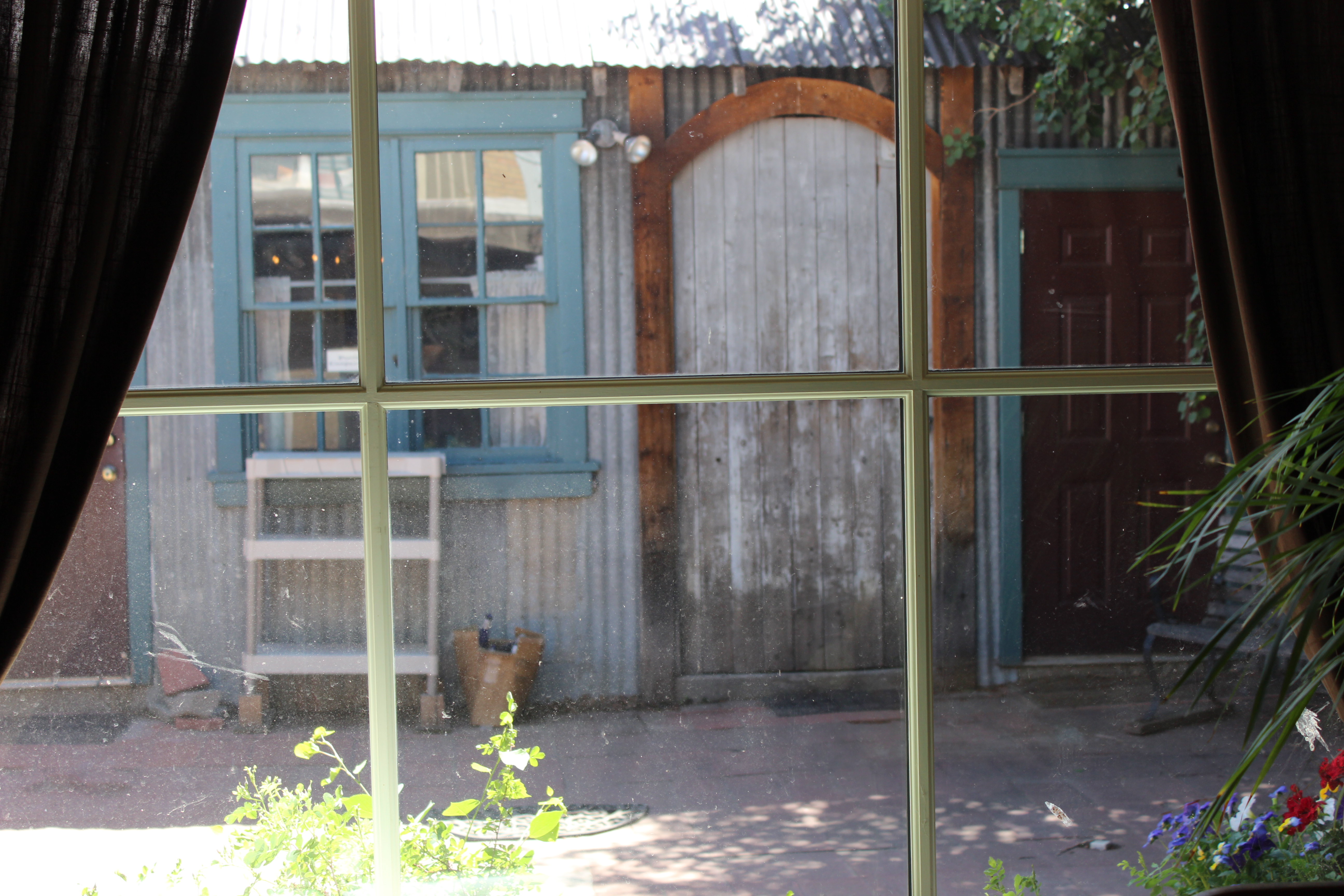
Gunnison, Colorado, 9.54 am
New Hope For Nuclear?
Michael Specter is coming around on nuclear power:
[L]ife is about choices, and we need to make one. We can let our ideals suffocate us or we can survive. Being opposed to nuclear power, as [Richard] Rhodes points out, means being in favor of burning fossil fuel. It’s that simple. Nuclear energy—now in its fourth generation—is at least as safe as any other form of power. Fukushima was a disaster, but was it worse than the fact that our atmosphere now contains more than four hundred parts per million of carbon dioxide, a figure that many climate scientists believe assures catastrophe? Sadly, we may soon find out.
Razib Khan points to polling data indicating that nuclear is more popular among liberals that you might expect. Meanwhile, David Roberts tries to change the debate:
Nuclear or coal is not the choice that faces us going forward, but were I convinced it was, I’d be a big nuke supporter. I am leery of them for several reasons that I’ll touch on below, but life is about risk, and the risks of coal and climate change are a hell of a lot worse than the risks of nuclear power. … But the reason I and most people I know are not nuke boosters is [economics]: Nuke plants are hellishly expensive to finance, build, insure, and decommission. It’s one of the most expensive ways to reduce carbon emissions and it’s not getting any cheaper. If anything, nuclear has exhibited a negative learning curve.
The response to this from supporters usually amounts to, “Yeah, but you can’t get all the way there on renewables.” This may or not be true. There are credible models of large-scale renewable penetration, but ultimately we won’t know until we try. If we reach a point where nuclear power is cheaper than the next increment of conservation, energy efficiency, demand shifting, renewables, cogeneration, and/or storage, then yay for nukes. But right now there are lots of cheaper options and more on the way. Renewables are plunging in price; nuclear prices are static or rising. You don’t need a weatherman to know which way the wind blows.
Will Latinos Give The GOP A Second Look?
A recent poll (pdf) asked Latinos how they would respond if Republican senators opposed and blocked the immigration bill:
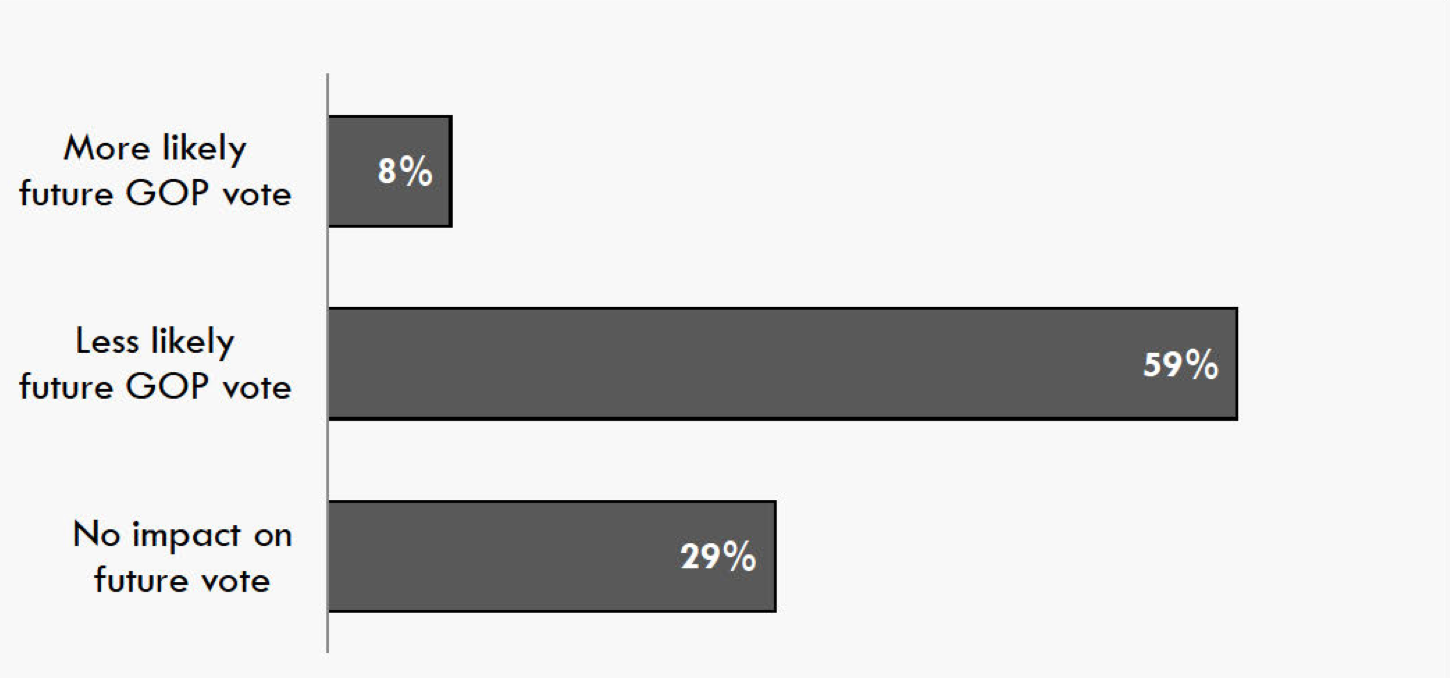
Yesterday Lindsay Graham claimed that, if the GOP doesn’t “pass immigration reform, if we don’t get it off the table in a reasonable, practical way, it doesn’t matter who you run in 2016”:
We’re in a demographic death spiral as a party, and the only way we can get back in good graces with the Hispanic community, in my view, is pass comprehensive immigration reform. If you don’t do that, it really doesn’t matter who will run, in my view.
It’s not just demographics. Dan Hopkins reviews “panel data, data which surveys the same individuals at multiple points in time”:
As it turns out, Latino McCain supporters were more likely to leave the GOP camp than any other demographic group analyzed here.
McCain supporters who were not Latino stuck with Romney 84 percent of the time, while the senator’s Latino backers only stayed with Romney 70 percent of the time. … [W]hat the panel does show is that changes in Latino voting are the product of changing minds as well as changing demographics. To some extent, to say that Latinos voters are lost to the GOP is to ignore recent electoral history.
Meanwhile, Ezra argues that, even if immigration reform is taken off the table, there is one big reason many Latinos will stick with Democrats:
Obamacare is really popular in the Hispanic community. Polling often shows support in the 2-to-1, and even 3-to-1, range. It could just be that Hispanics like President Obama and so they like his law. But it could be that 30 percent of nonelderly Hispanics are uninsured, as opposed to 11 percent of whites and 21 percent of African Americans. Hispanics stand to gain a lot from health reform, and so it’s important to them.
He notes that Republicans are currently “making a point of demanding that legalized immigrants can’t get Obamacare” and are “considering a crushingly punitive version of the individual mandate, in which undocumented immigrants need to purchase private health care on their own, without subsidies, or they can’t even become legal residents”:
The Hispanic community might find this year that Republicans aren’t as opposed to immigration reform as they thought. But they’re also going to find that Republicans are much more opposed to helping the large group of uninsured Hispanics than they ever imagined.
Obama Caves On Syria, Ctd
In a post noted yesterday, Marc Lynch predicts that the president’s decision “will have only a marginal impact on the Syrian war — the real risks lie in what steps might follow when it fails”:
The Syrian opposition’s spokesmen and advocates barely paused to say thank you before immediately beginning to push for more and heavier weapons, no-fly zones, air campaigns, and so on. The arming of the rebels may buy a few months, but when it fails to produce either victory or a breakthrough at the negotiating table the pressure to do more will build. Capitulating to the pressure this time will make it that much harder to resist in a few months when the push builds to escalate.
In response to Lynch, Larison observes that neither hawks nor doves endorse the president’s decision:
It is telling that virtually no one thinks it is worth doing by itself. Most Syria hawks have been demanding this measure only as the first step towards greater U.S. involvement, and everyone else in the debate has been rejecting it as useless or harmful, but there is no one that believes that this is what U.S. Syria policy ought to be. That is why the decision is so disturbing and foolish. The U.S. almost never scales back a foreign commitment and sooner or later opts for increased direct involvement. The administration has put itself in an untenable position of promoting a policy that no one can defend in good faith while ceding the initiative to the hawks that want a much bigger commitment. Syria hawks recognize the capitulation for what it is, and have wasted no time in clamoring for much more.
Rania Abouzeid points out that other countries’ attempts to organize the rebels by supplying arms have failed:
For the past year or so, Saudi Arabia and Qatar have sponsored a structured effort, with U.S. and Turkish backing, to funnel weapons—mainly light armaments like rifles, rocket-propelled grenades, and ammunition—to select rebel groups. The conduits have been the rebel F.S.A.’s various hierarchical structures, including military councils in each of Syria’s fourteen provinces. These were supposed to be the main tap for weapons, and an instrument of control over the men on the ground; they never were. The Saudis and the Qataris had conflicting ideas about which groups should be armed, and sent weapons in different directions. The operation was plagued, too, by claims of favoritism in the distribution process. Instead of being a model, the experience may provide a cautionary tale of what might go wrong with a U.S. effort to arm the rebels.
John Dickerson looks back:
The president has already confronted this complexity in Libya, where he tried to justify intervention to a war-weary nation on the basis of norms. In that instance, the president said that the international community had the responsibility to intervene when a state fails to protect its population from mass atrocities. The president described protecting the innocent in Libya as an American value. And allowing Qaddafi to massacre his people would have “stained the conscience of the world.”
But he added a second variable to the equation—the United States was taking action in Libya because it had the unique military capability to do so. In Syria, it doesn’t look like the president is going to add that second element; his advisers say he has ruled out boots on the ground or a no-fly zone (although that may be slipping, too).
How The People See The Parties
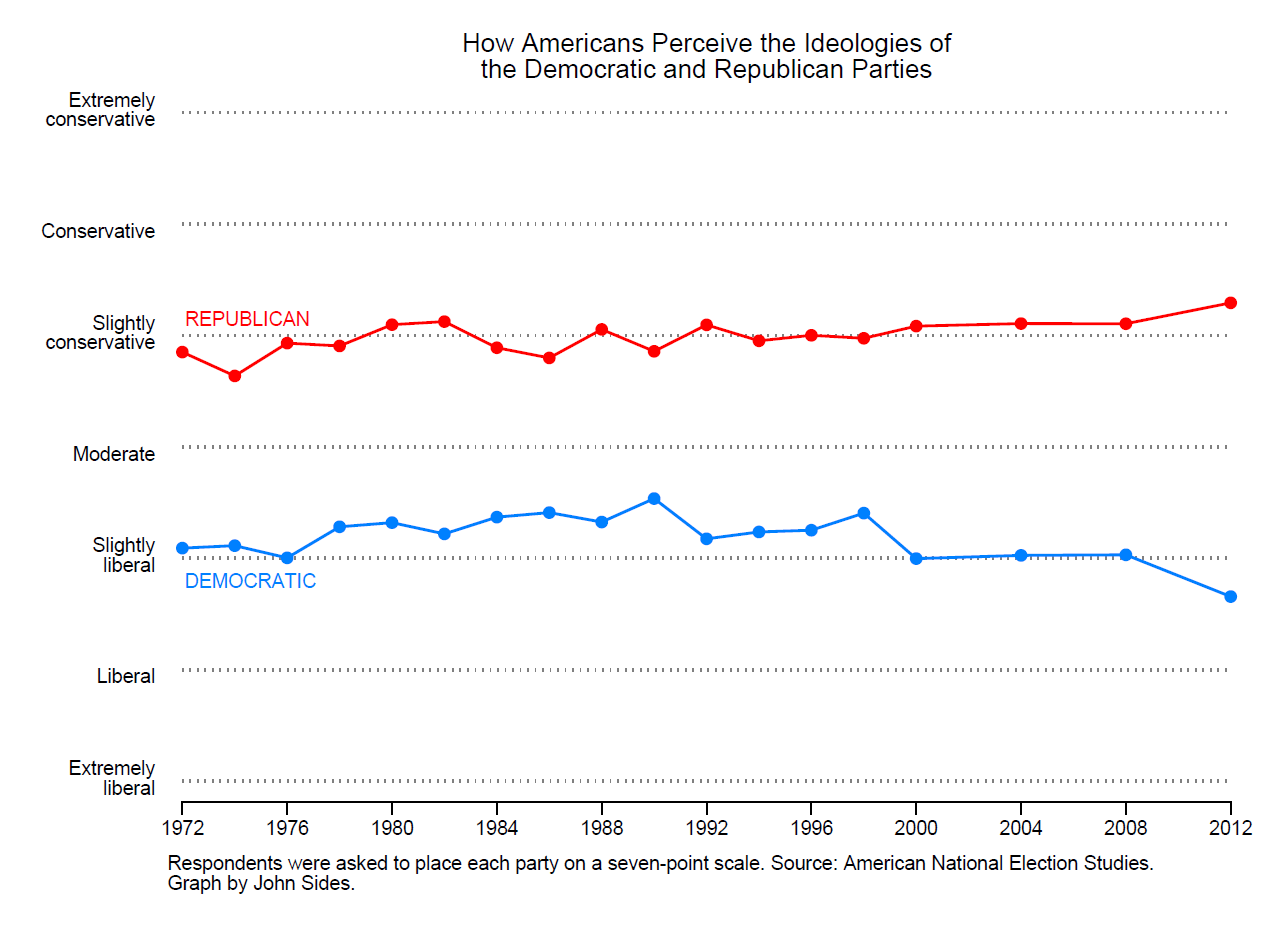
John Sides highlights how little it has changed over time:
Two features of this graph deserve emphasis, I think. One is how poorly the trends conform to prevailing narratives about how the parties have changed. In particular, there is precious little evidence that Americans perceived the Democratic Party’s “re-boot” in the late 1980s and 1990s—when many observers believe that the party moved to the center under the influence of the Democratic Leadership Council and Bill Clinton. This is one reason why I’m skeptical that ideological “re-branding” is all that consequential.
That skepticism is even more justified by the second, and overriding, feature of the graph: just how little change in perceptions there has been over time. The GOP is perceived to be only slightly more conservative than it was forty years ago. As of 2008, the Democratic Party was perceived to be as liberal as it was when it nominated George McGovern. As of 2012, it was perceived to be only a bit more liberal than in 1972. We can have an argument about whether the Democratic Party has shifted left or right. The point is that the public doesn’t see much of any shift.
Do Millennials Give A Damn About PRISM? Ctd
A reader writes:
Please no more of the “it’s modernity, get used to it” argument. That kind of argument from apathetic helplessness is lazy and illuminates nothing. Talk about the trade-offs between security and privacy; talk about the pros and cons of using our identity as a product of commerce. But your inability to conceive of a modern Internet that also protects privacy is simply not a justification for programs like PRISM. Just because you can’t imagine it, doesn’t mean it’s not possible. The technology is there to encrypt and protect private communications and to enforce chain of custody and access to data. It’s only a matter of deciding that this is something we value as a citizenry, and then vote with our wallets and at the ballet box, and it will happen.
Maybe people aren’t willing to pay for online services, and would rather commodify their personal information in exchange. But this is a value judgment and it is incorrect to argue that this is an inherent property of networked society. It’s not a fact of modernity; it’s just the way we’ve allowed corporations and our government to develop the Internet.
The second thing I find problematic is when people invoke the opt-out argument in reference to the Internet as a whole.
When dealing with private institutions, an individual can opt in or opt out on a service-by-service basis, which makes the ability to opt out easier. If you don’t agree with a particular terms of service, you don’t have to use that service. I know plenty of people who are not on Facebook and choose not to share their personal information with that company. But when you think about it, Facebook is really not an essential service and most of us can do without it. This government surveillance program, on the other hand, is an entirely different bargain: there are no terms of service, and if you want to opt out, you’d need to opt out of the whole Internet.
I work with street-engaged youth, and the Internet is one of the basic tools used to help them problem solve things like employment and housing. Lack of access to the Internet is a real barrier, and I think that people who easily dismiss the Internet as a non-essential service do so from a point of stability in their lives where they don’t really need to locate new resources or make new connections to people. You can do it for a time, but eventually you will run into a situation where you will need to interact with the modern world and then you will be stuck. Point is: it’s very difficult to opt out of the Internet entirely, and it’s not fair to say, “well then don’t use the Internet!”
Another:
I’m a 26-year-old who’s been reading your blog daily since your coverage of the Green Revolution in Iran, and who’s been a tech nerd for much longer. I couldn’t possibly disagree more with the comments you posted from other millennials. The idea that we should accept and understand the Internet as a free, open tool that also allows both private entities and governments to collect and monitor all of our data is absurd and contradictory on its face. The Internet really can’t be considered “open” or “free” without complete transparency from governments and private corporations about exactly how/when/why they’re using our data, and without our explicit permission to do so.
Which is exactly why Edward Snowden’s revelations are so profoundly troubling to me (and every other millennial I’ve talked to about this): back when we first started using the internet, we could expect almost complete privacy. Websites that wanted to keep your data would have to ask you about it. You could send emails, place purchases, read blogs, search Google, etc. without the fear of having those actions tracked – either by the sites you used or your own government. But now we no longer have a real choice to opt out of this kind of tracking and monitoring, and both the government and the companies that collect and use our data are unapologetic about doing so.
I mean, I find myself at the same place as your first millennial commenter – if you’re uncomfortable with data collection, you can choose to not use the Internet – but I come to the polar opposite conclusion about that place. The Internet is now so ingrained in my generational cohort’s lives that not using it is not a realistic option. So we must use the knowledge that our every digital move is subject to surveillance (knowledge that we now have thanks to Snowden) to have an actual debate about how far we’re willing to go to protect ourselves from a threat that, even at its worst, pales in comparison to the lethality of more pressing concerns (gun violence, obesity/disease, traffic accidents).
Snowden’s revelations have, in my mind, breathed new life into FDR’s warning that “the only thing we have to fear is fear itself.” This is something this county has been struggling with ever since 9/11: to what extent do we let our fear of the unknown incrementally drive us somewhere horrifying? To the point where we decide it’s fine for the government to collect data on all of our phone calls if we’re assured it’s being used to save us from the all-powerful terrorists? To the point where we let the NSA read all of our emails? Let them listen in on all of our phone calls (because our phone companies allow them to listen in when their own call monitoring programs pick up on patterns of speech that they find threatening)? Let them control who we can and can’t talk to or associate with (people who talk to politically troubling people have a chance of being problematic themselves, of course)? Let them decide which party we support (our Amazon wishlists and Facebook likes should predict that accurately, so why even bother to vote)?
Yes, that’s hyperbolic, but it seems to me that we’re still shamefully quaking in our boots about the threat of terrorism, based on fear and fear itself. We are better than that, and it is fundamentally wrong for us not to be outraged about blatant invasions of our privacy (legal or otherwise).
 The Dish