Is Iran Winning The Syrian Civil War?

Max Fisher worries that “it’s increasingly plausible that Iran will emerge as the big winner”:

How did it happen? The answer may be both simple and complex. For all the twists and turns in regional politics, sectarian divisions and even great-power politics, it might come down to something really simple: Iran just has a bigger stake in Syria than the U.S. does. …

A rebel-held Syria, whether those rebels were the Islamists favored by Saudi Arabia and Qatar or the moderates hoped for in Washington, would shut out Iran from its only major Arab ally and and make it much tougher for Iran to reach its proxies in Lebanon and the Palestinian territories. It would leave Iran less able to reach the outside world or to threaten Israel, which Tehran sees, rightly or wrongly, as an imminent threat to Iranian security that must be deterred.

Martin Longman questions the framing:

This makes it appear like we are openly aligned with the rebels, but that is not the case.

We are formally opposed to the continued rule of the Assad regime, and we are working with some rebel groups, but we are just as opposed to some of the rebels (probably the majority of them) as we are to the Iran-backed regime. As [Liz Sly’s WaPo article] notes, the war in Syria has morphed into a sectarian conflict that pits Sunnis against Shiities and Alawites. It is neither advisable nor possible for us to take the side of the Sunnis in a sectarian religious war. That would pit us not only against Iran, but against Iraq. Plus, it’s the wrong thing to do. …

It is a gigantic failure of analysis to look at Syria as a proxy war between Iran and the United States of America. We would like to diminish Iran’s power and influence, it’s true. But not at the expense of taking sides in a sectarian fight where the most effective fighters on our side are indistinguishable from al-Qaeda.

A Little Girl Gets Her Lungs

After being placed on an adult wait organ list, 10-year-old Sarah Murnaghan received her new lungs yesterday. Michael Fitzgerald ponders the case:

The data is murky, but according to one transplant expert I spoke to who has applied for pediatric patients like Sarah to receive adult lungs, outcomes for children who receive a lung transplant from an adult might be worse than in adult-to-adult transplants cases. Adult-to-child transplants can be complicated by size differences between an adult organ and a child’s organ cavity, among other factors. According to the same expert, it could be three to five years until the medical community has enough data to accurately rank kids next to adults based on the complex algorithms used to place people in an order that is considered most fair. Experts are divided as to whether a patient like Sarah would have a longer, healthier life than the adult recipients Judge Baylson has pushed behind her.

Barro uses the story to argue that we should be able to buy and sell organs: 

People are morally squeamish about the idea of paying for organs. They fear that a legal market in organs would exploit the poor and only benefit people wealthy enough to pay market prices. A well-designed market should overcome these concerns.

One such option is a proposal from Matas. Under his plan for kidneys, organs would not be traded person-to-person; insurance companies or the government would set prices and buy them like any other medical supply. Combined with a system of universal coverage, this would ensure that transplanted organs would not be a luxury for the rich.

It is highly likely that live organ sellers would tend to be poor. But the prognosis for donors giving in the legal market is good: A mortality rate of just 0.03% for kidney donations. That is still a risk, but people make all sorts of life choices that entail added risk for added money, including entering dangerous occupations; legal organ sales would simply make one more such option available.

He also praises Singapore, which has “a system of ‘presumed consent’ where all people are organ donors unless they affirmatively choose to opt out.”

One And Done

Slate published an excerpt from Lauren Sandler’s new book, One and Only: The Freedom of Having an Only Child, and the Joy of Being One:

I get it. I do. All I have to do is see our friends’ kids—plural—playing together, caring for each other, sharing a secret language. All I have to do is watch Dahlia’s joy and tenderness when she gets to hold their baby brothers and sisters. Justin sees it too, and he knows what she’s missing. But he reminds me often how the sacrifices we’d need to make to raise another child would impact Dahlia’s happiness—not to mention our own.

In an interview with NPR, Sandler addresses common concerns about having only one child:

“I think that there’s the concern that only children are lonely children. And I think that when parents consider having a second child as a gift to their first, that is probably the thing that they are most often concerned about, which I understand. I think that we have a very visceral response to seeing a child alone in a sandbox.

“But it was interesting, speaking to psychologists about the experience of loneliness for only children, a lot of them believe that we have the strongest primary relationship with ourselves, which is incredible armor against loneliness; that for a lot of only children, being alone is the experience of solitude, which is a very rich thing, instead of loneliness, which is a very painful thing.

In an interview with Salon, Sandler admits that she’s “still shocked at how this topic rankles people”

I mean, I wrote a book about Evangelicals from a feminist atheist perspective and did a ton of Christian radio — and the blowback I got was nothing compared to when my Time cover story  came out saying, quite simply, that only children are OK.  It’s like I’m suggesting that people should have aborted their own children — or that their parents should have aborted their siblings.  It’s fascinating to me how emotional, how fraught the topic is.  At a conference I spoke at recently, a professor hugged me and told me how “brave” I was to take this on — when the conference had been focused on family planning and poverty … and this is what’s brave? That’s nuts. Listen, I‘m not telling anyone how many kids they should have — lord knows, we have enough people telling women what to do with their bodies — just saying that if this is a choice you want to make, or that your body is making for you, then you should know that only children aren’t fundamentally rotten, or no more rotten than anyone else.

Whom Will Obamacare Burden? Ctd

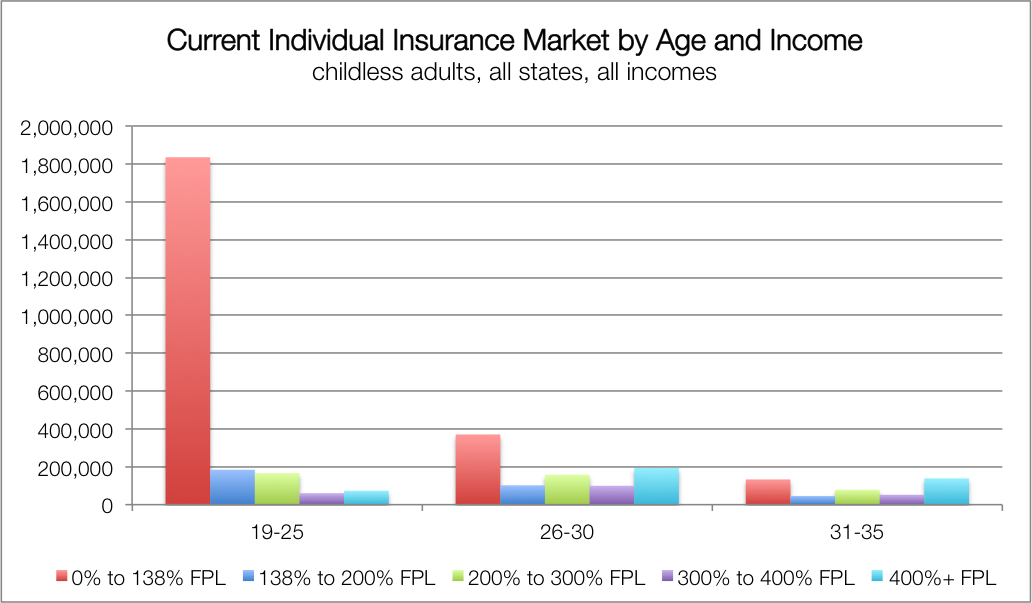
currentmktallincomes (1)

Aaron Carroll focuses in on the above chart from Adrianna McIntyre and Josh Fangmeier to bolster his claim that the ACA’s rate shocks (or “the plight of the bros”, as he calls it) are “a distraction”:

Weep for the bros, if you like, those “lucky duckies” who earn too much to qualify for subsidies. Me? I can’t believe how many of those who are 19-25 live in poverty. All of those red column young adults on the left side earn less than 138% of the poverty line. All of them would qualify for the Medicaid expansion. Yet many of them, possibly most of them, won’t get it because of all the states who are refusing the expansion.

I think they are who health care reform was about. I think it’s pretty horrific that next year a large chunk of them will continue to be uninsured. But I guess the tragedy du jour will remain the “rate shock” for the bros.

Previous Dish on the distributional effect of Obamacare here and here.

Convenience Uber Alles

Cass Sunstein sees Uber – the app that connects people to luxury car service – as an existential threat to “taxi dinosaurs,” if it can get past the various regulatory hurdles that keep popping up:

[T]here is an important place for rules designed to promote safety and to prevent fraud or deception. But regulation of the taxi industry goes far beyond those goals. That regulation is a dinosaur; it should become extinct. Uber’s innovative approach raises a still more fundamental question. In countless domains, people have to spend a great deal of time and effort on searching and matching. For auto repairs, home repairs, household help, tutors and even child care, it can be difficult to find a convenient and reliable service. Wouldn’t it be a great improvement, indeed an amazing boon to people (and the economy as a whole), if a wide range of services, available on simple apps, emerged to decrease the costs of search?

Because of the happy combination of new technologies and private entrepreneurship, that possibility is getting more realistic every day. We shouldn’t allow pointless regulatory barriers, and self-interested private groups, to delay its time of arrival.

Previous Dish on Uber here.

Global Flaming

1243243447_f3fd7aef53_b

Commenting on the recent wildfires in Colorado tied to climate change, Tom Kenworthy looks ominously toward the summer:

The past decade has seen a sharp increase in the number of acres burned by wildfires. In 2012, 2007 and 2008 more than 9 million acres were burned, and the half dozen worst fire years since 1960 have taken place since 2000. A recent Department of Agriculture report predicts that the acreage burned by wildfires will double by 2050 to about 20 million acres annually.

The report’s findings are in line with previous studies on climate change’s relation to fire risk: a 2012 study found that wildfire burn season is two and a half months longer than it was 40 years ago, and that for every one degree Celsius temperature increase the earth experiences, the area burned in the western U.S. could quadruple.

(Photo: The Montana sun through forest fire smoke by Flickr user Julia Manzerova)

Demeaning The Friendships Of Women, Ctd

A reader writes:

I’d like to respond to the reader who wrote in with this criticism of the Bechdel Test. It’s not designed to be a screenwriting guide, or to suggest that all movies that don’t pass the test are unfairly sexist. It’s designed to show how disquieting the proportion of films that don’t pass it is. If the number of films in that video that pass the test were closer to 50%, it wouldn’t be making much of a point. It’s not meant to encourage screenwriters to add arbitrary scenes into movies to pass the test; it’s to encourage screenwriters to write more films about women in the first place, precisely what your reader claims to want.

Another:

I agree with the commenter that the Bechdel Test is problematic. Consider this scenario:

Two neurosurgeons who are also female are collaborating on a complicated case. The patient is male. The conversation they have about the treatment particulars technically fails the Bechdel Test.

Despite this issue, I still think the test can identify problems in writing female characters. The real problem it shines a light on, however, is that we don’t have enough protagonists who are female and the few we do have operate in a very narrow field of character types. An even more valuable tool to me as a writer is to flip the gender or ethnicity of my characters and see what’s left of their conflict in the story. If not much is left, then that can be a problem depending on the point of the story. Inevitably, flipping a character’s gender or ethnicity can show us how the default is to have characters who are white, male and straight.

Casting Helen Mirren as The Doctor would shake the franchise up in a good way, just as casting Judy Dench as M in the 007 movies did. I’m disappointed in how the casting was handled for Dench’s replacement. Sure, go back to M being male, but then make the new Q female. (However, note that they did cast Moneypenny as a black female.)

For a great example on how shaking up traditional expectations on gender, ethnicity and sexual orientation can create a great cast of characters, see Syfy’s Warehouse 13.  It’s ensemble cast includes quite a range of characters from a young female computer hacker (and Runaways fan) to a Russian Jew to a gay Buddhist ATF officer to an older Black female in charge of everyone. Oh, and in this show H.G. Wells was female writing under a male pseudonym.

Another:

It can also be enlightening to look at the “reverse Bechdel test,” in which you look at the number of times men talk with each other about something other than a woman. A friend of mine has been tracking this in some movies and TV episodes – here.

Of course, that doesn’t quite address what your screenwriter correspondent was saying; he (I’m guessing he’s male) was claiming that secondary characters in movies always talk about the protagonist, and that the protagonist is too-often male. The reverse Bechdel test doesn’t take that theory into account. But it’s nonetheless true that secondary male characters in movies and TV shows do very frequently talk about things other than the protagonist – and it’s also true that there’s almost always more than one male character in any given movie or show.

That reader follows up with more links:

Here is a Bechdel test movie list.

Here are ten famous films that surprisingly fail the Bechdel Test (note that Run Lola Run features a female protagonist but she never talks with other women)

Here are some examples of things real women talk about, other than men.

Here are some suggestions on writing good female characters, especially in comics.

Here are some problems I saw with female characters in stories submitted to my magazine.

Here are more of my thoughts on female characters.
Caffeine Crazed

Alex Moore notices that caffeine withdrawal is listed as a mental disorder in the new DSM-5:

Withdrawal “conditions are considered mental disorders when they impair a person’s ability to function in daily life,” writes the Wall Street Journal. It’s not exactly clear to me why this is being classified as mental disorder rather than just a physiological reaction. But if you’ve ever felt caffeine withdrawal, “impairing a person’s ability to function in daily life” is not hyperbole.

Caffeine withdrawal was upgraded from its previous status as pending in the last DSM. Researchers have concluded that in order to have full-on caffeine withdrawal a person needs to experience at least “three of five symptoms within 24 hours of stopping or reducing caffeine intake: headache, fatigue or drowsiness, depressed mood or irritability, difficulty concentrating, and flulike symptoms such as nausea or muscle pain.”

The Nine-To-Five Keeps The Doctor Away?

Orszag warns that retirement can prove deadly:

Researchers at the Institute of Economic Affairs in the U.K. have … recently identified “negative and substantial effects on health from retirement.” Their study found retirement to be associated with a significant increase in clinical depression and a decline in self-assessed health, and that these effects grew larger as the number of years people spent in retirement increased.

Similarly, a study published in 2008 by the National Bureau of Economic Research found that full retirement increased difficulties with mobility and daily activities by 5 percent to 16 percent and, by reducing physical exertion and social interactions, also harmed mental health.

The broader literature on the question of whether retirement harms health has been more mixed. The big question is whether the observed physical deterioration after retirement occurs because it is underlying poor health that leads people to end their working life. Some studies that try to control for this reverse causality, such as a 2007 paper by John Bound of the University of Michigan and Timothy Waidmann of the Urban Institute, find that retirement doesn’t harm health — and may actually improve it. Another study, by Esteban Calvo of the Universidad Diego Portales in Chile, Natalia Sarkisian of Boston College and Christopher Tamborini of the Social Security Administration, finds harm from early retirement but no benefit from delaying retirement beyond the traditional age.