Cool Ad Watch

And creepy as well, intentionally so:

Rusty Blazenhoff captions:

Think! is a driving safety campaign created by Leo Burnett London for UK’s Department for Transport. “Pub Loo Shocker” is the latest ad in the campaign and it aims to bring light to the problem of drunk driving, in a very shocking way. In the ad, young men (actors) are shown going to a pub’s bathroom and washing their hands, only to be startled when the bathroom’s mirror smashes in front of them and woman’s bloody (mannequin) head smashes through (as if she was involved in a car accident).

Cyclists Are Lazy

A clever argument from James D. Schwartz:

I step outside my front door and hop on my bike because I’m too lazy to go downstairs in the parking garage to get the car. I pull my bike up to the front door at my destination because I’m too lazy to drive around looking for a parking spot then having to walk from the car to the building. … Instead of walking 15 minutes to my destination, I ride my bicycle there in 5. Yes, I ride there because I am too lazy to walk. I ride my bicycle past dozens of cars at rush hour because I’m too lazy to be stressed out sitting in traffic and too lazy to explain why I’m late all the time. I sold the last car I owned in 2010 and bought a couple solid bicycles because I was too lazy to maintain the car*. I was too lazy to renew my license plates each year, too lazy to fill up the gas tank, too lazy to shop around for insurance rates, and too lazy to take it to the car wash.

Greening The Tubes

Kendra Tupper summarizes Google’s recent conference on the environmental impact of the Internet:

[K]eynote speaker and former Vice President of the United States Al Gore frame[d] the importance of the problem: the ICT sector and its associated energy use are growing at an unprecedented rate. Within the next seven years, there will be 50 billion smart devices connected to the Internet. Researchers estimate this could account for around 10 percent of current U.S. electricity consumption. Really, no one knows; not even Google. But the number will be significant. With that staggering energy consumption in mind, Gore stressed the urgency of the climate crisis we are facing, referring to the recent news reports of climate-related weather disasters as “a nature hike through the Book of Revelation.” …

Eric Schmidt, executive director of Google, kicked off the afternoon breakouts with an inspirational talk that really got to the heart of the matter—the growth in this sector is going to continue. And it’s adding immeasurable societal value in ways that we never could have dreamed of. The Internet has provided consumers with information to make more sustainable consumer purchases and enabled telecommuting and teleconferencing as alternatives to carbon-intensive travel. In some societies, the Internet provides people with their only access to medical treatment, politics, education, and socialization outside of their culture. “You think the Internet matters?” he asked. “It matters a lot.” He stressed that the solution shouldn’t be to use the Internet less, and certainly not to limit the global reach of these services. Instead, we must make the system components more efficient; power the sector with clean renewable energy; and leverage the Internet to help solve the climate crisis.

Separating The Mensa From the Boys

Noah Davis narrates his attempt to ace a Mensa test:

Before the first part, the proctor reads a story and informs us that we will have to answer questions about said story at some point before the end of the test. Scrap paper isn’t allowed, nor is written note-taking of any kind; we are supposed to remember.

I try to listen. I really do. There’s a sunrise, dancing in a circle, and a Greek chorus. I know that much. But pretty soon, I notice myself not paying attention. Then I notice myself noticing my mind wandering, thus entering a non-recall vortex. Mentally, I blame the Internet. (After the test, I inquired as to whether recall rates had dropped over the past decade, but a Mensa rep said they didn’t track that type of data.) A charitable person might give me credit for trying to take mental notes about the story while simultaneously attempting to make mental notes for this story, but that would be Bill Gates—a Mensa member, for sure!—Foundation-level charitable. I am just struggling to focus.

We begin Section 1 after being given—again—instructions not to write in our test books. We don’t. Instead, we answer questions about how shapes relate to each other. Five minutes later, we move to Section 2: 15 or so questions relating to the definitions of words. Or maybe the section involving the value of coins came first. Or perhaps the one featuring groups of tiny, thumbnail images was second. There is a math one, too, which I enjoy. But the first six sections all run together: answer questions for a brief period, put the pencil down, breathe, change gears, repeat. The format lacks the instant pressure of the Wonderlic, but it’s mentally exhausting nonetheless, an 800-meter race instead of a 40-yard dash. I answer every question in the allotted time, but I get the sinking feeling that I’m just not quite smart enough. Too frequently, the definite answers lie just out of reach.

Chart Of The Day

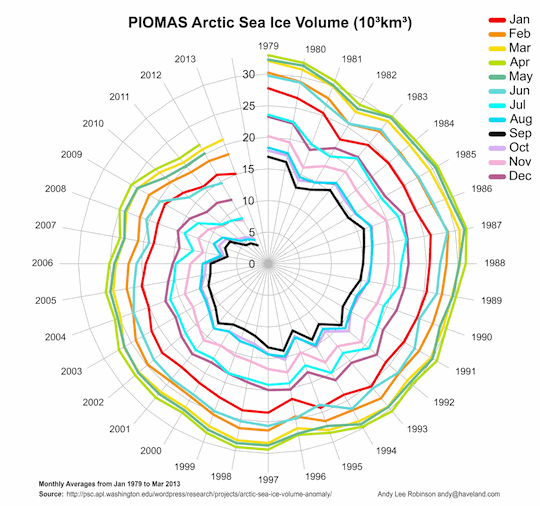
arctic-death-spiral-1979-201303

Joe Romm looks ahead to the future implied by Andy Haveland-Robinson’s “death spiral” chart of Arctic Ocean ice coverage over time:

If recent volume trends continue, many experts say we will see a “near ice-free Arctic in summer” within a decade. Recent research finds that may well usher in a permanent change toward extreme, prolonged weather events “such as drought, flooding, cold spells and heat waves.

Demeaning The Friendships Of Women, Ctd

A reader comments on the video we used for this post on Hollywood’s portrayal of female relationships:

As I think I’ve written to you before, the Bechdel Test is total and complete bullshit. I’m a Hollywood screenwriter, so let me drop a little knowledge on this one. The only way a film is going to pass the Bechdel Test is if the protagonist is female, or it’s an ensemble cast with a bunch of different storylines. Anything else is bad screenwriting. Here’s why: Movies do not suffer digressions well. To be good, they have to stay on their main storyline. This is one of the structural realities that separates them from novels.

That means, in a non-ensemble movie, If two characters are talking, and neither of them is the protagonist, then those two characters have to be talking about the protagonist. If you have a scene where two non-protagonist characters are talking about something unrelated to the protagonist (and thus, to the main storyline), any writer or executive worth her salt is going to cut that scene. It’ll drag the entire movie down and make people reach for their popcorn. Thus, if the protagonist is a man, then if he’s not on screen, any characters who are on screen are going to be talking about him. It’s just good writing.

Do I wish there were more movies with a strong female protagonist? Hell yeah, I do. I’m actually returning to writing one as soon as I finish this email. But the Bechdel Test is utter hooey. It’s using a metric that fails to understand the basic principles of the thing it’s purporting to measure.

A City’s Circulatory System

dish_bostonbusmap

Emily Badger explains the above image:

[C]reated by Andy Woodruff of the great cartography blog Bostonography, [it] illustrates a single day’s worth of bus travel across Boston, by speed. Each little line on this map represents one bus (tracked as the crow flies between data points, not along its actual route), with red showing speeds of less than 10 miles an hour, yellow of 10-25 miles per hour, and green faster than that. …

The concept was inspired by an earlier Eric Fisher map of transit in San Francisco. … The project is primarily impressive for its design – “it’s at least half art,” Woodruff says – but these daily maps also have the potential to reveal patterns in how the system changes from day to day, between week days and weekends, between business as usual and system break-downs. If you live in Boston, they may also simply confirm your suspicions about your own commute.

A live version of the map, which shows bus speeds over the past three hours, is here.

The Tax Reform Timeline

Stan Collender expects little movement on tax reform before 2017:

The deficit is expected to continue to fall both in nominal terms and as a percent of GDP between now and 2017. That will make it even harder for Republicans to justify a tax increase deal to their base. As the projected deficit starts to rise again after 2017, the pressure to do something about it will increase. This very conveniently will begin to happen after the 2016 presidential and congressional elections are over.

That’s when the real tax reform clock will start to run. If we give Congress some credit for the hearings, etc. that will have taken place, and if you assume that some serious internal discussions will have started within both political parties by then, the process is likely to take at least two-plus years from that point. That makes 2019 the earliest tax reform is likely to be enacted with implementation for some, but not all of the changes, starting in 2020.

The Best Of The Dish Today

fivethirtyeight-0611-nsa3-blog480

How fantastic an irony it would be if anti-Obama Republicans were integral to reversing a core Bush policy on NSA meta-data gathering? But that’s the remote but intriguing possibility as the issue crosses party lines to include Rand Paul and Ron Wyden.

Readers asked and answered a few questions about the NSA “revelations”: why do we trust Google more than government? Is the FISA court effective or not? I was assailed for being an Obama-groupie; and I defended myself. Meanwhile, the public remains largely in favor of PRISM.

We also aired a gasp-inducing paper-animation short; oh, and before a boxing match, whatever you do, don’t smile at your opponent beforehand.

The most popular post of the day was “This Is Bullshit.” The second was “Enter The Media Martyr.”

See you in the morning.

Don’t Fear Government Malice, Fear Its Incompetence

A reader writes:

A little real-life experience to put the whole NSA controversy in context:

Back in the 1970s when I was 12 years old, my parents took me down to the local Social Security Administration building to sign me up, figuring that soon I might need an SSN for ID purposes at some point. A nice lady typed up my card – on a typewriter, of course– and after about 15 minutes I walked out with an SSN of my very own, number ABC-XX-XXXX. The card stayed in a desk drawer until high school, when I got my first job for minimum-wage at the local library and entered the world of payroll taxes and FICA like any other adult.

A few months later, we received a letter from the IRS saying that I owed $8,000 in back taxes. My parents contacted the IRS, who thought I was a middle-aged U.S. male citizen living in Brazil, not a high school girl reshelving Young Adult Fiction. My father went down to the IRS with a copy of their letter, my SSN card, and my birth certificate.

What happened was that I was issued SSN number ADC-XX-XXXX and the nice lady typed ABC-XX-XXXX on my card by mistake.

ABC was the tax scofflaw in Brazil, and as soon as I was ushered into the tax system with my first job, I got dinged with his fine. They issued me a new card with my real SSN on it and off I went.

This is the thing: That mistake resulted in a file folder of official correspondence between my father, the IRS, and the SSA which now sits in my home office (and has been scanned and uploaded to my back-up in the cloud). I have been carrying this info around, from my parents’ home to first apartment and every move after that, for over thirty years. Because I do not trust that this mistake has been put to rest and that it won’t come back to haunt me at some point. And this is a benign error from hitting the wrong key on an IBM Selectric – not the NSA or the TSA getting me mixed up with whatever the American, 21st century version of the Baader-Meinhoff gang will be!

I’m not overly concerned that our government will abuse the info they’re collecting (for the moment at least). As a previous commenters said about people finding themselves on no-fly lists accidentally, I’m extremely concerned that our government will confuse the info of the innocent with that of the guilty. And the innocent will have no recourse.