Tackling Rush

Kevin Williamson treads carefully after a Limplosion:

The Republican party is plagued by leaders who really want to be Fox News personalities and talk-radio hosts rather than politicians. Those professions have very different skill sets and very different success metrics. They simply are not the same thing. There’s a reason Bill Buckley never expected to win his mayoral race. Rush of all people should understand that. If you are good at what Rush does, you end up becoming Rush; if you’re not very good at it, you end up becoming Christine O’Donnell. Q: Who thinks the Republican party or the conservative movement needs another Christine O’Donnell?

But notice how wary he is of including Limbaugh in this litany – and how insecure Limbaugh has become:

I don’t mind that Rush misunderstood my point, which is the sort of thing that happens all the time, but I could do with a good deal fewer butt-hurt lamentations from him and his radio brethren about how National Review “used to be a conservative magazine.” Given that Rush has filled up many minutes of his precious airtime reading my work to his audience, it is strange that he would think of National Review, or me, as something other than conservative.

An Awards Show Opening That Didn’t Suck

Linda Holmes encourages the other award shows to take a lesson from NPH’s Tony opening, maybe “the greatest awards show opening ever”:

[I]f you’re talking about awards shows in recent memory, [not only] was it the best opener, but it utterly embarrassed just about everything except maybe Jimmy Fallon’s “Born To Run” at the 2010 Emmys. It’s funny, energetic, committed, and ultimately deeply and touchingly warm-hearted.

The next time you’re tempted to give an Oscar host a pass on the basis that it’s an impossible, can’t-win job, and that the lazy, easy, corny, toothless humor that passes for patter is a fundamental of the awards format, and that the jokes can’t be better and the numbers can’t be better and the hosting can’t be better and the crowd can’t get excited, keep in mind that that’s exactly what people who want to keep making lazy awards shows want you to think.

One Last Reading Assignment

The Daily Beast asked a host of authors and academics what essential book every student should read before graduating college. My pick?

Pascal’s Pensées:

They’re episodic, cryptic, elegant, and sometimes as brief as tweets. But Pascal was one of the greatest mathematicians of all time and his defense of Christianity would help remind today’s students that having a mind and following Jesus is not a contradiction.

Tom Wolfe chose Max Weber’s Economy and Society:

In 1998, the International Sociological Association named Economy and Society the most important work of sociology of the 20th century. Now, there’s a piece of timid praise for you!—since with that book Weber supplanted Darwin as the greatest theorist of the modern age. Darwin’s theory of Evolution fit only dumb animals comfortably. When it comes to the creature who speaks—namely, man—we must look to Weber’s far grander theory of Status.

Enter The Media Martyr, Ctd

A reader adds to this post:

I spent a decade as a government IT contractor and another five years in commercial IT contracting (which I’m back to).  Over the course of my government time I was basically in the same job, but as contracts rebid or companies merged or whatever, I worked directly or indirectly for four different companies.  It’s entirely possible that Snowden was in the job prior to March but under a different lead or sub contracting company.  The relevant question isn’t when did he start at Booz, since that’s really just a paperwork and billing question, but rather when did he start on site.

Another:

Your reader’s suggestion is to call the Ethics Hotline maintained by the NSA? That’s unrealistic to the point of being laughable – what conceivable effect would that have (aside from costing Snowden his job without publicizing the program)? As for the idea that he work with members of Congress, it’s just as silly.  Remember, Wyden and Udall were deeply troubled by the program, but couldn’t say anything because they didn’t want to release classified information.  The only way that this program comes into the public eye is for a hero like Snowden to take the hit and alert everyone.  It seems to be legal, so there’s no crime to report; and yet it’s nevertheless causing a huge public outcry.  The case for leaking this material couldn’t be clearer, and I applaud Snowden for his brave act of civil disobedience.

Huge public outcry? We’ll see. But the debate itself and the end of secrecy around this program are healthy developments, it seems to me. Meanwhile, Noam Scheiber compares the missions of Edward Snowden and Aaron Swartz:

Both Snowden and Swartz (and, for that matter Manning) were precociously talented computer programmers who were frustrated in classroom settings—neither completed high school or college—but easily assimilated knowledge on their own. Both had strong moral and idealistic streaks, along with (apparently) well-worked out, libertarian-ish, ideas about the proper relationship of government to its citizens. Both had high hopes for Barack Obama, but became disillusioned with his administration relatively quickly.

And yet both come off as basically liberal in their outlook, as opposed to anarchist or some other form of radical. Snowden told The Guardian there was a key difference between himself and Manning: “There are all sorts of documents that would have made a big impact that I didn’t turn over, because harming people isn’t my goal. Transparency is.” (Manning observed no such restraints.) Swartz, according to several friends I interviewed for this profile, likewise believed that Wikileaks went too far in releasing information that could do more harm than good. He worried that the group had become an exercise in showmanship and preening.

Now, clearly, there are key differences between Snowden and Swartz. Even though Swartz was facing the prospect of decades in prison, the act that got him in trouble couldn’t have been more than a minor offense under any rational legal code. (JSTOR articles are available to anyone with access to a university or research library; JSTOR itself declined to pursue the case.) By contrast, it’s obvious that Snowden, whether you agree or disagree with his decision to distribute classified material, has undertaken something of enormous legal consequence.

Drop The “Hawk” Label?

 
Millman longs for a term “for people who are eager to fight without being very clear on whom they want to fight or why”:

The chief argument on the part of advocates for Syrian intervention is that if we don’t do something, events will take a course beyond our control. Perhaps Assad will win; perhaps the rebels will win, but will resent us for not helping them; perhaps the war will drag on and spread to neighboring countries; perhaps Syria will fall apart entirely with parts of the country being taken over by terrorists; and whatever happens, thousands, even tens of thousands more people will die. War is proposed not to counter a specific threat, but to assert control over a chaotic situation. The enemy is the unknown itself.

I don’t want to call people making arguments like these “hawks” because I think that grants an argument that hasn’t properly been made: that we are debating about how serious to take and how seriously to respond to a threat. We aren’t debating about that yet, because a coherent picture of an adversary posing a threat has not yet been drawn by the advocates of military action. Because they are not really proposing action to meet a threat – they are proposing action so as to be involved.

I think that’s a helpful distinction. Larison offers up a dinosaur analogy:

This reminded me of an old column from The Economist from long ago in which Paul Wolfowitz was described as a “velociraptor” to capture how much more aggressive he was than ordinary hawks. Using this description, we could say that a “velociraptor” sees threats where they don’t exist, exaggerates the ones that do, and always argues for taking a hard line against all of them. In other words, a fanatic.

But he contends that Syria “hawks” do in fact know their enemy:

Almost all Syria hawks are Syria hawks because they are hawkish on Iran, and view the conflict in Syria in those terms. They are very clear on whom they want to fight and why. They also happen to be horribly wrong.

A Poem For Monday

ponsotpoem

“Roundstone Cove” by Marie Ponsot:

The wind rises. The sea snarls in the fog
far from the attentive beaches of childhood—
no picnic, no striped chairs, no sand, no sun.

Here even by day cliffs obstruct the sun;
moonlight miles out mocks this abyss of fog.
I walk big-bellied, lost in motherhood,

hunched in a shell of coat, a blindered hood.
Alone a long time, I remember sun—
poor magic effort to undo the fog.

Fog hoods me. But the hood of fog is sun.

Tonight at the headquarters of the Poetry Foundation in Chicago, Marie Ponsot will accept the 2013 Ruth Lilly Poetry Prize, about as good as it gets for an American poet. For a tour through Ponsot’s remarkable career, check out the Poetry Foundation’s site here and the Poetry Society of America’s site here (the latter by our much-loved poetry editor, Alice Quinn).

(From The Bird Catcher © 1998 by Marie Ponsot. Used by permission of Alfred A. Knopf, a division of Random House, Inc. Photo by Flickr user weegeebored)

Iran Non-Election Update: The Final Week

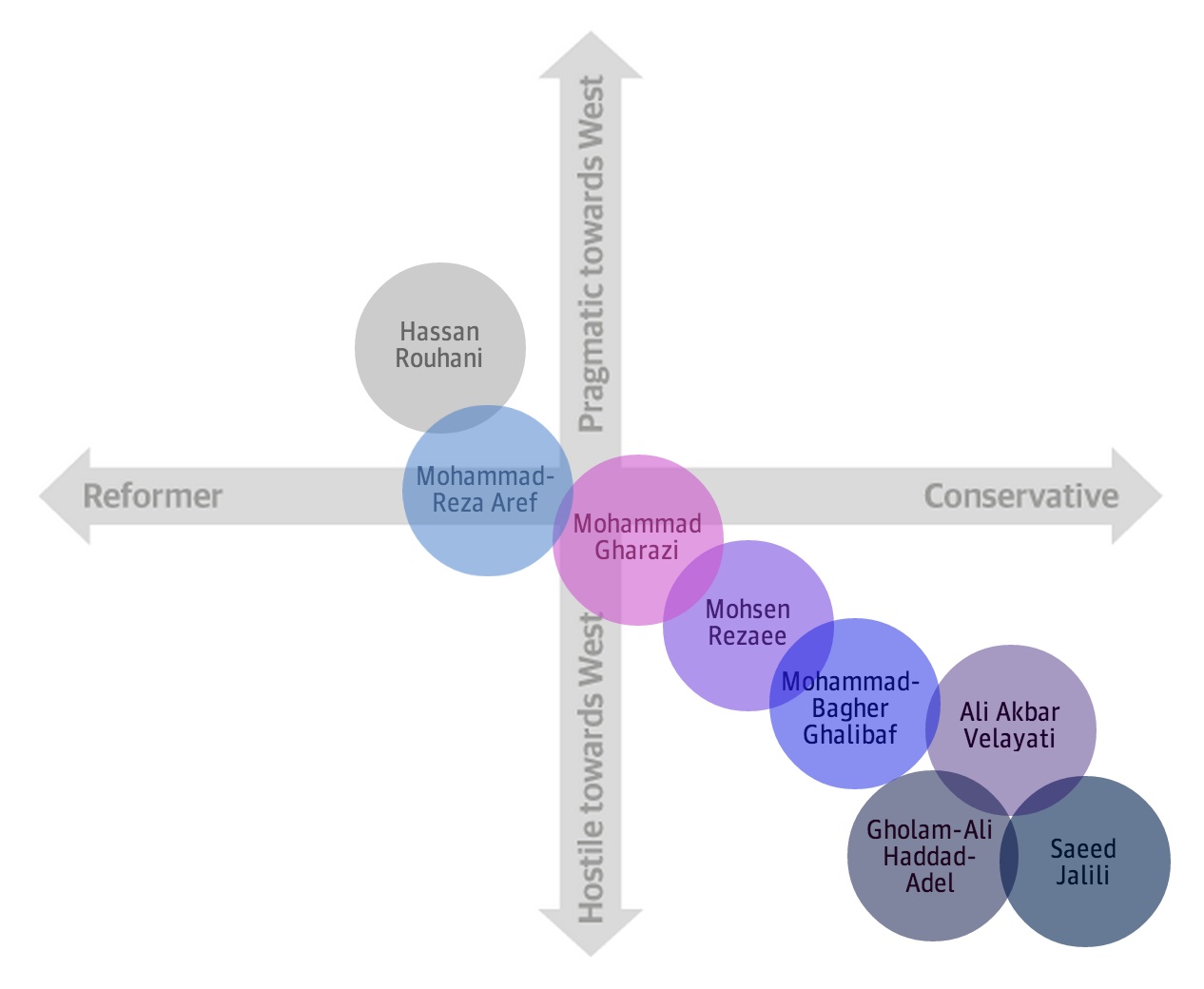
Guardian-IranPresCand-Chart

With Friday’s “selection” fast approaching, Barbara Slavin points out that, “if Iranian elections are supposed to follow a script, [some] of the actors seem to have forgotten their lines.” In particular she notes how much sanctions-related criticism has been directed at Saeed Jalili, the country’s top nuclear negotiator and the candidate widely considered to be Khamenei’s first choice for the presidency:

[During the third debate, former foreign minister Ali Akbar] Velayati and former nuclear negotiator Hassan Rowhani both implied that they would have done far better that had they been in charge [of the nuclear negotiations with the West]. Rowhani, who negotiated with the Europeans from 2003-2005 when he held Jalili’s post, has repeatedly noted that during his tenure, Iran continued to make progress on its nuclear program without being referred to the Security Council and hit with heavy sanctions.

The sanctions have seriously impacted the Iranian economy — the major topic of the presidential campaign. Thus, even if Khamenei had wished to prevent discussion of the nuclear question, he would have had a hard time succeeding.

Slavin believes that while both Rowhani and Velayati may realize they can’t win, they are nonetheless using the freedoms allowed them by their candidacies to criticize the regime. The reformist Rowhani, for instance, has suggested that Iran’s nuclear program should not be a higher priority than the country’s economy, and he has spoken out on other issues as well:

“We will open all the locks which have been fastened upon people’s lives during the past eight years,” Rowhani said during a speech on 1 June in the north Tehran neighbourhood of Jamaran. “You, dear students and hero youth, are the ones who have come to restore the national economy and improve the people’s living standards. We will bring back our country to the dignity of the past.”  … Tuesday night, in a 30-minute documentary more biography than manifesto, he verged on crossing Iran’s media “red lines” as he criticised the harassment of Iranian civilians by “plainclothes people” – a clear reference to the Basij militia – and the country’s “securitised atmosphere”. He also poured scorn on Ahmadinejad’s record, though that is by now a million miles from any red line. Elsewhere in the documentary, Rowhani, who is campaigning on the slogan Government of Proficiency and Hope, talked of “interaction with the world” and gender equality. “In my government, differences between women and men won’t be tolerated,” he said. …

[However, t]hough Rowhani may stimulate the reformists to back him and mobilise disenfranchised voters to the polling venues, he is no firebrand reformer. He has so far cleverly toed the line between appeasing the establishment by showing due deference to Khamenei and exhibiting his revolutionary and Islamic bona fides.

But that’s to be expected from most anyone trying to navigate the regime’s system. It also seems like Rowhani’s campaign may be working from Mousavi’s 2009 playbook:

Supporters entering [a Rowhani campaign rally on] June 8 were handed purple wrist ribbons, the color he’s using on campaign posters. The move may be inspired by Mir Hossein Mousavi’s 2009 campaign, which became so associated with the color green that the opposition born out of post-vote protests became known as the Green Movement. …

Most people at [Rowhani’s] rally were middle-class Iranians in their early 20s, and some also wore purple headscarves, headbands or T-shirts. A spillover crowd lined the street outside. Hundreds of policemen and dozens of police vans were stationed outside the stadium to prevent the possibility of spontaneous protests.

Indeed at a few rallies, Rowhani supporters broke into chants calling for the release of Mousavi and Karroubi, leading to some arrests as well as rumors, so far unfounded, that the Guardian Council would reevaluate and then bar Rowhani from the race. While most analysts believe Rowhani doesn’t have a chance, there are at least some signs that his rhetoric is resonating with voters:

News websites in the country run their own informal polls, and these have shown a strong lead for moderate reformer Hassan Rowhani after three rounds of televised presidential debates. With the conservative camp split among three candidates, [and 50.1% of the vote required for a definitive victory,] this could mean Mr. Rowhani forcing a run-off vote. Nonetheless, the widespread belief that the 2009 election was rigged has prompted caution among most Iranian observers about whether any of the anti-establishment candidates would be allowed to make it through to the run-off, let alone win.

The regime is worried about low turnout as well:

[Authorities] have taken the unprecedented step of scheduling local council elections for the same day, along with by-elections for the Assembly of Experts – a group of clerics that appoints the supreme leader. The authorities hope that combining the three elections will boost the vote, especially as official statistics show that turnout in local elections is often relatively high.

Meanwhile, Max Fisher scans a recent (US) poll conducted among voters in Iran which shows technocratic Tehran mayor Mohammad Ghalibaf in the lead instead:

The poll has 39 percent of decided voters saying they support Ghalibaf, a remarkable lead over all the other candidates. However, the poll also reports that 57 percent of voters are undecided, meaning that presently undecided voters could easily erase his lead. It’s plausible, though, that many of the undecided voters are disillusioned with Iranian politics – an increasingly common sentiment after the protests and crackdowns that followed the disputed 2009 election – and thus not likely to turn out on election day. … The polls look bad for Saeed Jalili, the country’s nuclear negotiator and a fervent nationalist who appears to be a favorite of Supreme Leader Ali Khamenei and the clerical establishment. He received 13.9 percent support from decided voters in the poll, placing him in a distant third.

Jason Rezaian profiles the supposed frontrunner:

Ghalibaf is viewed warily by some of Iran’s political conservatives and clerical rulers, who view him as being more focused on pragmatism than revolutionary ideals. But there are few signs that he would make bold diplomatic shifts or decisions about Iran’s nuclear program if elected. …

Ghalibaf is not just a wonk. With many years in law enforcement, he also has a history of doing what he deems necessary to maintain order, and critics say that has included the use of excessive violence in suppressing the biggest protests of the Islamic Republic’s 34-year history. In a recording that surfaced last month, Ghalibaf can be heard giving a speech to members of the Basij, a state-funded paramilitary group often enlisted to provide assistance to police in times of domestic tension or unrest. In it, Ghalibaf allegedly takes pride in his role in cracking down on protesters in Tehran in 1999 and 2003, and he acknowledges being a key player in the security forces’ violent crackdown against post-election protests in 2009.

Meanwhile, Gholam-Ali Haddad-Adel, a hard-liner candidate without much support, has now dropped out of the race.

(Image: Screenshot of the Guardian’s interactive guide to the Iranian presidential candidates.)
The Dish On The Leaks

A mid-day round-up of today’s coverage: my view is basically David Simon’s – that a lot of this is bullshit – but that’s clearly not how many readers Water_drop_animation_enhanced_smallsee this issue. Au contraire.

More Dish fodder: a post where I hope this is an opportunity to debate if we still need a serious counter-terrorism policy at all; a reader wonders about whether Snowden sought the Booz-Allen job in order to leak; a granular primer on what PRISM actually is; the foolishness of Snowden’s seeking refuge in Hong Kong – or perhaps not; and the inherent difficulty of a full public debate about programs that are labeled secret.

Stay tuned.