The True Costs Of Coal

energy_social_cost_large

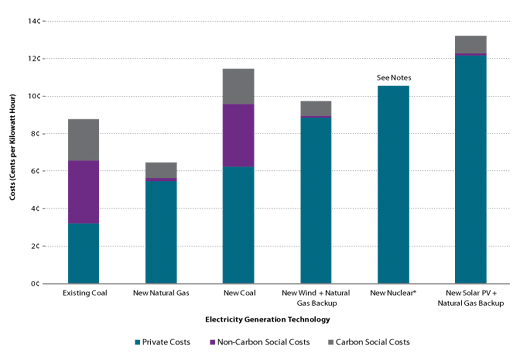
Yglesias sees a “pretty strong” case for the war on coal in the above chart from the Hamilton Project, which shows the total social cost of a kilowatt-hour of energy from a variety of resources:

[T]he only way to consider new coal-fired plants a remotely plausible undertaking is to completely ignore the social costs of burning the coal. By the same token, simply throwing all my garbage into my neighbor’s backyard could look like a cheap and appealing alternative to proper trash disposal if I were allowed to completely ignore the costs to my neighbor.

Existing coal plants are a closer call since the private costs of a plant you’ve already built are naturally quite low. But we can see quite clearly that phasing out existing coal in favor of new natural gas is a clear winner. It’s worth dwelling on that for a moment, since it’s actually quite extraordinary for the cost of a brand-new infrastructure project to be lower than the cost of continuing to run what you’ve already built. The moral of the story here is that if you were able to completely ignore political considerations, the case would be very strong for an aggressive and robust war on coal even if you don’t care a whit about renewable energy.

Meanwhile, David Brodwin tires of climate change’s “environment vs. economy” storyline:

Many politicians and journalists will frame this issue in a misleading way. It will be positioned as a question of “promoting growth and jobs” versus “protecting the environment.” Those who oppose action on climate will ask if we can really “afford” to take action on climate at a time that the economy is still in recovery. This framing is misleading because it implies that taking action to protect the climate will cost more than it saves. Nothing could be more wrong. Stabilizing the climate by reducing carbon emissions saves the economy much more than it costs.

Hunting For Healing

Katy Steinmetz describes an outing for returning veterans:

Then they sat shoulder-to-shoulder on a long plank, loaded their guns, and waited in silence for the snow geese to appear. Though seven men sat in the blind on that February morning, the hunting trip was really for just three of them: combat-wounded veterans invited by Freedom Hunters, one of dozens of non-profit groups across the U.S. who believe that hunting can be therapeutic for returning troops. …

The three men say that hunting reminds them of the camaraderie and ritual that defined their time in the service. On the ground in Maryland, they became a makeshift platoon. “You’re replicating the training, the kind of thing that you love to do,” Corbett says, “almost like that guard duty that every sailor and soldier and Marine goes through.” Lamke calls the long stretches of quiet in the goose blind “shared solitude” because he knows he’s with other veterans who feel like they’re at a listening post again. “Even if we never say a word to each other,” Lamke says, “we’re always looking out for each other.”

But it’s not without its dangers:

Military psychiatric experts say that mental health issues make hunting a dangerous hobby for some veterans. “Watching [an animal] die may trigger a lot of intense emotions and impulses,” says Nash. “And having a loaded gun in your hand when you’re feeling intense emotions is probably not a good thing.” Ritchie warns that the smell of gunpowder or ring of shots might trigger flashbacks and that veterans who have had suicidal or homicidal thoughts shouldn’t be going afield. Freedom Hunters tries to screen for potential problems by asking veterans basic questions about hunting experience and combat injuries. But they do not outright ask if a potential hunter has suicidal tendencies or known flashback triggers.

Alec Baldwin, Would-Be Gay-Basher

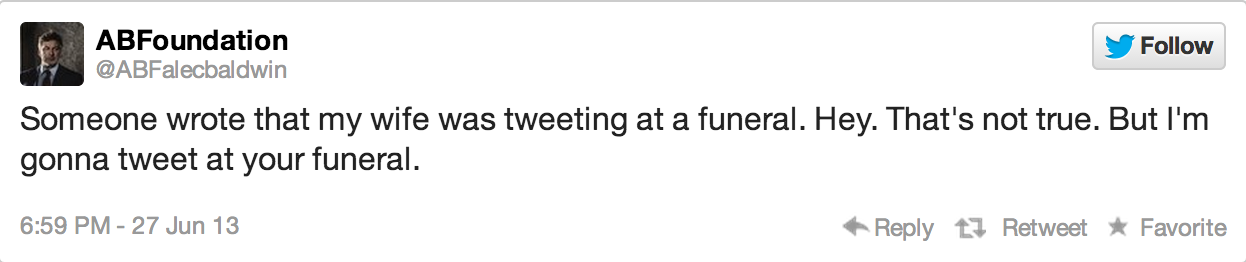
Screen Shot 2013-06-28 at 2.22.39 PM

I can understand the man’s rage at a reporter, but what’s with the anti-gay shit?

“George Stark, you lying little bitch. I am gonna f%#@ you up … I want all of my followers and beyond to straighten out this fucking little bitch, George Stark. @MailOnline … My wife and I attend a funeral to pay our respects to an old friend, and some toxic Brit writes this fucking trash … If put my foot up your fucking ass, George Stark, but I’m sure you’d dig it too much … I’m gonna find you, George Stark, you toxic little queen, and I’m gonna fuck…you…up.”

This is not just hate speech; it’s a specific call for other people to physically attack a gay man. It’s a call to violence against a specific person, which, last time I checked, was a crime. He’s a pro-gay liberal, so he may get a pass for this. He shouldn’t.

A Congress In Denial

climate map

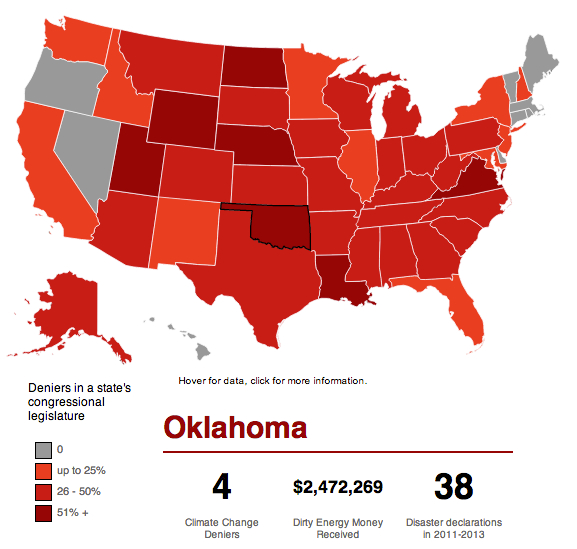
Tiffany Germain, Ryan Koronowski, and Jeff Spross pass along the results of a recent study on climate change skeptics in Congress:

Despite the overwhelming scientific consensus and high costs to taxpayers, there are still elected officials in Congress who refuse to accept that climate change is happening. Almost 70 percent — 125 members — of the current Republican caucus in the House of Representatives deny the basic tenets of climate science. 65 percent (30 members) of the Senate Republican caucus also deny climate change. What this means is that they have made public statements indicating that they question or reject that climate change is real, is happening, and is caused by human consumption of fossil fuels.

This refusal to accept overwhelming scientific evidence is not just a symptom of the rank-and-file backbenchers. Members of GOP leadership and the committees that make critical decisions on national energy policy and air pollution have even higher concentrations.

See Think Progress’ fully interactive map here.

(Image: Via Think Progress, the proportion of each state’s congressional delegation that deny the link between human activity and climate change)

What Happens Now With Immigration?

Wth the Senate on board, Dylan Matthews previews the House’s Gang of Seven bill:

The bill will almost certainly include a path to citizenship, border security measures, a guest worker program and other similar attributes to the Senate Gang of Eight bill. However, there will likely be significant differences. [Mario Diaz-Balart (R-Fla.)] has said that he thinks some parts of the Senate bill — such as the scale of its guest worker program, as negotiated by the AFL-CIO and the U.S. Chamber of Commerce — are unworkable, and the House bill may reflect those differences of opinion.

Diaz-Balart has also sounded optimistic about passing the bill through the House with majority support from Republicans, allowing House Speaker John Boehner (R-Oh.) to obey the “Hastert rule,” wherein only bills supported by a “majority of the majority” reach the House floor. However, [Rep. Luis Gutierrez (D-Ill.)] has signaled it may be able to come to a vote without meeting that requirement. Some outside observers are optimistic about this channel; Clarissa Martínez-De-Castro, director for civic engagement and immigration at the National Council of La Raza, expressed optimism about it in an interview last month.

Nate Cohn, on the other hand, argues that “if the Senate bill can only attract 30 percent of Senate Republicans, it has no chance of earning 50 percent of the more conservative House GOP caucus”:

Which brings immigration back to the so-called “Hastert Rule.” Last week, Speaker Boehner suggested that he wouldn’t move an immigration bill without the support of a majority of House Republicans. If so, immigration reform is in jeopardy. The Speaker and House Republicans have few incentives—if any—to cave to immigration reform. When Boehner folded on the “Hastert Rule” in the past, many or maybe most House Republicans probably thought it was a good idea. No, they didn’t like Sandy relief, VAWA, or the fiscal cliff compromise, but none of those bills were bad enough to justify stomaching the public backlash that would have accompanied outright blocking the legislation. In contrast, House Republicans appear authentically opposed to immigration reform. They also hail from safe, conservative districts where the Hispanic vote is unlikely to threaten their reelection campaigns.

Morrissey agrees that immigration reform could fail in the House:

[W]hen will the House get around to passing their bills? Nothing has come out of committee yet, and there’s only about three weeks left on the legislative schedule before the August recess. When they come back, both chambers will be working on debt ceilings and FY2014 budgets, which have tighter deadlines than does immigration reform. There’s a good chance that the House will end up doing nothing on immigration reform, or perhaps only passing a border-security bill that the Senate will ignore.

Chait sees another way forward, a “discharge petition” to make sure the bill gets a vote:

If 218 members of the House sign one, then it automatically comes to the House floor for a vote. Last December, Democrats in the House threatened a discharge petition to bring up a Senate bill extending the Bush tax cuts on income under $250,000 a year. …

So then the question would be, could Democrats find seventeen House Republicans willing to endure the wrath of conservatives to sign a discharge petition? The threat would come from primary challenges from conservatives. On the other hand, there is a lot of pro-immigration money out there available to support any Republican facing such a challenge. And the other big advantage of a discharge petition is that Republicans wouldn’t need to save bipartisan face by rounding up a respectable number of their own party to support it. Just the bare minimum would do.

Indeed, the House wouldn’t have to legislate at all — it could (and would have to) simply photocopy the Senate bill. No hearings, no negotiations — and since the House is bad at all those things, that’s another plus.

I fear that the chaotic nature of the GOP may turn this critical moment to ashes. But Chait’s proposal is an intriguing one. And some of the grandstanding right now is exactly that: grandstanding. My true worry is simply that the GOP hates the president so much that giving him another massive reform, after Obamacare, would cement his transformational legacy and drive them nuts. It’s not rational, but reason has almost no role any more in the GOP base.

Yglesias Award Nominee

“Mike Huckabee is not only recruiting Jesus to be a foot soldier in the culture wars; he’s trying to raise money for his political action committee on it. I understand that how one views this is entirely subjective, but I for one find this kind of thing to be, at a minimum, tasteless and crass. We all get the game that’s being played: the Supreme Court renders a verdict on a hot-button social issue –and within hours ‘Jesus wept’ is used as a fundraising tool. One has to strike while the iron is hot, after all. Still, you might think that a Christian would use a good deal of caution when it comes to leveraging poignant verses about Jesus into three dollar donations for HuckPAC. …

I will say that on policy, Mr. Huckabee and I are fairly close in the views we hold (though certainly not identical). But what troubles me, and what I would hope would trouble Huckabee, is we’ve seen what happens when Christians use their faith as a blunt political instrument. It isn’t good for politics; but it’s a good deal worse for Christianity. A politicized faith is discrediting. It pushes people away. And it frankly distorts who Jesus was,” – Peter Wehner.

“It’s The Economy, Faggots” Ctd

A reader writes:

Andrew, please don’t ruin this great joy we’re all feeling about DOMA and Prop 8 by getting caught up again in your personal three-decade-old psychodrama with the Clintons. Bill is not a sociopath, per your recent post. He may have been craven to sign DOMA because he thought it was needed to salvage his reelection (and he may have been right, for whatever that’s worth), but that doesn’t even put him in the top 100 lists of political villains towards the gay community in the 1990s. If you haven’t read Josh Marshall’s take on DOMA back then, you should. He perfectly captures my take on the situation at the time, and now.

For the record, I’m a 45 year old gay man, and no I’m not an HRC guy – I find them as useless as you do – and you’re a personal hero of mine. But please don’t go down one of the over-the-top rabbit holes you do a couple times every year.

A reader on our Facebook page is more succinct:

Andrew, in another post you said that gay rights proponents should approach their former adversaries with a spirit of generosity. Maybe you should start with yourself and your bitterness towards the Clintons.

When he actually apologizes, I’ll leave this behind. But you cannot forgive someone who refuses to admit they did something wrong. Even above, he fails to take responsibility for what he did. He never took responsibility for his own actions. he wasn’t a passive observer on this; he was an active enemy of marriage equality, even exploiting homophobia in a re-election he was already winning in a landslide. Another reader:

I’m not going to defend Clinton and his craven actions around DOMA, but there are a few things that strike me about then and now. We had just come through the Federal Marriage Amendment. So, DOMA could be seen as a stop-gap measure to keep something like it from actually happening. Clinton doesn’t seem to have mentioned this in his more recent speeches, but it was surely a factor. Also, I have to wonder if something like DOMA needed to happen to get us to where we are today.

It kept us “safe,” if you will, from same-sex marriage while allowing it to build up from the grassroots. Of course, we’ll never know given that we can’t go back and test that theory. But change does often happen this way.

The IRS Inspector General Must Resign, Ctd

A reader writes:

You concluded that the Treasury IG for Tax Administration “must go” – based, in appears, in part on the characterization of the situation on Rachel Maddow’s blog. Aren’t you and your reader rushing to judgment much like, although in the opposite US-POLITICS-TAXdirection of, Darrell Issa?  The situation is more complicated than Issa portrayed it, but also more complicated than portrayed by the Democrats.  Have you read the letter by TIGTA to Levin [pdf]?  To hit the highlights:

“Progressive” or similar words appeared on BOLO lists, but not the portion that said, in effect, if you see these terms, refer them for scrutiny for impermissible political activity.  The IRS was “on the lookout” for more than just “terms that indicate possible political activity and should be reviewed for such.”

Some progressive or left groups were scrutinized for impermissible political activity, but it amounted to 30% of those groups that submitted applications during the audit period, rather than 100% for “tea party” or similar in their titles.

That looks much more like the progressive “referred for scrutiny based on permissible criteria” rather than “targeted and referred for scrutiny based solely on the name.”  The letter specifically says TIGTA was not able to determine from its review why those groups were selected for review.  TIGTA concluded that approximately 70% of ALL applications showed indications of improper political activity beyond the mere name of the organization.

Was the IG review biased, whether intentionally or not?  Possibly, although not entirely clear – worth exploring.  Were groups with “progressive” in their title treated the same as groups with “tea party” in their title?  No, they weren’t.  Did the differential treatment extend to the IRS National Office?  Possibly, although probably not the top levels of the IRS, who are generally politically sensitive – worth exploring.  Was this differential treatment driven by the White House?  No evidence of such, and common sense says almost certainly not; I would be completely shocked.  Until and unless someone at the IRS implicates the White House, we shouldn’t even be discussing that.

Is there as MUCH to this scandal as Darrell Issa implies?  No.  Is there as LITTLE to this scandal as Levin and other Democrats imply?  No.

There’s more we should know about all of this. Werfel certainly doesn’t think he knows as much yet as he needs to about what happened.  In the meantime, let’s cool the rhetoric on both sides.  Why not let the process continue and then decide who must go?  After all, the hasty call for heads to roll is what lead to firing Shirley Sherrod.

Another goes into further detail:

I know you may be a little hung over for this today, but you need to take a closer look at this IRS list being used by Democrats on the House Ways & Means Committee and liberal opinion commentators, to purportedly show targeting of both liberal and conservative groups.  Indeed, if you do so, you will retract your hasty call for the Inspector General’s resignation.  It is of the utmost necessity to scrutinize what the “list” actually represents. Here is the list [pdf].  The first thing to notice is that it does not include any documentation stating for what purpose this list was to be used.  It does not contain the words “Be on the Look Out”.  It initially appears to be a sort of directory identifying how to categorize certain types of applications, and where, within the IRS, those applications are to be sent.  Moreover, “Progressive” and “Tea Party” fall within different sections of the list.

On the one hand, you find “Progressive” under a section headed, “Tab 2 – TAG Historical”.  There it says, “applicants submit form 1023,” which is the form for 501(c)(3) status.  And, “their ‘progressive’ activities appear to show that (c)(3) may not be appropriate.”  Does this indicate targeting for an unwarranted level of scrutiny?  Or is it meant to say simply that (c)(4) status would be more appropriate, because some of their activities are political?  The list is unclear on that point.  Why is the section in which “Progressive” is placed labeled, “Historical”?  Is this to indicate these kinds of groups are no longer to be scrutinized?  That their cases have already been disposed of?  Also unclear.

“Tea Party”, on the other hand, falls under the section headed “Tab 3 – Emerging Issues”.  There, it says that “local organizations in the Tea Party movement are applying for exemptions under 501(c)(3) or 501(c)(4)”.  It gives an “issue number” of EI-1 (the section on”Progressive” lacks an issue number). Additionally, it lists the name of a group (7822) and coordinator (Liz Hofacre) where “Tea Party” cases should be sent.

Finally, the list states that “[Tea Party] cases are currently being coordinated with EOT”.  What is EOT? Well, the GAO says that EOT is the “Enhancing Ownership Transparency” project, which is a group within the IRS devoted to gathering detailed information about organizations, particularly about the ownership, in order to prevent noncompliance with tax law.  Read about the EOT here.

What this list would appear to show, then, is precisely that Tea Party groups were singled out for a higher and more specific type of scrutiny, and treated differently that “Progressive” groups.  Progressive groups were perhaps mis-categorizing themselves as (c)(3)’s, while Tea Party groups needed to be investigated by a special compliance group.  And that fact is revealed by the very documents the Democrats are now touting in an effort to lessen the scrutiny on the IRS, and those within Congress and the Obama administration who may have been aware of or even encouraged the abuses, but failed to correct it.

But more important is the real issue: the actual, documented, verifiable targeting of conservative and Tea Party groups applying for tax exempt status to a degree that was not experienced by liberal groups seeking the same status.  This is about what actually happened, in real life – not what is on some list whose purpose and provenance is obscure.

The distinction my readers make – and my thanks for their diligence – is worth noting. I never said the treatment of progressive and Tea Party groups was identical. But the evidence is that both types of groups were scrutinized. If the public had known that at the start of this circus, the tent filled wth Issa’s bloviations, would have collapsed.

And the key categories on this list are “Historical” and “Emerging Issues”. That implies that the impulse to examine the Tea Party groups more closely than the “Progressive” ones was about grappling with a relatively new phenomenon, especially after Citizens United – and not an ideological choice. J Russell George, in his testimony under oath, compared this with Nixon’s crimes (an absurdly partisan allegation), and gave the impression that liberal groups were not examined at all. It seems to me that when an IG is exposed as such a naked partisan, he has no credibility left and should resign.