The Lingua Franca Of Science

Scott L. Montgomery, author of Does Science Need a Global Language?, believes that English has become the mother tongue of science. In an interview, he argues that a global tongue makes scientific communication more efficient and also “opens up the potential for participation in the scientific enterprise to the greater span of humanity”:

Q: You argue that English should be “fully integrated into the science curriculum.” What would that entail?

A: It would entail treating English as a core subject of scientific training for non-native speakers. It would also mean unburdening English of any necessary association with a specific country or set of countries, so it could be handled as a normal and necessary skill, like mathematics. This is already done in a number of countries, like the Netherlands, Norway, Finland, and Switzerland. All of these have succeeded in teaching their scientists to use English and to publish at the international level. What their success shows, however, is that a significant amount of investment has to be made here — good teacher training, student motivation, adequate classroom facilities, good instructional content, are needed. There is no way all of this can be done overnight, especially in developing nations, where resources are lacking. It took Finland over two-and-a-half decades to put everything in place. But if scientific work is to become truly global, something like this has to happen. Otherwise, in many countries, scientists will only ever emerge from the rich elite — something we all hope the world has largely left behind.

Montgomery considers the potential disadvantages for native speakers:

Q: Why do you say that “the real casualty from the global spread of English may well be the native speaker himself”?

A: Because the rest of the scientific world will be multilingual and will have access to scientific material in at least two — but often three or more — languages. The native speaker, feeling encouraged to resist the learning of other tongues (everyone wants to learn his language, after all), will be without this capability. Put differently, the rest of the world will have access to everything s/he does, but s/he will have access to little or nothing beyond the edges of his own tongue.

Philosophy’s PR Problem

Mark Vanhoenacker argues that philosophy’s profile could use some raising, especially considering how thought experiments are so well-suited to our times:

Thought experiments (TXes TM, we’ll brand them) are the perfect philosophical consumer product for our age. The high they produce—a gratifying puzzlement, a perfectly framed issue, an “A-ha!” moment of insight into you and your society’s intuitions and contradictions—is quick and addictive. TXes are accessible and democratic, often by design. They strip out extraneous details and walk the user straight to the heart of a complicated issue. They’re much more democratic than science: By definition they don’t require a lab, special equipment, or any pesky numeracy skills. They’re easily remembered and shared (many fit into 140 characters). They’re fun on your own but wouldn’t be out of place at those dinner parties, either.

So how should we reintroduce philosophy to the masses?

Philosophy needs a slogan.

If I say “The Other White Meat,” “The Fabric of Our Lives,” or “Good to the Last Drop,” you know just what I’m eating, wearing, or brewing. When I lived in the United Kingdom, I was fond of the “Nobody Forgets a Good Teacher” campaign. “Philosophy matters” isn’t a bad slogan. Or “Philosophy? That’s a Good Question.” … Once philosophy has a logo and a slogan, it needs a campaign. One option would be to put some controversial thought experiments onto posters. E.g., using [a] gun control TX:

What’s the difference between supporting gun control and taking the gun out of the hand of a gun owner at the very moment he or she comes face-to-face with a home intruder?

Philosophy. The best answers come from the best questions.

Proust Without Presuppositions

Morgan Meis urges you to approach Marcel Proust’s writing without a rigid interpretive scheme, letting his beautiful prose carry you along:

The entire structure of Remembrance of Things Past, insofar as it has a structure, is meant to create a loose scaffolding for these incredible sentences, for these moments when Proust burrows his prose deepest into the murky core of his own existence and shines a light on aspects of his being, and thus our own experience, that we rarely get to see. For this reason, reading Swann’s Way can feel like falling into a dream. Pages will drift by light as ether. You sometimes forget you are reading. You get lost in the stories, the memories. Is Proust still unfolding that memory of his grandmother in Combray or have we moved back to the present tense again? You have to re-read Proust more than you do other authors. You have to move back and forth in the text, finding your place again. The dream world puts you to sleep. That’s okay. Let it do that. Let yourself fall away into the sleepy prose and then you will have the experience of snapping awake, suddenly, when Proust goes into one of his rhapsodies. The prose itself will shake you awake. “Now,” Proust will say, “now, I really have something to tell you.”

You cannot have an entire book of luminous sentences, just as you cannot have an entire musical composition made of poignant “little phrases.” The endless trivial babble of Proust’s various great-aunts provides necessary resting places, stretches of boredom from which extraordinary moments of Being can finally be plucked. But that is how experience is. Proust found a way to make his prose as numbing as the emptiest of conversations. And then, when you’ve started to loose the thread of the narrative completely, the urgency of his writing will start to jump and tremble on the page again and you’ll feel yourself convulsed “in one of those sobs which a fine line of poetry or a piece of alarming news will wring from us.”

Update from a reader:

I began reading Remembrance of Things Past back in 2008, and I have very slowly been making my way through the series since then. I am currently about a third of the way through “Cities of the Plain”. One of the more interesting aspects of these books, I find, is that as I have gotten deeper into the series they seem to be less and less defined by the hypnotic prose-poetry that Meis describes.

The Guermantes way takes place almost entirely in drawing rooms and society parties, and is preoccupied with the social rises and falls of its dozens of characters. Proust himself seems to acknowledge as much, going so far as to justify his change in focus as an examination of the changing society in which he grew up. Just like great works of art, he says, the fortunes of Parisian socialites are worth our scrutiny because they can show us how a new age is coming into being. In Proust’s view, the telltale sign is the dispute over the Dreyfus case. The anti-Dreyfusards/Nationalists, symbolizing the old world aristocracy with its easy condescension and thoughtless anti-Semitism, are fading away in the face of the Dreyfusards: modern, wealthy, of low birth but high station.

Compare this social analysis to the beautiful opening passages of Swann’s Way and the difference is striking. One has the impression that memories that are nearer to Proust’s present are less enshrouded in the beautiful poetic fog that immerses his younger days at Combray. Swann himself makes a dramatic reappearance at the end of The Guermantes Way, as an older and sicker man whose confession of a terminal illness fails to move his once close friend, Oriane Guermantes, that emblem of old world high society.

Proust closes this third volume with Basin Guermantes’ utterly vulgar encouragement to Swann (a Jew and a Dreyfusard): “Don’t worry old boy, I’m sure you’ll outlive us all!” In one moment, Proust captures the entirety of his social critique. The callousness and racism of the old guard, condescending to the new high society even as it predicts the very rise of that new high society. Swann himself (I assume) will not fulfill Basin’s prediction, but the irony is that Basin is quite right: the Dreyfusards will write history, and they will write aristocrats like the Duc de Guermantes out of it.

Ok, now back to my day job. You probably catch flak for it but let me say I always love your Proust coverage (if that’s the word for it).

Fabergé Fractals

dish_fabergefractal

series by artist and former physicist Tom Beddard:

Like an ornate Fabergé egg, Beddard’s creations boast brilliant and intricate design patterns. The English artist uses a formulaic method to create his digitally rendered three-dimensional models.

Beddard explains: “The 3D fractals are generated by iterative formulas whereby the output of one iteration forms the input for the next. The formulas effectively fold, scale, rotate or flip space. They are truly fractal in the fact that more and more detail can be revealed the closer to the surface you travel. The fascinating aspect is where combinations of parameters can combine to create structural ‘resonances’ of extraordinary detail and beauty—sometimes naturally organic and other times perfectly geometric. But then like a chaotic system it can completely disappear with the smallest perturbation.”

For more of Beddard’s work, see here.  Below the jump, a video visualization by Beddard:

(Image: courtesy Tom Beddard, subBlue)

E-Reading Comprehension

In 2010, a study indicated no difference in recall after reading electronic text vs the printed page. A new study backs up these findings:

[Researcher Sara] Margolin’s team invited 90 student participants (average age 19 years) to read ten short passages of text. One third of them read on paper (A4 size, Times New Roman font), 30 of them read on a second gen. Kindle (6 inch screen), and the remainder read via a pdf reader on a computer monitor. Five of the passages were factual (biographies) and five were excerpts from literary fiction. After each passage, the students answered five to six multiple-choice comprehension questions. They could take as long as they wanted to read each passage, but there was no going back to the text once they started answering the questions.

Overall accuracy was at around 75 per cent and, crucially, there was no difference in comprehension performance across the three conditions. This was true whether reading factual or narrative passages of text. “From an educational and classroom perspective, these results are comforting,” the researchers concluded. “While new technologies have sometimes been seen as disruptive, these results indicate that students’ comprehension does not necessarily suffer, regardless of the format from which they read their text.”

But the experiment could have been more comprehensive:

Unfortunately the study didn’t look at the participants’ familiarity with e-reader devices. It remains to be seen whether the same results would hold with an older sample and/or with readers who may be less experienced with digital devices. Also the text passages were only around 500 words long. Future research needs to examine comprehension for entire chapters and books. Devices like iPads, which are back-lit and have more potentially distracting functionality, also need to be tested.

Recent Dish on e-readers here, here and here.

The Maps In Our Minds

David Banks posts a belated reply to Evgeny Morozov, who recently cautioned against the dangers of personalized Google maps. Banks counters that personalized maps are nothing new:

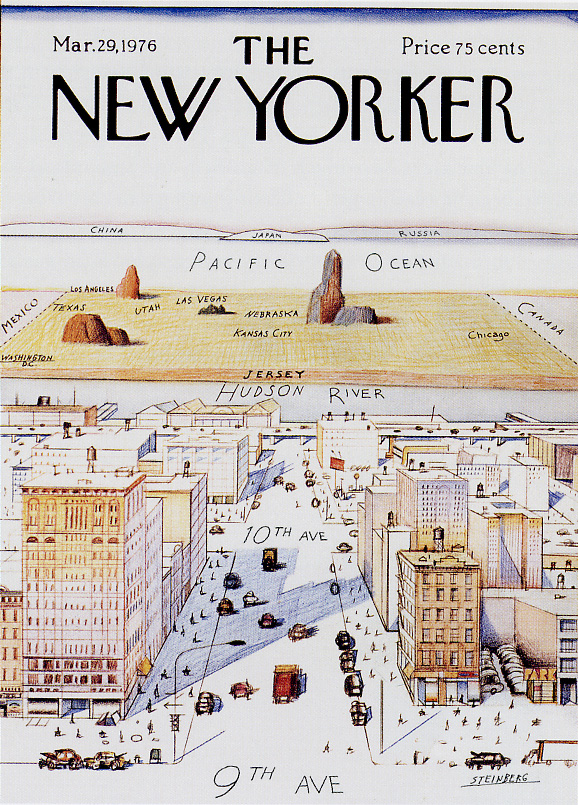
In the late 50s, MIT urban planner and architect Kevin Lynch asked residences of Boston, Los Angeles, and newyorkview4Jersey City to draw a map of their city. He found that while individual maps were distorted, the distortions almost disappeared in the aggregate. One person might forget the existence of an entire boulevard or transpose the order of churches going North to South, but overall the maps were fairly accurate. Lynch, while acknowledging that his sample sizes weren’t very representative or large (30 in Boston, 15 in Los Angeles and Jersey City, all of middle and upper income) couldn’t help but comment on how strong and predictable the trends were. People with cars would see highways as smaller than they actually were (the speed of the car tends to reduce perceived distance), while pedestrians tended to exaggerate the size of the highway (because it was a nuisance and an obstacle, rather than a useful path).

Lynch concluded that we all have an “image of the city” in our minds that exaggerate salient features and actively delete places that do not serve a purpose in our daily lives. We’ve always had personalized maps, but up until recently, lacked the tools to effectively share them with each other on a consistent basis or in useful ways. Personalized Google maps, so long as they provide an opportunity for sharing, could provide some of the richest, most evocative maps to date. The over-lapping of millions of personal maps will illuminate hot public spaces and identify emerging new ones. The key here is whether or not Google lets us compare our maps. It seems like a killer social media function so there’s no reason not to.

The Science Of Stuffing Your Face

Among many observations on the junk food industry, Paul McFedries offers an explanation of why food makers don’t simply add more sugar, salt, and fat:

Why not just crank these ingredients up to 11 if we crave them so much? It turns out that although we generally do like more of them, when you go past a certain amount, we like the result less. That optimum amount of salt, sugar, or fat is called the bliss point. Scientists also adjust these ingredients as well as factors such as crunchiness to produce a mouthfeel—that is, the way the food feels inside a person’s mouth—that causes consumers to crave more. Technologists can also induce a flavor burst by altering the size and shape of the salt crystals themselves so that they basically assault the taste buds into submission.

The holy grail of junk-food science is vanishing caloric density, where the food melts in your mouth so quickly that the brain is fooled into thinking it’s hardly consuming any calories at all, so it just keeps snacking.

In the process, packaged-food scientists want to avoid triggering sensory-specific satiety, the brain mechanism that tells you to stop eating when it has become overwhelmed by big, bold flavors. Instead, the real goals are either passive overeating, which is the excessive eating of foods that are high in fat because the human body is slow to recognize the caloric content of rich foods, or auto-eating: that is, eating without thinking or without even being hungry. (The opposite problem is being overhungry, where you’re so ravenous that you’ll basically eat anything that’s put in front of you.) Either way, if you end up with a food baby, a distended stomach caused by excessive overeating, you’ve made a fast-food executive somewhere very happy.

The Best Of The Dish This Weekend


Ira Glass attacked the way Christians are portrayed in the mass media – “too many Christianists, too few pageviews” is my basic explanation. And we pondered the eternal questions: does masturbation draw you away from or toward others? And can we help ourselves anyway? Dennett posited language as the core human experience; and we got a glimpse into the life of one GTMO inmate – trapped for eight years with no one who could speak his language.

I discussed the new NSA revelations and the proud leaker, Edward Snowden and the post-patriarchal manliness of Jesus.

The most popular posts of the weekend was this update on Peak Faggot on Reddit, and DFW on the surveillance state.

See you in the morning.

Face Of The Day

Unrest Continues In Turkey With Anti Government Protests

Thousands of demonstrators attend the demonstration in Taksim Square on the ninth day of the nationwide protests on June 8, 2013 in Istanbul, Turkey. Istanbul has seen protests rage on for more than a week, with two protesters and one police officer killed. Initially a protest over the fate of Taksim Gezi Park it has broadened into anger over what has been seen as a heavy-handed response of the police and Prime Minister Recep Tayyip Erdogan and his government’s increasingly authoritarian agenda. By Lam Yik Fei/Getty Images.

Enter The Leaker

“I understand that I will be made to suffer for my actions … I will be satisfied if the federation of secret law, unequal pardon and irresistible executive powers that rule the world that I love are revealed even for an instant,” – Edward Snowden, the leaker of the NSA surveillance program. Video interview with Glenn Greenwald here.

Some helpful perspective (polling in April of this year) as to the broader impact of these revelations:

Only 20 percent of people said they believed the government had gone too far in restricting civil liberties in the fight against terrorism, while 26 percent said it had not gone far enough and 49 percent said the balance was about right. In 2011, the share of those worried about losing civil liberties (25 percent) was larger than that favoring more intrusive government approach (17 percent).

Mulling this over as the facts have come in, I remain underwhelmed. Big Data is a core tool for terror prevention and is less dangerous, it seems to me, than many other counter-terrorist programs (like occupying foreign countries, killing people with drones, etc.). Of course, you may believe that we need to end counter-terrorism altogether, because it is a hyped and over-blown threat. But say that in that case – and make the argument that we will be better off without this kind of data-gathering being allowed, and safer. Or that our freedom is worth a few terror incidents.

I’m sympathetic to the latter point of view (see Imaginationland). But then I’m not the president of a country targeted by such religious mass murderers. But what seems inescapable to me are two related things: this data is out there, and the private sector has it. It’s the first real data of its kind to be seeking computer algorithms, not necessarily content of phone conversations. It works, which is partly how Obama got re-elected. And any system of such surveillance is inherently much easier to expose than ever before. There are more Edward Snowdens out there. And they have real power – just a different and asymmetric kind. In the end, the potential for disruption is as great as the potential for knowledge.