
The GOP vs Social Conservatism

New York City Clerks Offices Open Sunday For First Day Of Gay Marriages

Tim Noah recognizes that “one of the ironies of the marriage equality movement is the conservative movement’s stubborn refusal to recognize its fundamentally conservative nature”:

John Geddes Lawrence and Tyron Garner [of Lawrence v. Texas] were not conservatives’ type of people. One was demonstrably irresponsible, the other was a rootless drifter, and their case was about a sexual act (albeit one never actually committed) that most conservatives really don’t like to think about. Edith Windsor and Thea Spyer [of U.S. v. Windsor], on the other hand, are precisely conservatives’ type of people (except for their sexual orientation and maybe their politics). They are (in Spyer’s case, were) affluent and mutually committed and responsible members of society. Their case is about not being bullied by the IRS into paying too much in taxes, which is something conservatives fret about all the time.

When the history books are written, one likely conclusion will be that the swift ascendancy of gay rights in the second decade of the 21st century was largely attributable to gay people’s relentless pursuit of a boring lifestyle.

And this has definitely affected my views about American conservatism. There is a conservative position against marriage equality, which is simply resistance to any drastic change in such a crucial institution. But thanks to federalism, we can now see that fears of unintended consequences have not materialized so far in any of the equality states, and that marriage as a whole is in a much worse state where heterosexuals-only marriage endures. What you would expect an actual socially conservative party to do would be to adapt to these new realities, after legitimate initial skepticism, and try to coopt an emerging social group by integrating them into society in a conservative way.

Imagine, say, a pro-marriage movement among African-Americans. Do you think the GOP would oppose it ferociously? Imagine any group’s desire to leave behind leftist balkanization and cultural revolt in order to embrace the values of family, stability and responsibility. On what grounds would the GOP oppose it? None. So why the resilient hostility to gay conservatives and their remarkable triumph in a traditionally leftist sub-population? In fact, it is precisely those gay conservatives who are barred from Fox News – or immediately hazed by homophobes like Erick Erickson.

In Britain, you can see a direct analogy. The Tories went from hostility to homosexual equality in the 1980s to an embrace of it as a conservative cause in the 21st Century. To cite David Cameron’s speech to his own party conference:

I don’t support gay marriage in spite of being a conservative, I support gay marriage because I am a conservative.

Canada’s and New Zealand’s Conservative parties have also backed the reform. And many Republicans have supported it now as well. So why the remaining resilience?

The only real explanation is religious fundamentalism.

The GOP, at its core, is a religious organization, not a political one. It is digging in deeper on immigration reform, and marriage equality, and abortion. It is not acting as a rational actor in political competition but as a fundamentalist movement, gerrymandering its way to total resistance to modernity’s increasing diversity of views and beliefs. It is emphatically not a socially conservative force: it is a radical, fundamentalist movement, incapable of accepting any political settlement that does not comport with unchanging, eternal dicta.

It is the great tragedy of the era that Republicans targeted one of the few grass-roots, genuinely conservative movements as their implacable enemy in the last quarter century. They went after the one group truly trying to shore up and support marriage – and they even wanted to amend the Constitution to do so. They did so, I believe, for one reason alone: fundamentalism. And that is not conservatism. In so many ways, it is conservatism’s eternal nemesis: the refusal to adjust to the times in favor of an ideology that never changes.

(Photo: Same-sex couple Joseph and Jim pose for a photo as they wait to be officially married at the Manhattan City Clerk’s Office on the first day New York State’s Marriage Equality Act went into effect July 24, 2011 in New York City. By Anthony Behar-Pool/Getty Images.)

The “Scandals” Go Up In Smoke

US-POLITICS-OBAMA

There was always something desperate about them: an attempt somehow, after five years of remarkably scandal-free governance, to try once again and prove Michelle Malkin’s fantasies (and Peggy Noonan’s feelings) correct. Darrell Issa was the perfect charlatan for the purpose; and Roger Ailes desperately needed a new narrative in the post-election doldrums. But there really was no there there … and you can feel the air escaping from the hysteria balloons. Chait marks the end of this strange interlude of Republicans’ creating reality and failing:

The IRS inspector general is defending its probe, but the IRS’s flagging of conservative groups seems, at worst, to be marginally stricter than its flagging of liberal groups, not the one-sided political witch hunt portrayed by early reports.

What about the rest of the scandals? Well, there aren’t any, and there never were. Benghazi is a case of a bunch of confused agencies caught up in a fast-moving story trying to coordinate talking points. The ever-shifting third leg of the Obama scandal trifecta — Obama’s prosecution of leaks, or use of the National Security Agency — is not a scandal at all. It’s a policy controversy. One can argue that Obama’s policy stance is wrong, or dangerous, or a threat to democracy. But when the president is carrying out duly passed laws and acting at every stage with judicial approval, then the issue is the laws themselves, not misconduct.

The whole Obama scandal episode is a classic creation of a “narrative” — the stitching together of unrelated data points into a story.

(Photo by Nicholas Kamm/AFP/Getty Images)

Why Tax Married Couples Differently?

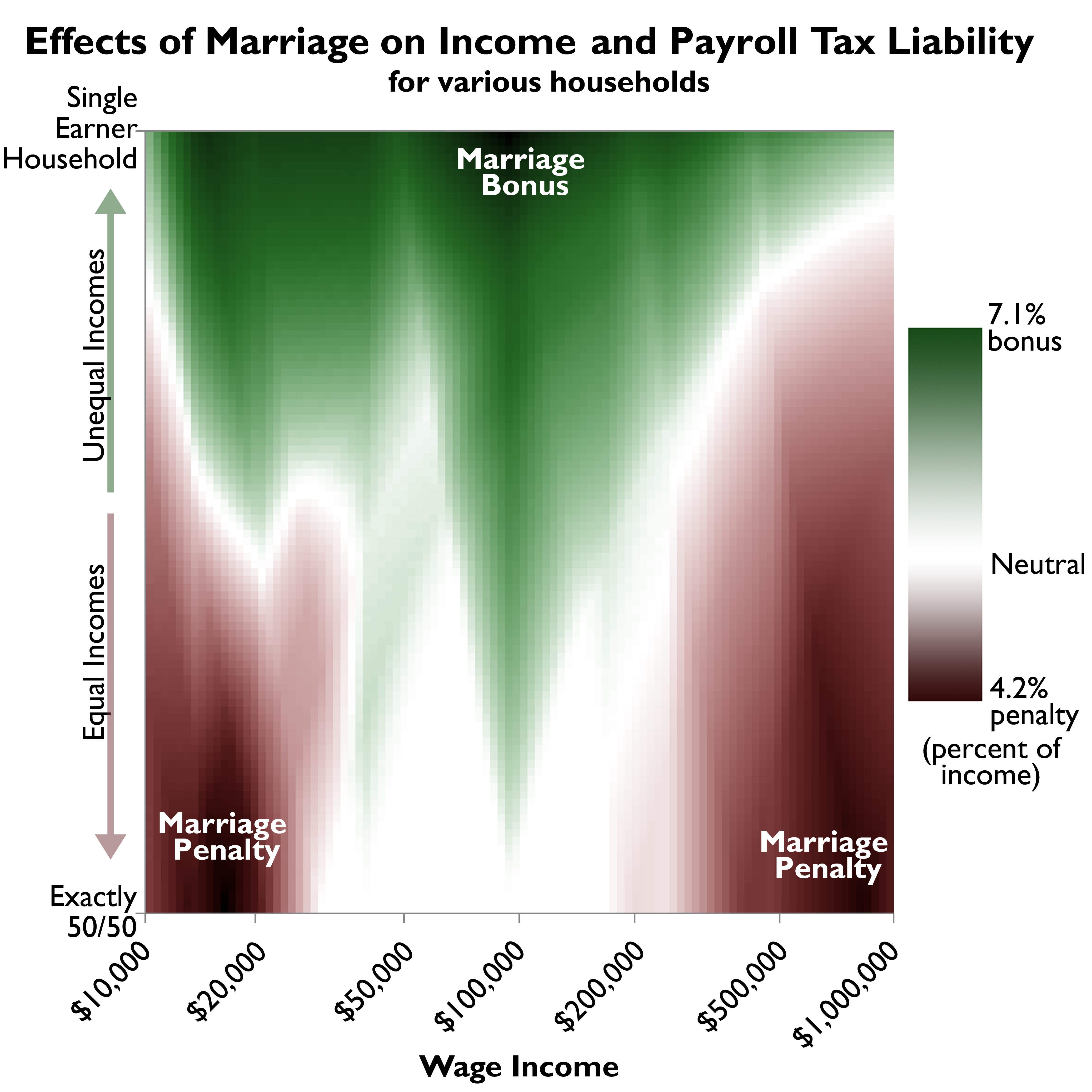
Marriage Penalties And Bonuses

Dylan Matthews digs up a 1997 CBO paper by Roberton Williams and David Weiner on marriage penalties and bonuses:

The income tax code, effectively, benefits single-earner married couples at the expense of dual-earner ones.

And because there are more of the former than the latter, there’s a net “marriage bonus,” or at least there was when Williams and Weiner wrote (which, sadly, is the most recent CBO data available); 51 percent of taxpayers got a bonus, compared to 42 percent who got a penalty, with a net $4 billion bonus overall. Williams says that some changes to the tax code since 1997, such as the introduction of the 10 percent tax bracket, should reduce penalties on the low end and increase the overall bonus rate. Then again, more families today are dual-earner rather than single-earner, which works in the opposite direction.

Matthews goes on the make the case for “cutting the link between taxes and marriage.” I disagree. One reason I wanted marriage equality was because I believe in the way marriage can – but not always, of course – stabilize people’s lives, give us a designated human being to take care of us when sick or unemployed, ease men toward domesticity, support women and men in child-rearing, etc. And I think finding a way to support that in the tax code is a small nudge toward real social conservatism – increasing the ties that bind and the institutions that guide us.

(Chart from the Tax Foundation)

Studying Abroad In Autocracies

Jackson Diehl worries about the integrity of American universities as they expand into “unfree countries whose governments are spending billions of dollars to buy U.S. teaching, U.S. prestige — and, perhaps, U.S. intellectual freedom”:

In September a joint venture between Yale and Singapore will open on a campus built and paid for by that autocracy. Then there are the Persian Gulf states. The United Arab Emirates hosts branches of Paris’s Sorbonne and the Louvre and Guggenheim museums in addition to NYU. While funding jihadists in Syria and Libya, Qatar is on its way to spending $33 billion on an “education city” hosting offshoots of Cornell, Georgetown, Northwestern, Texas A&M and Carnegie Mellon.

Is it possible to accept lucrative subsidies from dictatorships, operate campuses on their territory and still preserve the values that make American universities great, including academic freedom? The schools all say yes, pointing to pieces of paper — some of them undisclosed — that they have signed with their host governments. The real answer is: of course not.

Drezner puts things in perspective:

I’d suggest that one’s attitude about this phenomenon depends on whether you’re concerned about a particular American university or about U.S. foreign policy.

If you care about the intellectual integrity of, say, NYU or Yale, then Diehl and [Anya] Kamenetz raise some pretty valid concerns.  Clearly, intellectual life in these satellite campuses is different from intellectual life in the home institution.  I’m more dubious about assertions that these differences will somehow “infect” the state of academic free speech in the United States, however.  Sure, these campuses are moneymakers for U.S. universities, but the bread and butter of higher ed’s revenue stream remains tuition and research dollars from the advanced industrialized states.  I suspect administrators in state schools fear their own legislatures more than the implications of going overseas.

On the other hand, from a U.S. foreign policy perspective, matters are less clear.  Diehl’s worldview is sympatico with the idea of spreading American values across the globe.  His column provokes a question:  is the likelihood of that spread of liberal values stronger or weaker with these kind of activities?  The counterfactual of no U.S. higher education involvement in authoritarian capitalist economies would be less discussion of the liberal arts in these venues.

Discrimination On The Lot

Derek Thompson is troubled by research “that finds merchants charging different prices to different people based entirely on their race and gender.” He writes that the “best weapon against sexist and racist pricing tactics is to arrive at the negotiating table with a price of your own”:

study by economists Meghan R. Busse, Ayelet Israeli, and Florian Zettelmeyer looked at car repair shops and found that women tend to be quoted consistently higher prices than men when the callers didn’t mention a price. The most reasonable explanation, as Nanette Fondas explained on TheAtlantic.com, was that repair shops believe women are less informed about prices than men. So they’re gullible. But get this. When women and men suggested a price — any price, fair or too high — both genders got the same offer. Just saying a number closed the price gap. Once the mechanic had data telling him exactly how well-informed his potential clients were, gender was no longer “a useful basis.” In fact, repair shops were more likely to offer a price concession if asked by a woman.

Kicked Off Kickstarter

Reddit user Ken Hoinsky was running a successful Kickstarter campaign for his book Above the Game: A Guide to Getting Awesome With Women when controversy erupted over what some saw as the sexist and potentially dangerous nature of its contents – as a “guide for rape.” In response, Kickstarter issued an apology, banned “seduction guides” from its platform, and donated $25,000 to RAINN. Hoinsky, seen above, was disappointed in Kickstarter’s decision:

They’re a private company and they can do whatever they want, but it’s a cop-out, and it’s an overreaction on their part.

Maria Bustillos sympathizes with his situation:

No one has a “right” to Kickstarter. Out in the real world, however, we know that the rights to publish and speak are ten thousand times more important than the overheated rantings of some fool who can’t read. As PUA [pick up artist] guides go, Hoinsky’s is very, very far from being the most aggressive or objectifying. It is an entirely harmless book—as all books are. … [I]t is wrong and dangerous to suggest that shutting someone up is the best answer to any problem, ever.

Kat Stoeffel counters that “it’s okay to hate” Above the Game:

Hoinsky’s book may not be a rape manual, but it is a guide to exploiting the less-than-ideal conditions under which women have sex. It doesn’t hamper anyone’s free speech to say he’s unqualified to write about women to the point of being bad for them — or criticize Kickstarter for profiting from it.

Emily Greenhouse zooms out:

[T]he removal of Hoinsky’s project from Kickstarter might initially seem like a violation of free speech. But the right to publish is quite different from the right to speak, particularly on a platform like the Web. It’s the difference between a fundamental right and a market proposition. … It isn’t Kickstarter’s responsibility to endorse every project that it posts, and it isn’t Twitter’s responsibility to stand behind everything that’s tweeted. But their business models are built on the creations of others. Kickstarter skims money off of each successful project. What Kickstarter was made to realize, and what these other companies have already learned, is that when you profit from something, even if you don’t condone it, you’re complicit.

Will Support For Equality Slow?

Nate Cohn expects so:

When people discuss the inexorable rise of support for gay marriage, they talk about it like racial integration. The supporters of Jim Crowe were routed: it became impossible to publicly support segregation, and the opposition eventually died or flipped. But there’s another possibility: that gay marriage is somewhat more like abortion, where an entrenched minority remained steadfastly opposed, largely for moral and religious reasons. So far, the data suggests that gay marriage will be more like abortion, at least for a while.

Evangelical and Republican opposition to same sex marriage hasn’t budged.

According to Pew Research, Republican support for gay marriage has only crept up by a net-7 points since 2003, from 22-71 to 25-67. White evangelicals have moved a little quicker, but they still oppose by a 75-19 margin—a net-15 point improvement from 2003. In comparison, the public as a whole has shifted 30 points toward gay marriage—despite being held back by Republicans and evangelicals. Generational change isn’t helping very much, either. Just 30 percent of 18-34 year old evangelicals support gay marriage, which isn’t a huge improvement from the 25 percent who supported it in 2003. Young Republicans are a little more supportive of gay marriage than young evangelicals, but they still oppose gay marriage by 15 points, 39-54.

The Reverse Of A Carbon Tax

This embed is invalid

Jodi Beggs criticizes recent efforts by Virginia and North Carolina lawmakers to levy a tax on hybrid cars to make up for their reduced contribution to gas taxes:

Economically speaking, both Virginia and North Carolina are saying that they want at least some of their residents to switch back from purchasing hybrid cars to purchasing regular gas guzzlers. The most frustrating part is that this makes perfect sense from a self-interest perspective – the state legislature certainly feels a lot more pain from having an increasing budget shortfall than it does from producing some more pollution that everyone else who doesn’t write stupid policy has to deal with. …

Here’s the problem, though – it’s one thing for a for-profit business or consumer to be self-interested and not do what is best for society unless it has the proper incentives to do so, but a main principle of government is that it is supposed to have a fiduciary duty to society and be immune to what would typically be thought of as profit pressures. In this way, both Virginia and North Carolina are failing – can’t you both just find something that imposes costs on society to tax instead?

When Innovation Was A Crime

Emma Green traces back the word “innovator” to when it wasn’t such a positive buzzword:

According to [Canadian historian Benoît Godin], innovation is the most late-blooming incarnation of previously used terms like imitation and invention. When “novation” first appeared in thirteenth century law texts as a term for renewing contracts, it wasn’t a term for creation — it referred to newness. In the particularly entrenched religious atmosphere of sixteenth and seventeenth century Europe, doctrinal innovation was anathema. Some saw this kind of newness as an affiliation with Puritanism, or worse — popery. Godin cites an extreme case from 1636, when an English Puritan and former royal official, Henry Burton, began publishing pamphlets advocating against church officials as innovators, levying Proverbs 24:21 as his weapon: “My Sonne, feare thou the Lord, and the King, and meddle not with them that are given to change” (citation Godin’s, emphasis mine). In turn, the pot-stirring Puritan was accused of being the true “innovator” and sentenced to a life in prison and worse — a life without ears.