Map Of The Day

Gay Tolerance

Pew asked (pdf) citizens of 39 countries, “Should society accept homosexuality?” Max Fisher mapped the results:

It’s not even close. While there’s wide variation in places like Latin America and Europe, Africa is almost uniformly anti-gay. Nigeria is the only surveyed country where just one percent say society should accept homosexuality; 98 percent said society shouldn’t. Results are under 10 percent for almost the entire continent, including sub-Saharan Africa and North Africa, which has closer cultural ties to the Middle East. The important exception is South Africa, famous for its gay rights movement, where a still-low 32 percent answered “yes.”

Muslim-majority countries tended to reject homosexuality, with results under 10 percent for Islamic societies from Africa to Southeast Asia to the Middle East. The only exception is Lebanon, although the country is only about two-thirds Muslim. Only 2 percent of Pakistanis and Tunisians – who are generally considered cosmopolitan by Mideast standards – said society should accept gays.

To be clear, though, some Christian-majority countries also overwhelmingly say that society shouldn’t accept homosexuality: Ghana and Uganda, both in sub-Saharan Africa.

Quote For The Day II

“I appreciate that conservative reformers must pay lip-service to shibboleths about Barack Obama being the worst president of all time, who won’t rest until he has snuffed out the remains of constitutional liberty, etc. etc. Dissent too much from party orthodoxy, and you find yourself outside the party altogether.

Still … conservative reformers should admit, if only to themselves, the harm that has been done by the politics of total war over the past five years. Now Republicans are working themselves into a frenzy that will paralyze Congress for the next 18 months at least, and could well lead to an impeachment crisis. As it becomes clear that the IRS story is an agency scandal, not a White House scandal, conservative reformers need to be ready to do their part to apply the brakes and turn the steering wheel. There will be a Republican president again someday, and that president will need American political institutions to work. Republicans also lose as those institutions degenerate,” – David Frum, taking a breather from blogging for a while.

The Recipe For Romance

Hannah Gersen surveys the cookbooks she’s loved reading. One favorite? 1952’s Venus in the Kitchen, or Love’s Cookery Book:

This is a cookbook of aphrodisiac recipes. I would be surprised if anyone has ever cooked from it, and even more surprised if they derived aphrodisiac benefits from the entrees, which includes a large number of recipes for brains and kidneys. It is the most literary of cookbooks and the most bizarre. Many recipes begin with declarative, faintly poetic instructions such as: “Feed your snails for a fortnight on milk”; “Boil the meat until it is practically cooked into rags”; or, my favorite, “Take some pig guts.” Many recipes end abruptly with a vague opinion: “Rather banal, I venture to think” or “Not everybody cares to treat oysters in this fashion.” If Evelyn Waugh and Edward Gorey collaborated on a cookbook, it might look something like this one.

In 2002, The Guardian excerpted some of the book’s recipes for a Valentine’s Day meal plan, advising sparrows’ brains for the entrée:

Sparrows have always been praised as stimulants. Aristotle has written: Propter nimium coitum, vix tertium annum elabuntur. Recommended also by the school of Salerno.

Whoever wants to test this should take several brains of male sparrows and half quantity of the brains of pigeons which have not yet begun to fly. Take a turnip and a carrot and boil them in chick-pea broth. Cut in little slices the turnip and carrot, and put them in a deep pan with half a glass of goat’s milk, and boil till the milk is almost absorbed. Now put in the brains and sprinkle them with powdered clover seeds. Take off from the fire as soon as they come to the boil, and serve hot.

Attack Of The Patent Trolls

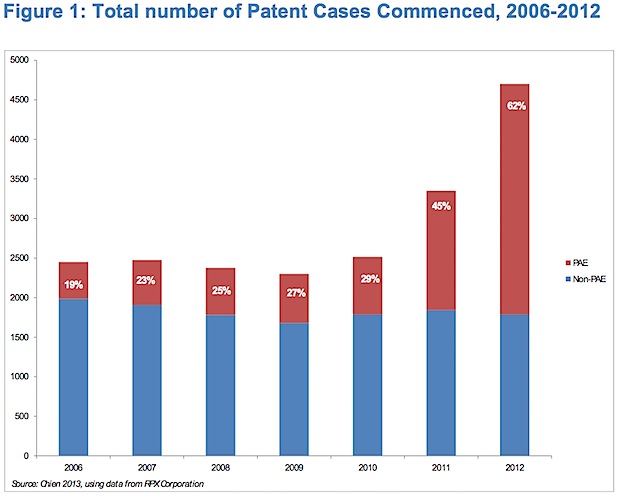
Litigation by patent trolls, often called Patent Assertion Entities (PAEs), has exploded in recent years:

Patent Trolls

Felix Salmon explains why this is a major problem:

Go to any technology conference these days, and you’re likely to find VCs who say that there are entire sectors they refuse to invest in, just because the waters are so troll-infested. Google and Apple might be able to do interesting things in wearable computing, for instance, but a single lawsuit could easily wipe out a startup in the same space — even if it was entirely frivolous. Even the 3D printing industry seems to have boiled down to a handful of companies, despite the fact that most of the patents in the space have expired, because it seems to be all to easy to get patents on tiny improvements to established technology. Technological innovation is increasingly a game that only the largest technology players can indulge in; every VC has a story of a portfolio company which gets sued for patent infringement and then gets a lowball acquisition offer from the plaintiff. Either sell out to us, is the message, or we’ll destroy you with legal fees.

Timothy B. Lee worries that focusing specifically on patent trolls will prove ineffective:

Legislation that focuses on defanging patent trolls won’t do anything to stop non-troll firms from abusing the patent system. And it may not even do much about the trolls.

For example, one popular anti-troll proposal, sponsored by Rep. Peter DeFazio (D-Ore.), creates a “loser pays” rule for patent trolls. But it’s hard to draw a principled distinction between abusive lawsuits filed by “trolls” and those filed by other types of entities. The DeFazio bill defines a troll as someone who is not engaged in the “production or sale of an item covered by the patent.” In many cases, it would be trivial for a troll to evade this requirement by producing a token number of units of a product covered by its patent.

Drum thinks fixing the patent system will fix the troll problem:

[I]s a firm with lots of legitimate patents a patent troll? Nope. Whether we acknowledge it or not, the stuff that strikes as trollish is almost always related to firms with lots of patents that seem kind of bogus. If we want to reform our patent system, that’s where we need to start. Limit patents much more stringently than we do and, perhaps, place common sense licensing rules on them. If we do that, we’ll no longer care who owns the revenue stream.

Where’s The Line Between Friendship And Networking?

Ann Friedman observes that when women “meet other women who seem happier, more successful, and more confident than we are, it’s all too easy to hate them for it”:

When we hate on women who we perceive to be more “together” than we are, we’re really just expressing the negative feelings we have about our own careers, or bodies, or relationships. Here’s my solution: When you meet a woman who is intimidatingly witty, stylish, beautiful, and professionally accomplished, befriend her. Surrounding yourself with the best people doesn’t make you look worse by comparison. It makes you better.

The benefits of this philosophy:

Approaching and befriending women who I identify as smart and powerful (sometimes actively pursuing them, as with any other crush) has been a major revelation of my adult life. First, there’s the associative property of awesomeness: People know you by the company you keep. I like knowing that my friends are so professionally supportive that when they get a promotion, it’s like a boost for my résumé, too, because we share a network and don’t compete for contacts. Also, it’s just plain tough out there — for all the aforementioned reasons about the economy and the dating scene and body-image pressures. I want the strongest, happiest, smartest women in my corner, pushing me to negotiate for more money, telling me to drop men who make me feel bad about myself, and responding to my outfit selfies from a place of love and stylishness, not competition and body-snarking.

Hanna Rosin has misgivings about aspects of Friedman’s article:

[T]he problem is that this worldview posits a definition of friendship I can’t really relate to as a strategic alliance, a self-improvement project, or maybe just networking, which is a fine and noble pursuit but not the same as actual friendship. I might have a “ranking system” in my mind (although I don’t spend all my time on it), but it involves my colleagues or fellow journalists, not my friends. My friends, even if they are journalists, are largely exempt from this ranking system.

Is Peak Derp Here? Ctd

A reader writes:

Contrary to the NY Mag article you posted, “derp” was not invented as “an onomatopoeic exclamation uttered in response to a boneheaded action of some kind.” According to Matt and Trey, its original meaning was that of an obvious joke that you could see coming from a mile away – a derp joke. They came up with it on the set of BASEketball. Whenever someone ran in to a wall or something they’d yell “derp!” in reaction to the low brow gag. So it’s a callout of lazy comedy rather than general stupidity … hence the Rob Schneider bit.

Seen above – one of my favorite takedowns of Hollywood of all time. And I’m totally serial about that. Meanwhile, Noah Smith provides his own definition of derp.

What’s Erdogan’s Next Move?

Mustafa Akyol and HA Hellyer ponder the way forward for the Turkish government, noting a few encouraging signs:

The events of the past few days do not mean Erdogan has to resign – but it does suggest he ought to try to be a force for reconciliation. A good step was taken on Tuesday, when Bulent Arinc, Erdogan’s deputy, gave a press conference in which he promised police restraint, dialogue with the opposition, and “self-criticism” within the cabinet. Erdogan will do a great service, to himself and his country, if he uses similarly calming language on return from north Africa. His visit to that region ought to remind him that the best governments listen seriously to the demands of all citizens, not just those who voted them in. Erdogan’s accomplishments are so significant that the alternative route – of further confrontation and crisis – would be a great pity.

Claire Berlinski feels more pessimistic:

Erdogan may believe that he can outlast the protesters, and he may be right, particularly if the protesters succumb to the temptations of violence and vandalism. So far, they have been reasonably constrained. But the Robocops are exhausted—photos are circulating of them falling asleep on the street—and if there is one thing a prime minister best known for “taming the military” can’t do, it is to call in the army to settle things down. If the protests keep escalating and the crackdown intensifies, it’s hard to see how this can end well. Best case: the protests will spook the prime minister and give him a much-needed dose of humility. Worst case: The protests will spook the prime minister and leave him even more paranoid and vengeful.

Jenny White looks at how Erdogan has treated the protestors thus far:

[L]ike a rubber band after several years of liberal opening, the [ruling] AKP [party] has snapped back to what has long been the status quo of strongman autocracy, authoritarianism, patriarchy, and intolerance. These are characteristics that polls show are reflected by the population and characterize the still highly valued traditional family structure. But even an authoritarian father is expected to keep the welfare of his children foremost in mind. And that is where Erdogan has crossed the line. He dismissed the tens of thousands of citizens in the streets initially as purveyors of terror instigated by outsiders, then as “marginals,” as alcoholics, and finally, in perhaps the most revealing statement, as people who have an ideological gripe and who don’t like him personally.

It is the grandiosity of power and the increasingly punitive state that has pushed people onto the streets and keeps them hanging from the windows of their homes every day, banging pots into the night. Even the revered father of the traditional family is expected to care about all this. But Prime Minister Erdogan, after insulting the protesters and refusing to acknowledge that there was any problem whatsoever, instead left for Morocco to attend a trade meeting.