Climate Change Trade-Offs

A reader comments on a recent Malkin Award nomination:

I really, really hate that I’m about to defend Exxon CEO Rex Tillerson, but I’m not so sure this qualifies as “shrill, hyperbolic, divisive and intemperate right-wing rhetoric.” Short-sighted, rather ignorant, and driven by deeply questionable motives, sure. But at the same time, there’s actually an important point subsumed here (at least as I read it). Attacking carbon emissions with the utmost gusto, at this point in time and with currently existing technology, could well have implications for lifting the global bottom two billion out of energy poverty; and, it would almost certainly create additional cost burdens for individuals in the developed world. Climate impacts will be most acutely felt by those in the bottom socioeconomic rungs; but so too is it going to be harder for folks at the bottom to pay for higher energy costs – wherever they may live – if they’ve got to rely on renewables, or coal with carbon-capture.

So it’s something of a balancing act, I’d argue.

Contra Exxon, this consideration is not a reason not to act, of course; people just need to be clear-eyed about potential trade-offs. Brad Plumer wrote about this with some concern a while back, and he is surely not worthy of a Malkin Award! There’s a legitimate conversation to be had about the future trajectory of human development, the trade-offs between competing goals, and the advantages or disadvantages of the various supply – and demand-side steps we can take to achieve them.

I also understand the context here. Exxon is probably one of the worst corporate actors on climate. Their record and outlook is shameful, and flies in the face of what IEA, the World Bank, and other bodies say we need to be doing. Obviously Tillerson is using this argument as a shield, not in good faith. But just because he can use this argument as an excuse for poor corporate citizenship doesn’t necessarily mean it belongs with the Malkins.

The Best Of The Dish Today

family_of_saltimbanques

The Dish enjoyed skewering Erick Erickson’s brain-dead form of Republicanism today; and wondering when Bob Woodward had his sense of shame removed. There was a debate about what exactly bigotry is; and whether Obamacare will raise or lower most premiums. The human brain has a unique capacity to see real things in painting; animals not so much with mirrors. And we welcomed my old friend Fareed Zakaria (yes, we met as students at the Oxford Union) to an Ask Anything series.

The most popular posts were about rape and orgasm and, once again, my conversation with Dan Savage.

See you in the morning.

Roy Vey, Ctd

A reader writes:

What continues to burn me about this entire debate is that opponents of Obamacare act like insurance premiums were dirt cheap and totally stable before Democrats started mucking with the system.  Long before Obama was even elected, I had begun the almost yearly ritual of filling out the same draconian health survey so my company could shop around for new insurance.  Our insurer was raising the rates 25-40% over last year’s.  AGAIN.  Or calling to interrogate us after every follow-up doctor visit to see if there was any way they could weasel out of paying for it.

I’ve seen the quality of plans offered go steadily down, even while having to pick up a larger percent of the cost myself.  And when my wife and I finally decided that the cost increases had become too punishing, and tried to find some bare-bones, individual alternative, we were turned down flat.  The reason?  Three months earlier, I had a cholesterol test come back high.

Maybe the exchanges will be a stabilizing force on premiums, and maybe the cost-saving measures will end up lowering health care costs in general, but at least it’s something.  People need to stop talking like there was never a problem to begin with.

Neuro-Cosmology

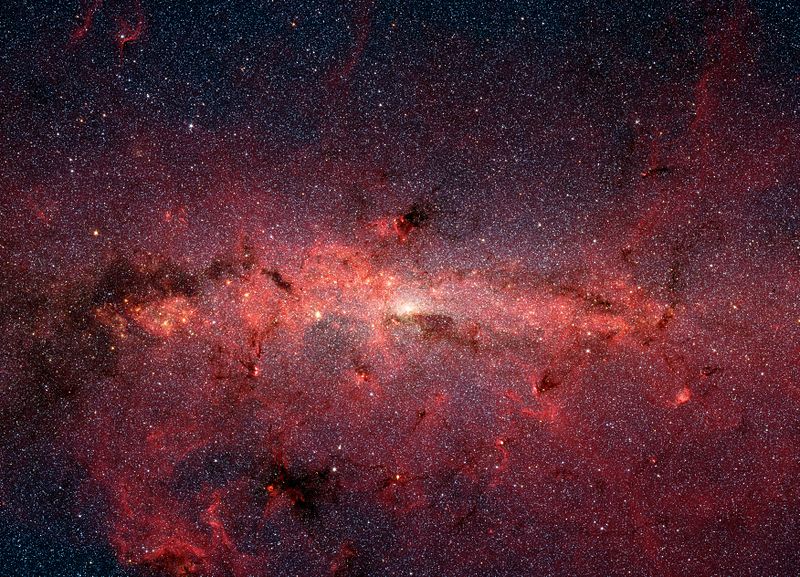
dish_milkyway

Are there equally as many neurons in the human brain as stars in the Milky Way? Bradley Voytek provides the latest data on the subject, then walks us through how scientists arrived at the numbers:

Even though we can’t conceive of the number of stars in the Milky Way or the number of neurons in the human brain, equating the two gives people a sense of enormity. And as conscious beings we like to find patterns, and we find equivalencies interesting, especially when the things being equated are “important” or “epic” (like neurons and stars).

For a long time, neuroscientists would say that there are about 100 billion neurons in the human brain. Interestingly, no one has ever published a peer-reviewed scientific paper supporting that count. Rather it’s been informally interpolated from other measurements. A recent study from 2009 published by Azevedo and colleagues took a crack at a more precise estimate. Their answer?

Approximately 86 billion neurons in the human brain. The latest estimates for the number of stars in the Milky Way is somewhere between 200 and 400 billion. So close, but the human brain certainly doesn’t quite stack up!

(Image: Infrared image of core of Milky Way galaxy, NASA/JPL-Caltech/S. Stolovy (SSC/Caltech), via Wikimedia Commons)

The Species We Don’t Know

On the heels of new discoveries by the International Institute for Species Exploration (IISE), Sarah Soat explains why taxonomy matters:

Only about two million of the estimated 10 to 12 million living species have been identified. (We’re talking plants and animals; microbes are another 20 million-plus story.) And in an era where the rate of species extinction may exceed species discovery, [IISE founding director Quentin] Wheeler reasons that millions of species may not survive the 21st century. So it’s important—urgent, even—to establish a baseline of species to give us the necessary facts to monitor these changes as they happen. Without a major taxonomic initiative, Wheeler told me, “We are literally flying blind into a storm and hoping for a safe landing.”

A Woman On The Edge Of Your Seat

The Maria Bamford Show is the brainchild of standup comic Maria Bamford, whose sensibility is, according to Madeleine Davies, “as unique as it is necessary”:

Perhaps what’s most special about Bamford’s goofy, surreal and stylized brand of humor is that it doesn’t end up seeming stylized at all. At times, she comes off as so intensely fragile and vulnerable that you want to hug her and tell her that everything will be alright. Then, with remarkable skill, she’ll flip it around and force you to stare your own reaction in the face — why do you assume that there’s something wrong with a person who gets on stage and says something hard and honest? Why should that kind of bravery be perceived as weakness that needs comforting rather than empathy?

Check out more of her work on the series “Ask My Mom!” here and here. She also appears in the new season of Arrested Development alongside Anus Tart. Previous Dish on Bamford here.

Can Africa Monitor Its Own Elections?

While acknowledging that international observers sometimes overstep their role, Judith Kelley pushes back against calls to replace them with African counterparts:

[I]t is not quite the time to boot out the observer organisations from the wider international community. Despite their problems, they have made important contributions, particular where they’ve worked with local officials to improve voter registries, implement other institutional reforms to bolster election processes, improve the legitimacy of competitive elections, and train domestic observer groups. Furthermore, whatever legitimate concerns there are around the role of international observers, African organisations have the same problems, only worse. With so many autocratic states and tentative democracies still on the continent, African monitoring organisations still have some way to go before they are ready to hold each other accountable.

Face Of The Day

Tensions Grow As Demonstrations Against The Government Continue In Istanbul

A protestor wears a mask at the Gezi Park in Taksim Square on June 4, 2013 in Istanbul, Turkey. The protests began initially over the fate of Taksim Gezi Park, one of the last significant green spaces in the center of the city. The heavy-handed viewed response of the police, Prime Minister Recep Tayyip Erdogan and his government’s increasingly authoritarian agenda has broadened the rage of the clashes. By Uriel Sinai/Getty Images.

Guilty Until Proven Guilty

Dana Milbank pans the congressional investigations attempting to connect Obama to the IRS scandal, accusing them of not only “placing the sentence before the verdict, they’re putting the verdict before the trial”:

Congressional investigators have not produced evidence to link the harassment of conservative groups to the White House or to higher-ups in the Obama administration. But the lack of evidence that any political appointee was involved hasn’t stopped the lawmakers from assuming that it simply must be true. And so, they are going to hold hearings until they confirm their conclusions.

Ed Kilgore cautions that “if it’s possible to screw up this can’t-lose situation, it may well be that House Republicans are capable of it”:

I figure congressional Republicans and their media friends have about a week to make the IRS investigations interesting and/or revelatory before it begins to look like conservatives are quite literally just talking to themselves, at which time the whole thing could backfire. But they don’t exactly seem to have a firm grip on the ball or a clear play to run.

Ramesh offers advice to Republicans:

Republicans had a better response to the last round of IRS scandals, in the 1990s. In 1997, congressional hearings revealed that IRS agents were being pressured to meet quotas for back taxes and penalties. Agents, sometimes anonymously, admitted that these quotas had led aggressive collectors to squeeze taxpayers for money they didn’t really owe. … The earlier IRS scandals produced useful reforms partly because the Republicans who did the most to publicize them weren’t focused on pinning the blame on President Bill Clinton. They instead wanted to demonstrate the dangers of letting the federal government have too much power, and in finding ways to reduce those dangers.

Good luck with that, Ramesh. And I’m not being snarky there. But I suspect they’re a lost cause and this will be the only thing the House cares about in this session.