Jared B. Keller surveys research on Internet addiction:
As [cognitive scientist Tom] Stafford explains, our love for the Internet is rooted in the fact that human beings, in Ghose’s words, “compulsively seek unpredictable payoffs.” The cognitive-reward structure offered by services like email and social media are similar to those of a casino slot machine: “Most of it is junk, but every so often, you hit the jackpot.” This is a symptom of low-risk/high-reward activities like lotteries in general. As researchers found in a 2001 article in International Gambling Studies, systems that offer a low-cost chance of winning a very large prize are more likely to attract repetitive participation and, in turn, stimulate excessive (and potentially problematic) play. Although the stimuli are different (the payoff on the Internet being juicy morsels of information and entertainment rather than money), Stafford says that the immediacy and ubiquity of Internet “play”—i.e. being able to check your tweets or emails on your phone with no major transaction cost—only increases the likelihood that someone will get sucked into a continuous cycle.
My one complaint is the use of the term “bigots” to describe anyone opposed to marriage equality. Some are; many aren’t. And the use of the word does nothing to help engage opponents of equality – and merely reeks of the Maddow-like smugness that encourages the foes of equality to dig in.
Philosophy instructor Dien Ho engages in a thought experiment:
In some respects, the idea that becoming a zombie is a bad thing borders on a platitude. Zombies wander around in constant hunger in a semi-decomposed state. Their actions are guided entirely by impulses. They seem to lack the complex cognition that’s critical for most of the activities we consider worthwhile – social interactions, intellectual pursuits, personal projects, etc.
But in other respects, the life of a zombie has characteristics many of us strive mightily to achieve. Their lives are highly centralized and simplified, since their needs and wants often revolve around just a few things, like brains or human flesh. They are largely indifferent to pain and suffering. Short of severe head injuries, zombies enjoy a type of immortality. Zombies do not care about most of the pesky concerns that fill our daily lives: they do not care about the weather, their appearance, their social status, their retirement plan, their morning commute, and petty office politics. They are not concerned about the threat of terrorism, floods, earthquakes, and hurricanes. And they certainly do not become jealous, depressed, worrisome, or suffer the other anxieties that regularly plague our waking moments. Indeed, if we focus on just these qualities, the life of a zombie resembles the ideal state of a disciplined Zen Buddhist monk who has managed to let go of his earthly concerns.
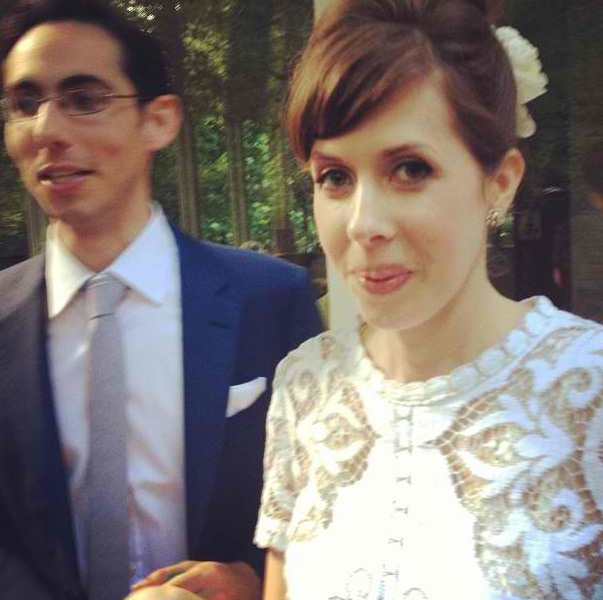
Over the weekend, longtime Disher Zoe Pollock gave us all our third Dish marriage – to former Dishtern Will DiNovi. She’s now moving on to a career in social work, which tells you something about her character. Zoe was another staffer who began as an intern, rising to associate editor and having particular responsibility for the weekend coverage. Sometimes, I’m told that at the Dish, we can get a little fratty at times, especially with all the coverage of sex. If that’s the case, then Zoe was the chief fratboy of the team – her raw humor, dirty mind, and sense of hippie mischief made a big impact on what we cover and how we do it. She also helped me out with scheduling, press calls, and my ridiculously complex regimen of medications. We all loved and love her, and miss her every day. She’s the perfect millennial mixture of outward propriety, open mindedness and relentless practicality. And she worked incredibly hard every day.
The good news is that the Dish’s first ever exclusive-to-us intern, Jessie Roberts, has come back. At the Atlantic, Jessie all but created the recipes that feed the Dish every day. She set up our first RSS feed to ensure we miss nothing among the bloggers we have come to admire. She found new voices, and produced an amazing stream of web-gems – cultural, scientific, political – that came to define the mix we have. To have her back among the little team that produces this little blog is extremely exciting. She is already a one-woman machine of productivity and imagination.
I take a lot of pride in the fact that we’ve discovered all the talents that enrich this space. We’ve never hired any staffer from another publication or site. I believe in finding talent, not poaching it, and in rewarding and promoting the best and most dedicated. My reward has been a group of young bloggers of incredible loyalty, brilliance and dedication. If you want to encourage and support them, there’s one simple way you can: by [tinypass_offer text=”subscribing”]. That’s how we pay their salaries and health insurance.
I admire the season for its problem-solving skills, developing some intricate narrative structures that allowed them to make those limitations work in their favor on many occasions. I think one could look back on the season and observe a number of compelling choices that reflect a desire to create a new way of telling television stories (even if many of them proved unsuccessful). I appreciated returning to these characters, I’m glad that my $8 a month Netflix subscription gave me the ability to enjoy another season of a show I enjoy, and this in no way stains the series’ legacy in the way that some might have feared.
However, it’s also an experiment that didn’t work as often as it did. We admire experiments without fully embracing them, and there was never a point in the season where it felt like the show was fully comfortable in its own skin for more than an episode or two at a time. Taken as one larger story broken up into fifteen parts, the larger plot developments that string the various characters together are thin to the point of boredom, functional rather than funny; the election has no stakes, Michael’s movie becomes a background excuse for him to visit each member of his family, and the Cinco celebration is sketched in predictably enough to lose any of its convergent potential. And yet the season spent enough time developing these ideas that for the finale to pay none of them off seemed as though it left the puzzle unsolved, while simultaneously failing to provide enough points of interest to make me desperate to see the puzzle solved in the future.
Readers share their thoughts:
I’ve seen the first five episodes of Arrested Development Season 4, and I think in some ways it is even better than the first three.
It certainly seems to be more intricately plotted, and has at least as many subtle jokes per minute; I have no idea what Jace Lacob is talking about when he talks about a lack of finesse in this season. The mural at the end of episode one, while Ron Howard’s voiceover talks about Phoenix being Michael’s destiny, is pretty amazing (though I only caught it after someone mentioned it on a comment thread). The whole Google/privacy thread is fun. Rebel’s laughing when Michael says he knows Ron Howard is funny, but you don’t know why, because you don’t know that Isla Fisher’s character is Rebel at that point. The whole scene where Michael tries to get a copy of the inflight magazine from the guy at the airline counter is also priceless. I’m having a great time just recalling these scenes for this email!
I really have never seen anything so carefully plotted on TV. The closest I can think of is the 1960s comedy troupe The Firesign Theater, which did records that you had to listen to repeatedly, because they unspooled out of order – they’d do things like have one side of a phone conversation on one side of a record, with the other side of the conversation being on the other side of the record.
On the whole, I love season four. But as Jerry Garcia once said, when asked about the Grateful Dead’s lack of technical proficiency “You can’t please everyone.”
Another:
I binged on all the episodes yesterday, and I loved it. I immediately wanted to watch it again. It’s a matter of expectations. If you’re expecting a continuation of the first three seasons, everyone should know it’s not that. I went in thinking that it’s just the ice cream course after a hilarious meal of mayonegg and hot ham water. Many of the new episodes had us rolling on the floor laughing. The knee-jerk criticism was completely predictable. People view Arrested Development through rose-colored glasses. Some episodes of the original Fox series don’t even live up to the platonic ideal some people have crafted of “Arrested Development.”
After watching season 4, episode 15, Netflix cycled back to the pilot. It’s striking how different a show it is from season to season. Not better or worse, just different. For example, I actually love that season 4 doesn’t hold Michael Bluth up as a paragon in the way earlier seasons did. My recommendation: Watch the fourth season, then rewatch the show again. (Not redundant!) The beginning is just so bitter and acerbic that it’s jarring. The new episodes are softer. It’s a different feel, and that’s fine. I think it’s honestly done a little more lovingly, and all of the characters are treated with equal affection.
Remember that the thing is called Arrested Development. Their emotional development is still stunted, but 10 years have passed. They’re still immature, but now it manifests in new ways. It might take time for the audience to get used to it, but it’s still brilliant.
Another:
I’d like to tell the media critics to stop the hand-wringing and buy a damn Netflix subscription so there is monetary incentive for more Arrested Development. K thx.
A reader on the ground in Turkey shares his perspective:
I’m in Istanbul at the moment, and until this morning I was staying five minutes’ walk from Taksim Square. When I arrived there was tear gas everywhere, floating down the side-streets and punishing practically the entire Beyoglu neighbourhood. I can’t help but feel that this kind of collective punishment is doing plenty to turn people who would otherwise be content to sit aside against Tayyip Erdogan and his government. The protestors have been incredibly destructive to people’s property, especially down the main Isklidal street which is Istanbul’s main shopping avenue – but this hasn’t met with the kind of revulsion I saw a couple of years ago during the London riots, I think because the Istanbullos feel the protestors are defending rather than attacking the city. Whenever a crowd of protestors – who now wear gas masks as a badge of pride wherever they go – pass through town on their way to Taksim, ordinary, non-protesting people nevertheless stand up and applaud them as they go. There’s a quite diverse range of protestors – you have the usual anarchists and eco-warriors plus Kurdish nationalists, and I’ve even seen a couple of Hizbullah graffitos (though that’s probably just mischief-making) but on the whole it is just a range of ordinary people without any kind of political affiliation.
(Photo: Protestors clash with riot police near Turkish prime minister’s Recep Tayyip Erdogan office, between Taksim and Besiktas in Istanbul, on June 3, 2013, during a demonstration against the demolition of the park. By Gurcan Ozturk/Getty Images.
In a defense of millennial lingo, Steven Poole encounters a term he finds especially endearing:
[A]gainst the claim that the internet is impoverishing our language must be set the truth that it is (somehow simultaneously) expanding it with new and entertaining means of expression. Take, for instance, the very useful ejaculation “facepalm”. This splendidly economical way of indicating ironic despair — sometimes accompanied by an image of Captain Jean-Luc Picard covering his face with his hand — is just one of the useful lexical innovations the internet offers to those who actually read it. As Tom Chatfield’s recent book on the subject, Netymology, explains: “When I type out the word ‘facepalm’, nobody actually thinks that I’m dropping my own head into my hand (even though I may be doing so). The agreed convention, rather, is that typing this neatly compressed term is an efficiently vivid way of suggesting – through a word – that I consider myself lost for words.”
The same kind of enjoyable perfomativity attends a semantic cousin of “facepalm” that Chatfield doesn’t mention, and which is slightly more violent in its ironic despondency – “headdesk”. One should be careful to distinguish between the two usages. “Headdesk” seems to imply that one is so appalled by the stimulus in question that one is prepared to cause oneself physical pain as a welcome distraction. But just covering one’s eyes with one’s hand seems gentler, sadder, perhaps even a little sympathetic.
With the news that Helen Mirren may play the next Doctor Who, a counter-factual re-imagining of the series if all eleven doctors had had two hearts and one vagina.


 The Dish