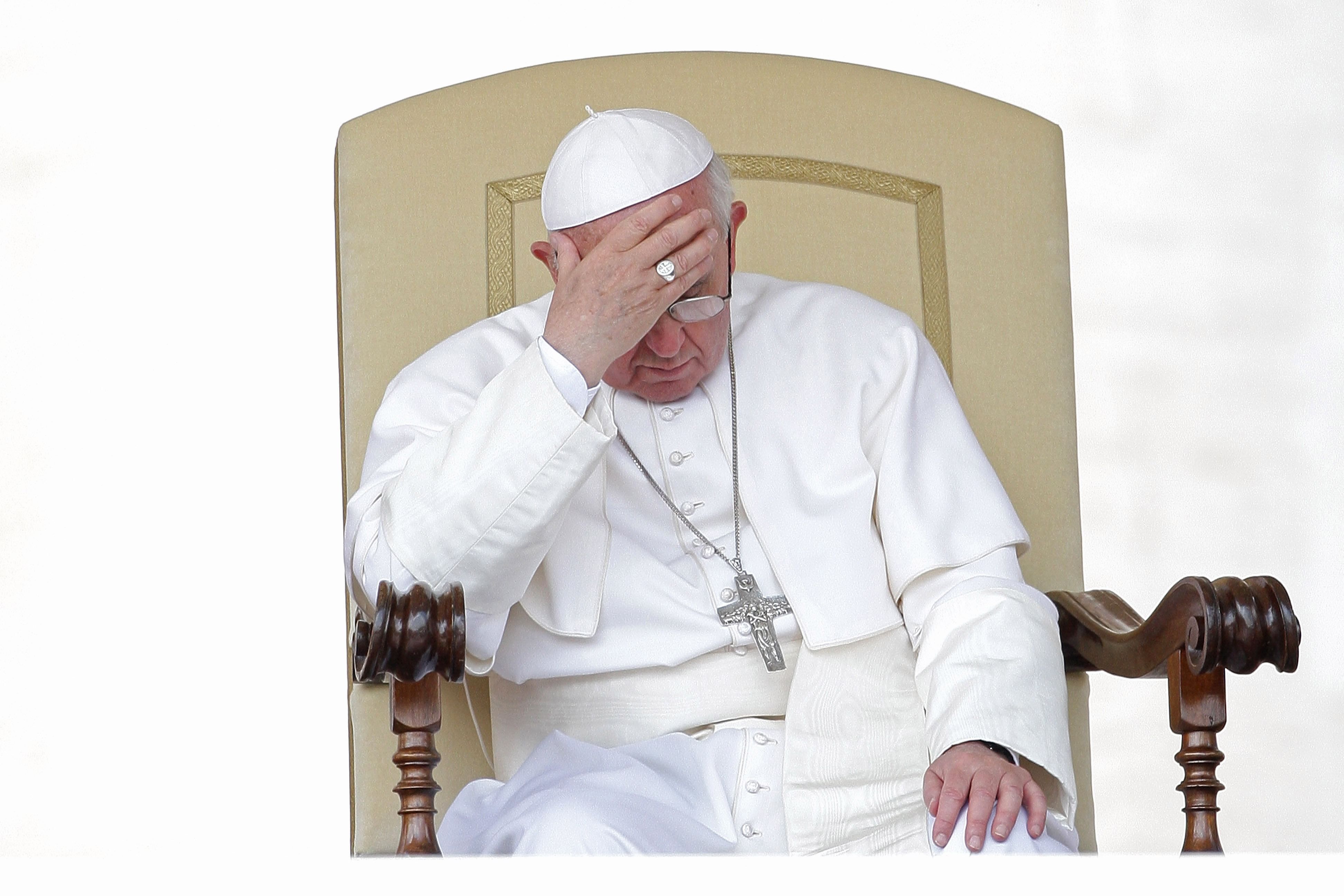
The Pope And Atheists, Ctd

Pope Francis Holds Weekly Audience - May 8, 2013

After the Pope’s words on atheists last week, the Vatican walks its Pontiff back:

Pope Francis has no intention of provoking a theological debate on the nature of salvation through his homily or scriptural reflection when he stated that “God has redeemed all of us, all of us, with the Blood of Christ: all of us, not just Catholics. Everyone!”  Consider these sections of the Compendium of the Catechism of the Catholic Church that offer the Church’s teaching on who will be “saved” and how. …

[A]ll salvation comes from Christ, the Head, through the Church which is his body. Hence they cannot be saved who, knowing the Church as founded by Christ and necessary for salvation, would refuse to enter her or remain in her. At the same time, thanks to Christ and to his Church, those who through no fault of their own do not know the Gospel of Christ and his Church but sincerely seek God and, moved by grace, try to do his will as it is known through the dictates of conscience can attain eternal salvation.

As a theological corrective to those suddenly claiming that atheists go to the Catholic concept of Heaven, this walk-back is right. But it misses, it seems to me, the spirit of Francis’ words – which would have not occurred to his rigid and anal-compulsive predecessor. Meeting atheists in the good work of helping and serving others is an indication of openness, of ecumenical commitment to the common good and (in my inference) a sprinkle of mystery about what all of our relationships with God may become in that undiscovered country from whose bourn no traveler returns. Erasmus at The Economist downplays the significance of the Pope’s statement:

In theological terms, neither the pope nor his spokesman said anything new. It’s a basic Christian teaching that the status of humanity as a whole was transformed when God took human form and neutralised the power of mortality by freely undergoing death. It’s also axiomatic that individual human beings are free to accept this divine gift or reject it. The Catholic church has never ceased to see itself as possessing the “fullness of the means of salvation” but especially since Vatican II, the reforming council of the 1960s, it has freely accepted the possibility that God can be at work in places outside the visible boundaries of Catholicism.

Amidst all the apparent contradiction and confusion, there is a basic problem that besets all communication between the religious and the secular worlds. Religious statements are rooted in a metaphysical system, an understanding of the universe, which is pretty foreign to the modern, liberal mind. In traditional Christian thought, the primordial (and for many modern minds, intensely controversial) assertion is the existence of a loving God, from whom humanity has been estranged. Within that system, self-exclusion from that loving God is self-evidently a “hellish” choice; that is almost a tautology, a statement of the obvious. Outside that metaphysical system, statements about exclusion from God’s love don’t make any sense at all, they sound like pious nonsense.

But at the same time, we are wrong to put human limits on the extent of our Creator’s love for us. We must be open to being surprised by the unconditionality of the love that Jesus introduced into human consciousness.

Erdogan’s Paternalism

https://twitter.com/agurcanozturk/status/341203823873896448
 
Louis Fishman paints a picture of the prime minister’s arrogance that would make even Mike Bloomberg blush:

From implementing policies encouraging women to have three children, to his goal to raise a ‘moral’ generation of youth that will sign up to his interpretation of what a good Muslim is, more and more Turks have become tired of a Prime Minister who promotes policies that interfere with their daily lives. Just before the protest began new laws were enacted aimed at curbing alcohol consumption in the public sphere. It should be clear it is not that so many Turks would be affected by the laws; even if drinking Raki (and beer to some extent) is considered by many as a Turkish pastime, actually a low percentage of them actually drink on a regular basis. Rather, it was in the very condescending way Erdogan related his disdain for those who do drink, inferring that they were all drunks.

Parallel to this, Erdogan’s personal dictation of the policies of urban renewal and of massive infrastructure projects have taken their toll on the Turkish population. It seems that no power is strong enough to stop a project that the Prime Minister supports; whether it is the third Bosphorus bridge, the new mega-airport, or the numerous dams that are flooding cities throughout the Anatolian heartland. In fact, it was due to this very reason that the Erdogan’s obsession to replicate an Ottoman armory, even stressing his wish that it be used as a shopping mall, irked so many, regardless of political affiliation or social background. As high rises replace shanty towns, and shopping malls blossom at the speed of flowers in the spring, the 606 trees at Taksim Park turned into a real issue for many.

Earlier Dish on the protests in Turkey this weekend here and here.

Dan, Me, Sex And Marriage

Last week, my old friend Dan Savage and I sat down for an extremely ill-advised public chat about, well, a lot of things. We were at the New York Public Library at a sold-out event, promoting Dan’s typically funny, moving, enraging, provoking, uplifting series of essays, now collected as American Savage. Here’s the full program. Enjoy:

This embed is invalid

Hope, Not Optimism

Nadia Bolz Weber sermonizes on the distinction:

The Easter hope we have, brothers and sisters, the hope that never disappoints has nothing to do with optimism or the avoidance of suffering, is a hope that can only come from a God who has experienced birth, and love and friendship and lepers and prostitutes and betrayal and suffering and death and burial and a decent into hell itself. Only a God who has born suffering himself can bring us any real hope of resurrection. And if ever given the choice of optimism or resurrection I’d go with resurrection any day of the week.  This is the God of whom Paul speaks.  And the Christian faith is one that does not pretend things aren’t bad. This is a faith that does not offer platitudes to those who lost children this week to suicide or a tornado. This is not a faith that produces optimism it is a faith that produces a defiant hope that God is still writing the story and that despite darkness a light shines and that God can redeem our crap and the beauty matters and that despite every disappointing thing we have ever done or that we have ever endured, that there is no hell from which resurrection is impossible. The Christian faith is one that kicks at the darkness until it bleeds daylight.

A Poem For Sunday

Dew_drops_on_spider_web

“Sonnet 71” by Edmund Spenser (1552-1599):

I joy to see how in your drawen work,
Your selfe unto the Bee ye doe compare;
and me unto the Spyder that doth lurke,
in close awayt to catch her unaware.
Right so your selfe were caught in cunning snare
of a deare foe, and thralled to his love:
in whose streight hands ye now captived are
so firmely, that ye never may remove.
But as your worke is woven all above,
with woodbynd flowers and fragrant Eglantine:
so sweet your prison you in time shall prove,
with many deare delights bedecked fyne.
And all thensforth eternall peace shall see,
between the Spyder and the gentle Bee.

(From Amoretti, published in London in 1595 by William Ponsonby. Photo via Wikimedia Commons)

Quote For The Day

“Looking at Western societies I think that if we have religion, we shall have to have religion without God, because belief in a personal God is becoming increasingly impossible for many people. It’s a difficult question actually to know what believing in a personal God is. I know that I don’t believe in one. I don’t want to use the word god in any other sense. I think it’s a proper name. I don’t believe in the divinity of Christ. I don’t believe in life after death. My beliefs really are Buddhist in style. I’ve been very attached to Buddhism. Buddhism makes it plain that you can have religion without God, that religion is in fact better off without God. It has to do with now, with every moment of one’s life, how one thinks, what one is and does, about love and compassion and the overcoming of self, the difference between illusion and reality,” – Iris Murdoch

Home And Our Restless Hearts

In his Jefferson lecture last year, Wendell Berry parsed the distinction between “boomers” and “stickers”:

My teacher, Wallace Stegner…thought rightly that we Americans, by inclination at least, have been divided into two kinds: “boomers” and “stickers.” Boomers, he said, are “those who pillage and run,” who want “to make a killing and end up on Easy Street,” whereas stickers are “those who settle, and love the life they have made and the place they have made it in.” “Boomer” names a kind of person and a kind of ambition that is the major theme, so far, of the history of the European races in our country. “Sticker” names a kind of person and also a desire that is, so far, a minor theme of that history, but a theme persistent enough to remain significant and to offer, still, a significant hope.

Alan Jacobs questions Berry’s categories:

[W]hy does he insist on the validity of this binary code? It’s useless — it’s worse than useless, it’s simplistic and uncharitable. There are many reasons why people stay home, and many why they leave; and probably no single person is driven by one reason only. “There’s no such thing as an unmixed motive,” as Rebecca West is said to have commented.

Jeffrey Bilbro thinks Jacobs misunderstands Berry:

In an earlier essay, “The Conservation of Nature and the Preservation of Humanity,” Berry is more careful to define the terms “boomer” and “sticker” as conflicting internal desires.  He warns against seeing these as categories of people, arguing instead that they differentiate between parts of individuals.

As Berry writes, “All of us, I think, are in some manner torn between caring and not caring, staying and going.”   The choice to root ourselves in place is not a clear-cut, one-time choice.  Rather, it is a long process of refining and ordering our affections, of choosing to submit to the limits of our place rather than to fulfill our individual desires.

The larger problem underlying this sort of misreading of place in Berry’s work stems from a lack of engagement with his fiction.  As Jake Meador observes, Berry’s essays are incomplete without his fiction: “If the only thing you read is The Unsettling of America Berry may well come off as an angry white environmentalist with a shocking streak of naiveté. But if you read Jayber CrowA Place on Earth, or Fidelity, you begin to become acquainted with the entire world associated with the place of Port William and you begin to understand that the place is more than just a physical place, but an entire world and culture marked by certain long-held-and-now-forgotten beliefs.”  I know for myself that if I had not first read Berry’s fiction, his essays would have seemed incorrigibly grumpy; they are occasional, contrarian, prophetic, and provocative and aren’t meant to offer his full vision.

Confronting Death In The Midst Of Life

crossworship

Amidst the unbearable lightness of prosperity gospel mega-churches and a religious culture obsessed with entertainment, Carl R. Trueman meditates on the centrality of tragedy to authentic Christian worship:

The Church knows how far humanity has fallen, understands the cost of that fall in both the incarnate death of Christ and the inevitable death of every single believer. In the psalms of lament, the Church has a poetic language for giving expression to the deepest longings of a humanity looking to find rest not in this world but the next. In the great liturgies of the Church, death casts a long, creative, cathartic shadow. Our worship should reflect the realities of a life that must face death before experiencing resurrection.

It is therefore an irony of the most perverse kind that churches have become places where Pascalian distraction and a notion of entertainment that eschews the tragic seem to dominate just as comprehensively as they do in the wider world. I am sure that the separation of church buildings from graveyards was not the intentional start of this process, but it certainly helped to lessen the presence of death. The present generation does not have the inconvenience of passing by the graves of loved ones as it gathers for worship. Nowadays, death has all but vanished from the inside of churches as well.

(Photo by Flickr user Forsaken Fotos)