“Bearing The Beams Of Love”

In an interview, the poet and memoirist Mary Karr reflects on how she got sober:

The really horrible thing about quitting drinking is, I think, inside my mind I was so divided against myself. Nobody really talks about what happens to you and your level of self-confidence when you tell yourself every fucking day you’re going to drink X, and then you drink 10 times that—or you’re not going to drink at all and you drink anyway. You become very split off against yourself. So there was a part of me that would yell and scream and say, “You stupid bitch, goddamnit, you said you weren’t gonna drink and you drank anyway.” And there was this other part that was like “Fuck those people! Fuck the rules!” you know, blah blah blah…

You assume that when you quit drinking, you’re surrendering to that kind of nasty schoolmarm rule-maker. But for me getting sober has been freedom—freedom from anxiety and freedom from…my head. What has kept me sober is not that strict rule-following schoolmarm. There’s more of a loving presence that you become aware of that is I think everyone’s real, actual self—who we really are.

Blake said, “…we are put on Earth a little space / That we might learn to bear the beams of love.” And I think, quote-unquote, “bearing the beams of love” is where the freedom is, actually. Every drunk is an outlaw, and certainly every artist is. Making amends, to me, is again about freedom. I do that to be free of the past, to not be haunted. That schoolmarm part of me—that hypercritical finger-wagging part of myself that I thought was gonna keep me sober—that was is actually what helped me stay drunk. What keeps you sober is love and connection to something bigger than yourself.

(Hat tip: Maria Popova)

Bonding Sessions

A new study from the Netherlands suggests that being into BDSM can be beneficial to mental health:

“Our findings suggests that BDSM participants as a group are, compared with non-BDSM participants, less neurotic, more extraverted, more open to new experiences, more conscientious, yet less agreeable,” the researchers write. They add that females in the BDSM group had “more confidence in their relationships” and “a lower need for approval” than those in the mainstream sample.

Why might this be? [psychologist Andreas] Wismeijer notes that “BDSM play requires the explicit consent of the players regarding the type of actions to be performed, their duration and intensity, and therefore involves careful scrutiny and communication of one’s own sexual desires and needs.” In other words, it requires thought, awareness, and communication—all of which lead to happier relationships, both in and outside of the bedroom.

Thou Shalt Not Slut-Shame

Abigail Rine profiles evangelicals questioning their faith’s single-minded emphasis on remaining a virgin before marriage:

The central thrust of these evangelical critiques is a rejection of the “damaged goods” metaphor. On her high-profile website, New York Times bestselling author Rachel Held Evans calls out the “horrific object lessons”…which aim to convince young people that “premarital sex ruins a person for good.” Sarah Bessey, author of the forthcoming book Jesus Feminist, shares her own story of feeling condemned by the “true love waits” rhetoric of her church, which conveyed the message that she, as a non-virgin, was now “disqualified from true love.”

Prodigal Magazine, an up-and-coming online publication that caters to twenty-something evangelicals, recently featured a candid piece on abandoning the concept of virginity. While deliberately keeping her own sexual history private, Emily Maynard, the author of the article, proclaims that she is no longer going to think of herself as a virgin or a non-virgin. “I’m done splitting my sexuality into pieces,” Maynard writes, “I’m done with conversations about ‘technical virginity’ and couples who ‘win the race to the altar.’… I’m done with Christians enforcing oppression in the name of purity.

PTSD And Violence Against Women

We often see them as separate issues, especially with the PTSD and suicide epidemic among soldiers returning from war and the horrible, systematic crisis of sexual assault against women in the military. And most often they are. But they can be connected. And sometimes they should be. Patrick Stewart gives a truly moving and beautiful account of domestic violence against his own mother in his own childhood. But what I admired most about his impromptu speech was his insistence that ending domestic violence against women is above all the work of men. Men alone can end this – and must.

A Poem For Saturday

Edmund_Spenser_oil_painting

The poet Edmund Spenser (1522-1599) was one of the greatest of Renaissance sonneteers. The Dish will be running three from his cycle Amoretti, first published in 1595, describing his courtship of and devotion to the woman he married, Elizabeth Boyle, who was of Anglo-Irish descent. First up is “Sonnet 70”:

Fresh spring the herald of loves mighty king,
In whose cote armour richly are displayd
all sorts of flowers the which on earth do spring
in goodly colours gloriously arrayd.
Goe to my love, where she is careless layd,
yet in her winters bowre not well awake:
tell her the joyous time wil not be staid
unlesse she doe him by the forelock take.
Bid her therefore her selfe soone ready make,
to wayt on love amongst his lovely crew:
where every one that misseth then her make,
shall be by him amearst with penance dew.
Make hast therefore sweet love, whilest it is prime,
for none can call againe the passed time.

Heads up, Renaissance fans: the New York Botanical Garden‘s summer exhibition is Wild Medicine, Healing Plants Around the World, featuring a stunning re-creation of an Italian Renaissance Garden. Renaissance poems will appear on placards on the garden grounds, including two by Edmund Spenser, and there will be three afternoons of Renaissance music and poetry on June 22, July 27, and September 7.  More details here.

(From Amoretti, published in London in 1595 by William Ponsonby. Portrait of Spenser via Wikimedia Commons)

Seeing Stravinsky

Composer and software engineer Stephen Malinowski made a stunning visualization of Stravinsky’s The Rite of Spring, a ballet that premiered 100 years ago this week:

In an interview, Malinowski describes his inspiration:

From your vantage point, what’s the benefit of visualizing scores?

People usually respond to sound in a unitary way. It’s the reason why you can’t follow more than one conversation at a time at a party, for example. But with vision, your brain is trained to comprehend multiple things at once: you can take in many more elements simultaneously. In music, there’s often much more going on than you can grasp in that moment of hearing. When you have a visualization, your eyes lead your ears through the music. You take advantage of your brain’s ability to process multiple pieces of visual information simultaneously. … When that information is presented as graphs, it’s very easy to understand.

Malinowski created similar visual scores for pieces by Debussy and Beethoven.

Criticizing The Critics

Evan Kindley, an editor at the Los Angeles Review of Books, recently revealed a policy regarding first-time authors: either review the book positively, or not at all. “I just think it’s ethical to give writers a grace period,” he tweeted.  Scott Esposito wants clarification:

Where is the line between “constructive critique” and “reviewing positively”? Surely most first-time writers would benefit from honest feedback from competent critics. If the critic ultimately sees the book as a failure, then the constructive critique would not be run?

D.G. Myers dislikes the policy:

If the only values assigned to first books are going to be positive values, they will quickly become debased. Orwell understood the danger clearly:

For if one says—and nearly every reviewer says this kind of thing at least once a week—that King Lear is a good play and The Four Just Men is a good thriller, what meaning is there in the word “good”?

If all first books are good in some fashion or other, what is the point of calling any of them good? No discrimination is involved, only a priori institutional policy. To lay down special rules for first books may seem to relieve the anxiety of criticism, but the problem of individual judgment is not solved; it is merely eliminated from critical practice. The consequences are not pretty.

“Is Writing A Means Of Survival?”

The Paris Review posts a long excerpt of an interview with Imre Kertész, who won the 2002 Nobel Prize in Literature. How Kertész responds to the above question:

I was able use my own life to study how somebody can survive this particularly cruel brand of totalitarianism [the Holocaust]. I didn’t want to commit suicide, but then I didn’t want to become a writer either—at least not images-2initially. I rejected that idea for a long time, but then I realized that I would have to write, write about the astonishment and the dismay of the witness—Is that what you are going to do to us? How could we survive something like this, and understand it, too?Look, I don’t want to deny that I was a prisoner at Auschwitz and that I now have a Nobel Prize. What should I make of that? And what should I make of the fact that I survived, and continue to survive? At least I feel that I experienced something extraordinary, because not only did I live through those horrors, but I also managed to describe them, in a way that is bearable, acceptable, and nonetheless part of this radical tradition. Those of us who were brave enough to stare down this abyss—Borowski, Shalamov, Améry—well, there aren’t too many of us. For these writers, writing was always a prelude to suicide. Jean Améry’s gun was always present, in both his articles and his life, always by his side.

I am somebody who survived all of it, somebody who saw the Gorgon’s head and still retained enough strength to finish a work that reaches out to people in a language that is humane. The purpose of literature is for people to become educated, to be entertained, so we can’t ask them to deal with such gruesome visions. I created a work representing the Holocaust as such, but without this being an ugly literature of horrors.

Perhaps I’m being impertinent, but I feel that my work has a rare quality—I tried to depict the human face of this history, I wanted to write a book that people would actually want to read.

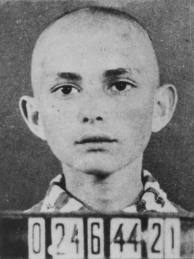
(Photo of Kertész as an adolescent, taken from the website of the play adapted from his novel “Kaddish for an Unborn Child”)

Face Of The Day

dish_crumpledpaper_ii

Carolyn Rauch explains the piece:

For his series Crumpled Paper, Brooklyn-based photographer Ofer Wolberger took images from the pages of fashion magazines. He folded, crumpled, taped and lit them from behind, allowing the photographs to morph both sides of the page. The project was used to re-conceive and re-explore the idealized images of beauty found in women’s magazines. In some cases, the models’ faces become distorted and even grotesque, causing us to consider a different perspective on beauty.

(Photo: Crumpled Paper II, Ofer Wolberger)