Can Egypt’s Economy Be Saved?

Caroline Freund encourages Egypt to institute economic reforms:

The right approach to Egypt’s economic problems would be to force it to bite the economic reform bullet now by ending wasteful expenditures, especially fuel subsidies. These cost almost half of government revenue at a time when Egypt’s budget deficit is more than 10 percent of gross domestic product and growing, and they encourage energy consumption, especially among wealthier Egyptians, while doing little to help the most vulnerable. Smart budget rebalancing would cut the subsidies, add more to the social safety net for the poor, and reduce the fiscal deficit.

Egyptians Protest The US Ambassador

https://twitter.com/ghazalairshad/status/350670119686520834

Fisher notices that “Egyptians demonstrating Sunday against President Mohamed Morsi’s first year in office waved signs singling out U.S. Ambassador Anne Patterson, telling her to “get out” and accusing her of clandestinely aiding Morsi’s Islamist government”:

[T]he criticism seems most rooted in a perception that Patterson, and thus the United States, are helping to prop up Morsi even at the expense of Egyptian democracy. Partly this is rooted in recent history: the U.S. worked closely with Mubarak’s government for years, at times pressing him for reform but more often looking the other way. But it also appears to comes from a misunderstanding of Patterson’s role in Egypt. When she refuses to more roundly criticize Morsi in public comments, that’s perceived as backing him. But the United States has ongoing business with Egypt, after all, and letting relations sour might satisfy protesters’ desires to punish Morsi, but would be unlikely to help.

Egypt’s Second Revolution: Tweet Reax

The Independent Dish: Six Months In

We promised to keep you up to date with the new independent Dish’s progress – and six months seems like a good time to summarize. The current number of subscribers to the Dish now stands at 27,349. I don’t think there’s a purely online site (that isn’t money or porn) that has that kind of subscriber base. That’s your achievement.

More to the point, the number of readers who have used up their five read-ons now stands at 28,000. If you’ve clicked five times on the read-ons, you’re one of them, you really are a dedicated reader, and we’d love you [tinypass_offer text=”to sign up”]. If you did, our subscription tally would double overnight – and we’d be set. So if you still think a reader-supported, ad-free site, free from corporate control is worth supporting, please [tinypass_offer text=”subscribe”]. It won’t just help us, it will, we hope, help generate a new model for good online journalism answerable only to its readership – an almost unique oasis on the web right now.

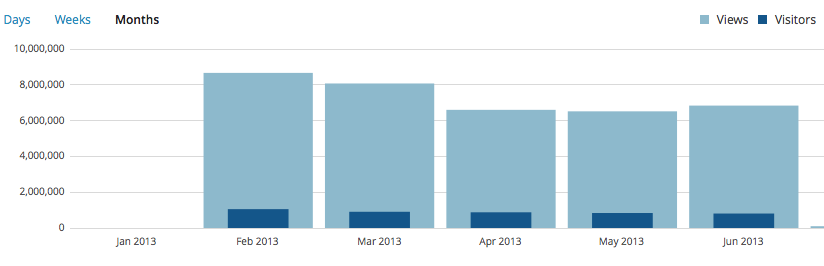
Our traffic, like many other sites, dipped a little this spring, but has stabilized and even up-ticked a little lately:

Screen Shot 2013-07-01 at 12.40.39 PM

Revenue is now at a gross $715,000 – with our stated goal remaining $900,000 for the entire year. It may seem like we’re well on our way, and we are, with 80 percent of our stated annual goal achieved in only six months. The caveat – and it’s a big one – is that the vast majority of our income came in the very first few days of the launch, and, because we didn’t even have our own site then, none of that was auto-renewable:

Screen Shot 2013-07-01 at 12.47.55 PM

From March onward, everyone is on auto-renewal, which gives us much more stability. But we won’t really know how sustainable we are until we see if we can get all our most devoted Dishheads to give the same amount next February when their subs come due. I’m pretty confident we can – but enough of a worry-wart not to declare success until then. Nonetheless, the good news is that when you look at the revenue after that first money-bomb, it has stabilized since April and shows little sign of declining. Last week was our best since April, for example. The weekly revenue from March 1 to July 1 per week is as follows:

Screen Shot 2013-07-01 at 12.50.00 PM

Here’s the conversion rate – i.e. the percentage of readers who hit the pay-meter and actually pay:

Screen Shot 2013-07-01 at 1.03.55 PM

We’re doing slightly better than the industry average (2.5 percent vs. 2 percent), even after the bulk of our most dedicated readers subscribed in January. Two things have helped – our [tinypass_offer text=”$1.99 a month offer”] and the gift subscriptions. If we sustain this trend, we should have gross revenue of around $815,000 by the end of the year, which is damn close to our entire budget in our last year at the Beast. Only this time, our budget will actually be paid for in full by readers.

I’d like to thank all of you who have made this possible from the depths of my heart, and invite all of you who have enjoyed the Dish but not yet signed up to get all of it, to [tinypass_offer text=”become a subscriber”]. It’s only [tinypass_offer text=”$1.99 a month”] or [tinypass_offer text=”$19.99 a year.”] Or if you’re already a subscriber and want to help us some more, give the gift of the Dish to a friend for a year and see how she or he likes it.

We’re really trying to forge a new path here for online media. [tinypass_offer text=”Help us get there.”] Update from a reader:

For what it’s worth, I thought I’d mention that I’m one of those people who has read your blog for years and just reached my click-through limit in the new subscriber format. So I subscribed. But I did it today because of the six-month report you just posted. Absent that, I probably would have kept perusing without clicking through for who knows how many more months. I admire your transparency about this new thing you all are doing.

Another:

Great idea in today’s blog: giving someone a subscription as gift. I just bought my 23-year-old daughter, a political junkie like her mom, a year’s subscription. You should post the suggestion more often.

Another:

Although a loyal reader for years, I resisted subscribing because I don’t like being hustled, even for the cause, and your meter, to me, seemed somehow unworthy of the enterprise. Sort of like seeing under the bearded lady’s mask. However, anyone who can reference Kenneth Burke and Bobby Bland, two of my all-time picks for “which three people would you like to have dinner with?” (the third being Fritz Perls or JS Bach, alternately.) I admit I am beaten and shall resist no more. I subscribed today.

Another:

After telling me about your blog for years, a good friend borrowed my laptop and “somehow” left my browser open to your site. I’ve been poking around ever since. I finally subscribed today because I can now actually afford to do so. Thanks for the various subscription paths, for the transparency of the journey, for the ethics of your workplace, and for the talents of those you’ve hired.

PS. Two words of constructive criticism: More cowbell.

Done. Another:

Reminding people to buy really does work – I just did it! I’m on my married partner John’s computer and subscribed under my own e-mail address. We got married in Provincetown three years ago, so we’re happy that California now joins the club (we live in Laurel Canyon). Thanks for all your hard work on marriage equality. What a long journey we have all been on.

Egypt’s Second Revolution, Ctd

Shadi Hamid notes that there “is no legal or constitutional mechanism through which Morsi, who was elected with 51.7 percent of the vote just a year ago, can be ousted”:

Opting for a revolutionary course this late in the game — after more than two years of transition and five elections — means starting from scratch with little guarantee that the second time will be much better. At some point, the past cannot be undone, except perhaps through mass violence on an unprecedented scale. If the first elected Islamist president is toppled, then what will keep others from trying to topple a future liberal president? If one looks at Tamarod’s justifications for seeking Morsi’s overthrow, the entire list consists of problems that will almost certainly plague his successor. They have little to do with a flawed transition process and a rushed constitution that ran roughshod over opposition objections and everything to do with performance (“Morsi was a total failure in achieving every single goal, no security has been reestablished and no social security realized, [giving] clear proof that he is not fit for the governance of such a country as Egypt,” reads the Tamarod statement of principles). Legitimacy cannot depend solely or even primarily on effectiveness or competence. If it did, revolution could be justified anywhere at any time, including in at least several European democracies.

Umar Farooq talks with Morsi supporters, who make related points:

“The constitution says the President stays for 4 years,” said Akram Elkot, a 27-year-old physician and a Morsi supporter from Alexandria. “If you don’t agree with the president, then wait for new elections.”

J.J. Gould describes the reaction of Mona Eltahawy, an Egyptian-American democracy activist:

“I actually think it’s the best thing possible that the Muslim Brotherhood are now in government in Egypt,” Eltahawy said, “because they’ve embarrassed themselves for the terrible job of governing that they’ve done in a way that none of us could have done; they’ve done us a huge favor.” The Muslim Brotherhood has, in other words, accelerated both its political implosion and the comprehensive discrediting of its political ideology — at the cost to the Egyptian people of having had to endure a year of super-dreadful governance

And Avi Issacharoff points out that new elections might not bring change:

[I]t is worth remembering that at the moment it is easy for the opposition to arrange itself around the idea of bringing down Morsi. In the unlikely event of the president deciding to resign in the near future, then the old divisions between opposition factions would reappear. There is even a chance that should presidential elections be brought forward, a Muslim Brotherhood candidate would win yet again.

What If Alec Baldwin Had Tweeted This?

A reader uses the anti-Semitism angle:

George Stark, you lying little kike. I am gonna fuck you up … I want all of my followers and beyond to straighten out this fucking little jewboy, George Stark… I’m gonna find you, George Stark, you toxic little hebe, and I’m gonna fuck … you … up.

Would Hilary Rosen be fine with that? So why is she fine with homophobia and not anti-Semitism? Remember the bad joke Tracy Morgan made? The apologies were many – including a condemnation from Tina Fey. But Morgan’s horrible joke was a hypothetical. Baldwin was actually threatening to beat up an actual gay man, and urged thousands of others to track him down and beat him. What we are witnessing is Hollywood’s real loyalty: to its self-righteous, preening own.

Egypt’s Second Revolution

EGYPT-POLITICS-UNREST

Protests are still simmering and five ministers have resigned from Morsi’s cabinet. This morning, the Egyptian military offered (NYT) Morsi a 48-hour ultimatum to effectively respond to the demonstrations, turning this into a military coup in the eyes of some:

In a statement read on state television, General Abdel Fattah al-Sisi, the head of the Egyptian military, said the mass demonstrations that intensified over the weekend, including the storming of the Muslim Brotherhood headquarters in Cairo early Monday, reflected an “unprecedented” expression of popular anger at Mr. Morsi and his Islamist backers in the brotherhood during his first year in power.

It was unclear from the general’s statement whether the military was specifically demanding that Mr. Morsi resign. But the statement said that if Mr. Morsi did not take steps to address demands for a more inclusive government, the armed forces would move to impose their “own road map for the future.”

Reuters reports seven dead and over 600 wounded so far. Issandr El Amrani explains how Morsi became so hated over the past year:

[H]is November 27, 2012, constitutional declaration was probably illegal and ended any benefit of the doubt the opposition was ready to give to him. The rushing of the constitution was likewise a slap in the face that created the opportunity of the current moment, with revolutionaries, liberals and old regime members temporarily collaborating against what they perceive as the greater evil of the Muslim Brotherhood. And he has made at least one disastrous decision, in the context of last December’s crisis, that has significantly worsened the economic outlook of the country by postponing reforms that had been planned as part of the IMF rescue package. I do not think it is fair, however, to blame Morsi for the more general economic situation (he inherited massive debt, an electricity crisis, a subsidies crisis, etc.) but it is true that save from raising loans from Qatar and elsewhere he has done little to stem it — and indeed his profligate spending on civil service salaries has worsened things to some extent.

Juan Cole emphasizes that much “of the protest is economic”:

Morsi’s government has pursued austerity policies and it has failed to revive tourism or attract substantial productive investment. Egypt’s foreign currency reserves have been cut in half, causing the Egyptian pound to fall in value, and hurting Egyptians, who depend on imported food and fuel. The textile workers of al-Mahalla al-Kubra, whose 2006-2008 strikes were a rallying cry for anti-Mubarak activists, have warned that under Morsi their factories are threatened with closure altogether. Although some of the animus against Morsi comes from liberals and secularists annoyed by his religious fundamentalism, many of the protesters on Sunday were devout Muslims who just object to Morsi’s high-handed style of governing, failed economic policies, and favoritism toward his Muslim Brotherhood base. One banner in Tahrir said, ‘we are for Islam, against the Muslim Brotherhood.’

Laura Dean reports from Cairo:

I spoke with Amani Sayed, 43, who wore a full face veil, about why she had decided to come out. Holding a piece of cardboard over her head to shield herself from the sun, she told me she had been in the square since ten thirty in the morning. This at around five in the afternoon. When asked why she was there, she was adamant: “He has divided us.”

“Christians from Muslims!” her friend interjected.

“And Muslims from Muslims,” said Amani. “We are munaqabat [wear face veils], muhagabat [wear hijabs], unveiled. Egyptians are liberals, secular, conservative. We’re all Egyptian.”

And Jonathan Guyer provides a slideshow of political cartoons skewering Morsi:

Morsi is drawn as a cowboy, as Godzilla attacking Cairo’s skyline, and, of course, as a pharaoh. He is a cleric in Muslim Brotherhood regalia. He sends a Tweet from his cell phone to the Egyptian people, as he sits on the toilet, pants dropped. He orders carryout: “I’d like the revolutionary platter…and hold the opposition.”

(Photo: Egyptians hold a plaque of the Muslim Brotherhood emblem which was removed from the party’s burnt headquarters in the Moqattam district of Cairo on July 1, 2013 after it was set ablaze by opposition demonstrators overnight. By Khaled Desouki/AFP/Getty Images)

Clinton And Forgiveness

I post the above video to point out that there were many at the time who opposed DOMA for the right reasons, including civil rights icons like John Lewis. Not Bill Clinton. A reader writes:

“When [Bill Clinton] actually apologizes, I’ll leave this behind. But you cannot forgive someone who refuses to admit they did something wrong,” – Andrew Sullivan.

“Father, forgive them, for they know not what they do,” – Jesus.

So to your retort that Clinton knew what he was doing, reread Jesus’s words, spoken from the cross. Looks like he forgave people who did not admit they were doing something wrong.

Forgive, Andrew. Forgive. Either that or stop talking about faith, grace, mercy, the whole shooting match. Because it seems, in this instance, you don’t get it.

The trouble here is the distinction between public officials and their public acts and private human beings in your actual life who fail or stumble or hurt you. I truly do try and forgive those who have done me wrong (it isn’t always easy) in the warp and woof of living. But in assessing public affairs – like, say president Bush authorizing torture or backing the Federal Marriage Amendment – it seems to me to be a different case. As a public writer, it is my job to criticize, to judge when someone’s public statements in public office are defensible or wrong. I play a role as a blogger which requires me to be much tougher and harsher than in real life – when I am dealing with public figures, public statements and public records. I have met Bill Clinton only once. I am dealing with the public, not the private, man.

And when a public official like Clinton did so much damage to gay lives, inflicted so much pain (he didn’t just sign DOMA but the HIV travel ban and DADT), and when he then portrays himself as a civil rights activist and gets applause from pathetic liberal gay groups (GLAAD, HRC, et al.), I figure if I don’t point out what a glaring bullshitter he is, who will? I wouldn’t care much if he weren’t still machinating his way back to power, and using the gay community as part of his and his wife’s second run at the presidency. But he is.

As for the Gospel reference, I am, of course, in awe of the power of Christ’s forgiveness even on the cross. But his workaday executioners did not know they were killing the son of man. Clinton knew full well that he was using the gay issue as a wedge to win him back the then-center and right, as he angled for re-election. Dick Morris himself explained it all to me subsequently and actually personally apologized.

And yet Clinton cannot even publicly apologize – for the same reason Alec Baldwin cannot: narcissism and sociopathy.

In 1996, Clinton instructed his own Justice Department to state that DOMA was entirely constitutional on the very day of the DOMA hearings, in which I testified. Do I not have a right to point out that his current position is, er, at odds with that – and that a little attempt to acknowledge his own (and HRC’s) role in making DOMA happen as quickly as possible would make him far more credible? In fact, make him credible, period? He could have refused to sign the law and let it pass without him. He didn’t. He signed it because he thought it would get him votes. That’s who Bill Clinton is. Another reader:

If I didn’t forgive the people in my life (public and private) who refused to admit they did something wrong, I’d go insane with the rage.  I think you’re confusing forgiving and forgetting, and I think it’s a very important distinction.

I hope you don’t forget what Clinton did and didn’t do – I hope millions of people don’t forget – but if we don’t forgive, we’re only contributing to our own pain and anguish and feeding our anger, and that takes precious time and energy away from doing what needs to be done to fix the wrongs.  Sometimes it’s incredibly difficult to be truly Christian, but here’s a great opportunity for all of us – forgive but don’t forget, and keep fighting state by state until it’s done.

I live in Chapel Hill, NC – a lovely liberal, gay-loving bastion in a very red state that passed a constitutional amendment banning gay marriage – so I have to walk the “forgive but don’t forget” talk myself.

Another quotes the Buddhist monk Thanissaro Bhikkhu:

Forgiveness and reconciliation are two different things.  Forgiveness is finding a way to be non-reactive and unperturbed by what has happened to you. Reconciliation means a return to amicability, and that requires the reestablishing of trust.

Forgiveness has nothing to do with what the other person does or doesn’t do. It’s all about understanding how holding on to anger hurts you.  I can understand why an apology would be necessary for you to reconcile with Clinton.  However, forgiveness is about you recognizing that holding onto your anger and hurt in this area only causes further suffering for you.  It’s like carrying around a hot coal – once you realize that you’re only harming yourself, you can drop it.  I found this description helpful in understanding the difference between forgiveness and reconciliation.

Sounds like there’s still some lingering anger and/or hurt inside about this. Not always an easy step to take, but if you’re able to forgive, you will ultimately benefit.

Ask Dan Savage Anything: The Risks Of Being Monogamish

Dan gets into the benefits and risks of one being in a somewhat open relationship:

Last year, Dan ran a bunch of emails from his readers discussing their successful monogamishness, as well as another series from readers heralding their monogamy, which the Dish featured here. Dan’s new book, American Savage: Insights, Slights, and Fights on Faith, Sex, Love, and Politicscame out a few weeks ago. My recent conversation with him at the New York Public Library is here. Dan’s previous answers are here. Our full Ask Anything archive is here.

This Is Your Brain On Pop Neuroscience

Robert Long summarizes problems with the burgeoning field:

[T]he uses and abuses of neuroscience are more illustrative as a story of our tendency to get ahead of ourselves. Our perennial thirst for elegant mechanisms and overarching narratives, noble in its own right, can lead us to take lazy shortcuts and place our hope in the Next Big Explanation, whether phrenology, Freud, or Freakonomics. Culture, history, and politics are complicated, confusing, and mostly boring. With the recent successes of neuroscience, it’s easy to wish that the chatter of narratives, prejudices, habits, and emotion could be replaced with the clinical pings of the fMRI machine.

Without religion or a shared culture, science has assumed a role it is not qualified to play: a judgment of the whole, not just of its relevant area of inquiry. Don’t get me wrong: science is a vital mode of human thought; it is also just part of it. History, aesthetics, prudence, morals, virtues: these it cannot understand; and when it tries to explain them, it is not wrong, so to speak. It’s just irrelevant.

Recent Dish on the neuroscience debate here and here.