A Poem For Saturday

http://youtu.be/GUcXI2BIUOQ

Monica A. Hand’s “dear Nina”:

I want vengeance
an eye for an eye
a dish served cold
two wrongs
a tale of two cities
contrapasso
ill will
a settling

not with a grain of salt
with a heavy hand

a slow burn
boiling point
a huff and a puff
blow the mother-fucking house down

no cage forestalls
no age forgets
no gene forgives
I cane those who give me
this fury

a hundred lashes
acrimony and dander
needle and tizzy
umbrage
ruckus

(From me and Nina. Copyright © 2012 by Monica C.Hand. Used by kind permission of Alice James Books. Video: Nina Simone sings “Ain’t Got No/I Got Life”:)

What Poetry Can Learn From Pop Music, Ctd

Continuing her arguments about bringing poetry to the public, Tasha Golden takes on the myth that “wanting readers isn’t a noble enough desire for ‘real’ poets—that we should instead write strictly ‘because we must,’ or because ‘the muse has us'”:

[A]s George Orwell has famously illustrated, there are (valid!) motivations for writing that actually require a readership. And if our work is driven to any degree by its potential human impact, as Orwell’s was, it’s irresponsible to eschew the work of reaching out. This was what I wanted us to translate from pop music: Its gritty determination. Its insistence on being heard. Its put-our-stuff-where-folks-will-find-it creativity. Its refusal of insularity.

It’s time for writers to stop feeling shallow or guilty for wanting what only makes sense: to be read. It’s time we stop policing each other’s motives and frowning on self-promotion, and instead empower each other to explore where our poetry can go. Why? Because if readers are required to want and seek poetry in order to find it, we’ll never get beyond each other. If the wider world’s not reading poetry, it’s at least in part because it rarely encounters it. That’s what we can change.

Cool Ad Watch

A big step toward normalizing pot as a positive good:

Fans attending a major NASCAR race this weekend will see a most unlikely video posted on a giant video screen shortly before entering the track: a pro-marijuana legalization ad. Outside the NASCAR Brickyard 400 in Indianapolis, the same track that hosts the famed Indianapolis 500, Marijuana Policy Project, the nation’s largest pro-marijuana legalization advocacy group, has purchased space to air – dozens of times over the weekend – a video that pushes the theme that marijuana is less harmful than alcohol.

It marks the first time a pro-marijuana legalization ad will appear so close to an entrance gate of a major sporting event. The Brickyard 400, in its 20th year, is regarded as one of NASCAR’s biggest races.

Update from a reader:

After the ad ran for several hours on Friday, it was pulled. A spokesman for the company that pulled that ad issued this statement:

“We in no way support marijuana at family events,” the spokesman said. “We didn’t expect this ad to be interpreted the way it did. We don’t want anything to do with it anymore.”

So, a major event with huge alcohol sponsors (Crown Royal & Miller Lite, anyone?), and a sport with a huge culture of alcohol consumption “doesn’t want anything to do” with marijuana. Not even a simple ad that isn’t promoting “marijuana at family events” but simply promoting the idea of an alcohol alternative in general. Wow.

I live in Colorado, so I can see first-hand that the tide is starting to turn, but decades of culture war are going to be tough to crack in some places.

A Literary Living Room

Martin Amis makes an analogy to describe two kinds of authors:

A great part of writing is hoping to make things as nice as possible for the reader — be a good host, have them put their feet up by the fire, pull up a chair, get out a good wine. The writer who loves the reader always feels that; Nabokov would always give you his best chair.

But there have been one or two writers who didn’t give a shit about the reader, like Joyce — partly because he had patronage, he didn’t need the reader to earn a living. And Henry James, who went off the reader in a huge way, which is why those last few novels became impenetrable. If you look at early James, he’s almost middlebrow, then you get The Ambassadors, this incredibly convoluted thing. Joyce and James became bad hosts: If you wandered into their house you wouldn’t be welcomed. You’d stagger around while they were in the kitchen making some vile concoction which might amuse you, but it would taste disgusting and eccentric.

The View From Above

Astronaut Sunita Williams describes how space travel changes your perspective:

When you’re flying in space some of the things down on Earth seem trivial. Things like politics leave your mind. I didn’t feel like I was a person from the United States, I felt like I was lucky enough to be a person from Earth. For me, [most] news wasn’t important but people are important, so when you hear about natural disasters like hurricanes and fires, that makes you miss home and wonder how everybody’s coping. But I would also look back at the planet and think, “Gosh, it’s a pretty little place, everybody’s going for a walk on the beach or something like that, they must be enjoying life down there.”

What’s A Bisexual Anyway? Ctd

Like so many children of the ’90s, James Patrik learned about bisexuality from Friends:

“Sometimes men love women/Sometimes men love men/And then there are bisexuals, though some just say they’re kidding themselves.”

As an impressionable kid, those lyrics [from Phoebe], comedic as they might be, represented the first time television had told me what to think about bisexuals. Whoever these bisexuals were, I was taught, they were foolish and cowardly. Too scared to just come out and admit their obvious gayness.

Growing up, the television and the community sold me a binary world view: gay or straight. There were only two viable options, and I secretly dreaded the eventuality of having to pick one. So I didn’t. I proceeded, undefined, not wanting to belong to either one of these groups. Not out of spite or youthful rebellion, but out of truth. I never really believed I was straight, and I never really believed I was gay.

After years of identifying himself as either one or the other – “I was always ashamed of my dishonesty when I did this, but also relieved at having avoided a potentially complicated conversation” – Patrik came out as bisexual. But he says the stigma remains:

Some likened my sexuality to a light switch, flicked in either direction on a whim. Some have regarded me as foolish and simply afraid of admitting my attraction to men. Some have just called me greedy. … What is it about bisexuality that so confounds? Labels and categories inform so much of how we interact with others. They flavor our expectations of how people will (and should) behave and force us to see otherness where none exists. In a society so bent on ‘outing’ celebrities and public figures, the bisexual man or woman circumvents this game and evades inquiring minds by sitting on the fence and defying categorization.

Read the whole Dish thread on bisexuality here.
It’s Hard To Ex Out Your Exes

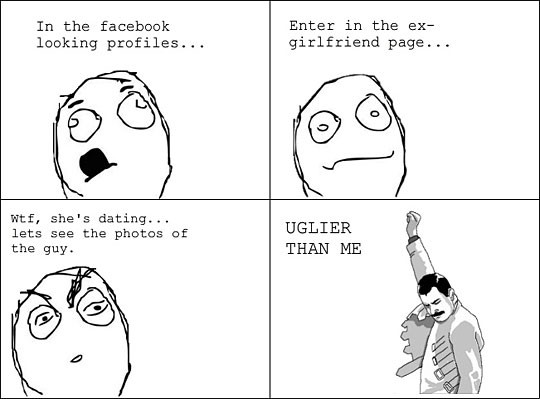
funny-Facebook-ex-girlfriend-relationship-status

Maureen O’Connor believes that in the era of social media, breakups are an increasingly relative concept:

[M]ore often than not, you will see him again. Like “dialing” a cell phone or “filming” a digital video, “one-night stand” is an anachronism. Even if you only have sex once, you will spend time with your hookup when he finds you on Facebook, appears in a mutual friend’s Instagram, or texts about a weird bump he found on his penis. Older generations didn’t have a word for this kind of thing—they couldn’t have. But these are, in fact, relationships. Even casual dates have expansive biographies to plow through and life narratives you can follow for years.

You hear about their hangovers when you check Twitter for the morning news. You see their new apartments when you browse Facebook at work. They can jump into your pants whenever they want by sending text messages that land in your pocket. Online, you watch your exes’ lives unfold parallel to yours—living, shifting digital portraits of roads not taken with partners you did not keep.

There was also a time, I am told, when staying in touch was difficult. Exes were characters from a foreclosed past, symbols from former and forgone lives. Now they are part of the permanent present. I was a college freshman when Facebook launched. All my exes live online, and so do their exes, and so do their exes, too. I carry the population of a metaphorical Texas in a cell phone on my person at all times. Etiquette can’t keep up with us—not that we would honor it anyway—so ex relationships run on lust and impulse and nosiness and envy alternating with fantasy. It’s a dozen soap operas playing at the same time on a dozen different screens, and you are the star of them all. It’s both as thrilling and as sickening as it sounds.

Previous Dish on social media and exes here.

Food Without Thought

Jessica Love parses a study that finds we’re significantly less conscious of the flavor and quality of our food while we do other things. She calls it “zombie eating”:

Just about anything can turn us into zombie eaters: reading the newspaper, listening to Pride and Prejudice, even socializing. As distractions mount, so do the dangers. When our focus isn’t on our food, we may be slower to notice the physiological cues that tell us we’re full. And without tangible evidence of our binge—a pile of incriminating candy wrappers, say—we tend to lose track of how much we’ve eaten. This spurs us to eat more, for this meal and—hey, why not?—even for our next.

The antidote to zombie eating is mindful eating, where one focuses on eating—just eating—in a deliberate, even meditative, manner. Yesterday over lunch I gave mindful eating a whirl. To my mind the experience was not unlike silent hiking: my movements slowed, my senses piqued, the familiar became wonderfully strange.