Will The GOP Shut Down The Government?

Ramesh Ponnuru warns Republicans against their plan “to oppose any bill to fund the government or increase the debt limit that also provides money for putting the health-care law in place”:

The chance that Democrats would go along — would give up on their signature legislative initiative of the last decade soon after having won the presidential election and gained Senate and House seats — approaches zero percent. So if Republicans stay firm in this demand, the result will be either a government shutdown or a partial shutdown combined with a debt default. Either would be highly unpopular, and each party would blame the other. The public, however, would almost certainly blame Republicans, for five reasons.

First, Republicans are less popular than the Democrats and thus all else equal will lose partisan finger-pointing contests. Second, the executive has natural advantages over a group of legislators in a crisis atmosphere. Third, people will be naturally inclined to assume that the more anti-government party must be responsible. Fourth, some Republicans will say that government shutdowns or defaults are just what the country needs, and those quotes will affect the image of all Republicans. And fifth, the news media will surely side with the Democrats.

Jesus Christ, Super-Zealot?

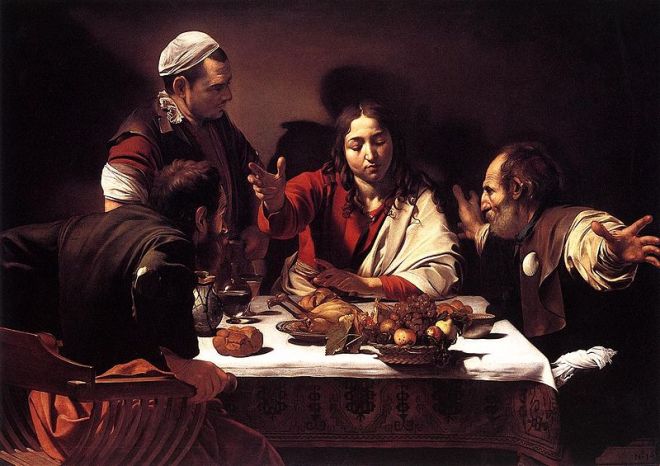
Caravaggio.emmaus.750pix

Adam Kirsch reviews Reza Aslan’s new biography of Jesus, Zealot, which revisits key moments in the Gospels to cast the Nazarene as a staunch Jewish nationalist:

Take, for instance, the moment when Jesus is asked, “Is it lawful to pay the tribute to Caesar or not?” In response, he takes a coin and asks whose picture is on it. “It is Caesar’s,” comes the reply; to which Jesus says, “Render therefore unto Caesar the things that are Caesar’s, and unto God the things that are God’s.” At least, that is how the King James Bible translates his words; and in this form, their message seems to be a kind of political quietism. Keep paying taxes, Jesus seems to advise, and obey the government, since money and worldly affairs are the government’s concern. But entrust your soul, which is what really counts, to God.

Aslan, however, shows that the same passage can be translated quite differently: “Well, then, give back to Caesar the property that belongs to Caesar, and give back to God the property that belongs to God.” Read this way, Jesus sounds much more like a zealot, demanding that the land and people of Israel—which are God’s property—be returned to God and freed from Roman control. It is sayings like this, Aslan writes, that led Jesus to be labeled a “bandit”—a term that was used for all sorts of popular revolutionaries in Judea. When Jesus was crucified next to two “bandits,” then, we should not understand this to mean thieves, as though the Romans were devising an insult to Jesus. Rather, he was crucified next to fellow rebels, whose crime, like his, was agitating for Jewish independence.

I haven’t read the book, but it sounds fascinating, and I hope to soon. But, as so often in his criticism, Kirsch penetrates to the weakness of the thesis. If Jesus were merely a political zealot, why did his message and example endure while those of hundreds of other such figures didn’t? Could it be, as the Gospels tell us, that he actually was life-changingly different, other-worldly, strictly non-violent, up-ending expectations of a political messiah by, say, riding on a donkey into Jerusalem, or consorting with the marginalized and stigmatized, and telling stories that invert the entire paradigm of power that lies behind actual politics?

Jesus, one might say, radicalized the language of Jewish messianism in such a way that it could be turned against Judaism itself. This act of religious creativity, more than his zeal, is what turned a minor Jewish preacher and miracle-worker into the Christian son of God.

And to miss that is to miss almost everything.

(Painting: A beardless Jesus, after his Resurrection, at supper at Emmaus, by Caravaggio)
Dick Morris Award Nominee

“Yes, I realize that the nursery photo in The New York Times Magazine’s recent cover story about Anthony Weiner’s rehabilitation was staged. Yes, I know that the disgraced former congressman was always “weighing” a run for mayor, and was never just a stay-at-home dad facilitating the political ascendance of his wife, Huma Abedin (he earned a hefty sum last year as a corporate consultant). But I can’t help it; I believe that Anthony Weiner, who once thought chicks would dig it if he tweeted them a picture of his namesake, is a changed man,” – Hanna Rosin, June 19, 2013.

A glossary of Dish awards can be found here.

Why Can’t Inspections Work In Iran?

A good question – answered thoroughly in a must-read here. Yes, they can. And in my view, Obama should do everything he can to reach a bilateral agreement with Rouhani to avoid another Middle East war.  If he can pull that off and get universal healthcare successfully installed, we’re talking Reagan. If Kerry manages some kind of Israel-Palestine deal in the next three years, we’re talking bigger than Reagan.

It Wasn’t Activist Judges

US-JUSTICE-GAY-MARRIAGE

Richard Posner considers how marriage equality gained acceptance:

All in all, the judicial role in the rise of homosexual marriage seems to have been quite modest. Probably the courts have done little either to accelerate the trend in acceptance of such marriage or, through backlash, to retard the trend. In retrospect, the growing acceptance of homosexual marriage seems a natural consequence of the sexual revolution that began in the 1960s rather than an effect, even to a small degree, of litigation. That should come as no surprise when one thinks of another significant social and cultural development in America in the same era: the virtual disappearance of discrimination against Jews, Catholics, Irish Americans, Italian Americans, and Asian Americans, which also owed very little to litigation.

Scott Lemieux counters:

Posner’s key mistake is to assume that gays and lesbians are merely seeking public acceptance. But while public acceptance may be necessary for the advancement of fundamental rights it’s not sufficient; gays and lesbians actually also want their legal rights protected. Litigation may not have much to do with the former but it has been very important to the latter.

In a follow-up post, Lemieux addresses another element of Posner’s article – on the importance of Lawrence.

(Photo: A same-sex marriage supporter has her forehead painted with rainbow colors as she joins demonstration in front of the Supreme Court on March 27, 2013 in Washington, DC. By Jewel Samad/AFP/Getty Images)

“Why Would Larry Need A Script?”

The AIDS activist and author of The Normal Heart and Faggots, Larry Kramer, got married two days ago. In an ICU. No formal vows of course, as the quote above explains.

Many inferred from Kramer’s ACT-UP advocacy that he was deeply anti-establishment in all things. And he is in many. But from his first searing novelistic indictment of gay culture in the 1970s through his disgust at gay sexual adventurism in the early AIDS years, he has always longed for marriage equality. There’s a line in the 1985 play, The Normal Heart, which actually wonders if there would have been a plague if gays had been allowed to get married a while back. So there’s a poignant circle here – as well as what can only be described as true love.

Mazel Tov, Larry. And if that isn’t the appropriate greeting for Larry, fuck you too.

Christie: “Live Unfree Or Die”

NJ Governor Chris Christie Holds Town Hall Meeting

The New Jersey governor’s remarks about growing concerns that the balance between security and liberty has shifted too much toward security were revealing in one respect. They suggest that he sees no trade-off between liberty and security at all. Christie is the walking antithesis of New Hampshire’s motto: “Live Free Or Die”. His view, it appears, is: “Live Unfree Or Die”.

There is, of course, a solid argument for tilting the balance in favor of security over liberty. That’s why I couldn’t quite muster the outrage of many of my libertarian and liberaltarian friends about PRISM. Too much relaxation of security could lead to a successful attack which could make future defense of pre-9/11 liberty even harder to defend. This is a tough area, especially for those of us not privy to intelligence about various threats. But there is none of this in Christie’s remarks, and I fear that this is one of his hallmarks – total, black-and-white certainty in areas where gray is inherently the dominant color. Note also the anti-intellectual populism at work:

“These esoteric, intellectual debates — I want them to come to New Jersey and sit across from the widows and the orphans and have that conversation. And they won’t, because that’s a much tougher conversation to have. The next attack that comes, that kills thousands of Americans as a result, people are going to be looking back on the people having this intellectual debate and wondering whether they put …”

He stopped himself at that point for some reason. But look: it’s a very strange thing for a Republican to call constitutional rights “esoteric”.

They aren’t. They’re basic. In a democracy, they are as core a set of values as we have. To reduce the difficult trade-off between preventing terror and maintaining civil liberties to a stark conversation with the victims of 9/11 is to load the emotional dice so heavily you are dismissing the entire debate as worthless. It’s Cheney-esque.

Then there’s this canard:

“President Obama has done nothing to change the policies of the Bush administration in the war on terrorism. And I mean practically nothing,” he said. “And you know why? Cause they work.”

We now know that the central anti-terrorism policy of the Bush administration was a program of brutal, indiscriminate torture of suspects. The second pillar was the invasion and occupation of two countries for a decade. Obama has abolished the former and, by the end of his term, will have ended both wars, whose consequences are still being felt in a bankrupted federal government, a wave of terrorist blowback and a collapse of America’s global credibility and moral standing.

The silver lining in this is that, for the first time in a while, these unreconstructed Cheney-style bromides are being challenged within the GOP, by Senator Paul in particular. And on a core question in our democracy – do we sacrifice our core liberties because of a network of religious terrorists? – we now know where Christie stands. Against freedom. And for his own power.

(Photo: Jessica Kourkounis/Getty Images.)