Card-Carrying Criminals

Kevin Poulsen narrates the fantastic tale of a talented, successful manufacturer of fake IDs who – as his customers and competitors eventually discovered – happened to work for the Secret Service:

Buying the cards from “Celtic” was simple. You’d give him the name you want on the card, the state, date of birth, height, and weight, and a headshot. Celtic would then whip up a digital proof of what the card would look like – sometimes watermarked with a big CELTIC across the front, more often not. If you were satisfied with the proof, then, and only then, would you send your payment by Western Union. Then Celtic would manufacture the physical card in his plant (whether it was at the Secret Service field office, or at an undercover offsite is unclear), pop it in the mail, and send you the tracking number. For U.S. customers, it was three days from order to delivery. …

From the Secret Service’s standpoint, selling fake IDs – “novelties,” in the parlance of the underground – would have held a number of advantages. Unlike intangible commodities like credit card numbers or passwords, fake IDs must be shipped physically, which gives the agency an address to check out for every customer. And, being photo IDs, the customer had to provide their photos. It’s a rare law enforcement operation that lets the cops collect mug shots before they’ve made a single arrest.

Sometimes Blue Is Just A Color

The first and third parts of the “pink boys” thread are here and here. The second post featured a straight female reader who grew up butch. Several readers continue that theme:

What about blue girls? I remember wishing I was a boy quite often when I was in elementary and junior high school, mostly because I realized from a very young age that being a boy would afford me more freedom and more access to things I wanted to do, like play baseball instead of softball and real basketball instead of that crappy 6-on-6 version. I dressed like a boy as often as I did like a girl. I played sports like a boy my whole life, lived independently, took care of myself, pursued what/who I wanted and even as late as my early thirties was still “manly” enough that people questioned my sexuality, which I always found odd, but people are nosy that way.

My most frustrating moment was in 5th grade. Boys at that age could be altar servers at my Catholic grade school and I engaged in a three-year battle with the nuns, and our parish priests, because I desperately wanted to serve.

I even wanted to be a priest a one point, but when one of the sisters found out, she tried to talk me into the “next best thing” – the sisterhood. Even at eleven, I wasn’t fool enough to equate the power of the priesthood with the submissive servitude of the sisters.

One of most vivid memories as a child is hearing one of my uncles remark to my father about what a great little ballplayer I was but “why would God have wasted talent like that on a girl?” I never wanted to be a boy to “be a boy”, but rather to have what they had – freedom and power. Life is easier for men in so many ways. I knew this when I was six and I still know it.

Another female reader:

I tell people I was a boy growing up. That’s because somewhere between 3 and 5, I began to hate wearing girl things and playing with girls’ toys. Because I was a sickly child, my mother gave into my demands that I wear slacks, a tie and a shirt when I wasn’t in school uniform. I remember steeling myself before walking into ladies’ restrooms just for the inevitable responses of “Aren’t you in the wrong bathroom little boy?” My voice always convinced the women that I was female, but oh my, the looks I got!

Because of how I dressed, and because my childhood illnesses kept me from school, I felt like an “other.” Because both occurred simultaneously, my feelings of being an “other” weren’t restricted to gender issues. As an adult woman, I’ve never felt the compulsion to be a man, though I will cop to still feeling boyish after all these years. And because my mother let me be a “boy” in almost every sense of the word, I don’t feel any unresolved gender issues.

Oh, I also had a boy name: David. A few of my friends knew and some thought it weird. I wonder if some of these “trans” kids are more like me than truly trans.

On the above trailer:

Tomboy is a 2011 French drama film written and directed by Céline Sciamma. The story follows a 10-year-old girl named Laure who, after moving with her family to a new neighborhood, dresses as a boy and introduces herself to her new friends as Mickäel. A neighborhood girl named Lisa instantly assumes that Mickäel/Laure is a boy and falls in love with him.  The film is supposed to explore themes of ambiguous sexuality. Writer/director Céline Sciamma said of Tomboy “The movie is ambiguous about Mikael’s feelings for Lisa. It plays with the confusion. I wanted it to be that way.”

Another reader:

I was not quite a tomboy, but I hated dresses and loved trucks and building things and science. To their credit, my parents never tired to encourage me to be more girly (except for forcing me to wear dresses when going somewhere fancy). I’m 24, so you’d think people wouldn’t have been surprised when I said pink wasn’t my favorite color and I didn’t care about growing up to be a “mommy,” but of course I got all sorts of crap. When I was 7, I told my grandmother my favorite sport to play was hockey. She said “You don’t want people to think you’re a dyke, do you? Pick a girl’s sport.”

In school, there was the usual teasing, from being told having hair on my arms made me a boy to rumors that I had a penis. The science teachers informed me that girls didn’t blow things up, so experiments that were interesting were limited to the boys. It culminated in middle school with students asking my (female) best friend if we were a couple and a contest among the boys to see who could “make her straight.” Yup, the students in my middle school had a campaign to rape me until I fit their idea of a girl. Luckily, being un-feminine, I wasn’t afraid to fight back and fight dirty.

Flash forward to today, where I have worked as a reporter covering the military, I still hate pink, and I’m happily straight. We forget just how pervasive our gender roles are assumed to be, and the ways our society has to try to enforce them. My life would have been easier if I’d chosen to live as a man, but I don’t think I ever really needed to; a man can love glitter and still be a man, and a woman can prefer discussing airplanes to soap operas.

A Literary Living Room, Ctd

A reader writes:

I’m bummed out by Martin Amis’s notion of the novelist as “host.”  I abhor a host.  I demand, to paraphrase Denis Johnson’s idea, that an artwork’s agenda not include me.  I want to be dropped into a strange and even forbidding land, one I could not possibly reach on my own, and I want to make my own damn way through it.  Then, when I return, I can take stock of whatever alterations the artwork has demanded of me.

As for Nabokov, I have a very hard time thinking of him as a gentle host who has offered me his best chair and poured a glass of fine wine and then pulled back the curtain on Humbert Humbert’s consciousness.  Nabokov presents Humbert as seducer, true, but he demands we enter HH’s world utterly.  We know he has succeeded when we’re aroused by the experience – Humbert’s experience – of a prepubescent girl on our lap.  And then the greatest power of Lolita is in precisely those moments when we are suddenly, even shockingly torn from Humbert’s dream and into the reality he refuses to guide us through – namely the damage HH does to Lo – but leaves us to recognize and reckon with alone.  No host he, I have to say.

Are We Failing At Grading Schools?

Big education news out of Indiana, where the state’s former schools chief – now Florida’s Commissioner of Education – apparently gamed his own school-rating system:

[Tony Bennett] built his national star by promising to hold “failing” schools accountable. But when it appeared an Indianapolis charter school run by a prominent Republican donor might receive a poor grade, Bennett’s education team frantically overhauled his signature “A-F” school grading system to improve the school’s marks [from an “C” to an “A”].

Bennett, an “Education Reform Idol” winner, has denied any wrongdoing, and Michael Petrilli, who hosted the contest, urges people not to jump to conclusions:

[Bennett] had spent months (and much political capital) building an A–F accountability system for Indiana’s schools. These systems are as much art as science (more akin to baking cookies than designing a computer), and when they tried out the recipe the first time, it flopped. One of Indiana’s brightest stars, a charter school known to be super high performing, ended up with a C. Clearly, the recipe needed fine tuning.

Ed Kilgore rolls his eyes:

The whole point of a “charter” public school is strict accountability for results. A “charter” is nothing other than a performance contract. If, as Bennett now claims, the bad grade for his pet school illustrated problems with the scoring system, it should have been discussed publicly after the results were released. I’m a long-time supporter of public school choice (and a bitter, last-ditch opponent of vouchers). But it’s getting to the point where you have to put “charter” in quotations when you are talking about some of these schools, particularly in states where the underlying commitment to public education is lacking.

Mark Kleiman is even harsher:

Look: I believe in outcomes measurement. I believe in accountability. I even believe in school choice. (After all, I live in the jurisdiction of the LA Mummified School District.) What I don’t believe is that the current testing/accountability/choice con artists and racketeering enterprises are going to make things better rather than worse. The cheating is so pervasive that I now see no basis for believing any claimed good result. That’s why Diane Ravitch has switched sides.

You’d have thought that charter schools, like private prisons, could hardly have done worse than their big, clumsy, bureaucratic, union-dominated public competition. But you would have been wrong, twice.

Andrew Ujifusa says the scandal could reverberate nationwide:

Bennett, in his new role as Florida’s education commissioner, the job he landed after losing his 2012 re-election bid in Indiana, recommended a dramatic change to Florida’s A-F accountability system so that no school’s A-F grade will drop by more than one letter in one year for both the 2013-14 and 2014-15 academic years. That move encountered some resistance, but won the approval of the state board of education earlier this month. The AP story may create a more difficult political environment for A-F school-grading systems in general and provide ammunition for those who believe the whole concept is flawed.

Quote For The Day

“In an alternative universe, the United States might re-intervene in Iraq, redeploying tens of thousands of soldiers to restore everyone’s sense of safety and allowing the political process to heal again. In this universe, the United States is never going to intervene in Iraq again, nor will the Maliki government ever request that we do so,” – Kenneth Pollack, architect of the Iraq catastrophe, wanting another bite at the cherry.

No, I’m not making this up. this is what he still believes. Take it away, Michael Maiello.

What’s So Wrong About Virtual Sex?

grac-1

I was glad to read Susan Jacoby’s op-ed today, pushing back against the Brown-Quinn thesis that women are somehow victims of sexting culture and not full, eager participants. She makes some of the points I did last week:

There is no force involved here; people of both sexes are able to block unwanted advances. Women are certainly safer on the Web than they would be going home with strangers they meet in bars.

But then she veers off into this diatribe:

The morality of virtual sex, as long as no one is cheating on a real partner, is not what bothers me. What’s truly troubling about the whole business is that it resembles the substitution of texting for extended, face-to-face time with friends. Virtual sex is to sex as virtual food is to food: you can’t taste, touch or smell it, and you don’t have to do any preparation or work. Sex with strangers online amounts to a diminution, close to an absolute negation, of the context that gives human interaction genuine content. Erotic play without context becomes just a form of one-on-one pornography.

Bingo: “one-on-one pornography”. That’s the most concise description of sexting at its best that I have yet read. And it prompts me to ask: what, pray, is so wrong with that? Sex has always been about fantasy and reality and the sometimes ridiculous and sometimes incredibly hot experiences that mix can engender. The most fundamental sexual organ is the brain, as my shrink often points out to me. And masturbation – which is solitary sex based on fantasy (sometimes from pornography, sometimes from real life, sometimes from an Old Spice commercial) – is as old as human beings’ brains.

That’s why virtual sex is not like virtual food. You can have an orgasm in your body as well as your mind without any actual “work” in a way you cannot eat or taste something virtually. In fact, your sexual experiences through masturbatory fantasy can be far more satisfying and intense than the actual thing – you know, when one of you has come and the other hasn’t, when the dog jumps on the bed in the middle of it, when one of you farts or queefs, when the word “ow” occasionally surfaces, or when your mind wanders for a bit and your already sated spouse has to look at the ceiling for a while and think of the skim milk that needs buying, as you plug away to get it over with.

Nothing is as over-rated as bad actual sex or as under-rated as good virtual sex. And, yes, it isn’t real in the way that a loving, physical fuck-fest with a loved partner is real. But so what? Since when is the ideal the enemy of the good? And the fact that it isn’t real – that it’s a fantasy deriving from a sexual avatar – means it’s less perilous. It’s a form of play, the kind of activity that marks intelligent beings from those with less developed frontal cortexes. It’s play between two fantasy partners; it victimizes no-one; it transmits no diseases; it risks no pregnancy; it renders both partners radically more equal than they would be in the actual sack; and, as long as it is kosher with your partner, if you have one, it is much more moral than actual adultery, precisely because it isn’t real.

And women would be the most likely to gain sexual pleasure from this without all the attendant headaches and dangers of an actual physical, real-life sexual encounter.

Men, for their part, love showing off their sexual prowess. There’s a reason why Chatroulette – remember that? – started as a free-wheeling chance for anyone to say anything, and ended up as a dizzying parade of jerking dick pics. Anthony Weiner may be a loser but he is not mentally ill; he is a classic high-testosteroned male of the species, maximizing his sexual pleasure while minimizing the chances of actually having sex with someone other than his wife. His fault was not telling his wife up-front and running for fricking mayor of New York. But single guys and women – or those whose entire sexual needs cannot be completely fulfilled by fucking one person for the rest of their lives (i.e. everyone) – rightly see virtual sex as the best of all possible worlds if you want to get off without getting it on.

All this is is personal, interactive porn. On the web, it’s everywhere. In our national discourse, especially among those who came of age before the web, it is somehow necessarily foul and disgusting. It isn’t. It’s just embarrassing if your sex talk and body pics end up being perused by the whole world (which is why a new sexting app can automatically cause your pics to evaporate after a fixed amount of time).

Instead of ranting about dickmanship, feminists should be cheering this avenue for female sexual liberation on. It isn’t what sex can be at its best. But it sure is victimless, non-coercive, often exciting sexual play. I’m sorry, but that does not equate either with the near-negation of sex, as Jacoby would have it, or with mental illness. As a culture, we’re just not ready to admit that. But soon enough, we will.

(Photo by Mathieu Grac, from a collection of “Amusing and Poignant Photos of Social Media Self-Portraits in Progress.”)

Is The Tide Turning Against FGM?

20130727_gdc133

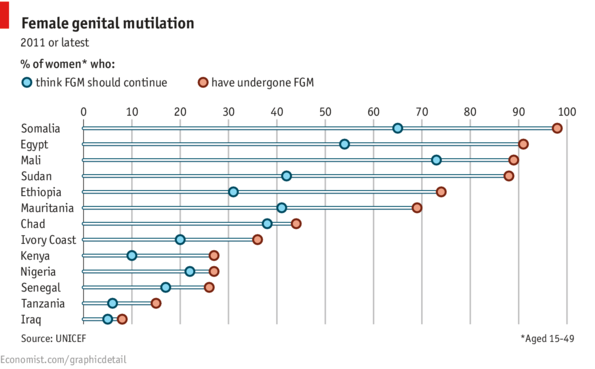
The Economist checks in on the barbaric practice that has affected 125 million girls and puts 30 million more at risk in the coming years:

[Female genital mutilation] has declined in more than half the countries UNICEF looked at, but most dramatically where it was already rarer. In the Central African Republic the share of women in the 15-49 age group who had been mutilated dropped from 43% in 1995 to 24% in 2010. In a few countries new data suggest the practice is all but eliminated. In the countries where it is most common, however, such as Egypt and Sudan, the prevalence has hardly changed. In Kenya it varies by ethnicity: FGM is now rare among the Kalenjin and Kikuyu tribes, and has almost disappeared among the Meru. Yet more than 95% of ethnic Somali and Kisii girls are still being cut.

Support for FGM, among both sexes but especially younger people, seems to be falling, even in countries where the practice is almost universal. Experience elsewhere suggests that this may herald an actual decline in coming years.

Here’s hoping.

A Grand Bargain To Nowhere

US-POLITICS-JOB-OBAMA

Obama’s proposal to cut the corporate tax rate if Republicans get behind his jobs and infrastructure programs seems to be dead in the water. In a truly hackish piece, Paul Ryan opines in USA Today that Obama is “interested in tax reform for corporations but not for families or small businesses,” while John McCormack reminds readers that “Obama’s push to lower the corporate tax rate to 28 percent comes less than a year after he raised the top individual income tax rate, paid by many small businesses, to 39.6 percent.” Meanwhile, business groups like the idea of tax cuts but object to the infrastructure spending.

Jared Bernstein is exasperated by the Republican response:

So, reviewing: we’ve got a big drop in the corporate rate that doesn’t add to the deficit, for which the Republicans have only to swallow a paid-for jobs program in areas they’ve historically supported. And what’s the response? From the spokesman for the House speaker, Representative John Boehner: “This proposal allows President Obama to support President Obama’s position on taxes and President Obama’s position on spending, while leaving small businesses and American families behind.”

I know, we’re in an upside-down world, but given how hard Republicans have fought for a lower corporate rate, the absence of accountability is particularly striking in this example. At this point, I truly wonder that if he finally gave in and offered to repeal Obamacare, they’d fight to implement it tomorrow.

Josh Barro pushes back:

[Obama] ended up proposing what amounts to a small corporate tax increase to pay for a small infrastructure program. This has been missed in much of the news coverage, particularly on television: Obama has called for a corporate tax rate cut, but he says that should come with enough base broadening to fully offset any revenue loss in the long term, and more than offset it in the short term. Liberals are, for some reason, expressing surprise that conservatives aren’t interested in this idea.

But couldn’t they refine it so that it is revenue-neutral? You know: actually negotiate a deal that would give both sides something? Howard Gleckman adds:

We remain stuck in the same Groundhog Day rut that has bedeviled tax reform – individual or corporate – throughout the Obama Administration. Obama and the Democrats won’t support reform unless it produces revenue to fund new spending and/or deficit reduction. Republicans won’t support it if it does increase revenue. So there we are.

But in that equation, the Democrats are clearly more willing to compromise than the GOP is. Alec MacGillis – who just a few weeks ago urged Obama to revamp the corporate tax code – says the administration’s plan is too vague:

As Obama has proposed before, the plan calls for lowering the corporate tax rate from 35 to 28 percent and making up the lost revenue by eliminating or reducing many of the credits and deductions that businesses use to get their rates far below 35 percent today. But the plan does not specify which of those credits and incentives it would target above all, and by how much – whether the depreciation credit for capital investments, the treatment of interest, etc.

It [also] promises simplification and investment incentives for small businesses, but does not reckon explicitly with the biggest objection to this general reform approach that we’ll hear from the executives at the many businesses (including some quite large ones) that now organize themselves as limited liability companies and “S-corps” rather than corporations and are thereby taxed at their owners and partners’ individual tax rates rather than corporate ones: that they’ll get hit with the loss of credits and incentives while not being able to benefit from the lower rates.

Rachel Weiner, who calls the proposal “basically DOA,” says Obama may not have expected the deal to catch on in the first place:

The White House can’t be expecting the House GOP to suddenly cave. They’re trying to do a couple of things. First, expand the idea of a “grand bargain” to mean not just deficit reform but any sort of economic agreement, and challenge Republicans to come up with a counteroffer. Second, try to win support from the business community for a proposal that contains two things they want: tax reform and domestic investments. Most of all, Obama is simply making clear that tax reform is one of his priorities, as Ronald Reagan did in his second term.

(Photo: US President Barack Obama speaks on job growth following a tour of an Amazon fulfillment center on July 30, 2013 in Chattanooga, Tennessee. By Mandel Ngan/AFP/Getty Images.)

Ask Frederic Rich Anything: President Palin

Fred’s new novel, Christian Nationis a work of speculative fiction that imagines an America in which John McCain won the 2008 election and subsequently died, making Palin the president and setting the nation on a path to theocracy. In our first video from the author, he sets the scene for something that had me waking up in cold sweats throughout the fall of 2008:

In other former half-term governor turned failed-reality star news, Andrew Kaczynksi flags some recent hathos in which Palin claims that the reason Obama was elected was because the McCain campaign banned her from talking about Jeremiah Wright.

Our full Ask Anything archive is here.