Urban Canyon

23_4

On his website, Swiss photographer Gus Petro explains the concept underlying Merge:

In this project two opposite places are merged into one: New York City, where, it seems like, everyone wants to live there, and Grand Canyon / Death Valley, which are unlivable.

Mark Byrnes spoke to the artist about his process:

To make it, Petro took the photographs he had of the two sites, matched their perspective points and lens angles, then put them through a process he calls “Photoshop magic.” And he’s been surprised by the reaction. “After showing the images, most of the people who haven’t been in either place thought it was real,” he says. “They began questioning me where it is. I didn’t expect that for sure.”

Smoking Bans And Hazy Science

Arthur Caplan points to a recent study suggesting that the health reasons for outdoor smoking bans aren’t backed up by strong data:

In getting these bans enacted three justifications were used: Smoking on beaches and in parks posed a health hazard to nonsmokers, especially children; cigarette butts were toxic to humans and animals and constituted an unacceptable form of litter; and public smoking by adults provided a dangerous model that threatened the future well-being of children and adolescents.

The problem is that the scientific evidence supporting each of these arguments is exceedingly weak. Consider the comments of some of the toughest anti-smoking groups in the nation about the best rationale for bans–the hazards of smoking in public to others. An official of the American Lung Association, concerned that efforts to ban smoking on beaches and in parks might deflect attention from more effective public health interventions, told [study authors Ronald Bayer and Kathleen E. Bachynski] in an interview, “I don’t think we should be making claims that are not supported by the data. If you try to tie it [banning smoking on beaches and in parks] to a health outcome, that’s where you get in trouble.”  A representative of the Campaign for Tobacco-Free Kids was even more direct in another interview: “There is not a lot of science around outdoor smoking bans…. There is some science, but you have to be very close to the smoke in an outdoor setting…. The last thing we want to do is put our credibility on the line with regard to the science.”

Where Is The Midwest? Ctd

A reader writes:

Your reader says that Pittsburgh cannot count as an East Coast city because it is 7+ hours from the coast. Then please explain to me why it belongs in the same region as Chicago (8 hours from Pittsburgh); Des Moines, IA (12); Lincoln, NE (14); and Rapid City, SD (19). Granted, the distance from Wilmington, NC to Shreveport, LA is a solid 14 hours, and no one thinks that North Carolina and Louisiana are in wildly different regions. I just get riled because frequently people from the East Coast actually have no idea how huge this country is, and make flippant statements like “Pittsburgh is too far from the coast so lump it in with the flyovers.” America is vast, and contains multitudes. Explore!

Another reader:

I was born and raised in the Midwest and lived in various states for 40 years, and it never ceases to amaze me how people conflate anything that’s not East Coast as Midwest. While I love my East Coast brethren, they are profoundly ignorant of the geography of this country. Pittsburgh is about as Midwestern as San Francisco. Wyoming in the Midwest? Huh?

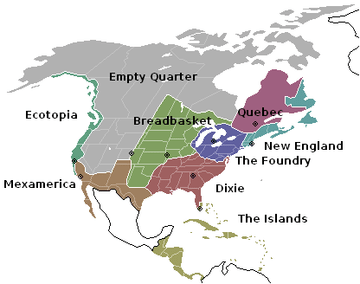
I have one very simple rule: if it’s in the 360px-NinenationsEastern Standard Time Zone, it’s not Midwest. To extend it, there are only a few tiny portions in Mountain Time that are Midwestern. Broadly speaking, there are two basic parts of the Midwest: the Great Lakes region and the Great Plains region. They may look similar to someone sitting in DC or New York, but they are different culturally, topographically and politically. But the best map and definition that’s ever been written to date is still Joel Garreau’s Nine Nations of North America. Garreau really nailed the specific differences and demarcation points (though I would lobby for an additional “nation” that picks up the Scandinavian quality of the people in the Upper Midwest into Canada).
Another:

Here’s a definition from a born-and-raised Midwesterner who often drives to its outer reaches: Midwest = Germans + Grids + Gardens

Germans: On this map of ethnic ancestry from the 2000 census, there’s a broad swath of German-plurality counties starting from central New York, through Pennsylvania stretching westward to the Rockies and beyond. Germans help define the southern border of the Midwest (though stray Finnish, Dutch and African-American counties are certainly Midwestern as well). Germans heavily influenced Midwestern architecture, food, religion, and its devotion to public education.  The “American” cultures of Kentucky and southern Missouri are southern – the accents change, Baptists predominate, and so does the food (it gets better down South, but that’s not Paula Deen’s doing). But not all German areas are Midwestern, so a limit to this is:

Grids. A central man-made feature of the Midwest is its grid pattern, which, thanks to the Land Ordinance of 1785 and Glaciation, stretches from south of Cleveland toward Cincinnati, and then west to the Rockies, defining the eastern and southern borders of the region. There are a few pockets where “queer” roads must follow the hills, such as around Bloomington, Indiana, or Athens, Ohio, or in the Ozarks. Those areas are on the fringes of the Midwest. Driving a Detroit-made sedan or pick-up truck down a straight state highway is a Midwestern rite of passage. So straight roads and flatlands (not Appalachian or Ozark zomias) help define the Midwest. This grid was made possible in part by Glaciation, which covered the land with very fertile soil. So the last characteristic is:

Gardens. (I couldn’t find a better synonym for farms that maintained the alliteration.) Anywhere that farming occurs on a wide scale and without irrigation is Midwestern, which defines the western border from about Joplin, Missouri, northward to Topeka, Lincoln continuing to just west of Fargo. Northern Michigan and Wisconsin are also peripherally Midwestern, and I suspect residents of those regions agree, though I can’t speak to northern Minnesota.

Putting this all together, Germans, Grids and Gardens means the Midwest begins in Downtown Cleveland, south to about Athens, Ohio, then west about Cape Girardeau, Missouri, with a bump up I-55 to St. Louis, and back down I-44 to Joplin, then north to Topeka, Lincoln, west of Fargo, to Canada.

Update from a reader:

Was that “born-and-raised Midwesterner” really suggesting that the defining characteristic of the Midwest is that it’s GGG?

Heh. One more reader:

There’s a historic line of demarcation that cuts right through some of the most contentious 100thmeridianstates. The 100th meridian quite accurately separates the lower-lying, well-watered eastern half of the Great Plains from the high-country, arid western half. Rainfall drops from two feet to a foot at the meridian; altitude crosses from under to above 2000 feet. In the past, east of the 100th was lush tallgrass prairie; west, sunburned shortgrass. Today, in the east, Mother Nature does a lot of the irrigating; in the west, farmers pump the aquifers and cosset every drop of rain. East is dairy cows; west is steers raised for beef.
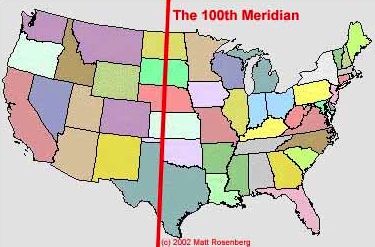
See where the U.S. highway system goes from a dense mesh to a loose net on this map? That’s the 100th meridian, and those roads speak volumes about the human population density on either side of it. Much has been written about the meridian – Wallace Stegner’s biography of John Wesley Powell is named for it, for example – and it remains meaningful to the regional culture today, as this 2011 article from the Pierre, South Dakota Capital Journal notes. I’d suggest that it’s what really divides the Midwest – a green and pleasant, neighbors-and-towns land – from the brown and solitary West.

Law School By Default

David Lat identifies a major problem with legal education:

Many of the challenges facing the legal profession can be reduced to supply and demand: too many lawyers chasing too little work, which itself results from too many people going to law school. And why do people go to law school? Often it’s a failure of imagination. As a former professor of mine put it, “Law school is the great American default option for smart kids who can’t stand the sight of blood.” If you’re intelligent, ambitious, and undecided about your future, going directly from college to law school is the path of least resistance. Too little resistance, and not enough deliberation—which is why law schools should follow the model of many business schools and require incoming students to have at least two years of post-undergraduate experience.

The Best Of The Dish Today

Anthony Weiner Holds Press Conference As New Sexting Evidence Emerges

I’m finding the new reader thread on suicide and its survivors illuminative and haunting. I went after the convenient fatalism of pro-Israel Middle East experts, and the finessed racism still thriving at National Review. We got more insights into why marijuana use seems correlated with lower weight and better heart-health; and how old media hacks at the NYT couldn’t bear Nate Silver’s success and accuracy.

Map fights!

The most popular post of the day was my cri de coeur against the vandals and saboteurs in the GOP, followed by my thoughts on old media, Nate Silver and old-fashioned envy. My post on Obama’s role as “defuser-in-chief” continues to rack up pageviews.

See you in the morning.

(Photo: Huma Abedin, wife of Anthony Weiner, a leading candidate for New York City mayor, listens as her husband speaks at a press conference on July 23, 2013 in New York City. By John Moore/Getty Images.)

It’s Not Racist …

… if you tell your children to be wary of all young black males they might meet:

The advice was not about race per se, but instead about the tendency of males of one particular age and race to commit an inordinate amount of violent crime.

It was after some first-hand episodes with young African-American males that I offered a similar lecture to my own son. The advice was born out of experience rather than subjective stereotyping. When I was a graduate student living in East Palo Alto, two adult black males once tried to break through the door of my apartment — while I was in it. On a second occasion, four black males attempted to steal my bicycle — while I was on it. I could cite three more examples that more or less conform to the same apprehensions once expressed by a younger Jesse Jackson. Regrettably, I expect that my son already has his own warnings prepared to pass on to his own future children.

That’s the gist of Victor Davis Hanson’s new piece in National Review. All young black men are guilty until proven innocent – a sentiment with which New York’s chief cop apparently agrees (especially if he can gussy up his racial profiling with minor pot possession, thus making the future of any young black male that little bit harder). I don’t think anyone in this debate, including the president, has denied the disproportionate amount of crime committed by young black men (primarily against other young black men). The question is how we should personally deal with that fact while living in a multiracial society. Treating random strangers as inherently dangerous because of their age, gender and skin color is a choice to champion fear over reason, a decision to embrace easy racism over any attempt to overcome it.

It’s also spectacularly stupid.

I can fully understand and appreciate TNC’s incandescent, yet reasoned, rage at the piece. Do yourself a favor and read it in full. But Ta-Nehisi’s core point is that making such blanket warnings about an entire group of human beings is just dumb if you actually care about the safety of your kids. It puts the race/gender/age category before all other obvious contexts: neighborhood, street, school, college, inner city, distant suburb, daytime, night, crowded places, dark streets, and the actual observed behavior of the young black man. As TNC notes:

This is the kind of advice which betrays a greater interest in maintaining one’s worldview than in maintaining one’s safety.

Indeed. And what ever else may be said about Victor Davis Hanson, he is far from stupid.

The interesting question to me is how this sentiment is different from that of John Derbyshire, who wrote almost the exact same column as Victor Davis Hanson did a little over a year earlier, framed around exactly the same trope – mocking the “Talk” parents give to African-American boys by explaining the “Talk” non-black parents give to non-black kids. Derbyshire’s rant was in a different magazine, but he was still fired from National Review for it. The difference is that Derbyshire tells his children to avoid all “blacks”, while Hanson focuses on advising his children solely about young black men. Any young black men they don’t know.

Is that the distinction National Review will now cling to as the acceptable face of prejudice?

(Thumbnail image: Screencap from The Hunted And The Hated)

Calls Of The Wild

Bernie Krause shares his recordings of wild soundscapes, including the happiest – and saddest – sounds he encountered:

A companion piece notes the usefulness of Krause’s work for determining the extent of our encroachment on nature:

Krause’s wild soundscapes give us an often-overlooked diagnostic tool to measure the health of a habitat — sound. And the difficulty of recording natural soundscapes speaks to the devastating changes happening in many ecosystems because of global warming, resource extraction and human noise. In [this talk], given at TEDGlobal 2013, Krause shares the extent of damage that he can hear in recordings taken from different points in his 45-year career.

“Every soundscape that springs from a wild habitat generates its own unique signature, one that contains incredible amounts of information,” says Krause. “When I began recording, over four decades ago, I could record for 10 hours and capture one hour of usable material … Fully 50% of my archive comes from habitats so radically altered that they are altogether silent or can no longer be heard in their original form.”

Life In The Fast-Pass Lane

While visiting an amusement park, McArdle bought a fast pass that allowed her to jump the line, but she was put off by the attitude of some of her fellow fast-passers:

The real problem with fast passes isn’t that they allow a tiny number of people to jump the queue; it’s that those people start feeling that they should never have to mingle with the people who don’t have the passes. They act like entitled jerks who have the right to shove everyone else out of the way.

Her broader point:

[M]ore people are living a fast pass Life. Getting a special queue with special service isn’t a rare treat, something to indulge in on your first vacation in three years. It’s a permanent condition.

Jump the security queue at the airport because you’re a frequent flyer. Walk straight into your rental car because you’re a Hertz#1 Club Gold member. Don’t like the kids your children are hanging around with? Push them into an elite program, or buy a house in a more exclusive school district. Join a gated community so the wrong people can’t even walk near you.

The economic elite used to just buy more of the things we all enjoyed. Now they have access to a different set of experiences entirely. No, that’s not quite true — of course the rich used to be able to afford better vacations and nicer cars. But increasingly they’re enjoying an exclusive version of the things we all do — right there in front of us, where we can resent them for it.

Joyner adds:

I’m not sure how one gets around the “entitlement” problem. Rich people have always had ways to avoid the worst aspects of life but, as the divide between the rich and everyone else widens, they’re able to buy their way out of more of them.

Sometimes Pink Is Just A Color

Alice Dreger, a professor of bioethics, revised her views on gender dysphoria after receiving a letter from a mother of a “pink boy” – one “whose manner of play and dress has often tended toward what’s common in girls”:

The approach I called “therapeutic” seeks to see a child’s gender dysphoria evaporate, if at all possible. This typically involves strictly limiting the child’s access to gender-atypical activities and trying to help the child adjust to fit a social environment that (supposedly) requires gender divisions. It also often involves family therapy. Though it would seem to promise to make a child more comfortable with his body, there’s very little data that the therapeutic approach “works.” Moreover, the proponents of it have tended to be obsessed with measuring outcomes in terms of ultimate gender identity and sexual orientation rather than ultimate well-being, which surely is what should really matter.

By contrast, the approach I called “accommodating” seeks to prepare the gender dysphoric child for a transgendered life—a life that will ultimately involve hormonal and surgical sex change. Though it seems superficially more gender progressive, the problem I have with this approach is that it may end up sending more children down a high-medical-intervention path than is really necessary to maximize well-being in the population of children who go through gender dysphoria.

“You’ve done a good job of outlining the warring factions,” Sarah told me. But, she added, “I think that there is a third, quieter point of view:

the perspective that, sure, transgender kids exist, but really, most of these gender-nonconforming kids are just kids who don’t fall to the most-masculine or most-feminine ends of the spectrum, and that’s okay. They don’t need treatment, they don’t need sexual reassignment, they just need a supportive home life, schools with anti-bullying protocols, and therapy for any harassment they face for being different.”

I felt kind of stupid reading Sarah’s message, because I realized that I had, in fact, left out this approach. I had targeted my article to parents who report that their male children are insisting they are girls or that their female children are insisting they are boys. But the truth is, as Sarah was suggesting, that a lot of “gender nonconforming” kids don’t have a simple story of being “trapped in the wrong body.” They are expressing more subtle, more complex, and more varied messages of self. What they need isn’t therapy; what they need is to know that it’s OK to be gender non-conforming. It’s perfectly OK be a male who has feminine-typical interests, behaviors, and desires, or a female who has masculine-typical interests, behaviors, and desires.

(Video: A father tells the story of his “pink boy” wanting a pink bicycle.)