The Old Media Knives In Nate’s Back

The Signal & The Noise - 2013 SXSW Music, Film + Interactive Festival

I’m not sure the role of public editor at the NYT includes the gossipy reporting of staff envy, resentment and resistance to the emergence of an Internet star in their midst. But Margaret Sullivan sure delivered – and she, at least by her account, was a defender of the 538 blog on the NYT site.

Still, if you wondered how the old-guard of journalism really regards the upstarts of the web, it’s a revealing piece:

His entire probability-based way of looking at politics ran against the kind of political journalism that The Times specializes in: polling, the horse race, campaign coverage, analysis based on campaign-trail observation, and opinion writing, or “punditry,” as he put it, famously describing it as “fundamentally useless.” …

A number of traditional and well-respected Times journalists disliked his work. The first time I wrote about him I suggested that print readers should have the same access to his writing that online readers were getting. I was surprised to quickly hear by e-mail from three high-profile Times political journalists, criticizing him and his work. They were also tough on me for seeming to endorse what he wrote, since I was suggesting that it get more visibility…

The Times tried very hard to give him a lot of editorial help and a great platform. It bent over backward to do so, and this, too, disturbed some staff members. It was about to devote a significant number of staff positions to beefing up his presence into its own mini-department.

I’m thrilled Nate got his new gig at ESPN. But it isn’t good news for journalism that the NYT could not really digest his work. In the first place, Nate (who’s become a friend since the Dish first featured his work in the 2008 campaign) is about as real, sweet and modest as anyone can be without turning into mush. His ego is as well concealed as mine sometimes swivels like a Drudge police siren. So personality clashes were almost certainly not an issue – or not Nate-generated.

But fear was: fear that his analysis could render moot some of the horse-race journalism that the NYT still does and does well. It’s a misplaced fear. Campaigns are narratives driven by human beings – no statistical analysis could begin to describe them adequately. There’s no reason the two approaches cannot work together and inform each other. But the pretensions and defensiveness of the old media guard seem to have made that a tough compromise to settle on – to the detriment of NYT readers. And when the top brass actually started spending resources on the upstart, then jealousy took over. What usually happens, ahem, is that the lone blogger attached to a media company gets brought in for traffic, buzz, innovation, etc. and is then promptly ignored, or taken for granted, while the old guard tolerates him or her, and all the actual resources and investment go to the established institutional structure. Institutions tend not to like individuals who can dominate attention in a way others do not. It weakens their sense of control – something that remains in their minds even as it has largely evaporated from the media world.

Jill Abramson rightly, in my view, took a different tack, trying to build 538 into something bigger and worth investing in. But the knives in Nate’s back were too plentiful to remove – and ESPN clearly outbid them and had no bitter dead-enders carping about the newbie. Besides, ESPN had already proven its willingness to invest in one key blogger/writer, Bill Simmons, and create a whole site within a site around him. Marc Tracy listened to an ESPN conference call on the news and talked to Silver directly about the Simmons model:

The calls were most useful for drawing out the shape and ambitions of Silver’s future site, whose model, as he and Skipper said many times, is Bill Simmons’ Grantland. “That Grantland precedent was as close as anything in media,” Silver said. It, too, will be editorially independent, and it will be similarly staffed, at least once FiveThirtyEight is fully staffed up post-relaunch ([ESPN president President John] Skipper pegged Grantland’s staff in “the low dozens”). It was clearly very important to Silver that he did not have to guess whether ESPN could build a Grantland-like site around him—that, instead, ESPN (and ESPN acting under the influence of Skipper) is what built Grantland.

Travis Waldron also considers the Grantland model:

Grantland is an important aspect to the story, since it provides the model for the new FiveThirtyEight. The site has been an unabashed success in the two years since it launched, so it’s no surprise ESPN wanted to duplicate it, and Silver’s site sounds like it will end up as Grantland with more numbers. Silver and Simmons are a lot alike, big names with devoted online followings who will bring traffic and readers and influence, and Silver repeatedly stressed the editorial independence ESPN has given Simmons as important to why he took the job. And while he guaranteed the new FiveThirtyEight would cover sports, politics, and economics, the rest is up in the air and dependent on who he hires, much like Grantland’s beats developed more through the voices that came aboard — think Wesley Morris’ movie reviews and cultural critiques or Jonah Keri’s baseball coverage — than through a specific plan to cover certain aspects of sports.

I thought Nate’s role at the NYT was one real bright spot in the evolution of journalism at the Times. So, it now seems, did plenty of others. And that was the problem. The good news is that the NYT needed Nate much more than he needed them, and what matters is getting an audience to write what you love to write about. At ESPN, he has all the resources he needs and none of the extraordinary resentment and envy so many old-school editors and journalists feel toward the blogstars.

Did I mention how great it is to answer to no-one?

(Photo: Nate Silver, Founder & President of fivethirtyeight.com speaks onstage at The Signal & The Noise during the 2013 SXSW Music, Film + Interactive Festival at Austin Convention Center on March 10, 2013 in Austin, Texas. By Amy E. Price/Getty Images for SXSW.)

What Went Wrong With The Motor City?

Detroit Abandoned Buildings

Chait, who grew up outside of Detroit, calls the city “the residual wound of the rise and fall of postwar America, the place where the egalitarian economy was born, and it where also died”:

It’s hard to imagine any plausible way to pull the city out of its death spiral. New jobs would help, but there’s nothing compelling the workers who got those jobs to reside in the city. The conventional urban policy solutions never intersected with the reality of Detroit’s crisis. As Ed Glaeser points out, urban renewal centered on furnishing housing and transportation, both of Detroit had in excessive quantities. The city needed better governance and education.

The major renewal project of my youth was the “People Mover.” It was initially conceived as a light rail project to connect the suburbs to the city, a massively expensive undertaking in a huge area with abundant freeways. It shrunk to a small downtown monorail loop. It became a stop on the downtown field trip, for suburban schoolkids — you’d visit the art museum, eat lunch in Greektown, ride a loop on the monorail, and pile back into the schoolbus. The People Mover operates at about 2 percent of its planned capacity. The People Mover is a relic to a time when it was possible to imagine a simple construction project could save the city. The sorts of solutions imaginative reformers contemplate today are vastly more radical.

Ilya Somin, who highlights another misguided Detroit development project, partially blames Detroit’s decline on “the city’s extensive use of eminent domain to transfer property to politically influential private interests”:

For many years, Detroit aggressively used eminent domain to promote “economic development” and “urban renewal.” The most notorious example was the 1981 Poletown case, in which some 4000 people lost their homes, and numerous businesses were forced to move in order to make way for a General Motors factory. As I explained in this article, the Poletown takings – like many other similar condemnations – ended up destroying far more development than they ever created. In his prescient dissent in Poletown, Michigan Supreme Court Justice James Ryan warned that there was no real reason to expect that the project would produce the growth promised by GM and noted that Detroit and the court had “subordinated a constitutional right to private corporate interests.”

Eminent domain abuse certainly wasn’t the only cause of Detroit’s troubles. But the city’s record is a strong argument against oft-heard claims that the use of eminent domain to transfer property to private economic interests is the key to revitalizing economically troubled cities.

(Photo: A tree stump sits among the ruins of the Packard Automotive Plant, a 35 acre site where luxury cars were manufactured until the 1950’s on May 2, 2013 in Detroit, Michigan. Sitting on the East side of Detroit, the former automotive plant is now a site for scavengers, urban explorers and graffiti artists. By Ann Hermes/The Christian Science Monitor via Getty Images.)

Vandals And Saboteurs

John Boehner Holds Weekly Press Briefing At The Capitol

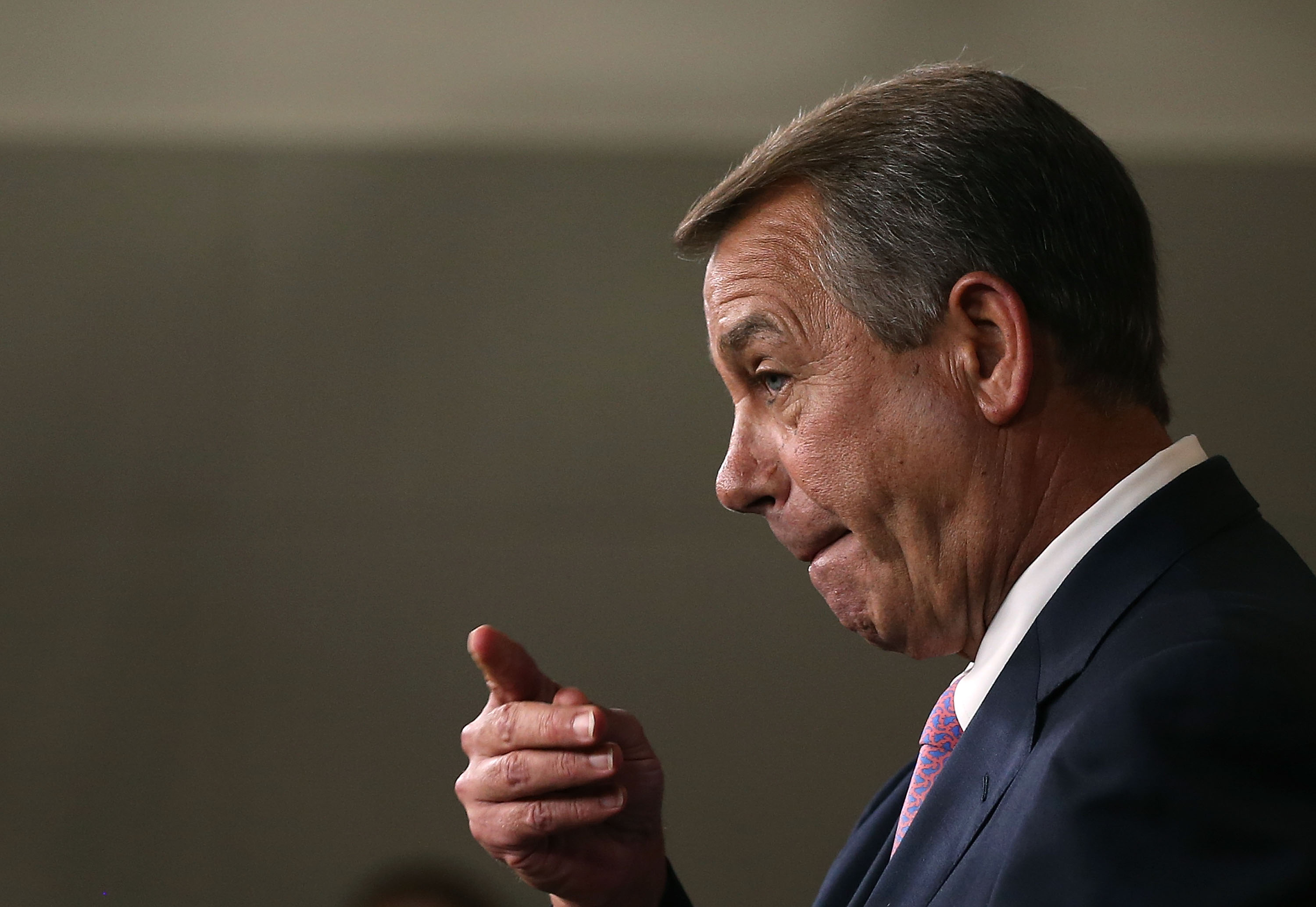
“Some of my Republican colleagues are already saying we won’t raise the debt limit unless there’s repeal of ObamaCare. I’d love to repeal ObamaCare, but I promise you that’s not going to happen on the debt limit. So some would like to set up another one of these shutdown-the-government threats. And most Americans are really tired of those kinds of shenanigans here in Washington,” – Senator John McCain.

What stands out to me – again – is the nihilism of it all. A candidate ran for president on a platform for a right-of-center plan for universal Screen Shot 2013-07-23 at 11.12.09 AMhealth coverage, much more incremental than the Clintons’ proposal, far less statist than Nixon’s, and adopting several conservative ideas – such as the healthcare exchanges which already seem to be bearing fruit in lowering premium prices.

He got it through the Congress, was re-elected solidly, his own party won the popular vote in both Houses … and the GOP in the House is effectively threatening to sabotage the economy and the government’s fiscal stability to cut off its funding. What do they intend to do about tens of millions of people without insurance (or more than ten million people living in this country without papers)? Not a single thing – except bromides against big g0vernment that could have been uttered (and were) in the 1980s.

Screen Shot 2013-07-23 at 11.15.30 AMWhatever else this is, it is emphatically not an opposition party in a democratic system.

It is a nullification party, unable to pass anything itself but endless, fruitless repeals of the ACA, incapable of supporting immigration reform as well as health reform, eager to deny the president even his own executive officials, and abusing the filibuster to make any kind of progress in addressing what few deny are real problems. This is a protest movement – not a democratic opposition. It’s acting out, not opposing.

And its only rationale is to drag this president down, even if it means, as it has, that their own reputation is at record lows. And they are having some small effect as Americans understandably look at Washington’s mess and throw up a little in their mouths.

What can the president do? He’s decided to go out on the trail again urging more action on the economy and rightly touting his economic stewardship as the most effective in the West since the crisis began. He’ll be trying to reach precisely those Americans who need health insurance when the new law comes into effect.

It turns out the election meant nothing to the GOP. Their contempt for the public as a whole – and not just their primary voters – is palpable. And their positive contribution to the issues facing this country and the world are non-existent.

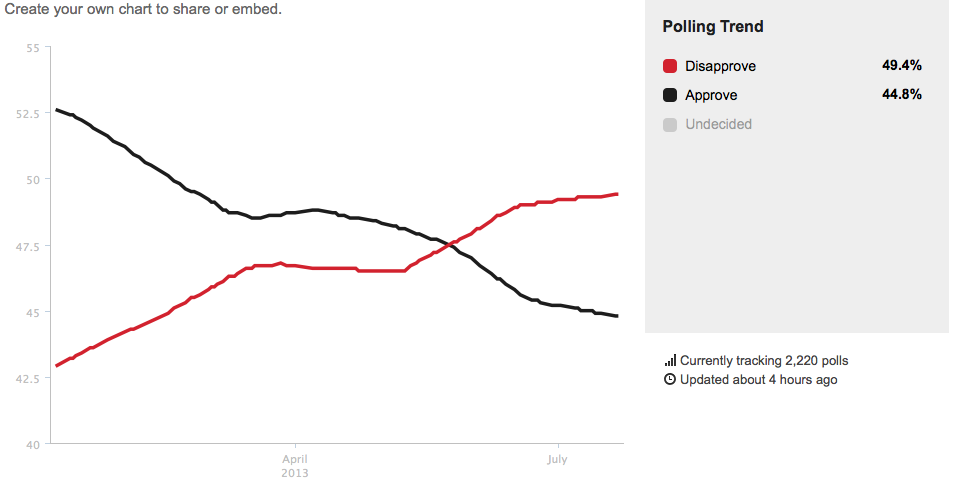
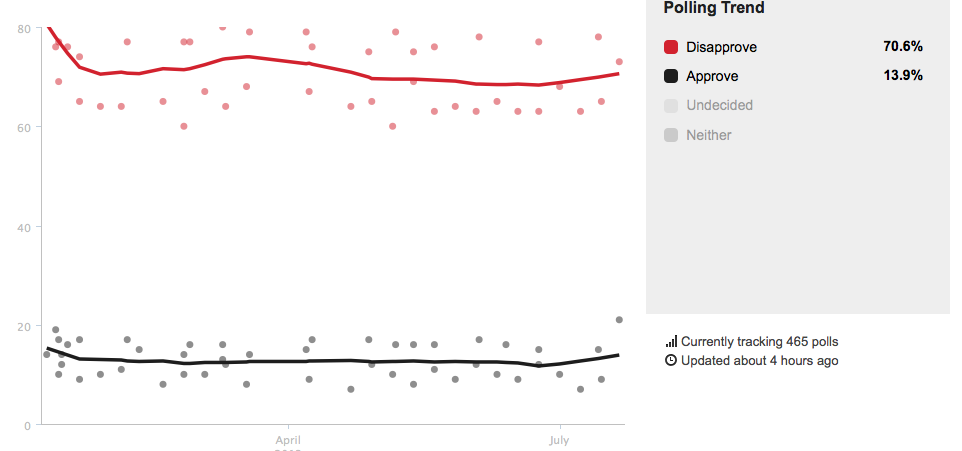
(Photo by Getty. Graphs of Obama’s and the Congress’s approval ratings, from Pollster’s poll of polls.)

Where Are All The Female Atheists? Ctd

Katie Engelhart wants the New Atheists to reach out more to women:

Writers have suggested that the doggedness of New Atheism tends to turn off women—and that, for social reasons, women don’t muster the same militancy when defending their (non)beliefs. Others have looked to sexism within the Atheist community (read: Elevatorgate). A few have made unconvincing references to biology. And some academics blame the fact that churches have pulled a retroactive fast one on history: falsely claiming credit for progress on the women’s front.

Or perhaps it’s all a mirage? In a 2011 article in Bitch, journalist Victoria Bekiempis made the provocative claim that the “showboating [Atheist] boys’ club” is a media construct. She notes that around 2006, several news articles were published describing Dawkins et al. as a “band of intellectual brothers”: Atheism’s bullheaded bro-elite. That image—with its tidy narrative and ready stock characters—stuck. Bekiempis’s advice: “Let’s reframe. For every mention of Hitchens, counter with a mention of Hecht.”

Jennifer Michael Hecht, author of Doubt: A History: The Great Doubters and Their Legacy of Innovation from Socrates and Jesus to Thomas Jefferson and Emily Dickinson, is seen above. Update from a reader:

Don’t forget Madalyn Murray O’Hair! For at least a couple of decades before her mysterious death, she was the face of atheism, certainly in Texas if not nationally. I believe it was her advocacy against school prayer that religious conservatives still use as part of their cultural lamentation.

Previous Dish on women and atheism here.

The Shrinking Of Big Law

Noam Scheiber covers it:

There are currently between 150 and 250 firms in the United States that can claim membership in the club known as Big Law, the group of historically profitable firms that cater to the country’s largest corporations. The overwhelming majority of these still operate according to a business model that assumes, at least implicitly, that clients will insist upon the best legal talent instead of the best bargain for legal talent. That assumption has become rickety. Within the next decade or so, according to one common hypothesis, there will be at most 20 to 25 firms that can operate this way—the firms whose clients have so many billions of dollars riding on their legal work that they can truly spend without limit. The other 200 firms will have to reinvent themselves or disappear.

Yglesias adds that, “while the pace of change obviously seems furious to the people at the center of the storm, the genuinely remarkable thing is how long the Big Law model has lasted—not the fact that it’s fading away.”

The South vs Social Mobility, Ctd

Screen Shot 2013-07-22 at 11.20.59 AM

A reader writes:

Your reader’s reaction (comparing the “black belt” and the NYT map [seen above]) was my first reaction, too. But the article focuses a lot on the issues of social mobility between different cities. Most of the “black belt” is quite rural (these counties may vote deep blue, but their states are GOP strongholds because not that many people live there). Not only are there fewer opportunities in these areas, but the data may be somewhat skewed by smaller response rates. The question is: why do several of the largest and most successful cities in the south (Atlanta, Memphis, Charlotte) have such low rates compared to cities in other parts of the country?

Another sharpens the points of the previous reader:

That’s a fascinating map!  But sadly it speaks to racial division more than simple geography (despite what the NYT article seems to suggest).  That low-mobility corner of Arizona?  The slaves-500x393Navajo reservation. West coast of Alaska? Native Alaskan villages.

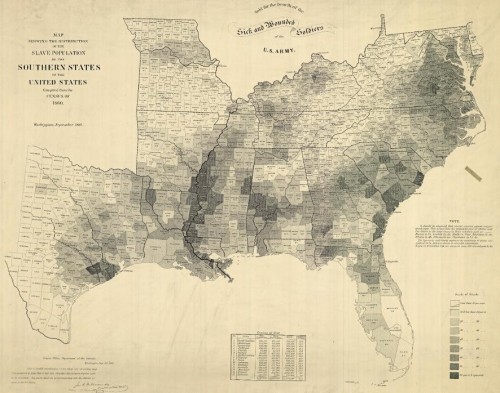
Also, low mobility is not just in “the South”, or even “the deep South”, but in the specific parts that have a high percentage of African-American population: the Mississippi Delta, the black belt of Alabama (so-called originally because of its soil, but it also applies demographically).  Compare the South in the mobility map to this map of county-by-county presidential election results from 2008, which in the South reflects where African-American voters are concentrated.  (Or, for that matter, this map [seen right] of the last slave census, in 1860.)

Oh, that high-mobility patch on the North Dakota / Montana border?  Beats me.

Another has the answer:

I wanted to make a few observations on the mobility map you posted:

1) Manifest destiny is alive and well. The West still provides opportunities for new settlers after all these years. The map demonstrates the West’s promise for a fresh start has not dried up yet.

2) Extractive resources are the best bets for mobility.

The map’s blue tinge in the Bakken in North Dakota and Montana, the gas and coal fields of Wyoming, and West Virginia and eastern Kentucky’s coal country highlight how important that mining, oil and gas, and coal are for large scale mobility. Pennsylvania’s pale interior of Marcellus fracking production also demonstrates this trend. Where can someone right out of high school rise to a six figure income right away without working on an oil rig? Also, these are the industries that will be hurt the most by efforts to mitigate carbon emissions in the face of global warming. More immediately, these trends show how efforts to slow or halt horizontal drilling and hydraulic fracturing act to shut the door on many people’s best chance at mobility.

3) The Ogallala Aquifer is one of our key national resources. The blue strip down the center of the country largely overlays the Ogallala Aquifer, supporting significant corn and agricultural production. This rich source of groundwater has recently gotten a little press in the Keystone XL debate, but this map shows how important the natural resource really is. As of late, concerns have arisen that the aquifer is being mined, depleting the water traveling beneath the nation’s center.

These observations avoid discussion of the Black Belt, the Rust Belt, and Indian reservations, as enough ink is spilled on those topics. However, in our move to a service-based economy, recognition of the natural resource-driven reasons European nations first set forth in conquest still apply today. Gold, cod, and timber (suitable for mast building, at least) have fallen away to oil, gas, and corn, but these resources provide the most opportunity for achieving the “American dream.”

Globalized Gangsterism

Organized crime is on the rise internationally:

Gangsters are cropping up in all sorts of odd places. Criminal syndicates are implicated in everything from the poaching of rare wildlife to the counterfeiting of drugs and manufactured goods. That growing range of activities attests to the criminals’ skill at exploiting the possibilities offered by deepening global interconnectedness. Consider the opening of this story about a recent global raid by Interpol: “More than 6,000 people around the world were arrested in a two-month anti-counterfeiting sweep that netted tens of millions of dollars worth of fake shampoo in China, phony cigarettes in Turkey and bogus booze in Chile.” The investigators discovered everything from a subterranean factory in Ukraine manufacturing counterfeit cigarettes to a workshop in Peru that puts false labels on motors from China.