Once trapped in an elevator with a rent-boy, he’s now set to run the Vatican Bank. And why not? If the Vatican were intent on only hiring straight men to high positions in Rome, they’d always be coming up empty. Which is not to dismiss the absurd, foul, laughable hypocrisy of the entire charade. Just to smile at its lofty and manifestly preposterous pretensions.
Month: July 2013
The View From Your Window

Apaioa, Spain, 10.45 am
Lights Out For Liz Cheney?
Weigel assesses the Wyoming Senate primary:
Harper Polling, the first company to take a temperature in the Wyoming GOP Senate primary, returns with a bevy of bad news for Liz Cheney. In a trial heat with Sen. Mike Enzi, she trails him 55-21. … There’s no way Enzi ends up winning by 34 points, but Cheney has to do an unheard-of amount of damage to him to close in.
Harry Enten believes that Cheney is going to lose:
In order to successfully challenge someone in a primary, you need to be more popular than the incumbent. Enzi is actually the more popular one.
He sports a 76% favorable rating against just 6% who see him in an unfavorable light. Despite being less well known, Cheney has a higher unfavorable rating at 15%. Her favorable rating, meanwhile, is 31pt lower at 45%. That will go up as the campaign goes on, but so will her unfavorable rating.
You might be wondering whether or not Cheney’s connection to her father Dick will help her during the campaign. The former vice-president does have a 58pt net favorable rating, yet that’s significantly less than Enzi’s 70pt net favorable rating. The younger Cheney is going to have to come up with a better strategy than just connecting herself to her father if she wants to win.
Larison thinks that running as a Tea Partier won’t work for Cheney:
To think of this challenge as a Tea Party-style insurgency is to get things backwards. That sort of insurgency requires someone to pose as an opponent of political insiders and a critic of the current party leadership in Washington, and Cheney is neither of these. She might try to use the rhetoric of an insurgent candidate, but it will be impossible to miss that Cheney’s run is backed by outside money and Washington connections. It will be an exceedingly cynical attempt to exploit anti-Washington sentiment in order to entrench a family dynasty in national politics.
Women In The Cannabis Closet

Ann Friedman ponders women’s hesitancy to identify as marijuana users:
In pop culture, “stoner” and “slacker bro” are practically synonymous. The modern slacker-stoner, [professor of sociology Wendy] Chapkis writes [pdf], “resists the conventional expectations of manhood” to be an ambitious breadwinner, as well as the sixties political, countercultural associations with weed. He’s just kinda … hanging out. “The slacker attitude relies on a mismatch between expectation and condition; this is why it is most available to white heterosexual men with some measure of class privilege,” Chapkis writes. “The slacker’s refusal to work hard and assume ‘adult’ responsibilities doesn’t function quite the same way for people of color and women who are already saddled with a stereotype of dependency.”
This is perhaps why so many women are hush-hush about their kush. Most women I spoke with said they didn’t feel they could publicly own up to their marijuana use, even in cases where it was truly for medicinal purposes. “I do not feel part of a ‘weed culture,’” a Canadian woman wrote me. “I am not someone you would ever suspect smokes pot. I’ve always been kind of proud of that fact. I have my shit together.” This sentiment was covered in a great 2009 Marie Claire feature on “stiletto stoners,” women who dominate in the workplace and opt for weed over white wine when it’s time to unwind at home. “One in five women who admitted to indulging in the previous month lives in a household earning more than $75,000 a year,” according to the article.
Previous Dish on women and weed here, here, here and here.
(Photo: Alfredo Estrella/AFP/Getty Images)
The South vs Social Mobility, Ctd
Compare this map on social mobility:
 With this:

A reader observes:
An interesting thing to note about the map: the deep red areas in the South are the so-called “black belt,” the majority African-American counties that remain devastatingly poor. Note that the other deep red areas – northeast Arizona, southern South Dakota – are majority Native American. Interestingly, the white south – Appalachia, Cajun Country and the area around the Gulf, the Florida Panhandle – is not red at all.
To me, it says less about Red State politics (though it still does, indirectly) than it does say about how much harder it is for poor people of color to have a chance to succeed. The Red States seem pretty good about taking care of their white, GOP brethren, even the poor ones – that’s why you’ll note Utah is so mobile.
Also, note the impact of the oil boom in the Dakotas and Wyoming – the turquoise colored counties that go up the spine of Montana/the Dakotas/Wyoming that suggest the huge amount of money that has been pumped into the economies there.
What’s Putin’s Game?
Boycotting Putin over Snowden (a product of our sloppiness) would be silly; over Navalny would be symbolic
— Zbigniew Brzezinski (@zbig) July 21, 2013
Russian activist and Moscow mayoral candidate Alexey Navalny was released from prison on Friday. Masha Lipman expects he will be jailed again in the near future:
His and his co-defendant’s conviction will most likely be confirmed by a higher court. Even if the eventual sentence is shorter than five years, it will still disqualify him as a political candidate. And if the reëxamination of the charges is scheduled for before the mayoral election, on September 8th, the Navalny campaign would have to be terminated midstream. Navalny’s fate is in the hands of Russia’s most powerful decision-makers. But although he remains securely on the hook, right now he’s free—and he’s going to use his freedom to the full.
Julia Ioffe suspects that Navalny was released so he can lose at the ballot box:
If Navalny runs against [current major Sergei] Sobyanin, he will surely lose—in the polls, he still has yet to break into the double digits, and Sobyanin enjoys all the perks of a relatively popular incumbent. Navalny losing is a way to neutralize him. The Kremlin can then say, “Look, buddy, you lost fair and square. You are not a real contender.” But given that the protest movement was basically Moscow’s rage at massive election fraud, the race has to at least appear to be maximally fair. Which is why Sobyanin is going out of his way to help Navalny, even helping Navalny clear the candidate registration hurdle. (This is normally the step where the state neutralizes opposition and keeps them off the ballot.)
Max Fisher’s bottom line:
Don’t bet against the Kremlin. As difficult as it is to know why this has happened, what Russian officials are planning and what will happen next, this is still a high-stakes political case in Putin’s Russia. The end result, however we get there, is unlikely to favor Navalny at Putin’s expense.
Turning Human Beings Into 2.9013
Physicist Alan Sokal, who was last seen demolishing postmodernist pretensions, has set his sights on positive psychology. This time his target is the critical positivity ratio, which blogger Neuroskeptic describes as “the idea that if your ratio of positive to negative emotions is over a certain value, 2.9013, then you will ‘flourish’; any lower and you won’t.”
The concept was laid out in an influential 2005 paper, which according to Google Scholar has been cited more than 950 times. Neuroskeptic explains what Sokal and his colleagues, Nicholas Brown and Harris Friedman, found:
[T]he idea of a single ‘critical ratio’ that determines success or failure everywhere and for everyone is absurd in itself. … But even were there a magic ratio, it wouldn’t be 2.9013. The whole analysis in the 2005 paper was based on taking a poorly-described dataset and then making it fit a mathematical model, purely by means of elementary misunderstandings.”
Of course it drew on 1960s geophysics:
[Study author Marcial] Losada observed positive and negative emotions change over time, and that we can model this process in the form of a Lorenz system. The Lorenz system is a mathematical function famous for being pretty (e.g. ooh!). There are infinitely many Lorenz systems, based on three set-up ‘parameters’, each of which can be any number. It turns out that Losada set two of those three variables to the values used by a geophysicist in 1962, who picked them purely to make a pretty illustration for his paper about air flow.
If you set up a Lorenz system in exactly this way, and set it running, you can get a number out, 2.9013. This number is meaningful only within this particular system, with those particular parameters. Yet by means of an epic series of assumptions, Losada declared this meaningless quantity to be the Key to Happiness and Success.
Mathematicians David H. Bailey and Jonathan M. Borwein aren’t terribly surprised:
From all indications, the Fredrickson-Losada article is an exercise in “physics envy” — trying very hard to dress work in the social sciences, which, by definition, are not closely connected to very precise physical laws and processes, in the exalted language of mathematics and mathematical physics. It is also the case that the whole area of social psychology has been rocked by recent scandals and by a prevalence of sloppy ‘science’. It has been described by Nobel economist Dan Kahneman as a “train wreck waiting to happen.”
But more generally, the lesson for all who would apply mathematics in this or any other arena of modern science and engineering is clear. Mathematics is a powerful tool, but there is no point in attempting to apply it beyond reasonable boundaries, or with a level of numeric precision far beyond what is justified by the original problem in hand. Mathematical excesses can lead to nonsense.
Watch out, David Brooks.
When Is It OK To Detonate A Bomb At An Airport?
Adam Pasick examines the Chinese public’s largely sympathetic response to Beijing airport bomber Ji Zhongxing:
If Ji Zhongxing had set off a hand-made explosive in an airport in most other countries, he would be labeled a terrorist. But Ji, who was protesting a beating by local government officers in 2005 that left him paralyzed and in a wheelchair, is being hailed as a hero by many Chinese social media users. What’s more, officials in Guangdong, where Ji previously ran an unlicensed motorcycle taxi service, have been ordered to reopen his case.
The unusual reaction highlights the fact that many Chinese are becoming increasingly outraged at cases of official misconduct, especially thuggish behavior by municipal urban management officers known as chengguan, who are known for heavy-handed crackdowns against street vendors and other independent businesses. There have been been several high-profile violent incidents involving chengguan in recent weeks, including a watermelon vendor in Hunan province who was beaten to death.
Notably, Ji warned away bystanders before detonating the bomb and injured only himself. Pasick notes that “not all of China’s frustrated citizens have been so considerate”:
In May, a Xiamen man named Chen Shuizong, angry that officials refused to correct an error in his identity documents and give him social security benefits, killed 47 people including himself by setting a public bus on fire. By comparison, Ji was described as a “good person” by social media users, and discussion of his action was not censored by Chinese internet authorities.
That jibes with the response found on Weibo, the Chinese microblogging site:
Most of the comments on Chinese social media expressed sympathy for Ji, seeing him as a victim of social and political injustice. Ji has started writing his experience in a blog since 2006; Feng Chingyang (@风青杨V) reviewed his blog and concluded:
I finished reading Mr. Ji’s blog and found out that he was beaten and became crippled because of running an illegal motorcycle taxi. His family was in debt and they could not get any reasonable compensation after years of petitioning. His parents had passed away and his heart also died with them. I don’t agree with the way Mr. Ji handled his misfortune. However, if we don’t want to see another Mr. Ji in this country, we have to pay attention to the root of matter. He was a normal person in the very beginning, what made him abnormal?
Weibo user “South of the Sea” warned that China can expect more of the same:
All citizens who have faced injustice are a time bomb! To deactivate the bombs, grievances have to be channeled and addressed. Maintaining social stability through political control and repression is a dead end.
The Ten Most Controversial Subjects On Earth
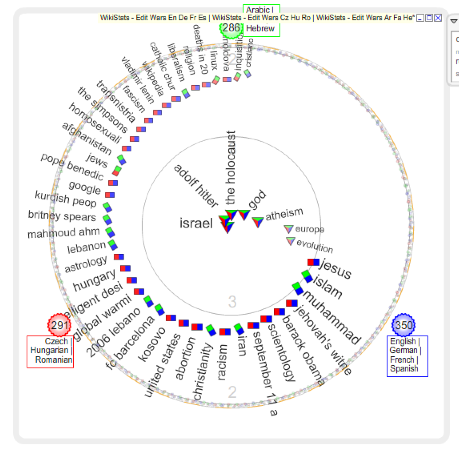
Here are the ten topics (pdf) that have been most contested by armies of editors on the English language version:
1. George W. Bush
2. Anarchism
3. Muhammed.
4. Professional wrestlers and their stats.
5. Global Warming.
6. Circumcision.
7. US.
8. Jesus.
9. Race and IQ.
10. Christianity.
Somehow, the Dish missed the great wrestling controversy and anarchism. But we’ve got the others covered.
The spiral image from above? The combined controversial topics from the English, French, German, Spanish Wikis (blue), Czech, Hungarian and Romania (red), and Arabic, Persian and Hebrew (green). Yes, Israel remains the most controversial and contested topic on Wikipedia across the globe. The idea that the “unbreakable US-Israel” alliance is not a big factor in weakening America’s international leverage is as ludicrous as General Mattis said it was.
Other nuggets from the paper about Wikis around the world: in the Czech Republic, they’re obsessed with gays (1, 5, and 7); in Germany, scientology, homeopathy and Rudolf Steiner; in France, Freud, UFOs, and 9/11.
Ask Ken Mehlman Anything: Talking To Republicans About Marriage Equality
In our first video from Ken, he explains how to talk Republicans about marriage equality, as well as how to counter the most prominent arguments against it:
Ken Mehlman is a businessman, attorney, and political figure who held several national posts in the GOP and Bush administration. He managed Bush’s 2004 re-election campaign, which used anti-gay marriage arguments to win the critical state of Ohio, and subsequently chaired the RNC from 2005 to 2007. After that, Mehlman worked for the law firm Akin Gump Strauss Hauer & Feld, then became the Global Head of Public Affairs at Kohlberg Kravis Roberts, a private equity firm. In 2010, Mehlman came out as gay, making him one of the most prominent openly gay Republicans and a major advocate for the recognition of same-sex marriage. He also serves on the board of the American Foundation for Equal Rights. Our full Ask Anything archive is here.
 The Dish