The Best Of The Dish Today

After the show trial and threatened imprisonment of a charismatic, snarky opposition leader, Putin panicked and shut down Red Square. Huge numbers of protesters showed up on the streets. Tweets and breaking news here; analysis of Aleksey Navalny here.

We examined how the Obama administration intends to sell its healthcare – the same way they sold their candidate. And there was another testament to the quiet wisdom of “Calvin and Hobbes“.

The most popular post was my lamentation of the gratuitous, bitter hatred toward gay couples in the current GOP; the second most popular was this reflection on suicide: often happening to “the very people we most appreciated having around.” Like Kurt Cobain and DFW.

See you in the morning.

How Can The GOP Win Again?

Responding to critics, Sean Trende writes that his thesis “has never been, as some have suggested, that the GOP should ‘double down’ on white voters while writing off non-whites”:

Far from encouraging the GOP to select a particular path, the series simply lays out multiple options for the GOP. Each of them contemplates some improvement with at least one minority group, as well as some shift of the GOP agenda. The best scenario, described in part three, actually involves modest outreach to all groups, majority and minority alike.

From his conclusion:

Whites have become more prosperous over the past 50 years, and income still correlates with Republican voting habits (for Hispanics, non-Hispanic whites and, to a lesser extent, African Americans).

Moreover, Democrats’ decision to embrace policies aimed at their “coalition of the ascendant” cannot be viewed in a vacuum. A case in point is Arizona, a state where Mitt Romney ran about as well as George W. Bush, despite a less favorable national environment. The Hispanic vote there has grown and, given a state GOP that stands as a poster child for how not to attract Hispanic voters, has moved sharply toward Democrats. But the Democrats’ stance on immigration isn’t particularly popular among whites, and whites, especially whites without college degrees, have shifted toward Republicans, resulting in no net change.

The bottom line is that political scientists have been reasonably successful at predicting elections based on a few basic factors. None of them, to my knowledge, includes a demographic variable. If the only relevant demographic change were the growth in the non-white vote, we’d expect these models to take on a pro-Republican bias over time, as a pro-Democratic variable that the models fail to account takes on increased salience.

Nate Cohn goes another round:

Yes, the GOP is making gains with whites and there are missing white voters. But no, the GOP can’t count on current trends or a pool of missing white voters to hand them the presidency. To win, they’ll need to boost turnout, make heretofore unrealized gains among whites in the non-Southern, “blue wall” battleground states, and, yes, they really could use some gains among Hispanics—especially in Florida. If the economic fundamentals are consistent with another competitive presidential election, Republicans might need to make some painful changes to broaden their appeal by so much.

Another Rwanda?

Burmese refugee Ahamed Jarmal, who fled to Bangladesh last year to escape mounting violence, warns that his country is on the verge of genocide:

In Burma, ethnic cleansing is happening. We have seen more human rights violations and attacks on Rohingya minorities in the past two years than in the last 20. Organized in monasteries and on Facebook, a wave of hate is being broadcast against the Muslim Rohingya community in Burma and a new apartheid system is being introduced. My family regularly get called “dogs” or worse when they walk down the street. The government continues to deny us citizenship, telling us this isn’t our home. …

[T]he situation is getting really desperate. Mobs have attacked our villages, driving us from our homes, children have been hacked to death, and hundreds of my people have been killed by members of the majority. Thugs are distributing leaflets threatening to “wipe us out” and children in schools are being taught that the Rohingya are different.

He begs world leaders not to repeat the mistakes of the 1990s:

The only way to stop genocide is to prevent it from happening in the first place. World leaders failed to act 20 years ago in Rwanda, then promised they would never let such horrors happen again. My people are praying they meant it.

Recent Dish on Ashin Wirathu, the Buddhist monk and self-proclaimed “Burmese bin Laden,” here.

And The Greatest American Novel Film Is … Ctd

A reader sticks up for Mario Puzo:

No surprise there’s backlash against the inclusion of The Godfather. Academics and those who think of themselves as literary types can’t give credit to any novel that isn’t either “beautifully” written or previously endorsed by the academic/literary community. It’s easier to harp on sentences and metaphors than to talk about mythic story, plot, character, and theme. And the notion that the movie version of The Godfather was saved from the hack Puzo and created by Coppola’s genius is simply not borne out by facts. Coppola insisted the film be called “Mario Puzo’s THE GODFATHER” because Coppola recognized the power and importance of Puzo’s story. And Puzo co-wrote the screenplay.

I give a great deal of credit to Dr. Ferraro for being willing to think outside of the academic/literary box and giving credit to one of the greatest stories of the century. Most of the books on this list are snoozers, far removed from the reading tastes or interests of ordinary Americans.

Update from a reader:

Literary types!  Oh, noes!

First, it’s worth noting that the reader doesn’t defend Puzo’s writing.  S/he just tries to pretend it doesn’t matter by diverting attention from it to what the previous posts had already readily acknowledged: that The Godfather is a great story.  For my money, though, if something is going to be labeled the Great American Novel, it had better damn well be a great story and be fantastically written.  No amount of story greatness can make up for shit writing, and vice versa.

Nor does the writing need to be difficult or flowery to be great.  E.B. White never wrote a difficult or flowery sentence in his life, but his writing is, aside from the usual contrarians, universally praised for its elegance.  To take his most famous book, Charlotte’s Web is an American novel that has immensely powerful story, plot, characters, and theme; and the writing … well, it’s testimony to the wonderful roominess of the human mind that we can even think of what White did and what Puzo did as the same activity.

Remaking An Iranian Epic

Iranian graphic artist Hamid Rahmanian collaborated with Professor Ahmad Sadri on Shahnameh: The Epic of the Persian Kings, a revamping of a 1000-year-old national legend by Abolqasem Ferdowsi. In an interview, Rahmanian explains why he took on the project:

[W]e wanted to take it out of the hands of the scholars and introduce it to a larger, broader audience. There is an interest in mythology here in the West, particularly, in American. If you go to a bookstore, you can find books on every mythology on earth, but for some reason, Persian mythology seems inaccessible and not represented in the pantheon of world mythologies. Also, many younger Iranian Americans know about Shahnameh but few have read it. We thought this would be a great introduction the text for second generation Iranians who have grown up here in the US, a way to connect to their roots.

Rahmanian also discusses the artwork in the book:

In terms of the illustrations, I’ve taken from over 500 hundred years of the visual culture from Iran and its neighbors, The Ottoman Empire, Central Asia, and Mughal India who were influenced by Iranian painting from the late fourteenth to mid nineteenth centuries. I deconstructed hundreds of miniature paintings and lithographs then wove together thousands of these elements into new illustrations, much like a DJ samples different sounds to create new music. For those who are not familiar with Persian miniatures, it’s a great introduction to the art of that region. For those who know the­ work, it’s a totally new take on something familiar.

Sourena Parham emphasizes the cinematic qualities of the work: “The unique result is a fresh visual narration that makes the ancient text feel as if it is flows seamlessly, like a finely edited film.”

The Gym In A Pill

Richard Gunderman considers the benefits that an “exercise pill” – under development in Florida – might produce:

[W]e would recoup even more time than the two hours we actually spend on exercising. Think how many minutes we spend every week just talking ourselves into it, getting dressed for it, and driving to it. And what about all the after-exercise time – driving back home, showering, getting dressed again, and then sitting in the easy chair contemplating how tired and sore we feel or congratulating ourselves on what good care we take of ourselves.

He also imagines some setbacks:

Some might argue that exercise has benefits that extend beyond mere slimmer waistlines, lower blood pressures, and improved serum lipid profiles. They might point, for example, to the self-discipline required to exercise on a regular basis and lament the fact that Americans need no longer make such a concerted and sustained effort to remain trim.

Moralists among the naysayers might go even farther, attempting to portray the able-bodied among those of us who rely on the exercise pill as somehow lazy or undedicated. The most extreme might even argue that working hard at working out is good not just for the body but for the character, helping us to develop habits of short-term self-denial for the sake of longer-term benefits that they regard as an important feature of the most virtuous among us.

After Peak Oil

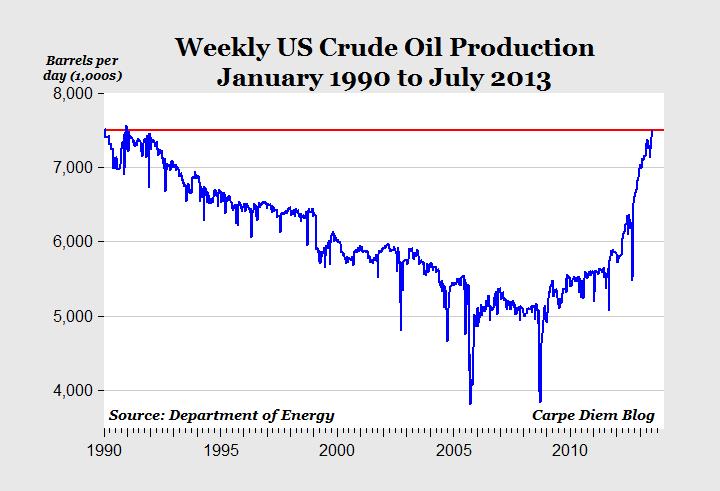
Mark Perry uses this graph as evidence of peak oil’s death:

Crude Oil

Noah Smith isn’t celebrating:

[W]hat happened was NOT that we switched to something better than oil. We switched to something worse than conventional oil: unconventional oil, which is more expensive to extract and/or to refine into usable products. This has left us permanently poorer than we would be if conventional oil hadn’t hit global supply constraints. Filling up your gas tank is twice as expensive now, in real terms, as it was two decades ago. And that looks unlikely to change. …

Basically, what happened is this: Scarcity attacked humanity, and Human Ingenuity battled back. Through heroic efforts, doomsday was averted. But Ingenuity did not win a smashing victory, as it did when we switched from wood to coal, or from whale oil to oil. Instead, humanity was forced into a fighting retreat, with Ingenuity executing a brilliant rear-guard action and forcing Scarcity to call off its pursuit…for now. But humanity has lost ground.

Yglesias backs up Smith:

[Unconventional oil] is nothing to sneer at. Not only is it causing an economic boom in North Dakota and select portions of Texas, but it plausibly explains some of why America’s overall economic performance has been so much better than Europe’s. But even so, America’s oil boom hasn’t pushed U.S. oil prices back down to mid-aughts levels and it certainly hasn’t pushed U.S. oil prices back down to 1990s levels. The good old days of genuinely abundant liquid fuel really do appear to be behind us.

Vaccine Trutherism Is A Disease, Ctd

A reader pushes back on this post:

In 1999, shortly before my first child was born, a relative asked me to take a look at vaccine additives.  In a previous life, I designed investigations of Superfund sites.  I decided to approach this as if I were analyzing dangerous chemicals at a waste site. After a review of all vaccine additives, I decided to take a closer look at the amount of organic mercury in vaccines.  I approached my analysis much like the epidemiologists with whom I worked during my career in hazardous waste management.

What I found was astonishing.

Applying the dosage limits in the EPA’s IRIS database for methyl mercury, I discovered that the vaccine schedule was causing two-month old infants to be injected with 120 times the maximum amount of organic mercury.  Newborns and six-month-olds were also being injected with multiples of the maximum exposure level. While the EPA database did not have data for the exact type of organic mercury in vaccines, it made sense at the time to apply the numbers for the most chemically similar compound.

Since 1999, the FDA has spoken out of both sides of its mouth about ethyl mercury.  On the one hand, it was deemed dangerous enough to be removed from most childhood vaccines.  On the other hand, they have made interesting claims about ethyl mercury being relatively safe, when compared to methyly mercury, despite the fact there hasn’t been any significant analysis of it.  As of today, the EPA has not added ethyl mercury to the IRIS database.  My guess is that due to lack of data and analysis.

The bottom line is that the FDA and the vaccine community have made at least one major mistake as the vaccine schedule has been expanded over the years.  And in my humble opinion, this is enough to question everything about the vaccine program. If we label every person who dares ask simple questions about vaccines a “diseased truther”, the vaccine program will likely go off the rails again, as it did during the 1990s.

A strong counterpoint from a recent NPR piece:

Thimerosal, which contains a form of mercury, was removed from most childhood vaccines in the U.S. and Europe more than a decade ago, amid public fear that it could cause autism. Several large studies later found no risk from the preservative and that removing it did nothing to change autism rates. Now the proposal before the U.N. has public health officials once again trying to reassure people that thimerosal is safe. Three separate papers in the journal Pediatrics argue against an international ban.

“This is critical,” says Dr. Walter Orenstein of the Emory Vaccine Center at Emory University, and an author of one of the papers. “Lives potentially would be lost if we banned thimerosal from vaccines.” Thimerosal keeps vaccines from going bad in parts of the world where other options, such as refrigeration or single-dose vials, aren’t practical.

The proposed ban is part of a larger effort to reduce exposure to mercury, which can affect brain development. And public health experts strongly support most aspects of that effort, Orenstein says. “But when it comes to thimerosal in vaccines, the benefits far outweigh any risks,” he says, adding that a ban could mean the return of diseases that used to kill millions of children each year in developing countries. “Pertussis or whooping cough could really resurge in these areas,” Orenstein says.

But Orenstein and other experts weren’t always so certain about thimerosal. In 1999, they asked vaccine makers in the U.S. to stop using the preservative in childhood vaccines. At the time, some parents of children with autism were alleging that the thimerosal in vaccines caused the disorder. Also, researchers realized that some children could be getting more mercury from vaccines than the Environmental Protection Agency deemed safe. So Orenstein says he and others erred on the side of caution. “At the time, we just didn’t know what the toxic effects might be or might not be,” he says. “And one of our concerns was, what if we did the studies and three years later found there was harm?”

The studies showed just the opposite, though. And scientists also determined that the form of ethyl mercury in thimerosal is far less dangerous than methyl mercury, the form found in seafood.
Ask Michael Hanna Anything: Blaming America

In our final video from Michael, he explores the complicated, often paradoxical perceptions that many Egyptians have toward US influence over their government. He also follows up with some pushback on the idea that US influence in the Middle East is somehow in decline:

Michael Wahid Hanna is a Senior Fellow at The Century Foundation, where he works on issues of international security, international law, and US foreign policy in the broader Middle East and South Asia. He appears regularly on NPR, BBC, and al-Jazeera. Additionally, his Twitter feed is a must-read for anyone interested in Egyptian politics. Our ongoing coverage of the current events in Egypt is here. Michael’s previous answers are here. Our full Ask Anything archive is here.

Chart Of The Week, Ctd

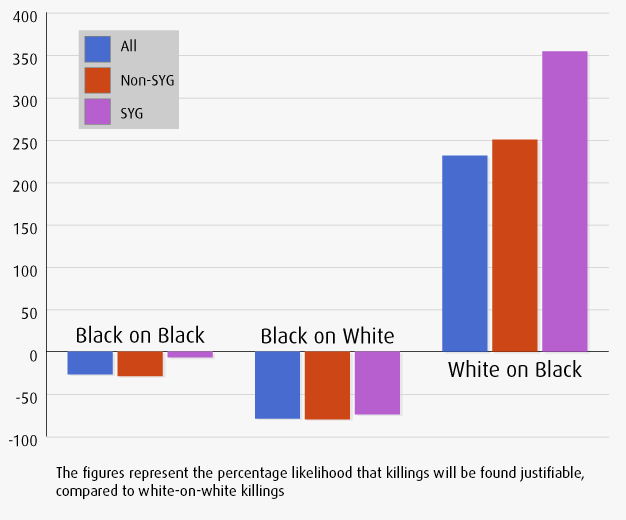
John Roman emails the Dish:

Many thanks for featuring my data. I noted the critiques you highlighted and wondered if I might respond. A reader was concerned that the small number of cases that look like the Zimmerman 11case nullify the analysis. To clarify, the 23 cases are cases where there is a single victim, a single shooter, they are strangers, neither is law enforcement, a handgun was used and the shooter was older than the victim. It’s not a sample of those kinds of cases – it’s every single one in the five years of FBI data. To generate the data in the chart, I ran a regression model, which includes about 5,000 other cases that did not share all of those attributes, so the overall sample is about 5,000, not 23, which is great for a social science dataset. There is no data about income in the dataset and unfortunately nothing about the setting where the shooting occurred (residence, business, street), but I controlled for everything else available.

The bottom-line is, I would have preferred to have conducted the data analysis your readers were looking for, but those data simply are not available anywhere. And I agree with them that my analysis is not sufficient to make any causal statements.

However, I do note that in a criminal justice system rife with disparities – blacks are disproportionately more likely to be stopped and frisked, to have the cars searched at a traffic stop, to be convicted and to receive longer sentences – this disparity dwarfs them all. So, it’s certainly worth discussing.

Robert VerBruggen joins the discussion:

I saw your post about the Stand Your Ground chart from the Urban Institute, and I just wanted to note a few other points I made at RealClearPolicy. Specifically, the overall racial difference (i.e. white-on-black homicides being more likely to be ruled justifiable in all states, SYG or not) might be explained by two factors – one, according to FBI data, black/white violent crimes are more likely to involve black offenders and white victims, so whites are presented with more opportunities to commit justifiable homicides against blacks than vice versa; and two, whites are more likely to own guns, so they’re more likely to have the means to commit justifiable homicide when they have the opportunity.