A helicopter on crack:
Month: July 2013
Why Do We Buy TV In Bulk?
Derek Thompson argues that, for the TV industry, “live sports is the keystone keeping the roof from collapsing”:
Networks have recognized that sports has unique social currency in live viewing, and they’ve stormed the marketplace in the last few years, throwing egregious sums of money in exchange for exclusive deals. Those costs are trickling up. As Patrick Hruby explained, “big time sports are taking a minimum of $84.90” out of each family’s budget even if they don’t care about sports. This amounts to a “sport tax” on families forced to pay for something they don’t watch. Cable companies sensing this backlash are starting to resist new sports networks. There is even chatter about what would happen if sports existed on a separate “tier” that untied the Gordian Knot of TV.
In a follow-up, he finds that TV a la carte is likely to be more expensive than the bundle. Relatedly, Meghan Neal believes that Google could threaten the cable companies:
Google’s certainly been lining up the resources to offer an All Access television experience. It has original programming on YouTube, TV shows and movies on Google Play, and the Google TV software (albeit in need of a redesign) to aggregate and manage the content while also looping in online streaming sites like Netflix and Hulu.
That’s a decent hand, but Google Fiber is the ace up the sleeve. The high-speed broadband and digital cable service is available in select cities, already offers a robust lineup of channels, including, for an extra fee, HBO. As of now most people still have to pay Comcast or Time Warner for broadband internet, which incentivizes their cable packages. If the fiber-optic network spreads nationwide, it’ll be the biggest threat to the cable giants in decades.
Kirsten Salyer adds:
Just don’t cancel your cable subscription yet. Google had discussions with media companies about a similar service about two years ago, without luck, and it’s not clear how far along plans are today, or when it would launch. There’s no guarantee Google could get the licensing deals it would need to put together a service that could compete with cable and satellite providers. Media companies might be reluctant to upset existing contracts in favor of a new online service and are generally more likely to give the best prices to providers with large numbers of subscribers.
“Even If You’re A 300-Lb Black Kid, You Still Wanna Be Calvin” Ctd
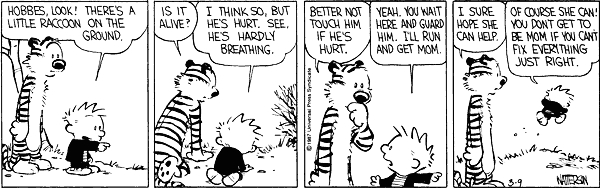
This post sparked a somber memory from a reader:
I was 32 years old when my little brother, just 28, died suddenly from injuries he sustained in a fall while hiking in early March, 1987. I was surprised by the comfort I found in this Calvin and Hobbes series from the same month and year, where Calvin finds an injured raccoon and tries to save him, and how he articulated exactly what I was thinking about my own real loss: “But he’s not gone inside of me” and “What a stupid world.”
Update from a reader:
I also remember that particular sequence in C&H vividly. And the key: Watterson never shows us the baby raccoon. We fill that in emotionally ourselves, with someone or something we loved and lost.
The Campaign To Sell Obamacare
Yglesias emphasizes its importance:
The people most in need of health care services will presumably be the most motivated to sign up expeditiously on their own. From a humanitarian viewpoint, that’s fantastic. From a program stability viewpoint, however, it’s a bit of a problem. The state officials running marketplaces—and the federal ones running the marketplaces in the large number of GOP-controlled statesthat have refused to set up their own marketplaces—face the challenge of enrolling enough young and healthy people to create balance. The Congressional Budget Office estimates that out of the approximately 20 percent of the population that’s currently uninsured or insured on the individual market, about 7 million people will sign up for an exchange plan in Obamacare’s first six months. The administration believes that in order to make the math work, out of that 7 million, about 2.7 million enrollees should come from the 18-to-30 age bracket.
To get the job done, they have essentially three arrows in their quiver: campaign-style demographic targeting, partnerships with people outside the formal federal health care apparatus, and substantial subsidies.
Ezra Klein and Sarah Kliff detail the administration’s strategy:
Can the federal government convince young, healthy people to buy health insurance?
[David] Simas [director of public-opinion research and polling for President Obama’s reelection campaign] is focusing his formidable analytical resources on understanding this group. He begins clicking through a Powerpoint that holds reams of data on these young adults. “What do we know about them?” he said. “They’re overwhelmingly male.” Click. “They’re majority nonwhite.” Click. “One out of every three lives in California, Florida or Texas.” Click. “We have census maps breaking this down into the smallest geographic units.”
A couple more clicks and Simas is showing which television channels they like to watch (Spike TV, among others), which social media platforms they use (Twitter and Facebook), and who they listen to (“No surprise. It’s mom.”). “We can figure out the message that works best for this group,” Simas said.
The focus on young, minority voters. The heavy reliance on microtargeting. The enthusiasm about nontraditional communications channels. The analytics-rich modeling. It sounds like the Obama campaign. And administration officials don’t shy away from the comparison.
Ask Frederic Rich Anything
Frederic Rich is an American lawyer and the author of a new novel, Christian Nation, which imagines an America in which McCain won the 2008 election and subsequently died, making a certain former half-term governor the president. From the publisher:
When President McCain dies and Sarah Palin becomes president, the reader, along with the nation, stumbles down a terrifyingly credible path toward theocracy, realizing too late that the Christian right meant precisely what it said. In the spirit of Philip Roth’s The Plot Against America, one of America’s foremost lawyers lays out in chilling detail what such a future might look like: constitutional protections dismantled; all aspects of life dominated by an authoritarian law called “The Blessing,” enforced by a totally integrated digital world known as the “Purity Web.” Readers will find themselves haunted by the questions the narrator struggles to answer in this fictional memoir: “What happened, why did it happen, how could it have happened?”
To submit a question for Fred, simply enter it into the Urtak survey after answering all of the existing questions (ignore the “YES or NO question” aspect and simply enter any open-ended question). To vote, click “Yes” if you have a strong interest in seeing him answer the question or “No” if you don’t particularly care.
Who Is Aleksey Navalny?
Source high up in Interior Affairs Ministry: Navalny to be released tomorrow
— Ilya Mouzykantskii (@ilyamuz) July 18, 2013
If true, this is a massive win for today’s protestors.
— Ilya Mouzykantskii (@ilyamuz) July 18, 2013
Julia Ioffe’s profile is well worth a read:
“He’s a natural-born politician,” Masha Lipman, a prominent Russian political analyst, told me at the time. “If Russia were a country with an open-field political competition, he’d be assured of a brilliant political career. He might even become a Presidential candidate.”
But this wasn’t Navalny’s main asset. Unlike every other person in opposition politics during the Putin era, Navalny understood that Putin was not Russia’s main problem. Rather, the problem was the post-Soviet culture of greed, fear and cynicism that Putin encouraged and exploited. Navalny carefully distanced himself from the shrill, old-guard Western-friendly liberals—“hellish, insane, crazy mass of the leftovers and bread crusts of the democracy movement of the eighties,” he called them—who simply participated in Putin’s cult of personality in reverse, for it is also cultish to believe that one man is responsible for all the evil in your country.
Masha Lipman reviews Navalny’s accomplishments:
Navalny had managed to do what nobody else had: he beat the system Putin had put in place to effectively bar any unwanted figure, group, or party from entering the political realm. He built a following in a country where mass-media outlets are under tight government control. He took on Russia’s high-ranking officials and large companies. He encouraged others to act. Don’t just rage and grumble over the government lawlessness and corruption, he would say; do what I’m doing—pore over the official postings on government procurement, and you’ll find plentiful evidence of corruption. He thus gave those who joined his effort a sense of “We can get them”—rare in a country where “Nothing depends on us” is the pervasive perception.
Face Of The Day
Russia jails anti-corruption activist; President Putin denounced as dictator by critics http://t.co/iwLCnaXDdn pic.twitter.com/9HZ0f0Kis3
— Reuters World (@ReutersWorld) July 18, 2013
Racism And Richard Cohen’s Reality, Ctd
More readers talk about overcoming their discomfort of neighbors of a different race:
I’d like to add my $.02 to the thread, from personal experience. Years ago, I was assaulted in my apartment in L.A. At least ten of my white friends either assumed or asked if my attacker was black. I told them no – the only black guy around was my big, scary-looking neighbor who rushed to my rescue when he heard me screaming. When the attacker was caught, he turned out to be (a) a serial rapist, suspected in hundreds of crimes and (b) a white, married Mormon. I hadn’t thought much about racism up to that time, but the lesson couldn’t have been more clear, and I’ve never forgotten it.
Another reader:
A few years ago, I lived in and around NYC jumping from sublet to sublet with two travel suitcases and one condition: $500 rent. This brought me to a plethora of places I had never experienced in college: Harlem, the Bronx, Queens, etc. And my Mom was terrified. And honestly, I was too. A child of the ’80s, I had grown up with the firmly held belief that New York was a war zone. This was on top of the fact that I lived in closet spaces that had a curtain (or hung up sheet) in place of a door.
But money was tight, so I just buckled up. And after a few months, it barely even registered. I felt safe – safer than I had ever been. At first, I wrote my parents off as paranoid, but over time I began to realize that things just used to be a lot worse.
Having said that, I’ve never erased the dread that seeps in when I find myself on an empty street – late at night – with a stranger my brain identifies as poor, male, and non-white. But there’s a difference between having that fear and acting on it – and certainly institutionalizing it. I could concede to Cohen that his idealized version of racial profiling could reduce even more crime, but like terrorism, there is a point where pure, practical security infringes upon liberty and justice for all.
Another:
I currently live in Crown Heights, a notable, new and exciting (and “gentrifying” – wink, wink) part of Brooklyn.
There’s still lots of black people here, and I hope it stays that way. There’s some tension in that regard, but I like to think the twenties to thirties-something white folk (and rough white equivalents – Asians/Indians like myself) and the black folk of all ages get along pretty well. There’s one bar in particular around here that’s known as a very mixed spot and it’s always a great time and no one – white or black, Asian or Jew – fears being shot. New York’s gun laws must help – so too, I will admit, the city’s policing tactics. NYPD is everywhere, but not in a very conspicuous way. It’s very smart, and I honestly admire their tactics, in this regard at least.
Some of the black people in my neighborhood are undoubtedly “thuggish” to the outside world. Sometimes they stand in groups of 8-10 dudes, maybe a few chicks, and they are not dressed in corporate attire. I’m not going to pretend some uneasiness didn’t cross my mind the first few times I walked through such groups of people. But I got over those feelings very quickly and now it’s like whatever. Sometimes I hear echoes of those feelings whenever my parents ask me if living in Brooklyn is safe, which makes me cringe every time I hear it. Granted, I’m a tall brown dude myself. But all the white girls I know, including my roommates, travel pretty long distances on foot at night without any trouble.
So I understand the feeling Richard Cohen is describing, but so do most people, and we all got over the feeling very quickly. That’s why Ta-Neishi is so spot on with calling it banal racism. Yes, we all sometimes feel afraid around people who are unlike us. That’s almost the most uninteresting point ever made. The interesting part comes in learning to overcome that feeling.
Another:
There is a video that has been making the rounds lately, and if memory services, The Dish featured it [we did]. It’s of Dustin Hoffman being interviewed about his role in Tootsie. He makes the point that society’s stereotypes about what a woman should be had “brainwashed” him into cutting himself off from meeting many, many interesting people. That idea also applies to race.
In the past two weeks in Denver, I have been checking out at a grocery store and a Target, and black ladies were the checkers. They were warm and I just felt that they were very loving people. When I was younger I had a lot of black male and female friends, mostly acquired by playing sports. I loved being around these friends. I don’t know what it was, but they were just warm and full of heart and funny. Not that my other white friends weren’t also, but it was different.
Now that I am a middle-aged white guy with a family, I find that the opportunities for those friendships are simply not as easy. It’s like after school – high school and college – my path just does not cross with blacks. And I really miss them and that opportunity.
They’ve Shut Down Red Square!
VIDEO: Thousands protest #Navalny verdict in Moscow, dozens detained http://t.co/hmpnWHfEUH
— RT (@RT_com) July 18, 2013
Mass protests have broken out in Moscow following the show-trial conviction of opposition leader and Moscow mayoral candidate Alexei Navalny, whose final update on Twitter urged supporters to congregate at Manezhnaya Square. Tweets from the scene:
58 detained at Moscow protests so far; 32 in Petersburg http://t.co/kKAU9gS9RM
— tom balmforth (@BalmforthTom) July 18, 2013
https://twitter.com/ilyamuz/status/357882813468512258
Activists have stuck Navalny stickers all over the entrance to the State Duma http://t.co/ERLGkgD71j via @TimurKhorev
— tom balmforth (@BalmforthTom) July 18, 2013
Navalny supporters have crawled to 2nd floor of Duma RT @nikbatalov: Залезли на второй этаж Госдумы pic.twitter.com/oNGXh1XHCa
— Ellen Barry (@EllenBarryNYT) July 18, 2013
Of course, there have been indications of censorship:
https://twitter.com/ilyamuz/status/357859509856772096
And some ironies:
LOL. Russian Ambassador at #UN speaks about important influence of #Mandela. On the day that #Navalny is jailed. http://t.co/J48x6ZxZeJ
— Frank (@FrankAlserda) July 18, 2013
A bus of very confused-looking Chinese tourists goes past. Probably wondering why Navalny protesters not been arrested yet
— max seddon (@maxseddon) July 18, 2013
The situation is developing rapidly:
Within the last hour – and within hours of the start of the street protests – the regional prosecutor’s office announced that it had appealed Navalny’s detention. Navalny had announced earlier today that he would drop his mayoral campaign, but just minutes ago, RT reported that Navalny would in fact continue to run if released. It remains unclear how this news will affect the demonstrations, if at all.
Meanwhile, the European Union, the US ambassador to Russia, William Hague, and Mikhail Gorbachev have expressed concern about Navalny’s five-year sentence, and Russian stocks have tumbled following the news. Arrests have been reported in Moscow and St. Petersburg. Daniel Sandford reports that Navalny was defiant at the sentencing:
In his closing remarks to the judge, Alexei Navalny was unrepentant. “We will destroy this feudal society that is robbing all of us,” he raged. “If somebody thought that on hearing the threat of six years in prison I was going to run away abroad or hide somewhere, they were mistaken. I cannot run away from who I am. I have nothing else but this, and I don’t want to do anything else but to help my country. To work for my fellow citizens.”
Navalny supporters say the election campaign will continue even if he is jailed. “This can’t go on forever,” he added. “A situation in which 140 million people in one of the biggest and richest countries in the world are subjugated by a handful of worthless monsters. They are not even oligarchs, who built up their wealth through shrewdness or wisdom. They are a bunch of former Komsomol activists, turned democrats, turned patriots, who grabbed everything into their own hands.”
The Economist says the conviction likely won’t be the end for Navalny:
Although only half of the country knows anything about the case against Mr. Navalny, most of those who do see it as retribution for his anti-corruption campaign, not as a way to stop him running for election. Yet jailing him for five years will mean that Sergei Sobyanin, the incumbent mayor, wins a tainted vote on September 8th. As it happens, Mr. Sobyanin was ahead of Mr. Navalny in the polls, partly because Muscovites see the role of a mayor as administrative, not political. Indeed, from a political viewpoint Mr. Navalny could have been hurt more by an apparent defeat in a mayoral election than by being sent to jail. …Mikhail Khodorkovksy, a former oil tycoon who challenged Mr. Putin over corruption in 2003, has been in jail ever since and is unlikely to come out even when his second term expires next year. Mr. Navalny’s sentence is also unlikely to be his final one. But as he himself said, “If anyone thinks that I or my colleagues will cease our activity because of this trial…they are gravely mistaken.”
The Interpreter and Radio Free Europe/Radio Liberty are live-blogging. Live-feed here.
People aren’t going home. And it’s lovely weather and stays light til 11pm.
— Miriam Elder (@MiriamElder) July 18, 2013
When Can A Fetus Feel Pain?

Ronald Bailey reviews research on the subject. On the one hand:
[Dr. Maureen Condic, an associate professor of neurobiology and adjunct professor of pediatrics at the University of Utah School of Medicine] does acknowledge that the “long-range connections within the cortex that some believe to be required for consciousness do not arise until much later, around 22-24 weeks.” But she believes that the fetal neural structures needed to detect noxious stimuli are in place by 8 to 10 weeks of development. She further asserts: “There is universal agreement that pain is detected by the fetus in the first trimester. The debate concerns how pain is experienced, i.e., whether a fetus has the same pain experience as a newborn or an adult would have.”
As evidence that it is possible to feel pain without a cortex Condic cites the fact that children born without a cortex and animals whose cortices have been removed will withdraw from pinches, burns, and so forth. As further evidence for fetal pain, Condic cites studies showing that various medical treatments applied to fetuses in the womb boost their stress hormone levels.
On the basis of this evidence, Condic contends, “Direct experimental evidence from adult humans contradicts that the assertion…that mature pain perception requires cortical circuitry.”
On the other:
The RCOG’s report, Fetal Awareness: A Review of Research and Recommendations for Practice was issued in March 2010. “In reviewing the neuroanatomical and physiological evidence in the fetus,” it found, “it was apparent that connections from the periphery [of the fetal body] to the cortex are not intact before 24 weeks of gestation and, as most neuroscientists believe that the cortex is necessary for pain perception, it can be concluded that the fetus cannot experience pain in any sense prior to this gestation.” In other words, while fetuses can react to pain, at the 24-week stage of brain development there is no subject present that is capable of experiencing pain.
(Photo: A 19 weeks old fetal bone development is displayed in VAM Design Center of Budapest on April 2, 2012 during an exhibition of the ‘Bodies2’. This unique exhibit is a display of several authentic human specimens, including whole bodies, individual organs and transparent body slices preserved through a special process called plastination. By Attila Kisbenedek/AFP/Getty Images.)
 The Dish