[The Department of Homeland Security] has helped create institutional inertia: Its very existence suggests the domestic response to the threat of terror is of equal weight with defense, transport, health, labor, or foreign affairs. It heaps largesse on a range of contractors, all of whom have an interest in hyping the threat of terror to ensure the money keeps flowing.
That’s unfortunate. Beyond the waste of money and the overregulation, the expansion of the homeland security state has created unnecessary fear among a population that should be able to trust its government to send accurate signals about risk. So let’s start sending the right signals. Shut down the DHS, and redistribute the agencies under its umbrella back to other departments, including the justice, transportation, and energy departments. Then start bringing their budgets into some sort of alignment with the benefit they provide.
[T]hough Kenny’s case against security theater is well-taken, it’s not clear to me that we would yield significant dividends from a deconsolidation of DHS. Though there is a compelling case that we should never have created the agency in the first place, striking a symbolic blow against a culture of fear is not quite enough to merit the expense of yet another reorg.
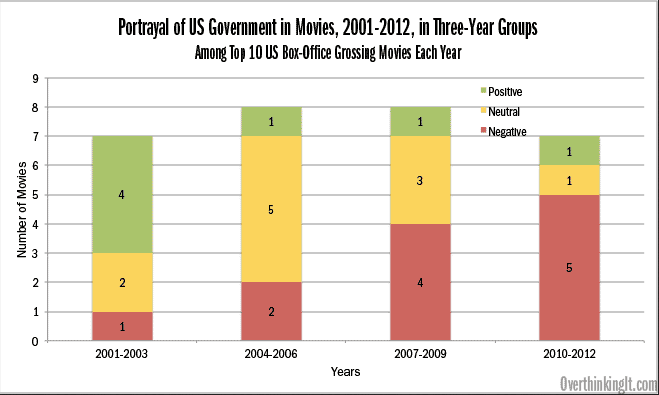
Mark Lee illustrates the increase of Hollywood movies portraying government in a negative light, linking it with Americans’ rising distrust of Washington in the real world:
The theory is that, in the years since 9/11, America has grown increasing disillusioned with its government due to its repeated shortcomings–Afghanistan, Iraq, Hurricane Katrina, the Great Recession, Congressional gridlock–and that Hollywood movies have reflected this disillusionment with more and more stories that involve rogue heroes operating outside of, or in some cases, directly against, the authority of the US government.
Both of these trends feel right on a gut level. Who among us isn’t more cynical and distrusting of the United States government now, compared to 12 years ago? And doesn’t Independence Day, in which the US government unequivocally saves the day, feel dated and corny compared to movies like The Dark Knight Rises and The Avengers, in whichnon-state actors rise above the pettiness of governments to get the job done?
Recent Dish on the appeal of anti-government cinema here.
Another reason why inactivity is an integral part of watching baseball was summed up by Robert Benchley: “One of the chief duties of the fan is to engage in arguments with the man behind him.” Watching baseball by yourself is entertaining only in proportion to your understanding of the subtleties of the game; but watching in a group or crowd inevitably turns into conversation, and it becomes the most convivial of spectator sports.
On that note, another sends the above video to defend the sport’s stasis:
At 300 feet away from the batter and the pitcher, you can have this interaction with the right fielder.
Another reader:
Here’s something that drives me crazy when people complain that there’s too much inactivity in baseball, and that it is thus boring. There are far fewer “time outs” than people realize, especially when there are runners on base. When the catcher tosses the ball back to the pitcher? Time’s in. If the catcher overthrows the pitcher, or throws it back too slowly, or the pitcher drops the ball, the runners will advance. When the pitcher is looking in at the catcher to get the sign? The runners can take off. If there’s a runner on second and the third baseman is playing too far from the bag to cover a throw from the catcher? Again, there goes the runner.
And all the while, infielders are shifting from one spot to another, to induce the runner to take too big a lead so that he can be picked off, or to hold him closer to the bag. Plus, the batter and runners take signs from the third base coach that are flashed too quickly for spectators to take notice, and the pitcher and catcher are changing sign sequences to keep their communications secret, often with instructions from the dugout.
Nothing going on? Bullshit.
Another:
Lowen Liu asks, “What other sport teases your attention in this way, dares you to look away, to yawn … ?” The answer is professional football.
There is almost 60% more action in a three-hour baseball game than a three-hour football game. According to a Wall Street Journal study of four games from week 16, the average NFL game features just 10 minutes 43 seconds of action. Commercials account for nearly 60 minutes of the three-hour affair. And when the networks are showing the game, the bulk of the time is spent either on replays or shots of players huddling, in pre-snap formations or “milling about.”
Another adds:
Sometimes the NFL game clock continues counting down while bunches of players or referees get together to have a chat. And then in a close game, just when the drama should be at its peak, the offensive team with a lead (and sometimes even a narrowly trailing team with the ball) is given an incentive to stand around doing nothing for half a minute every time it starts a play to run down the clock. Stand around, stand around, wait, count 35 seconds, then snap! And then 22 men spend 10 seconds sprinting maybe 40 feet each. Usually less. Then walk around a bit, get back in line, and wait for it, wait for it, have we counted to 35 yet? And repeat.
Ugh.
As a born-and-bred Midwesterner, I never questioned the constant action of the game my family watched every Sunday … until I caught games from the 1998 World Cup on TV. When the NFL season began a few weeks later, I couldn’t stop noticing, and being hopelessly bored by, the long stretches of nothingness that actually characterize the American game. Not that I became some huge soccer fan, but American football, with its endless committee meetings and appellate court proceedings and “athletes” who often play only a few dozen seconds per week, quickly became too boring for me to watch. When I kept a stopwatch of actual game-playing action a decade or so ago, I kept coming up with a figure of about 1/8, or about 88% downtime.
Don’t get me wrong – a football game is great background noise for a party. But to sit down and spend three hours paying attention? Give me a baseball game any time, or hockey, or even, yes, the one-and-a-half soccer games that can be played in the same span.
Another looks to another sport:
Lowen Liu claims that part of the beauty of baseball is the down time. So I guess Test Match Cricket, played over five days; with meal, drinks and sleep breaks in between; where attending any one day of play does not guarantee you will see all the players on the field (or even see the match reach a conclusion); and a two-hour nap wouldn’t matter a jot; then Test Match cricket must be THE beautiful game!
Of course the five-day limit is a modern adjustment – they used to play on until there was a winner. In Durban 1939, England played South Africa for ten days, until they were forced to call it a draw because the ship was leaving to take the England team back home! Now there’s a game with down time …
[T]here are not, and never have been, any new versions of the old Jesse and Al. Not a single young preacher or politician has even started to acquire national influence by taking a page from their old playbooks. The times have changed. If the more pessimistic strains in black America can be slow to fully acknowledge progress, we can take heart from the fact that Al Sharpton will be 60 next year, and a young version of his young self is now inconceivable as a national figure.
After moving to France with her child and confronting a brutal job market for mothers, Claire Lundberg asks how “a country that is so outwardly progressive [is] still plagued with such basic workplace inequalities”:
While France has a wonderful safety net for women, much of it is designed to promote the growth of families as a way of boosting the birthrate. Indeed, families in France receive numerous supports and subsidies the more children they have. A family with two children is eligible for an automatic monthly stipend of 125 euros, regardless of income. With three children, a family is designated a “Famille Nombreuse,” which includes a raise in the automatic stipend, a possible further subsidy of up to 500 euros a month for the mother if she chooses not to return to work, and even reduced admission for transportation, museums, and amusement parks. And, at four children, a woman becomes eligible for the “medaille de la famille,” an honorary medal from the French government.
Family-friendly socialism, [scholar Kay Hymowitz] notes, does seem to encourage more women to stay in the workforce after they have children. But it also helps explain the persistence of “the glass ceilings, as well as stubbornly large wage gaps in more progressive countries,” because working women tend to be shunted more decisively onto a mommy track than they are in the United States. And it shunts them in other ways as well: To borrow an insight Neil Gilbert, the author of one of the must-read books on this topic, the social-democratic combination of high tax rates and a large state-run caregiving apparatus creates a strong economic incentive for mothers to leave their children with professional caregivers while taking a job … as a professional caregiver. This boosts workforce participation and G.D.P. — but whether it boosts actual female welfare seems at least somewhat debatable.
Odra Noel’s “Map of Health,” on display at the Royal Society’s Summer Science Exhibition in London, illustrates the diseased tissues that most affect each part of the world:
Robert Gonzalez calls the piece “a weirdly beautiful combination of epidemiology and microscopy”:
North America, plagued by its obesity epidemic, is depicted as adipose tissue (fat). Central and South America are represented with pulmonary tissue, reflecting the lethal impact of smoking and respiratory illness in the region. Europe and Russia, their aging populations more susceptible to neurodegenerative diseases, are depicted with brain tissue; East Asia and the Pacific are represented with pancreatic tissue, which is affected keenly by diabetes. Much of the Middle East and central Asia, where cardiovascular diseases are on the rise, are painted with microscopic representations of heart muscle. Africa, where transmittable infections like malaria and HIV pose enormous challenges to public health, is depicted with blood cells. All data was taken from statistics gathered by the World Health Organization.
Cities are problems for authoritarian control, the traditional narrative goes, because by concentrating large masses of people, they improve communication networks, allowing anti-establishment sentiment to spread. In physical terms, dense neighborhoods are also ideal centers of resistance, easily blocked by barricades and featuring plenty of hiding places. To counter this, the wide boulevards of capitals like Washington, Paris, and Beijing have a practical as well as aesthetic purpose: allowing easy movement of police or the military in times of civil disturbance.
[Ohio State Professor Jeremy] Wallace argues that authoritarian regimes typically lavish attention on big cities over rural areas, knowing that this is where resistance is likely to take root first. But, he says, these efforts can ultimately be counterproductive as they encourage more people to move to cities. This is likely to be an issue in coming years for rapidly urbanizing China, which has typically taken the thousands of rural village protests that take place each year far less seriously than any sign of organized opposition in major cities.
Could the party really remain in thrall to the God, guns, and anti-government brigade until Ronald Reagan returns to save us all from eternal damnation? That’s doubtful. Clearly, though, the adjustment process is going to take more time. How much more? At this stage, it is looking like at least another four years—time enough for the party to suffer a third straight crushing defeat at the Presidential level. Based on history and common sense, that will probably be enough to give the reformers the upper hand. With today’s G.O.P., though, you never can be sure.
[I]nstead of grappling with what Bush did wrong, they have spent a lot of their time inventing a mostly fictional Obama record to run against. Making some changes on foreign policy–even superficial and rhetorical ones–seems an obvious way to address one of the party’s serious weaknesses, but there has been no movement on this except among a handful of members of Congress. The point here isn’t that foreign policy reform would be a panacea for the GOP or that it would remedy that many of the party’s electoral weaknesses, but that it is one of the more glaringly obvious opportunities for reform and a relatively easy way to break with the disasters of the Bush years. Despite that, there seems to be very little interest in it.
Kilgore explains such lack of interest, noting that the Republican coalition includes many people who don’t agree with the conventional wisdom “on how to win elections, don’t care about short-term political implications, or don’t care about anything other than expressing their opinion about the hellwards direction of the Republic and perhaps of the human race”:
Mix in another significant number of people with a large pecuniary interest in reactionary politics, and you have a movement that’s not going to turn from its current trajectory with any great speed. You can stamp your feet or call them crazy people or deplore their impact on the level of discourse all you want, but they just aren’t going away, and we might as well get used to it instead of marveling about it as though it came out of nowhere and will soon disappear.



 The Dish