Are We Still Rooting For The Bad Guys?

Heather Havrilesky notices that, whether intentionally or by accident, TV anti-heroes since Tony Soprano are becoming less and less sympathetic:

The trick that David Chase pulled off with The Sopranos was that he made us feel protective, affectionate love for a bad, bad guy, a guy who wanted to grow but couldn’t, a guy who, at the end of the day, just wanted to daydream about the good old days and stuff his face with onion rings. When Tony had a panic attack or missed the ducks in his pool or got beat up or embarrassed, it made us feel terribly sorry for him in spite of ourselves.

That’s not how we feel about Walter White.

But that’s not how we’re supposed to feel about him. Just as Walt wasn’t designed to occupy the same place in our hearts as Tony Soprano, neither was Don Draper of Mad Men. But because Matthew Weiner and the show’s other writers take pains to show us why Don does what he does, it’s more of a problem when we come way from these character sketches feeling unmoved.

In the show’s sixth season, Don didn’t necessarily make bigger mistakes than he ever had, but his hungry ego and his weaknesses were on full display like never before. Aside from being called a monster by Peggy and assuming the fetal position toward the end of the season, Don didn’t register guilt or awareness of his own terrible behavior that often. Even though it may be Weiner’s intention to demonstrate the limitations of Don’s consciousness, even though Mad Men is arguably guided by ideas more than emotions, and Don’s shortcomings are meant to embody the shortcomings of not just an entire generation but also late capitalist American society itself, the exercise can grow tiresome when Don is less likable than the writers seem to believe.

Reality Check, Ctd

A reader writes:

On that new Gallup poll, you said “The new poll doesn’t change much on the generic question as to approval of marriage equality.”  I’m not so sure. These results struck me as an important (even if incremental) shift for several reasons:

1)  Swings to the right in 2005, 2008, 2009, and late 2011 gave social conservatives some hope that an undercurrent against SSM was part of the trend line.  Once the pendulum swings far enough to the left, they reasoned, it swings back again.  After all, there was +8 gap for marriage equality in 2011, and by the end of the year it was once again a dead heat.  It was important, then, that this last Gallup poll showed no such compensatory shift.  After after consistent momentum across the last three polls, the American public no longer seems to be vacillating.

2) This is the first time in the history of the Gallup poll that that gap between marriage equality proponents and traditionalists has been in the double digits.  In electoral politics, those last 2-3 points is the difference between just a lead and a landslide.

3) Disapproval of SSM is at an all time low (43%), and those respondents seem to have shifted into the “I don’t know” column, which has tripled from 1% to 3%.  This indicates to me that there is growing uncertainty on the right.

A Pit Stop On The Road To Democracy? Ctd

Michael J. Totten reports on the disintegrating scene in Tunisia:

My Tunisian fixer Ahmed tells me he’s all but certain the labor parties will win the next election and that [governing Islamist party] Ennahda will be out on its ass. He can’t really know that, but it’s certainly plausible. Ennahda might even fall sooner than that if one of the liberal parties resigns from the government or if demonstrations become an unstoppable tide like they did during the revolution a few years ago. The country’s political center of gravity has been moving away from the Islamists since the day they entered the government, and the only hard power leverage they have is the banned Salafist movement, and even that’s just theoretical.

Tunisia is mellow, even pacifist, compared with Algeria. The army is smaller than Egypt’s, and it is not—or at least it has not been—a political player. So I don’t expect a full-blown Algerian-style insurgency or an Egyptian-style military coup. Nor is a Tiananmen Square-style massacre in the cards. Tunisia is not a police state, and Ennahda admits it’s afraid of the army.

But tensions are rising, the situation is volatile, the country is more dangerous now than even a week ago, and the region is always surprising. Keep an eye out because even the “moderate” Islamists empowered by the Arab Spring are back on their heels. They thought they owned the future, but they do not.

Max Boot sees an opening for fresh neocon meddling as the Arab Spring “sputters”:

This is why it’s vitally important–as Michael Doran and I argued in Foreign Policy  magazine–to develop our capacity for waging political warfare, as we did in the early days of the Cold War, when the U.S. helped various anti-Communist forces. Today we should be helping anti-Islamist forces. Instead, because we have let our capacity for political warfare atrophy, we are forced to either send F-16s and Predators to push regime change (as in Libya in 2011) or sit by ineffectually (as in much of the Middle East ever since).

There needs to be a better way–the U.S. needs to be able to overtly and covertly support more moderate and secular forces in the battle over the future of countries such as Libya and Tunisia, where there is an excellent chance of a decent and democratic outcome. Instead the widespread perception is of American retreat, leaving our natural allies at the mercy of radicals.

More Dish on the Mideast tumult here and here.

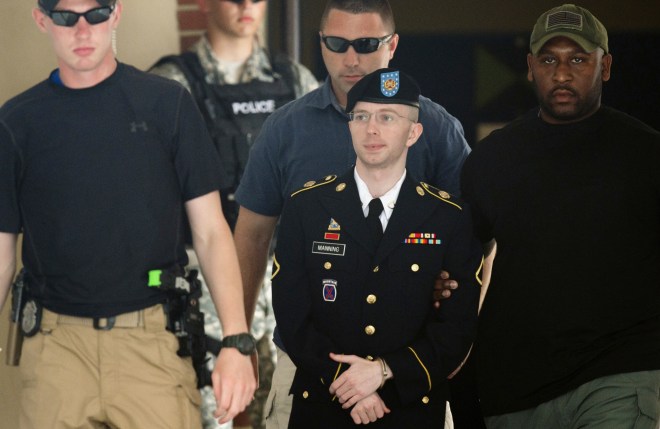
Manning Dodges A Bullet

US-COURT-WIKILEAKS-MANNING

As we mentioned earlier today, Bradley Manning was found guilty of violating the Espionage Act while acquitted of the separate charge of “aiding the enemy.” The former Army private now “faces a possible maximum sentence of more than 130 years in military jail after he was convicted of most charges on which he stood trial.” Paul Waldman and Jaime Fuller’s take:

It’s one thing to have only limited sympathy for Manning—after all, he didn’t just leak evidence of government malfeasance, he leaked hundreds of thousands of documents, most of which showed no one doing anything wrong, and the indiscriminate dump surely did damage to American diplomatic efforts. But if he had been convicted of “aiding the enemy,” it would have set an extremely dangerous precedent. National security leaks happen all the time—those who report on the topic wouldn’t be able to do their jobs without them—and if every time someone in the Pentagon passed a tidbit to a reporter they could be charged with something akin to treason, the chilling effect would be, well, chilling.

Manning was many things—you can call him misguided, overzealous, or foolish if you like. But had the court called him a traitor, we would have entered territory we don’t want to visit.

Fred Kaplan, who called it a “moderate” verdict, is on the same page:

Had the judge accepted the argument and found Manning guilty of the [“aiding the enemy”] charge, the implications would have been profound. By such a verdict’s logic, The New Yorker could have been accused of aiding the enemy for publishing Seymour Hersh’s article about the torture of detainees at Abu Ghraib. Hersh’s intention may have been to call attention to war crimes being committed by U.S. officers in Iraq, but a prosecutor could certainly have argued that the story served al-Qaida’s interests; and it’s certainly true that the revelations over Abu Ghraib were used as recruitment tools by jihadists worldwide.

Though Manning dodged the “aiding the enemy” charge, Dan Gillmor still worries about press freedom:

By finding Manning guilty of five counts of espionage, the judge endorsed the government’s other radical theories, and left the journalism organization that initially passed along the leaks to the public, Wikileaks, no less vulnerable than it had been before the case started. Anyone who thinks Julian Assange isn’t still a target of the US Government hasn’t been paying attention; if the US can pry him loose from Ecuador’s embassy in London and extradite him, you can be certain that he’ll face charges, too, and the Manning verdict will be vital to that case.

DJ Pangburn wants us to revisit the Espionage Act:

How could an act written in 1917 possibly address or, rather, handle the complexity of a whistleblower of Manning’s scale and intent? The fact is that the Espionage Act of 1917 was never written with Bradley Manning in mind. Its goal was not to address whistleblowing at all, but the delivery of intelligence to foreign governments. …

Now, it is one thing to create the legal mechanism to prosecute spies who deliver information to the enemy. But it is quite another to prosecute a soldier, or any American for that matter (journalists, for instance) for publishing documents that shine a light on shameful deeds. Manning wasn’t paid for his work by any foreign nation or agent. He wasn’t working on anyone’s behalf apart from his countrymen. All of this is to say that the Espionage Act needs to be amended to make room for whistleblowers. Because, as it stands, any whistleblower is at the mercy of the law, and the President’s particular whistleblower policies.

Looking back, Peter Walker runs through all the secret information we now know as a result of Manning’s leak.

(Photo: US Army Private First Class Bradley Manning leaves a military court facility after hearing his verdict in the trial at Fort Meade, Maryland on July 30, 2013. Colonel Denise Lind found Manning guilty of 20 of 22 counts related to his leaking of a huge trove of secret US diplomatic cables and military logs to the WikiLeaks website. She said she would begin sentencing hearings on July 31 at the Fort Meade military base outside Washington where the trial was held. By Saul Loeb/AFP/Getty Images)


Cameron’s Online Porn Crackdown, Ctd

tumblr_mqmkcfel6F1qj4tgpo1_500

Peter Jukes says the prime minister’s anti-porn move is smart political posturing:

Hard to enforce and easy to circumvent, Cameron’s plans to censor internet porn has much more to do with the populist optics than any practical policy. With a moribund flat-lined economy, the Labour Party, under new leader Ed Miliband, has established a double-figure poll lead for almost two years. However, with the help of a controversial Australian lobbyist and political strategist, Lynton Crosby (“the Wizard of Oz”), the Tories have managed to claw that deficit back to single figures in recent weeks.

Most of this was achieved through classic Rovian tactics: red meat to the right on issues like immigration and welfare, and—shooting UKIP’s fox—promising a referendum on continued EU membership. Meanwhile other moves, such as the successful passage of much-trumpeted legislation on same sex marriage (against the wishes of most his party) helps keep some of Cameron’s “compassionate conservative” credentials alive. Internet porn is another twist in these kind of triangulations.

Still, it doesn’t seem like Cameron is handling these triangulations very well. First he irritated feminists by declining to support their campaign against Page Three. Then it came out that the controversial firm Huawei – linked to the Chinese government and deemed a “threat to national security” by the US – will control the filter. Then the Open Rights Group found that the filter will be designed to block by default “esoteric material,” “web forums,” “violent material,” “smoking,” and “alcohol”, among other topics.

In protest, the blogger Sicksad built a filter to block everything but the naughty bits.

(Image via Google search)

It’s So Personal: Monoamniotic Twins

Dustin Rowles, who wrote the Pajiba post mentioned by a reader in our earlier post on After Tiller, recently went through a harrowing ordeal with his wife after doctors determined she was pregnant with monoamniotic twins:

The doctor told us that if we went forward with the pregnancy, if one fetus died in utero it would probably leave the other baby severely brain damaged. He said if that happened, we could make a plan to go to one of two states in the country — Florida or Colorado — that still have individual Doctors providing late-term abortions. Kansas used to be an option, we were told, but the Doctor who conducted procedures to terminate the pregnancies of severely brain damaged and deformed babies with no chance of a decent quality of life had been shot and killed. Ain’t that America.

We decided to terminate. It was the most difficult, most agonizing decision either my wife or I had ever made. We both are pro-choice, but when it comes to abortion, in the typical scenario, you decide to terminate a pregnancy you don’t want. We had made a decision to terminate the potential lives of two babies that we did want. That we wanted very badly.

However, we felt that the risks were too high and that it would be irresponsible to risk not only our future but that of our son, who was four. We didn’t want him to have to grow up in a home with parents that had to devote all their emotional and financial resources to profoundly disabled siblings. More than that, we didn’t want to bring beings into the world that would have to spend a lifetime suffering, who might have a severely low quality of life.

The thing is, there was no one from whom we could solicit advice. There’s not even a lot of anecdotal information with which to work when you’re pregnant with monoamniotic twins. There is one major support page online, but there is a lot of self-selection in posters, and most of the people who write have had a positive outcome that has either confirmed or bolstered their religious convictions. Many of the posts make clear that termination was never an option — and/or should not be an option — for others in this situation, which we totally disagreed with. What we were aiming to do was make the right choice for us — a rational, logical decision that an objective couple in our situation would make. We were relatively young. We could still have more children. We could wait a few months or a couple of years and try again.

The more we thought about it, the more sense it made to end the pregnancy. We felt — and we still feel — that this is a fundamentally personal decision, and we were shocked at the politicization of this medical issue, when of course nobody else can tell you what is right for your family. It is a decision that has the potential to fundamentally alter the entire course of your life, and until you are personally faced with something like this, there is no way to know how you are going to react or what the right course of action will be.

Rowles and his wife subsequently changed their minds and opted to continue the pregnancy. Mercifully, though their twin girls were born premature, they both beat the odds and survived with no ill effects. You can read the rest of his story here. And to read all the late-term abortion stories from Dish readers, go here.

Mental Health Break

For when you need to shred more than paper:

One commenter suggests:

Now throw one of those machines in that machine.

Update from a reader:

I did a bit of a double take when I saw today’s MHB, mostly because I’ve seen it before … sort of. It’s the exact same video, only in reverse:

Now it’s a miraculous machine that can make anything!

Another offers:

Today’s MHB isn’t all that impressive once you’ve seen an entire car shredded:

Prisoners For Peace?

Goldberg condemns Netanyahu for agreeing to release 104 Palestinian prisoners as a precondition for the Kerry-mediated talks that started yesterday:

Two of the men set to be released, according to the Washington Post, are Jumaa Adem and Mahmoud Kharbish, who killed a mother and three of her children in 1988, along with an Israeli soldier who tried to save them. Another is Mohammad Adel Daoud, who killed a pregnant woman and her 5-year-old son in a 1987 firebomb attack. Members of Netanyahu’s cabinet, and many other Israelis, opposed the release, but the prime minister, mindful of pleasing the American government, rammed it through. …

The real tragedy here is that the prisoner release is unnecessary. The Palestinian side was looking for any number of concessions. The Israeli government wouldn’t have been forced to release these murderers from prison had it agreed to a full freeze on the growth of Jewish settlements.  … So there you have it. The government of Benjamin Netanyahu would sooner release murderers from prison than stop building apartments on the West Bank.

Shmuel Rosner provides two interpretations of Bibi’s move:

Approving: Yes, it is heartbreaking and enraging to see those cold-blooded killers released. But Netanyahu prefers to pay this emotionally high price rather than pay a price that has strategic meaning. Agreeing in advance to the freeze or to the 1967 line would have much graver consequences than releasing some killers – it would weaken Israel’s position in negotiations, and would weaken the only card it has as it talks to the Palestinians, the land card.

Critical: Yes, agreeing to the 1967 line would be a strategic mistake. But mixing the line and the freeze is a political trick.

In fact, Israel has already agreed to a freeze in the past and it had no serious ramifications. A temporary freeze could have been the wiser choice – and Netanyahu didn’t go for the freeze because he wasn’t sure if he has the votes necessary to approve it. In other words: you aren’t happy with the release of murderers? Blame the coalition, blame hawkish Likud members of Knesset and the Habait Hayehudi party.

Brent Sasley figures the even if the moral cost of releasing the prisoners is high, the actual security risk is low:

[T]he Israeli security clampdown on the West Bank, the security barrier, the siege on Gaza, the Palestinian Authority’s own security measures, and broader stability in the West Bank seem to have removed both the incentive and the opportunity for a renewal of violence and terrorism. The stipulation that those most likely to engage in violence again be deported to Gaza or outside Israel/West Bank only reinforces the importance of this consideration.

In light of this, then, it’s easy to see why Netanyahu decided that releasing these prisoners was the best way to go in order to persuade Palestinians to return to talks. The security and political price was relatively small and easily absorbable. In his analysis [Shin Bet head Yoram] Cohen continued that the release of these prisoners would also lead to “calm” in the West Bank, dampening dissatisfaction with the process and undermining the motivation for a broader uprising. The release is also to take place over stages, and can be stopped any time Israel decides the Palestinians are not meeting their own obligations. And there is probably a sense that many who might engage in terrorism will get caught by normal counter-terror operations anyway.

Olga Khazan notes the popularity of the release in the Palestinian Territories:

[J]ust as Israelis believe passionately that the prisoners are terrorists, Palestinians view them as heroic crusaders, and most see their release as essential to the renewal of talks. According to a recent Gallup poll, the prisoner release was the top precondition for peace negotiations for Palestinians, with 93 percent saying it should be a precondition and 99 percent saying it was a “top priority.”

Previous Dish on the potential of the new talks here and here.

The Western Is Undead

Michael Agresta pities the state of the Western, which “finds itself in the ironic position of needing a hero to save it, and quick”:

If the genre in this era can be said to have a unifying aim, it’s to divest itself and its audiences of a strictly white, male, heterosexual perspective on history, and by extension on present day conflicts. Cowboys & Aliens is a cynical attempt at a post-racial Western–just take the Indians out of the equation so we can be good guys again!–but with more sincerity, True Grit, Django Unchained, and now The Lone Ranger have all put non-male, non-white perspectives front and center(Two other notable movies from the past 15 years, the wonderful Brokeback Mountain and the awful Wild Wild West, also fit this model.) It’s worth pointing out, however, that all of these examples (except Brokeback Mountain) were directed by white men, and The Lone Ranger has Tonto played by an actor with only the slightest claim to American Indian ancestry.

Meanwhile, Paul Cantor thinks the zombie film has taken the Western’s place as a cultural touchstone. Millman objects:

If we are uncomfortable with the traditional western because of the role it assigns to the aboriginal Americans, and this is because we recognize the massive injustices committed by our nation and our government in the course of our conquest and settlement of the continent, well and good. But it might be that we’re uncomfortable for the opposite reason – that we prefer to see our enemies as truly non-human. As orcs, or zombies.

And we still do have enemies, after all. But those enemies are human, with human, comprehensible motivations.

Orgies In The Islamic Republic of Iran

In an excerpt from her book Plays Well In Groups: A Journey Through The World Of Group Sex, Katherine Frank spotlights anthropologist Pardis Mahdavi’s research into Iranian sex parties:

When talking about their weekend adventures, some of Mahdavi’s informants focused on the recreational aspect of the parties: “[There is] alcohol, there is sex, there is dancing, there is—it’s just fun! It’s what we do for fun!” Others viewed the parties as a representation of “all things Western,” a way of gaining status and claiming a cosmopolitan identity; some also expressed ideas about sex as freedom that harked back to ideas underlying the sexual revolution in the United States. Still others claimed parties offered escape and “eased the pain” of living in Iran. As one man said, “Sex is the main thing here; it’s our drug, it’s what makes our lives bearable, that’s what makes parties so necessary.” “If we don’t live like this, we cannot exist in the Islamic Republic,” a woman declared. “We hate our government, despise our families, and our husbands make us sick. If we don’t look fabulous, smile, laugh, and dance, well then we might as well just go and die.”

But the new sexual culture in Iran, Mahdavi believes, is not simply an embrace of Western consumerism and morality nor merely an escapist hedonism, a “last resort.” Urban young adults, the focus of Mahdavi’s inquiry, made up about two-thirds of Iran’s population; they were mobile, highly educated, underemployed, and dissatisfied with the political regime at the time. Some were directly involved in politics. Many used the Internet to make connections, blog about their frustrations, and peer into youth cultures elsewhere around the world. Willingly taking risks with their social and sexual behavior, as these Iranian young people were doing, was viewed as a step toward social and political reform—not just a means of escape and excitement. After all, the consequences of partying in Tehran were different from in Los Angeles, despite similarities in flashy dress, electronic music, and group sex.

Previous Dish on sex in the Islamic Republic herehere, here, and here.