Salt Of The Earth

OLYMPUS DIGITAL CAMERA

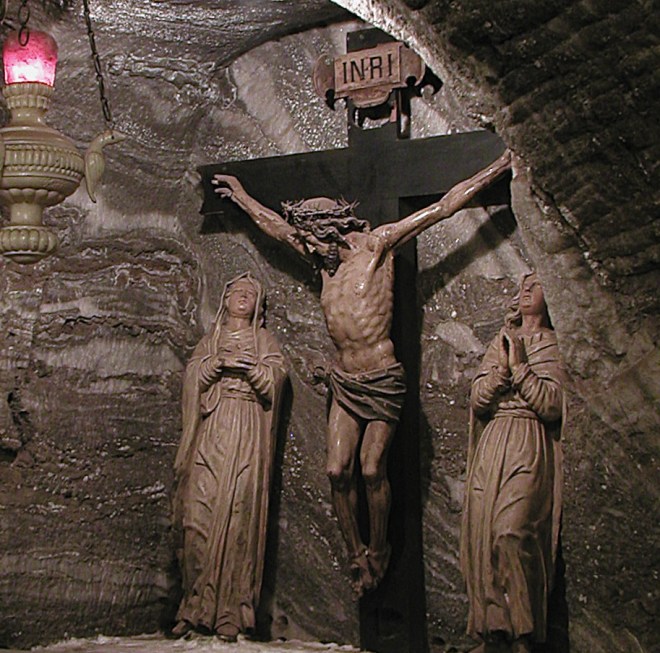
Eight miles south of Krakow and a considerable distance below it, the Wieliczka and Bochnia Royal Salt Mines contain a religious complex chiseled entirely out of halite, or rock salt:

The mine’s attractions include dozens of statues, three chapels and an entire cathedral that has been carved out of the rock salt by the miners. The mine, built in the 13th century, produced table salt continuously until 2007, as one of the world’s oldest salt mines still in operation.

Unesco recently expanded its World Heritage Site designation for the complex, which also features salt chandeliers and a salt John Paul II. More photos here.

(Photo: Detail from Bochnia Salt Mine, Małopolski Instytut Kultury)

What Would Actual Conservative Foreign Policy Look Like?

Jennifer Rubin says it should strike “a middle ground between unbridled intervention and neo-isolationism”:

Finding a conservative middle ground that incorporates the lessons of the past decade should be the work of elected Republicans, former officials and think-tank gurus. They must present a foreign policy that maintains (or restores, when Obama leaves) American supremacy in the world and is also politically sustainable.

Larison pounces:

Since neo-isolationism doesn’t really exist and even Rubin wouldn’t claim to favor “unbridled intervention,” we can be confident that the “middle ground” Rubin refers to here is not a compromise between her hard-line, aggressive foreign policy and a foreign policy characterized by restraint and respect for the limits of American power. By setting up two extremes that virtually no one favors, Rubin is resorting to the time-honored tactic of presenting her own position as the “middle ground” that will satisfy most conservatives and Republicans.

He describes the conservative foreign policy he’d like to see:

A conservative alternative to Obama’s foreign policy wouldn’t automatically support all or even most U.S. overseas commitments, but would reduce those commitments when regional allies and rising powers have the resources to assume responsibilities for security in their own parts of the world. It wouldn’t treat “American supremacy” as an end in itself, and it would recognize that America’s post-WWII and post-Cold War roles were exceptional ones that needn’t and shouldn’t be emulated forever. Unless a treaty ally is attacked, a conservative foreign policy wouldn’t allow the U.S. to be pulled into conflicts where the country’s security wasn’t at stake for the sake of preserving “credibility” or supposed allied solidarity. It also would oppose waging wars of choice.

Our Life Stories Are Missing Pages

Sarah Polley’s documentary about her mother Diane, Stories We Tellis driven by a conundrum: “How is it we talk and talk without conveying somehow what we’re really like?” Charlotte Hornsby riffs on it:

As people trail off about what her mother hid, what her mother thought and craved and feared, Sarah reflects that we can’t resurrect someone through our stories of them. In saying “she was like this” we risk turning her into a fiction, and feed the lie that Diane or any of us are a recipe of traits that if mixed in the proper order will rise and cool into a consistent personality. Given the gaps between stories, the discrepancies between the Diane her sister knew and the Diane her DNA-dad knew, Sarah wonders if any of us are truly knowable.

This is the loneliest question. I know I’ve asked it before and I’ve certainly seen it echoed by some of my favorite writers. In his play “The Cocktail Party”, T.S. Eliot’s Celia confides to her doctor, “It isn’t that I want to be alone, but that everyone’s alone—or so it seems to me. They make noises and think they are talking to each other; they make faces and think they understand each other. And I’m sure that they don’t. Is that a delusion?” “Being close,” Nicole Krauss writes, “as close as you can get to another person only makes clear that impassable distance between you.”

Has Greenwald Crossed The Line? Ctd

Glenn emails a response to a Dish reader:

Greenwald says (1) that Snowden took the “blueprints” because they’re necessary in order to prove “that what he was saying was true,” but (2) that Snowden doesn’t want the blueprints to be disclosed. But how can Snowden rely on the documents to corroborate what he’s saying unless he discloses them?

The answer to this is glaringly obvious. He does this by coming to responsible journalists and says: “I have documents revealing things the public should absolutely know about government excesses, deceit and wrongdoing – but these documents also reveal things that shouldn’t be published, so I want you – as journalists – to vet them carefully (as I have done) and publish only what should be published and withhold what should be withheld.”

That’s exactly what he asked us to do – repeatedly. And it’s exactly what we’ve done (which is why we’ve published only a portion of the documents we have on each article and withheld many). That’s called responsible whistleblowing and responsible journalism.

He could have done all sorts of things with those documents had he been malicious or reckless: sold them for a large amount of money, passed them to foreign governments, gave them to someone to indiscriminately dump, published them all himself on the internet.

He did none of those things.  That’s why the actual facts completely negate the predictable media-led demonization campaign now well under way.

Ask Michael Hanna Anything: Next Steps For Egypt

In today’s video, Michael explains why Egypt’s military and political leaders must pursue reconciliation and reform if they want the current transition to be successful:

Meanwhile, last night in Egypt there were more deadly clashes between security services and pro-Morsi protesters. Last week, Ahmad Shokr offered a succinct overview of Egypt’s precarious new order:

Egypt is still ruled by the armature of the old regime. Two and a half years of elite factionalism — the inability to forge a stable alliance — have set off a game of musical chairs. In this period, the momentum has rotated among Islamists, liberals, state bureaucrats, businessmen, military and security officials, and Mubarak-era dregs. They share a fetish for capturing the state but also the lack of a novel vision for dealing with Egypt’s deep structural problems. Attempts by any combination of these figures to restore full-fledged authoritarianism are likely be tempered by some level of public disobedience. At the same time, there is no revolutionary coalition strong enough to begin overturning the undemocratic and inegalitarian legacies of previous regimes. A balance of weakness has set in whereby no side in Egyptian politics is able to claim outright victory.

More distressing, perhaps, is a societal mood that is becoming more inclined toward intolerance and scapegoating.

Egypt’s unsavory climate of chauvinism, intransigence, opportunism and deceit from almost every side has been made worse by Mursi’s ouster and its bloody aftermath. Media outlets are constantly in search of fifth columnists to demonize, whether as “terrorists” or as “infidels.” The Brothers are portrayed as traitors with a penchant for violence who must be forcibly subdued. For their part, the Brothers paint the revolt against their rule as a little more than a conspiracy hatched by the old regime. They insist their resistance to the army is peaceful, but the string of violent acts by Mursi supporters — the killing of protesters in Cairo and Alexandria, the intimidation and mob attacks directed at Christians in Minya and Marsa Matrouh — tells a different story. There were even accusations that the interim president is secretly a Jew.

Thanassis Cambanis remains confident in Egypt’s revolutionary people-power:

Egypt can survive many more waves of revolt, election and coup, and it will, until the political order begins to reflect more of the will of the people. The latest roadmap repeats most of the mistakes of 2011 (for detailed explanations of how, read Nathan Brown and Zaid Al-Ali). The Egyptian public has developed a profound intolerance for arbitrary authoritarian rule; for opaque, paranoid leaders; for governments that ignore the country’s collapsing economy and standard of living.

Revolutionaries might not represent the majority, but they are now a maturing, key constituency. They are unlikely to embrace fascism or fiats from anyone: not the military, not the Brotherhood, not the old political parties. That’s the underlying signal of Egypt’s latest revolt. Until Egypt’s power brokers recognize the core demands of the public and begin to address them, the public isn’t likely to go away.

Michael Wahid Hanna is a Senior Fellow at The Century Foundation, where he works on issues of international security, international law, and US foreign policy in the broader Middle East and South Asia. He appears regularly on NPR, BBC, and al-Jazeera. Additionally, his Twitter feed is a must-read for anyone interested in Egyptian politics. Michael’s previous answers are here. Our full Ask Anything archive is here.
Vaccine Trutherism Is A Disease

Anti-vaccine conspiracy theorist Jenny McCarthy is joining The View. Michael Specter declares that executives “at ABC should be ashamed of themselves for offering McCarthy a regular platform on which she can peddle denialism and fear to the parents of young children who may have legitimate questions about vaccine safety”:

McCarthy has spent much of the past ten years campaigning against vaccines—which, it must be said, are the most effective instruments of public health in human history, aside from clean water. That does not mean that vaccines carry no risk: nothing is entirely without risk, and there is a small but measurable possibility that any vaccine can cause a serious adverse reaction. Still, the benefits for society so powerfully outweigh the risks that suggesting otherwise is irresponsible at best. It spreads fear and incites the type of ignorance that makes people sick. That is exactly what McCarthy has been doing. By preaching her message of scientific illiteracy from one end of this country to the other, she has helped make it possible for people to turn away from rational thought. And that is deadly.

Alyssa piles on:

[W]hile it’s possible to debate many sides of many issues, one of the benefits of medicine is that there’s actual evidence that some ideas and right and others are wrong.

McCarthy’s are wrong, and continuing to defend them with that other standby of people who like to advance conspiracy theories without evidence, that she’s just raising questions, doesn’t make her decision to stick to her discredited ideas any more admirable. And it doesn’t give The View cover, either. This is not a vital debate in American society in which McCarthy’s position has been historically underrepresented, or a polarity along which it’s important to have multiple perspectives in order to make for a lively conversation. It’s a hoax, on par with McCarthy’s original belief, before her son’s autism diagnosis, that her son was an “indigo child,” a New Age theory that tries to comfort parents of children with autism and learning disabilities by convincing them that their children actually represent a new stage in human evolution.

Allahpundit assumes “that she’ll be under a strict gag order in discussing vaccination on air”:

[E]ven if the network’s protected from liability by the First Amendment, the publicity from a lawsuit filed by a grieving mother whose child died after she watched a Very Special Episode of “The View” and decided not to have him/her inoculated would be catastrophic. But even if they muzzle her on the show, they’re rising her profile off the show by hiring her. She’ll sell more books now, she’ll get bigger crowds at public appearances, she’ll be a hot ticket for guest shots on radio and TV. Will they insist in her contract that she stay away from this subject off the air too?

When Republicans Stigmatized Moderation

Nearly 50 years after the GOP nominated Barry Goldwater for president, Ed Kilgore considers its shifting legacy:

It’s very interesting to note how memories of the Goldwater candidacy—especially among conservatives—have changed over the years. For some time it was a cautionary tale of what happens to a major political party when it goes on an ideological bender—much like the 1972 McGovern campaign is remembered in certain circles. By 1976 and 1980, with Ronald Reagan’s near-miss and then successful presidential campaigns, Barry’s crusade was retrospectively was viewed on the Right as ahead of its time… [E]ventually, as the rise of the conservative movement became recognized as one of the most important U.S. political phenomena of the second half of the twentieth century, the Goldwater campaign, despite its ostensible futility, was widely hailed as one of the three or four most important landmarks.

And it was. But, in my view, it was the coalition between these libertarian forces and the post-segregation South that, by immortalizing Goldwater and canonizing Reagan, that made extremism a virtue. Goldwater’s extremism was never put to the test in office, but he personally became, over the years, more Western than Southern. Reagan’s radicalism was relative to the challenges of his times – and he was far more pragmatic than today’s GOP would allow any leader to be. But both men in their peak periods represented a symbolic victory for the right against the center-right. There was only one significant push-back: George H. W. Bush. His political demise made moderation a dirty word – or, worse, an electorally negative one among the party faithful.

To respond to Goldwater: moderation in the pursuit of justice is indeed a virtue. And extremism of any sort may occasionally be a necessary corrective to an equal extremism, but if allowed to become a rallying cry, will eventually undercut any party’s ability to govern a country.

When you remove moderation from a conservative movement, and when you ally it with a region and a mindset Republicanism once went to war with, you end up with today’s ever-further ratcheting to the right. Until a centrist Republican wins office again, I fear the ratchet will keep moving further and further into la-la land.

The Spiritual Facts Of Life

Reviewing a pair of books by the German philosopher Peter Sloterdijk, The Art of Philosophy and You Must Change Your Life, Keith Ansell-Pearson grapples with Sloterdijk’s attempt to think through “the return of religion”:

The thesis that religion has returned after the alleged failure of the Enlightenment project needs to be confronted, Sloterdijk argues, with a clearer view of what we can legitimately consider as “spiritual facts.”

Such a consideration shows that the return to and of religion is impossible since, so goes Sloterdijk’s initial contention, religion does not, in fact, exist. Instead, what exist are only misunderstood spiritual regimens. All human life requires the cultivation of matters of body and soul, and all philosophies and religions have attended to this fundamental feature of our existence. By this view, any clear-cut dichotomy of believers and unbelievers falls away. In place of this dichotomy, we should distinguish between the practicing and the untrained, or those who train differently.

In one especially illuminating part of the book, Sloterdijk considers the Church of Scientology and the ideas of its founder, L. Ron Hubbard. With wit and irony, he takes Hubbard to be one of the greatest enlighteners of our times who, albeit involuntarily, increased our knowledge about the nature of religion: “After Hubbard, it is clear once and for all that the most effective way of showing that religion does not exist is to establish one’s own.” In The Art of Philosophy, he points out that the term “religion” is a Christian one that fails to do justice to the Indian, Chinese, Iranian, Jewish, and ancient European philosophical systems of leading one’s life. The ancient schools of philosophy were part of “training cultures” that were focused on the tasks of ethical self-transformation. Their aim was to align human agents to a cosmic order or a divine canon.

The Riots That Weren’t

Jelani Cobb responds to dashed expectations that riots would follow the Zimmerman verdict:

The prediction of violence was not simply wrong. It was wrong for all the wrong reasons, in an echo of the way responsibility in the case was shifted onto Martin’s shoulders. There’s a sly inversion at work in the references to lynch mobs and riots, one that takes Zimmerman’s acquittal and expands it to all of American history. This country has a long history of lynchings, but not one in which non-black defendants needed to fear the fury of black mobs. Amplifying the irony is the fact that the verdict was announced on July 13, 2013—the hundred-and-fiftieth anniversary of the Civil War draft riots in New York City, in which white mobs pursued and killed blacks on the streets and burned a black orphanage to the ground.

Weigel sounds off:

Did police scramble in the wake of the verdict to prevent anything from going sour in the cities? Yes. It just seems noteworthy that very little went sour. “Urban blacks may riot when X goes wrong for them” is a perennial story, one that got written in the run-ups to elections in 2008 (“Police fear riots if Barack Obama loses US election”) and 2012 (“New threats to riot if Obama loses the election”). An act of civil disobedience that blocks traffic—on a Sunday, not even rush hour!—isn’t an act of fury that tears a country apart. Honestly, don’t the panic-mongers remember what it felt like when peaceful Tea Partiers were accused of incipient anti-government violence?

Isaac Chotiner feels that Cobb “should recognize the lack of violence for what it is: a real sign of progress”:

A foreign example would be the absence of large-scale rioting after the attacks on Bombay in 2008, where there was the (not unfounded) fear that the country’s Muslim minority would face the wrath of its Hindu majority. Something similar had, after all, happened several times in the previous 15 years. … Anyway, India’s calm was a sign of progress, however tenuous (the country may elect an essentially fascist Hindu extremist as its next prime minister).

In the Zimmerman trial, too, the concern about violence was not just of the Gingrich variety. It was also a fear among people who actually care about racism that the country hasn’t come as far as it has. On a week when it is abundantly clear that America has a long, long, long way to go towards equality, this bit of non-news is the one reason for optimism.