
Arles, France, 7.34 pm
Arles, France, 7.34 pm
Leslie Jamison uses Rebecca Solnit’s “collage-style memoir,” The Faraway Nearby, to consider the contours of the essay:
As a genre grounded in productive uncertainty—collage rather than argument, exploration rather than assertion—the essay is constantly posing the conundrum of its own existence: What should an essay do? What should it offer? It finds its etymological roots in the old French essai: to attempt. It blends inquiry and confession into a hybrid weave that deepens each. It draws personal material into public mattering.
In a recent New York Times Op-Ed called “The Essayfication of Everything,” Christy Wampole traces these exploratory practices back to Montaigne—godfather of the essay and patron saint of strange conceptual constellations—in examining how the modern essay has updated an older mode of assemblage: “Banal, everyday phenomena—what we eat, things upon which we stumble, things that Pinterest us—rub elbows implicitly with the Big Questions: What are the implications of the human experience? What is the meaning of life?” Solnit’s book forces us to confront that these questions of formal construction—How is the essay assembled? How do its parts rub elbows?—are also questions of emotional motivation: What drives the essayist toward these acts of assemblage? What abiding hungers make us want to link the Big and the banal?
It was a sad day for me. My dear friend, the photographer Norma Holt, let go of this life this afternoon at around 5.30 pm. At 94, she was still thriving as recently as a couple of months ago. I saw her in New York City just before I left for Provincetown, a place she truly felt at home. A slide-show of her photography is above. A summary of her career is here. A photographic appreciation of her remarkable grace and stubbornness in her nineties – by Jane Paradise – is here. I wrote a post about her last January. I can’t summon up much else right now, except that she taught me to live until I die. But I will soon.
Today, it seemed as if the Republican death spiral quickened. Brooks did his best, but they are not listening. They don’t have to. We initiated a NSFW Saturday night and I wondered if there are double standards about male and female nudity.
If you think Islamist terrorism is a phantasm, look into this face. But don’t mess with Glenn Greenwald.
The most popular post was this one illustrated with vaginal mucus, followed by the corpse of Trayvon Martin. Both SFW.
May she rest in peace.
Christopher Flavelle reviews a new study showing that Americans have fallen behind Europe in life expectancy and considers our potential to catch up:
The inescapable context for this study is the enduring debate over whether the government should ensure that almost all Americans get access to health insurance. The portion of Americans who are uninsured, or who are insured but lack affordable access to care, is the single biggest difference between the U.S. and other developed countries. It’s also, through Obamacare, a difference that can be fixed.
Richard Gunderman dismisses the importance of the numbers:
[T]he mist of health statistics often obscures the mountain we are really trying to climb. It is true that U.S. life expectancy lags behind that of a number of other nations. It is true that if we could lower rates of smoking and obesity, we could probably bump these numbers up. But a more sober analysis reveals that life expectancy is a pretty poor indicator of health. We are attracted to it because it is straightforward to measure and makes it relatively easy to keep score. But we cannot tell from a person’s life expectancy how well they are actually living.
Suppose through some wonder of modern biomedical science we could suddenly double our life expectancy by staying in bed 20 hours per day, or giving up all solid foods, or never again reading a book. Would we do it? To say that we are willing to pay any price in order to increase the length of our lives is to say that we have forgotten what it really means to live. The Struldbruggs in Jonathan Swift’s Gulliver’s Travels are immortal specimens, but they are also miserable human beings, whose unending lives prove to be not blessing but curse.
John Sides expects that the failure of immigration reform would have serious consequences for the GOP:
One prominent theory of party identification is that people identify with the party that they associate with social groups they like or belong to. So it’s not so much about policy, or what the parties “stand for.” It’s who the parties “stand with.” The challenge for the GOP is that even if it supports other policies that many Latinos support, its hostility to immigration reform may be the driving force behind a broader impression: that the Democrats are “the party of Latinos.” And once those impressions are formed, they are very difficult to change. As I’ve noted, the perception that the GOP is the “party of the rich” really has not changed for 60 years.
Now, how firmly established is any impression that the GOP is not “the party of Latinos”? Probably not that firmly established, especially in the minds of Latinos that are not yet citizens. Most are unaffiliated, as noted, and only 25% identify as Democrats and 3% as Republicans. But among those that are naturalized citizens? Nearly half, 44%, identify as Democrats and only 15% as Republicans. In other words, the 22-point advantage Democrats have among non-citizen Latinos becomes 29 points among Latino citizens. This, to me, suggests that the “political environment” is not currently working in Republicans’ favor.
And if immigration reform were to fail, it is hard for me to see the environment becoming any more favorable.
Nate Cohn argues that the GOP most definitely needs a large percentage of Florida’s Latinos:
If turnout patterns stayed the same, Republicans would need to win whites by 28 points to overcome demographic changes. Could Republicans do four points among Florida whites in 2016, let alone keep increasing at that rate in future elections? Perhaps. But what a gamble! Surely even a GOP optimist would concede the serious possibility that they cannot improve by so much. Not after doing so well among Southern whites, not after running up the score against a candidate who was such a poor fit for the state. Not in a state where white voters are reminiscent of whites nationally.
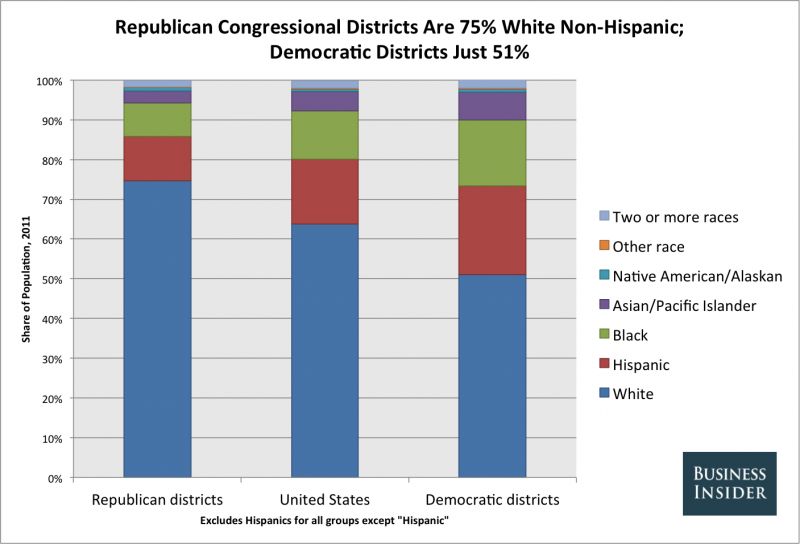
(Chart: Comparison of the racial composition of Republican and Democratic districts from Business Insider.)
Friedersdorf puzzles over Rand Paul’s connection to Confederate nostalgist Jack Hunter:
I do respect Hunter’s renunciations and rethinking, and the increased empathy that preceded this controversy. Within the world of commentary, I am disinclined to shun anyone earnestly seeking redemption from a past of talk-radio hackery — talk about getting the incentives all wrong.
That doesn’t change the fact that Hunter should resign his post immediately, because his continued presence can only undermine the effectiveness of his employer. Paul shouldn’t have ever hired him, because even if — to be overly charitable — Paul wasn’t aware of his objectionable views, or disagreed with all of them but didn’t regard them as pertinent to the job, a Senate staffer’s role is to help his boss govern, and any fool should’ve been able to see that having an avowed secessionist and Confederate nostalgist on staff would end in distraction, controversy, and many assuming (whether rightly or wrongly) an antagonism to blacks — just as many Americans assumed, during the Jeremiah Wright scandal, that Obama harbored antagonism toward America.
Bouie thinks Rand has a race problem that goes beyond the staffer:
Yes, Paul is on the right side of the war on drugs, and is one of the few Republican voices pushing for federal criminal justice reform. At the same time, as evidenced by his disastrous appearance at Howard University, he lacks any awareness of how his limited government views play to African Americans, who—as a group—have a strong memory of what could happen when you leave states to their own devices. On some level, he seems to think that his ideological purity makes it okay that he believes the 1964 Civil Rights Act was an imposition on “liberty,” despite the fact that this places him in the company of people who defend secession, and the Confederacy.
None of this is evidence that Rand Paul holds racist views, and if he did, it wouldn’t matter. Lyndon Johnson was almost certainly a racist—he also worked to usher a Second Reconstruction of far-reaching civil rights laws. But it is evidence that Paul is oblivious to the history of “limited government” ideologies in this country, which have been (and are) used to defend white supremacy.
Julia Ioffe nods:
As New York’s Jonathan Chait pointed out, racists tend to pop up in the Pauls’ circles. A lot. This has been true since the elder Paul got into politics, in Houston, in the late 1960s. Paul is going to have to explain this stuff, and explain it in a definitive way. How, for example, did he only have a “vague” notion of his co-author’s previous work? Wouldn’t his past work be an important qualifier when he was being considered for that job? How did he hire a man to direct his social media whose Twitter handle is @SouthernAvenger?
This is a different and more important question than the one his father faced over the racist, homophobic, and anti-Semitic apocalyptic drivel written under his name. Ron Paul had no chance of getting to the White House, but Rand could, and so it matters who those “lot of people” are. Rand, of all people, should know: He filibustered one of the people that was going to work for the current president (CIA Director John Brennan), and has threatened to filibuster another potential presidential employee (FBI Director James Comey).
Michael Hanna points out how shocking it was for the June 30th protests to not only come together as fast as they did, but grow to a size that far eclipsed the protests of 2011:
Nisral Nasr thinks the political landscape in Egypt is too foggy to tell whether the coup will be in the service of democracy:
There is no particular reason for now to believe that the Egyptian Armed Forces are the modernizers envisaged by American academics in the 1960s. Nor is there reason to believe that the Muslim Brotherhood is the carrier of democratization through an Islamic state as envisaged in the 1990s and early 2000s. Of course the governments after 1952, invariably led by Army officers, pursued industrialization policies for strategic reasons. So, too, the Muslim Brotherhood leadership pursued open elections for their own strategic reasons. Neither the Army nor the MB are or were particularly committed to the wider principles that academics like to read into these policy choices.
Sarah Carr declares that “the debate is semantic and tedious, and the nomenclature will not be decided now”:
I will not weigh in on the coup/revolution debate other than to say millions of Egyptians were on the ground demanding Morsi’s removal while military jets drew hearts in the skies above them, and then Defense Minister Abdel Fattah al-Sisi announced that Morsi had (forcibly) buggered off. Nothing has changed. The real revolution will happen when army involvement in politics is a distant relic of history.
Elsewhere, the Big Picture is up with a new gallery compiled from the past week in Egypt.
Michael Wahid Hanna is a Senior Fellow at The Century Foundation, where he works on issues of international security, international law, and US foreign policy in the broader Middle East and South Asia. He appears regularly on NPR, BBC, and al-Jazeera. Additionally, his Twitter feed is a must-read for anyone interested in Egyptian politics. Our ongoing coverage of the current events in Egypt is here. Michael’s previous answers are here. Our full Ask Anything archive is here.
Adam Waytz argues that the Internet has knocked cultural critics off their perch:
Albums and movies “leak” far in advance of their due dates, entire libraries of music or television shows can be torrented and hoarded in a matter of hours, and as quickly as terabytes of .mp3s and .avis are transmitted, so too are all of our opinions on the media we are consuming. All of this means critics no longer have exclusivity, priority, or even, necessarily, expertise.
Expertise requires that, compared to the average person, one has a deeper understanding of a topic, a more well-researched opinion on the topic, and privileged information on the topic. The ability for anyone with a fast wireless connection to obtain an entire Lou Reed discography or the entire compendium of Get a Life episodes means that anyone can dig deep into a particular body of work. Access to carefully written blog posts about the true meaning of Inland Empire and the hidden samples used in Paul’s Boutique (not to mention access to Wikipedia) means that research is easy. Music and film piracy means that priority access has become a thing of the past.
Carl Franzen explains the above video:
A Canadian duo and their Kickstarter-funded, pedal-powered helicopter have won one of the longest-standing challenges in the history of aviation — keeping a human-powered aircraft hovering up in the air at height of at least 9.8 feet, within a 32.8 by 32.8-foot square, for 60 seconds minimum. The challenge, known as the Sikorsky prize, has withstood at numerous failed attempts since it was established in 1980, 33 years ago, even with a $250,000 bounty. But it was finally bested earlier in June by the Atlas, a gigantic human-powered helicopter designed by Cameron Robertson and Todd Reichert, aeronautical engineers from the University of Toronto, who cofounded a company AeroVelo. …
The Atlas is controlled by having a single pilot pedal a bicycle-like wheel to turn the aircraft’s four enormous, independent rotors (one at each corner). The entire span of the craft is 190 feet. On June 13th, with Reichert pedaling away in the pilot’s seat in an indoor soccer stadium in Vaughn, Ontario, the Atlas reached a height of nearly 11 feet, stayed aloft for 64.11 seconds, and drifted only 32 feet.
Ali Gharib sides with Elliott Abrams on aid to Egypt. He doubts the withdrawal of US money will undermine the country’s ailing economy:
[A] common objection goes like this: Egypt is in tough economic straits, and cutting off both military and economic aid could plunge the whole economy—and society—into a chaotic tailspin. (Because the military dominates the economy, controlling between 10 and 30 percent of it, the military aid factors in here too.) Along with various members of Congress, Secretary of State John Kerry made this point: ”A hold up of aid might contribute to the chaos that may ensue because of their collapsing economy,” Kerry said. “Their biggest problem is a collapsing economy.”
The U.S. gives about $1.5 billion total in aid to Egypt. Since Morsi’s ouster, Gulf Arab countries like Saudi Arabia, Qatar and the United Arab Emirates pledged $12 billion—which appears to not be directed solely at the military. In other words, the Gulf Arabs have already rushed to fill the breach, with more—and more flexible—aid. The Egyptian economy won’t be peachy keen any time soon, but U.S. aid, in the context of the Gulf Arab money, will hardly make or break it.
Max Fisher counts Hagel’s close relationship with the head of the army as another reason we haven’t called it a coup and suspended aid:
The Egyptian defense minister who officially announced on state TV that the military had removed Morsi, a general named Abdel Fatah al-Sissi, also turns out to be friendly with U.S. Defense Secretary Chuck Hagel, according to a revealing story by The Wall Street Journal. They’re not old fishing buddies, exactly, but they had lunch two months ago, the foundation of a personal relationship that was, according to a senior administration official who spoke to the Journal, “basically the only viable channel of communication during the crisis.”
For the Obama administration, then, alienating Sissi would have left the United States without a “viable channel of communication” with one of its most important allies in the Middle East. That raises the potential costs of condemning the coup significantly, and may help explain why the United States is eager to preserve the relationship.
More Dish on the debate over Egypt’s aid here, here and here.
 The Dish