The American public doesn’t share your disdain of the president’s schmoozing skills. They know the real reason for gridlock.
Month: July 2013
How Much Would Parents Prefer To Work?
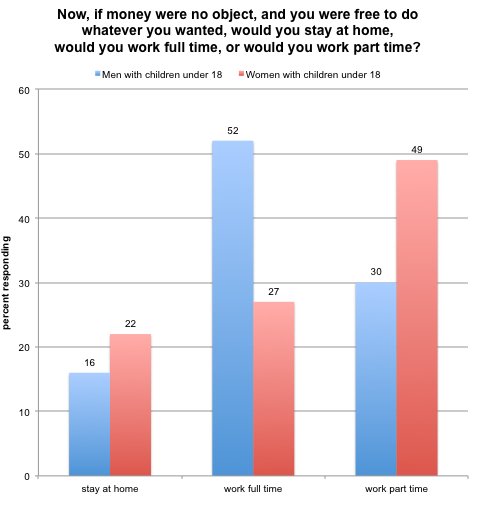
Catherine Rampell compares mothers and fathers:
I wrote in Monday’s article that “among all mothers with children under 18, just a quarter say they would choose full-time work if money were no object and they were free to do whatever they wanted, according to a recent New York Times/CBS News poll. By comparison, about half of mothers in the United States are actually working full time, indicating that there are a lot out there logging many more hours than they want to be.” On Twitter and elsewhere, people have asked me what the results were for fathers, so I’ll share here: Just over half of all fathers with children under 18 say their ideal situation would be to work full time, if money were no object. Another 30 percent of these fathers would prefer to work part time, and 16 percent would stay at home.
Tastes Just Like Sparrow
Exotic, “invasive” dishes are coming to America:
The Corvallis, Oregon-based Institute for Applied Ecology’s (IAE) Eradication by Mastication program includes an annual invasive species cook-off and a published cookbook called The Joy of Cooking Invasives: A Culinary Guide to Biocontrol (kudzu quiche! nutria eggrolls!). The program will hold a workshop this summer on how to dig, process, and cook up the highly invasive purple varnish clam. Tom Kaye, executive director of IAE, made one of three prize-winning entries at last year’s cook-off: battered, deep-fried Cajun bullfrog legs. Second place went to popcorn English house sparrow drumsticks. Despite their poor labor-to-meat ratio, Kaye says, “they were tasty.” Third prize went to nutria prepared three ways, including pulled-pork style and made into sausages. …
“It’s a chicken and egg situation,” says Wenonah Hauter, executive director of Food and Water Watch. “Getting more product available will make it easier for chefs to be able to cook with it. That could be a win-win situation for the environment and people who like eating interesting things.” But she adds, “I really think a well-known chef needs to take it up.”
Cool Ad Watch
A reader writes:
I’ve been following your long-term coverage of the NFL’s head-injury scandal with a great deal of interest. I played football in high school and it remains the only major sport I enjoy watching. But I definitely feel conflicted, if not downright guilty, about it now. How could one enjoy watching the slow, agonizing destruction of human minds?
Anyway, I suspect that Reebok has just released a device that could kill the sport dead. It’s an impact sensor for the head which can be worn under a helmet and records the number of hits at different intensities. It even has a flashing indicator recommending for players to be removed after enough dramatic hits. Here’s the product page and [above] is Youtube video describing how the thing works.
The impression I get is that a few NFL players wearing these things is going to create enough horrific data to precipitate a crisis for the game and those who are profiting from hiding the truth about football head injuries. I’d be interested in what the interested actors have to say about this thing. Will it be legal to wear in games? Will team doctors make use of them? Will players be removed from play if their indicator is going off?
The Arab World’s Tiny Giant
Doug Bandow profiles Qatar, the minuscule nation throwing more and more weight around in the Middle East:
This activist foreign policy rests on a docile population at home. Observed Jane Kinninmont of Chatham House: “Qatar’s behavior is explained partly by its complete lack of fear of domestic unrest.” As a result, Sheikh Hamad has given his own people none of the democratic freedoms he promotes abroad. [Christopher] Blanchard called the emir’s course one of “very limited political liberalization.” The only opinions that matter are those of members of the ruling family. Indeed, the baby steps taken, including formally granting the franchise to women, “constitute a facet of the Qatari state-branding strategy, since they are designed to legitimize the Qatari regime in the eyes of the international community,” argued [Professor Sultan] Bakarat.
But not all of Qatar’s foreign policy decisions have paid off. Jeffrey Goldberg notes that “Qatar pumped a lot of money into Mursi’s Muslim Brotherhood government” and that “Mursi represented its main chance to advance the cause of Islamic fundamentalism.” Goldberg also takes Qatar-funded Al Jazeera to task for spreading Muslim Brotherhood’s bile:
If it’s been a bad week for Qatar and Al Jazeera, it’s been a very bad week for the network’s star broadcaster, the televangelist Yusuf al-Qaradawi, a Sunni cleric who is a spiritual leader of the Muslim Brotherhood. Qaradawi has been Al Jazeera’s most important star for many years. His show, “Shariah and Life,” is seen by millions across the Middle East.
As I reported this week, Qaradawi is an extremist’s extremist: He endorses female genital mutilation (he doesn’t refer to it that way, of course); he has called for the punishment of gay people; he has provided theological justification to insurgents who targeted American troops for death in Iraq (though he’s hypocritically silent on the decision of his Qatari patrons to allow the U.S. to locate a Central Command headquarters on their soil); he has defended the idea that the penalty for some Muslims who leave Islam should be death; and also, by the way, he believes that Hitler’s Final Solution was a nifty idea.
The Blockbuster Business
Derek Thompson breaks down box office economics:
In The Hollywood Economist, Edward Jay Epstein revealed that the American box office
accounted for less than 10 percent of the MPAA’s total income (and international box office accounted for just a little more than 10 percent). “The other 80 percent now came from the ubiquitous couch potato who was viewing his movies at home via DVDs, Blu-rays, pay-per-view, a digital recorder, cable channels, or even network television,” he wrote.
What does that mean for summer movies? It explains why $1 spent on a blockbuster is (all things considered) worth more than $1 spent on a non-blockbuster. The potential for each mega-budget movie to go big and create a train of merchandise, licensing and sequels makes it strategically wise to bet a very large sum of money on a very small number of big films.

Meanwhile, Alex Mayyasi wonders why the films aren’t shorter, since all tickets cost the same:
For a summer blockbuster, Spider-Man 2 is not terribly long at 128 minutes (just over 2 hours). But let’s imagine what would happen if a thrifty producer had decided beforehand to decrease the length by half an hour. If we assume that the cost of shooting the film ($100 million) and editing it ($70 million) would decrease in proportion to the decrease in the length of the film, then the trim would reduce the cost by $39.8 million.
That’s a lot of money. It’s over 14% of the film’s cost – enough to fund the production of a film like the recent sci-fi flick Looper or pad the producers’ salaries. But in the world of blockbuster movies, where a few product placements can rope in an extra $10 million, it’s also not enormous.
Why Do We Put Down Books?
Peter Wild explores the question after looking at a new Goodreads infographic:
[O]bviously, there are those that are “difficult”. Not for nothing is Ulysses amongst the most abandoned classics. I’m sure there’s room on that shelf for Thomas Pynchon’s V, David Foster Wallace’s Infinite Jest and Don DeLillo’s Ratner’s Star as well (although as a person who never abandons a book, I take an obscure satisfaction in having finished all of them). But actually there’s no shame in saying that a book is too difficult. Not only is it an acknowledgement of your own limitations, which in itself is a kind of wisdom, it’s also a kind of challenge, an admission that a book is too much for me now but might not be in the future (it took me three swings at V before I finally made it all the way through).
Challenging reads are probably a small niche within the abandoned bookstacks . I’d hazard a guess that the main reason people abandon books is because life is too short.
Again, those good people over at Goodreads have conducted a straw poll and the chart is currently topped b JK Rowling’s The Casual Vacancy and EL James’s Fifty Shades of Grey. Whilst this demonstrates that the kind of readers who like to take part in straw polls have short memories, it also indicates quite well what kinds of books are most frequently cast aside: the books that disappoint (Rowling’s earnest novel for adults is a little too far from the ice cream and ginger beer of Harry Potter for most readers) and those that you read simply because everyone else is reading them (I haven’t succumbed to Fifty Shades of Grey myself but I’ve had enough people tell me it’s as bad as Twilight to know I’m not missing anything).
Scene Not Required
Joseph Flaherty profiles artist Matthew Plummer-Fernandez, who recently created a modern-day Venus of Willendorf using Google Images and a 3-D printer:
Flaherty discovered an online movement of tinkerer-artists:
Plummer-Fernandez sees his work as part of the New Aesthetic, a loose, emerging movement concerned with bringing the visual elements of digital technology and the internet into the physical world. Unlike other art movements that emerged in physical locations–the Cubists congregating at the Salon d’Automne, for example, or Pop Artists talking shop in Soho lofts–practitioners of the New Aesthetic meet primarily on Tumblr. ”Its a strange phenomenon but its definitely happening and helping a scene take shape,” says Plummer-Fernandez “Not only do you connect to artists, but you share ideas with writers, researchers and curators.”
More Dish on visual art and technology here.
The End Of The Hedge Fund Era?
Sheelah Kolhatkar heralds it:
Most of the advantages their investors once had—from better information to far fewer people trying to do what they do—have evaporated. In the easy, early days, there was less than $500 billion parked in a couple thousand private investment pools chasing the same inefficiencies in the market. That’s when equities were traded in fractions rather than decimals and before the SEC adopted Regulation FD, which in 2000 tightened the spigot of information flowing between company executives and hungry traders.
After 2000, the supposed “smart” money began paying expert network consultants—company insiders who work as part-time advisers to Wall Street investors—to give them the information they craved. The government has since cracked down on that practice, which in some cases led to illegal insider trading.
Meanwhile, Felix Salmon welcomes new rules that end the ban on “general solicitation” by hedge funds:
[W]e’re living in a world where hedge funds are increasingly mistrusted; a bit of openness and transparency will help their cause a great deal. You still need to be an accredited investor to buy in to these vehicles, but anybody at all should be able to visit their sites, look at their numbers, see what they have to say about themselves, maybe even read their blogs and follow their tweets.
For me, that’s the most exciting part of the new world: compliance officers are no longer going to ban hedge-fund managers from joining in the conversation on Twitter, under their own names. As a result, the quality of conversation on Finance Twitter is bound to improve, and smart hedgies are going to realize that Twitter can become the perfect marketing platform for them. If I follow someone on Twitter who seems consistently smart and ahead of the market curve, that’s going to be much more effective, in terms of getting me to invest with them, than any glossy marketing solicitation or television ad.
Finally, Matthew O’Brien strongly advises against investing in hedge funds.
The Best Of The Dish Today
The Great Scrotum Debate continued. I realized that I was out of touch, not realizing how sexual harassment law truly makes this blog’s webby visual mindset a liability to our readers. No more foreskin, then, but just a little vaginal mucus.
We defended your lazy asses while Greenwald kicked the Washington Post’s. Oh, and reasons to be cheerful, Part 3. My favorite email of the day was pretty succinct:
Honestly, all this hullabaloo about scrota in the workplace is nothing close to the embarrassment suffered with all the desk-shaking sobbing over dying dogs…
The most popular post of the day was Whence The Scrotum? Do not click the link if you do not want to see real live human balls.
See you in the morning.
 The Dish