A Liberal From “Real America”

David Masciotra evokes the complex politics of John Mellencamp, a man of the left shaped by small-town life in Indiana:

John Mellencamp is not a Republican. He is a self-avowed liberal—but his is a community-based leftism that distrusts bureaucracy and hates paternalism, yet believes in social assistance for the poor, sick, and hungry, the widows and orphans that the Bible identifies. Mellencamp inhabits common ground with libertarians on social issues, and he is a consistent opponent of war and foreign intervention, but he does not believe that an unfettered free market will solve every social problem.

He has watched the corporate conquest of family farms and sings about it on the angry lament, “Rain on the Scarecrow.” He has witnessed how after decades of politicians relegating poverty relief to an inefficient welfare state or indifferent corporate state, poor men, women, and children have become collateral damage, and he sings about it on the heartbreaking “Jackie Brown,” the story of a desperately impoverished man who commits suicide.

He has seen the wreckage that a market-driven, money-obsessed, and materially measured culture has piled up in place of the small communities he cherishes, and he measures the damage in “Ghost Towns Along the Highway.” The mode of American life that prioritizes mobility above all and instructs the young to conduct themselves in a constant search for the next big thing has created generations whose “love keeps on moving to the nearest faraway place.” In “The West End,” he sings of a dying neighborhood and in a powerful turn of phrase manages to capture and condemn decades of destructive policies from big government and big business: “It sure has changed here since I was a kid / It’s worse now / Look what progress did.”

The Complete Kafka

Reviewing three recent biographies of Franz Kafka, Kevin Jackson upends what we might assume about the German-Jewish writer:

One day, when he was walking in a Berlin park, Kafka saw a little girl crying. He asked her why she was sad and she told him that she had lost her doll. Oh no, Kafka said, her doll was not lost – the toy was simply off on an exciting adventure. Understandably sceptical, the girl asked for proof. So Kafka went home and wrote a long, detailed letter from the doll, and gave it to the little girl the following day. Then, every day for the next three weeks, he gave her an additional letter. It seems that the doll had met a boy doll, and become engaged, and then married. By the end of the three weeks, the doll was setting up her marital home and the little girl no longer missed her mute companion.

This is hardly the sort of thing you would expect of the fellow who wrote The Trial or The Castle or ‘In the Penal Settlement’ (one of the most horrific short texts ever to have sneaked its way into the literary canon), and it is poignant as well as charming, not least because in our own climate of nervy erotic suspicion a middle-aged male writer who attempted such kindliness would have the social services or police on him like a shot. But the story of Kafka and the Lost Doll is instructive as well as surprising.

It explains to the neophyte what an unusually kind and thoughtful man he could be, even when he was drawing his shallow breaths in sharp pain. Some of his fans think that – again like Beckett – he bordered on the saintly. But it also hints at Kafka’s knowledge of the power that lies in stories, his own stories in particular. Stories can cure the sadness of small girls. They can also frighten, console, give courage. They can help even a sick and dying writer make some sense of what remains of his short life. Kafka seems often to have thought of writing as a curse or (to borrow a term from the literature of shamanism) a sickness vocation. And yet the thing that makes you ill may also, from time to time, make you powerful.

“The Light Of Faith” Ctd

A reader responds to the Pope’s new encyclical:

I’m not surprised how much of the media coverage of Pope Francis’s Lumen Fidei has focused on the curious circumstances of its composition – “the work of four hands,” as the pontiff himself noted. Its an interesting element to the story, and relieves the media of having to grapple with the encyclical’s actual content. And, to be fair, it is a rather fascinating intellectual puzzle, playing the game of who-wrote-what and sifting through the document’s various emphases. Yesterday I read the entire encyclical, and its tempting to understand it through the lens of its joint Benedict-Francis authorship. You almost can feel the pen pass from Benedict to Francis, as it moves from a more “existential,” individual focus – rife with references to Wittgenstein and Dostoevsky, the Church Fathers and Greek philosophy – to its concluding chapters on our life together, both in terms of Church and society. The structure of the document almost is an emblem of the two men’s differences. The passages near the end on finding (and showing) God among the poor and the suffering almost certainly were written by Francis and point ahead to what I expect will be a major theme of his papacy.

Beyond all this, what most impressed me about the encyclical was its recovery of what faith might mean in our current context. I found it to be an open, searching document that seemed designed to reach out to those who are searching or doubting, as well as to prod the faithful to a more generous, nuanced understanding of their own religious commitments. Too often, “belief” or “faith” has come to mean a kind of intellectual assent to certain propositions. Faith comes to be about rigid doctrines, or, say, arguments about the existence of God. Christians debate atheists on our public stages, as if God’s existence or the truth of Christianity could be proven on philosophical or scientific grounds. We live in an age of debased religious “apologetics,” assuming that the faithful must meet the scientist’s arguments on the scientist’s own terms, that the “data” of a religion is on par with the data of laboratory. What is fundamentalism but a rendering of religion that treats its doctrines as literally true, shorn of myth, mystery, the numinous, or the ineffable? The fundamentalist believer and the modern atheist merely are two sides of the same epistemological coin. All truth is literal. And so, for example, the Bible gets read for insight into biology, creationism pitted against evolution, a holy text read and interpreted like a textbook. God becomes an object among other objects, to be spoken of and argued about like we would any other topic.

The brilliance of Lumen Fidei is that faith becomes less about “belief” than about a stance toward reality. For Benedict and Francis, faith is not in the first place about assent to certain doctrines, but trusting the Goodness and Love that undergirds and sustains our existence.

I’m tempted to put it this way: the document asks us which is deeper, love or violence? Faith means trusting that deeper than the suffering we see and experience, deeper than the war of all against all, deeper than the survival of the fittest, is love. When we love, when we help the suffering, when we live with compassion, we are moving with the grain of the universe. The glimpses of love, beauty, goodness, and wonder we see and feel point beyond themselves to the source of all things. The most striking passages in the encyclical grapple precisely with this theme. Consider these words from section 32: “Once we discover the full light of Christ’s love, we realize that each of the loves in our own lives had always contained a ray of that light, and we understand its ultimate destination.” Or this from section 35: “Because faith is a way, it also has to do with the lives of those men and women who, though not believers, nonetheless desire to believe and continue to seek. To the extent that they are sincerely open to love and set out with whatever light they can find, they are already, even without knowing it, on the path leading to faith.”

“Open to love” – what a beautiful phrase. For Christians, that is where faith begins, trusting that all the little loves we know in this vale of tears come from and point to the God who is love. And we see in Jesus himself, the suffering servant, who so loved the world that he allowed himself to be brutalized and killed for our sake, the Love that sustains all life made Flesh. When Pontius Pilate asked Jesus, “What is truth?”, he didn’t reply with an argument or apologetics. The truth is not a proposition, it’s found in a person. And the way he showed us was a life lived according to love. Faith is saying “yes” to that way, and seeing in it the ultimate meaning of our nature and destiny. I hope Lumen Fidei can help a world that sorely needs it recover this understanding of faith. It proved to be a moving, helpful document for this reader.
Mental Health Break

Wriggles & Robins directed Travis’s new music video, “Moving”:

The team shot at below freezing temperatures and filmed projected animations that could only be seen when the four band members would breath through the cold air. Although subtle, there are some amazing sequences that really make this worth watching all the way through.

Another video from Wriggles & Robins that uses the same technique is here.

The Higher Meaning Of Higher Education

After reading the recently released report from the American Academy of Arts and Sciences about the sorry state of the humanities in higher education, Paula Marantz Cohen sighs:

[T]he commission’s report, with the somewhat arch title, The Heart of the Matter, is itself indicative of the problem. It is not badly written—its grammar and syntax are dutifully correct, and in places it tries to be eloquent. But it was written by a committee. It turns the ineffable into a clear-cut “knowledge base” (a horrid phrase). Consider the goals listed in the report’s introduction: “1) to educate Americans in the knowledge, skills, and understanding they will need to thrive in a twenty-first-century democracy; 2) to foster a society that is innovative, competitive, and strong; and 3) to equip the nation for leadership in an interconnected world. These goals cannot be achieved by science alone.”

You may already be drowsing and can probably foresee the padding and platitudes to come—the stating of principles and ideas obvious to any person with common sense.

Peter Laarman likewise finds the report’s emphasis on the practical dismaying, quipping, “God help us if we think the only way to save humanities education is to corrupt it utterly by stressing the cash value—or the national security value—of brushing up our Shakespeare.” Instead, he finds the humanities’ true value to elude such calculations, and connects their study to religion:

The report fails to say anything of significance about the inexpressible joy that a traditional liberal education can ignite, the sense of belonging to the worldwide communion of persons living and dead who can/could think and ponder, the wonderment of consciousness that poets and sages of all epochs have celebrated. The report dwells instead, in a very American way, on the practical applications of a thorough grounding in the humanities and/or the social sciences.

Religion has a stake in this discussion. Religion is about the higher consciousness, after all. Second-century theological heavyweight St. Irenaeus is at least alleged to have said that God’s glory is the fully alive human being (there is a dispute about the translation). Rudimentary human consciousness makes us aware of our finitude; more advanced consciousness, usually the outcome of higher learning, makes the idea of that finitude bearable, even sublime.

A Poem For Sunday

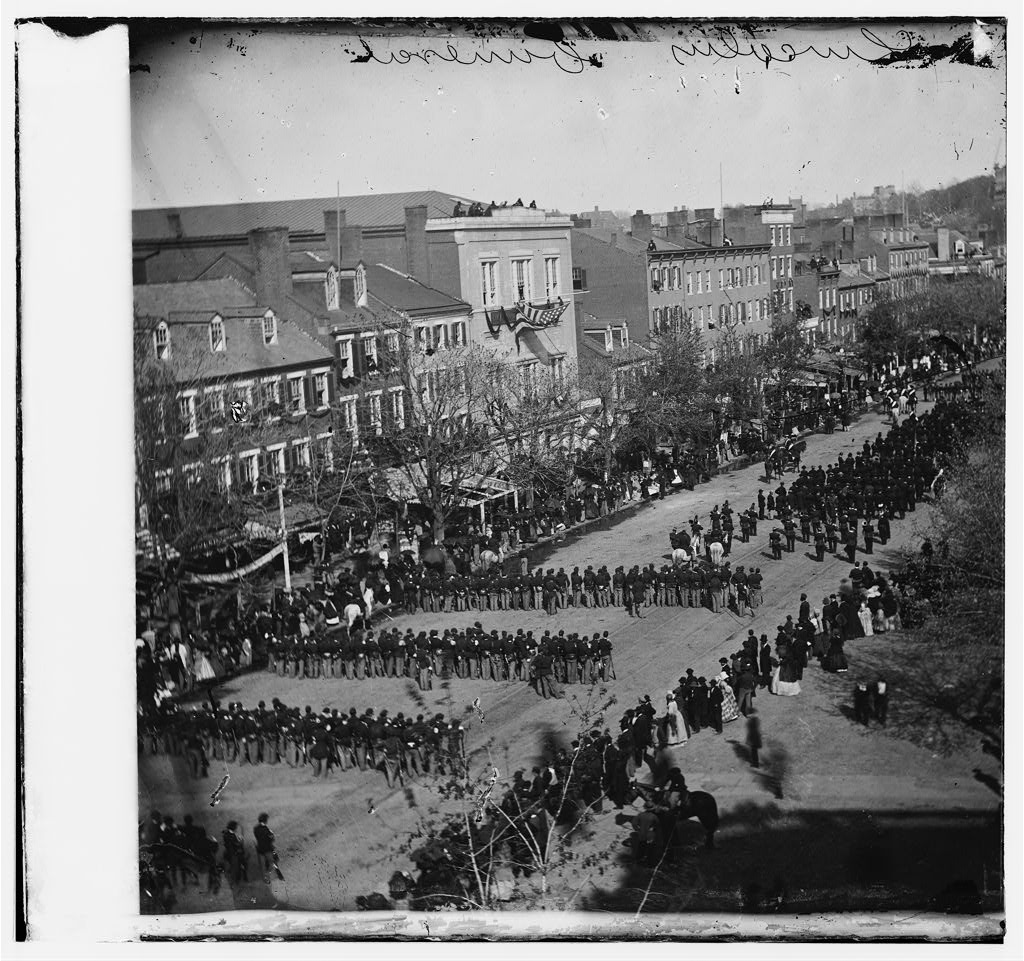
lincolnfuneral

From “Song of Myself” (1867) by Walt Whitman:

I have said that the soul is not more than the body,
And I have said that the body is not more than the soul,
And nothing, not God, is greater to one than one’s self is,
And whoever walks a furlong without sympathy walks to his own funeral
drest in his shroud,
And I or you pocketless of a dime may purchase the pick of the earth,
And to glance with an eye or show a bean in its pod confounds the learning
of all times,
And there is no trade or employment but the young man following it may
become a hero,
And there is no object so soft but it makes a hub for the wheel’d universe,
And I say to any man or woman, Let your soul stand cool
Composed before a million universes.
And I say to mankind, Be not curious about God,
For I am who am curious about each am not curious about God,
(No array of terms can say how much I am at peace about God
And about death.)

(Photo of Abraham Lincoln’s funeral procession on Pennsylvania Avenue, Washington, DC, via the Library of Congress)

Is “Jewish Atheist” An Oxymoron?

Herb Silverman doesn’t think so:

Within traditional Judaism, there is little interest in what one believes compared to what one does. Fixed prayers are standardized and required for the entire Jewish community, regardless of God belief. Saying these community prayers is not assumed to be an individual declaration of faith. There are 613 Torah commandments, and Orthodox Jews try to follow as many as possible. Some, like performing a ritual animal sacrifice at a temple in Jerusalem that no longer exists, are impossible. A commandment to believe in God is also impossible because people can’t will themselves to believe something they have solid reasons for not believing.

Judaism’s view about Jewish atheists is akin to “don’t ask, don’t tell.” When a rabbi from a Reform synagogue spoke to my local secular humanist group (Secular Humanists of the Lowcountry), he was asked how many in his congregation were atheists. He said, “I don’t know. We don’t ask such embarrassing questions.” When someone else asked which answer would be more embarrassing, he just laughed.

Some even pray, which Silverman believes is akin to “focusing or meditating,” and find meaning in worship beyond doctrinal niceties:

Many churchgoers, religious or not, are more interested in experiencing love and support within a community than in defining God or finding evidence for God’s existence. They can feel joy in religious fellowship and tradition even if they believe their official church doctrine is silly. Fred Edwords, Executive Director of the United Coalition of Reason, phrased it succinctly: “How many put up with nonsense for the smell of incense?”

The Search For Secular Salvation

New York Gay Pride On Display During Annual Parade

Wilfred McClay finds America’s collective self-understanding as the “redeemer nation” in more than just our foreign policy crusades:

What would American political culture look like without its pervasive moral dramas of sin and redemption, sometimes expressed in forms lofty and noble, but at other times resembling nothing so much as the smarminess and vulgarity of soap opera? One thing can be said for certain: We are not only intensely fascinated by these episodes of political theater, but fully in the grip of them, as far more than mere onlookers. For an allegedly secular society, the United States seems to be curiously in thrall to ideas, gestures, emotional patterns, nervous tics, and deep premises that belong to the supposedly banished world of religion. These habits of heart and mind are evident everywhere we look, and they possess a compulsive and unquestioned power in contemporary American life. It is as if the disappearance of religion’s metaphysical dimension has occasioned a tightening hold of certain of its moral dimensions, particularly so far as these relate to guilt and absolution.

Among other examples, he finds this dynamic at the heart of Jimmy Carter’s post-presidential career:

[R]edemption clearly has been on the mind of ex-president Jimmy Carter for the past 33 years. Carter has never gotten over the stern rebuke administered by voters in 1980, and the harsh judgment of many observers that his was a failed administration. In his case, a craving for redemption has animated an energetic, sometimes admirable, but often clumsy and self-seeking post-presidential career. In group photographs of president-elect Barack Obama and his four living predecessors at the White House, it was noticeable that Carter stood apart from the others, seemingly weighed down by a lingering sense of failure. One might think that his Christian beliefs would make him more at peace about how he is regarded in this world, given the priority his faith accords to the next one. But very few of us, and least of all the kind of man who wants to be president, can be genuinely indifferent to how we are regarded by others, and by history. And Carter is a proud man, in all the best and worst senses of that word. Redemption in the here and now, in the eyes of others, would be too sweet a vindication for him not to seek it; but it will likely elude him, because of the conspicuous pride that has motivated his quest for it. Who would be exalted must first be humbled.

(Photo: New York City mayoral candidate Anthony Weiner marches in the New York Gay Pride Parade on June 30, 2013 in New York City. Weiner has been polling neck-and-neck with long-time frontrunner Christine Quinn. By Andrew Burton/Getty Images.)