Hussein Ibish warns that institutionalizing “the exclusion of the Muslim Brotherhood will be a catastrophe”:
The lessons from the Algerian experience must hang heavy in the air. The Brotherhood left no choice for the whole rest of society, united, to reject their governance. But, if they stay within the law and eschew major outpourings of violence, they should not be persecuted or prosecuted. If they turn to violence, as some of their rhetoric suggests they might, this will be a calamity. It will lead to civil war, at least of a kind. They will lose, but it will be a generalized catastrophe.
If, on the other hand, non-Islamist forces who have now seized power by popular acclimation seek to systematically exclude the Brothers even if they continue to try to play by the new rules, they will be courting disaster. They must allow the Brotherhood to run in upcoming elections, and hope that they will learn their lesson and behave in a more reasonable, normative and inclusive manner if elected. If not, they will be rejected again. Democracies, from the outset, have always had to incorporate and accommodate non-democratic and authoritarian-minded forces (which the Brotherhood most certainly is) in spite of their hostility to the pluralistic order in which they participate. It is one of the great hazards of a free, open and democratic system: to be true to itself, it must generously afford oppressive groups more liberty than such groups would allow anyone else.
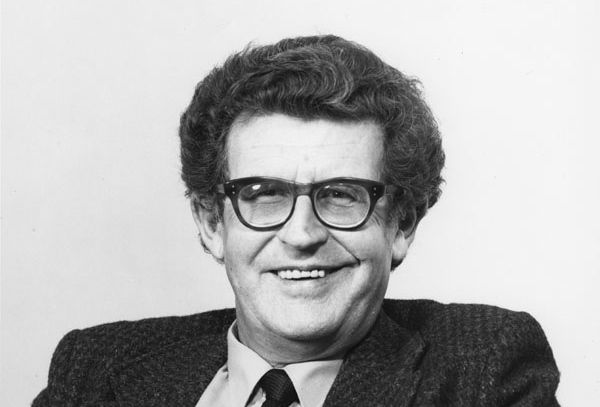
It was good to see a true conservative celebrated at National Review for a change. His works endure as classics, especially “The Liberal Mind“. A deep thinker in the classical liberal tradition of Constant and de Tocqueville, he escaped the religious fanaticism and pseudo-conservatism that has come, alas, to define much of the American right. Maybe that was because he was a New Zealand-born Australian. Here, for example, is a speech he gave about the thrill and yet dangers of modernity. He sees tragedy here as an opportunity for reflection, not a new political “ism”. The cultures of tradition and responsibility have declined as choice has expanded, he argued. At some point, this can lead to over-weening government or to social decay. And yet there is not a touch of puritanism in his prose – just an Oakeshottian perspective on the Enlightenment’s dark as well as bright sides
I only met him briefly while studying political philosophy at Harvard. He was the first president of the Michael Oakeshott Association, and his conviviality is captured by the always-convivial John O’Sullivan here:
Ken was always a cheerful and invigorating presence. His interests included Gene Kelly quite as much as Kierkegaard (more than, actually.) My last meeting with him was two weeks ago in London when we took in the Alan Ayckbourn hit comedy, Relatively Speaking, which Ken enjoyed enormously and which inspired an uproarious dinner afterwards.
His opening remarks in the following lecture on the idiocy of political idealism tell you much of what is to come. If you have enough time and interest, it’s well worth your time:
Here’s his critique of all forms of utopianism, but particularly that of atheistic leftism, which he called Olympianism:
Olympianism is the characteristic belief system of today’s secularist, and it has itself many of the features of a religion. For one thing, the fusion of political conviction and moral superiority into a single package resembles the way in which religions (outside liberal states) constitute comprehensive ways of life supplying all that is necessary (in the eyes of believers) for salvation. Again, the religions with which we are familiar are monotheistic and refer everything to a single center. In traditional religions, this is usually God; with Olympianism, it is society, understood ultimately as including the whole of humanity. And Olympianism, like many religions, is keen to proselytize. Its characteristic mode of missionary activity is journalism and the media.
If Olympianism has the character of a religion, as I am suggesting, there would be no mystery about its hostility to Christianity. Real religions (by contrast with test-tube religions such as ecumenism) don’t much like each other; they are, after all, competitors. Olympianism, however, is in the interesting position of being a kind of religion which does not recognize itself as such, and indeed claims a cognitive superiority to religion in general. But there is a deeper reason why the spread of Olympianism may be measured by the degree of Christophobia. It is that Olympianism is an imperial project which can only be hindered by the association between Christianity and the West.
I have a personal reason to be grateful to Minogue as well. Unlike almost everyone on the American right, he saw what I was trying to do in Virtually Normal and understood it, as I did, as an exercise in Oakeshottian restraint and Burkean adaptation to social change – rather than a revolutionary ideology. He reviewed it in National Review (no longer online) with the following words:
Andrew Sullivan has done for homosexuality what John Stuart Mill did for freedom: he has presented the whole range of social opinion about his subject with lucidity and fairness, and gone to work refuting most of it … Only those familiar with the deep wells of the history of political philosophy … will recognize the scale of his achievement.
Given all the abuse I’ve received from the hard right on gay equality, it was a tonic. It remains the review I’m proudest of – because it came from an Oakeshottian conservative of such learned good humor and intellectual rigor. It helped remind me that I was not betraying conservatism in writing that book, but doing my best to represent it in a new way for changing times. I was trying to integrate gays into their own society and families – with as little social disruption as possible.
(Correction: the first version of this post confused Minogue’s sub-title for “The Liberal Mind” with another book. It had no subtitle. let alone the Coulterish one I stupidly added. My dumb mistake. Apologies.)
Jay Ulfelder insists that the overthrow of Morsi was a coup:
Force deployed? Check. By political insiders? Check. Chief executive replaced? Check. Legal procedures not followed? Check. That the army’s apparent ouster of President Morsi may be popular doesn’t make it legal or erase the fact that he only “agreed” to go when coerced. That military leaders may not claim executive authority for themselves does not obviate the fact that they are pushing out a sitting president at gunpoint. That the coup could push Egypt onto a more positive trajectory doesn’t change the nature of the initial act.
Virtually all military coups come in response to a crisis. They don’t cease to be coups because of that.
When the military overthrew the elected president of Mali last year in response to the government’s failure to cope with the Tuareg rebellion, everyone could understand that it was nonetheless a coup. We shouldn’t pick and choose which military interventions in politics qualify as coups depending on whether or not we agree with the politics of the deposed leader. By law, the U.S. is required to withhold aid to a country when there is a military coup, but most likely that will be ignored in this case. Even so, there is no point in our pretending that it isn’t a coup, nor should we imagine that Morsi’s supporters will view it as anything other than this.
Jeremy Pressman thinks that this was an unusual sort of coup:
[W]hat happened clearly meets the definition of a coup. That said, this is an unusual case because it was matched, really preceded by, a huge mass mobilization on the part of the Egyptian people. I am not sure what precedent we have for that (any ideas?), and I think those millions who mobilized have a right to think they drove the train and compelled the military to step in. In other words, the fact that it fits as a military coup does not preclude the perception from developing among the popular anti-Morsi movement – millions of people – that it was somehow different from your average military coup and the military’s role was secondary, a tool of the people.
And Joshua Keating wonders whether this will be considered a “democratic coup d’etat”:
[A]re there cases when a coup can advance democracy? In a 2012 article for the Harvard International Law Journal, Ozan Varol, now a professor at Lewis & Clark Law School, argues that while the vast majority of military coups are undemocratic in nature, and lead to less democratic political regimes, there are significant examples of “democratic coups d’etat.”
I hear America singing, the varied carols I hear;
Those of mechanics—each one singing his as it should be blithe and strong,
The carpenter singing his as he measures his plank or beam,
The mason singing his as he makes ready for work, or leaves off work,
The boatman singing what belongs to him in his boat, the deckhand singing on the
steamboat deck,
The shoemaker singing as he sits on his bench, the hatter singing as he stands,
The woodcutter’s song, the ploughboy’s on his way in the morning, or at noon
intermission or at sundown,
The delicious singing of the mother, or of the young wife at work, or of the girl
sewing or washing,
Each singing what belongs to him or her and to none else,
The day what belongs to the day—at night, the party of young
fellows, robust, friendly,
Singing with open mouths their strong melodious songs.
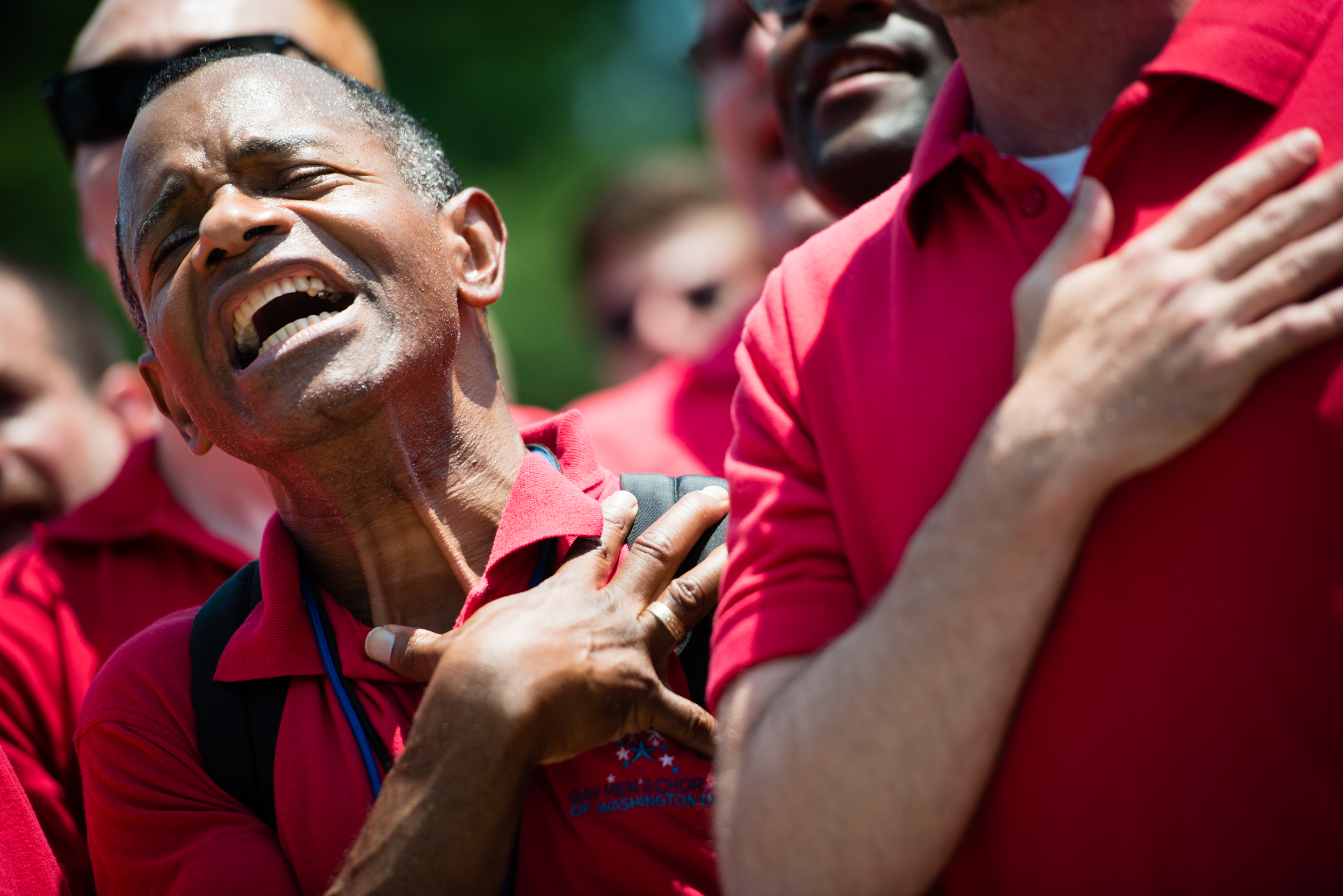
(Photo: The Gay Men’s Chorus of Washington, DC, including, Tim Allmond, 57, of Silver Spring, sings the National Anthem in front of the Supreme Court. The Supreme Court struck down a key part of DOMA on Wednesday June 26, 2013 leaving behind a victory for gay marriage. By Sarah L. Voisin/The Washington Post via Getty Images.)
If we feel pride, it should be in the accomplishments of our fellow citizens and in any contributions we ourselves have made toward making our country and community a better place, however small and local. Pride of simply being born American leads to hubris, which leads to bigotry and belligerence. For pride to be authentic, it must be something we feel we have earned.
The best American leaders have always made that distinction. We all know this line from John F. Kennedy’s 1961 inaugural address: “Ask not what your country can do for you; ask what you can do for your country.” But few seem to remember the next line: “My fellow citizens of the world, ask not what America will do for you, but what together we can do for the freedom of man.”
The brutal Cold War context of these words is almost lost to us now, but the higher ideals behind them are not ambiguous. Kennedy presented himself as a patriot of the United States and as a citizen of the world, seeing no contradiction. These words are, at root, an appeal for authentic pride—citizenship as something that must be earned, in a nation that is part of a community of nations. Those are ideals worth celebrating on the Fourth of July.
Maria Godoy investigates the culinary hardships of Civil War soldiers:
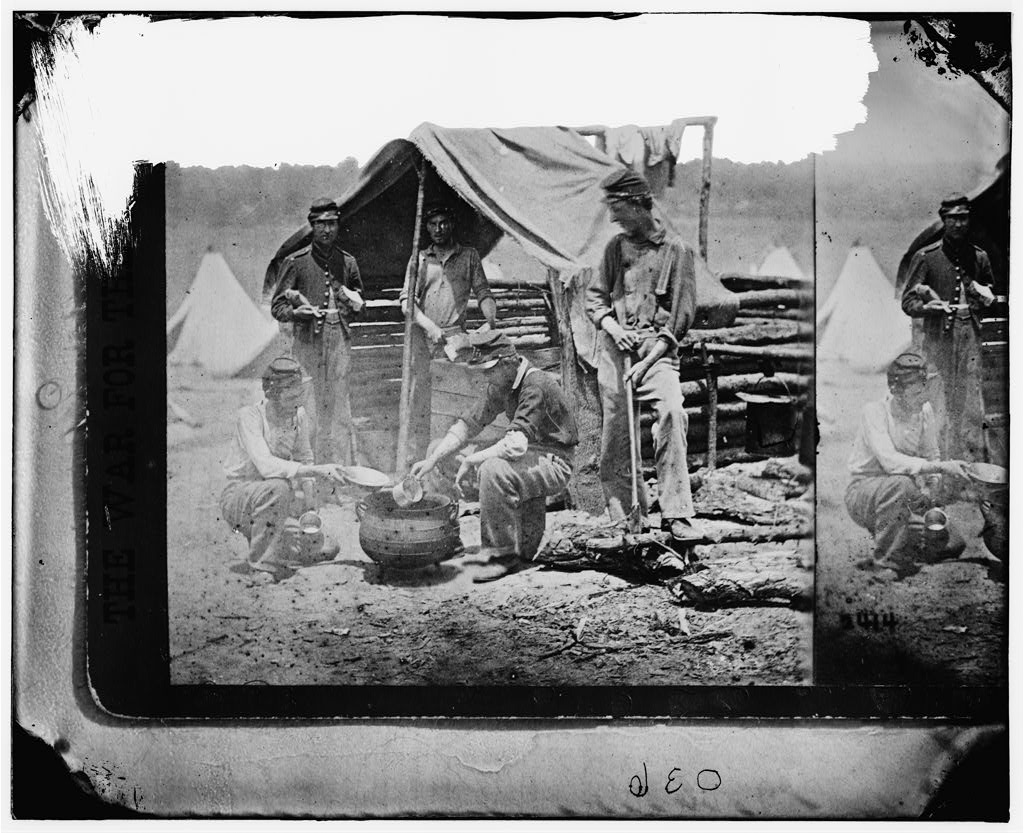
Insects and other critters commonly made it into Union soldiers’ meals in the form of hardtack — a stiff, flavorless cracker that could cost you a tooth if you bit it into it. (The biscuit was meant to be softened by dipping it in stew or coffee.) Along with salt pork or beef, hardtack — which the soldiers called “worm castles” or “teeth dullers” — was a staple of soldiers’ rucksacks. Yum…
The boys in Union blue also got dried navy beans and, occasionally, a “treat” of sorts: dehydrated potatoes, fruit and other items the soldiers jokingly called “desecrated” vegetables (perhaps because their flavor violated the laws of nature?). At least the North had coffee — though it was a brew “you probably wouldn’t recognize in New York,” as 16-year-old Union soldier Charles Nott wrote home. “Boiled in an open kettle, and about the color of a brownstone front, it was nevertheless … the only warm thing we had.”
Confederate soldiers weren’t so lucky: Union blockades kept coffee, flour and other goods from reaching the South. Those jonesing for a cup of joe had to make do with substitutes brewed from peanuts, chicory, rye, peas, dried apples — pretty much anything they could get their hands on.
(Photo: “Camp of 71st New Vols. Cook house Soldiers getting dinner ready,” via the Library of Congress)
Brian Anderson explores the potential of “micro-dosing” LSD, which would allow you to possibly “reap some of the reported benefits of a semisynthetic psychedelic like LSD without going all heavyminded”:
That’s the allure of what’s known as the sub-perceptual dose. It’s an idea that has been gaining traction in certain pockets of the medical community, though it’s neither new nor validated by any formal research. As James Fadiman notes in The Psychedelic Explorer’s Guide (2011), sub-perceptual psychedelic dosings have for centuries been known about and utilized by indigenous cultures the world over. Fadiman would know. He’s been in the trenches of legitimate mind-altering research for over four decades, and with time has become a sort of champion of the micro dose.
The problem – as usual – is prohibition’s effect on research:
[Fadiman] can’t establish proper lab conditions without facing criminal charges. The workaround? His volunteers must access the Schedule 1 drug on their own, and then parse the stuff into micro-hits of either 50 or 100 micrograms. Then they self adminster, and finally self-report. And then they repeat.
More Dish on drug research and micro-hits here, here, and here.
Seth Stevenson has some advice that might prove useful for your July 4th festivities:
Here in the U.S., the most-used term seems to be Irish goodbye, which, due to unfortunate historical stereotyping, hints that the vanished person was too tipsy to manage a proper denouement. Dutch leave is a less common, but apparently real, variant. (I picture someone taking a couple pulls on a vaporizer, scarfing too much bitterballen, and stumbling into the night.) And then there’s the old, presumably Jewish joke: WASPs leave and don’t say goodbye, Jews say goodbye and don’t leave. …
Let’s free ourselves from this meaningless, uncomfortable, good time–dampening kabuki. People are thrilled that you showed up, but no one really cares that you’re leaving. Granted, it might be aggressive to ghost a gathering of fewer than 10. And ghosting a group of two or three is not so much ghosting as ditching. But if the party includes more than 15 or 20 attendees, there’s a decent chance none will notice that you’re gone, at least not right away. (It may be too late for them to cancel that pickleback shot they ordered for you, but, hey, that’s on them.) If there’s a guest of honor, as at a birthday party, I promise you that person is long ago air-kissed out. Just ghost.
The most popular post was my late night rumination on the looming death of my beagle, Dusty – although today, she climbed up on her favorite rock in Provincetown harbor and smiled as broadly as a South Park Canadian. My take-down of Cardinal Dolan came in second.
See you tomorrow (we have some July 4th crack fresh from the Intertubes and, of course, continuing coverage of Egypt’s eruption).


 The Dish