When Help Is Not A Choice, Ctd

by Chris Bodenner

In response to a recent post on the ethics of mandatory psychiatric treatment, a reader shares her story:

My brother is schizophrenic. But he’s one of the lucky ones. He has a very involved family, an incredible psychiatrist, and is on medication that works for him. He’s finishing up college. He has a job and a fiancee. Fingers crossed, he’s going to be able to have the sort of normal life that seemed impossible when he first started hearing voices eight years ago.

He never would have reached this point if my family hadn’t managed to involuntary commit him twice. The first time was in the U.S. He was a college student being supported by my parents, but counted as an adult when it came to medical care. Luckily for us, as he’d made suicidal statements, a very understanding judge considered him “a danger to himself” and had him committed and forcibly given medication.

The second time was in Egypt. He was a college student there. His medication made him so exhausted the entire time that he hated it and thought he could safely stop taking it. He relapsed, my sister and I flew to Cairo to track him down, and had him forcibly committed to a private clinic. I signed the papers. It was easy. It’s the only time I’ve ever been thankful for a country’s lack of civil liberties laws.

He was put on a new medicine, which works and doesn’t have the terrible side effects. He’s been sane for five years now, and is very responsible about managing his illness. Now he has complete personal autonomy when it comes to his medical care.

But that’s the point. If someone is in the middle of a schizophrenic episode, they don’t have autonomy over their thoughts, senses or actions. Forcibly putting a person on medication isn’t taking away their autonomy; it’s restoring their autonomy. By committing him, we gave him back his sanity and his personal autonomy, and almost certainly saved his life. It was the best thing my sister and I have ever done.

(Incidentally, he was a very heavy pot smoker as a teenager. And then he moved to hash when he was in Egypt. Our family has a history of severe mental illness, so he was genetically predisposed, but I definitely believe that marijuana contributed to him developing full-blown schizophrenia. I only smoked pot very occasionally in college. I haven’t touched the stuff since my brother became ill. It now terrifies me.)

Previous Dish on cannabis and schizophrenia here.

Why Did Picasso Prosper?

by Jessie Roberts

Ian Leslie suggests that Pablo Picasso’s success with Cubism was hardly inevitable, but rather the product of circumstance:

First, there was a new kind of consumer: the industrial revolution had created a class of young, educated, affluent Parisians, who, keen to distinguish themselves from their dish_picasso more conventional elders, prided themselves on daring displays of taste.

Second, new channels of distribution were opening: the French government had divested itself of responsibility for the city’s annual art salon, and private galleries sprang up in its place. Finally, a new breed of art dealers emerged, many of them foreign and thus outsiders to the Parisian establishment. These young, hungry businessmen competed to find the new new thing first and sell it at the most aggressive price possible.

In short, and almost without anyone noticing, Paris’s art market had become receptive to the commercial possibilities of risk-taking. Artistic innovation was becoming economically viable for the first time. Breaking with the past was starting to be encouraged; soon it would be demanded. This was the environment in which Picasso made his leap into the unknown.

[Professor Stoyan] Sgourev’s analysis of Cubism suggests that having an exceptional idea isn’t enough: if it is to catch fire, the market conditions have to be right. That’s a question of luck and timing as much as it is of genius.

(Image: Portrait of Pablo Picasso, Juan Gris, 1912, via Wikimedia Commons)

A Shooting Victim Against Stop-And-Frisk, Ctd

by Chris Bodenner

A reader writes:

A few years ago I was attacked and beaten unconscious on my street in Brooklyn. I was set upon my three young black men, one armed with a pipe and wearing, yes, a hoodie.

During the attack, another man came to my aid. He saw the attack, rushed in and received a blow to the head with that same pipe for his trouble. But this man, a complete stranger to me, made enough noise and drew enough attention that my attackers fled.

Brian Beutler is correct to say that I can’t draw a conclusion from the fact that the only person who has ever attacked me was a young black man wearing a hoodie. But here’s one fact I can add: The only person who has ever rescued me from a street attack was a young black man wearing a hoodie.

Sadly the story of the Australian baseball player randomly targeted in Oklahoma didn’t end nearly as well. Update from a reader with another story:

I lived in the Bushwick neighborhood in Brooklyn for 7 years, moving promptly after a group of black boys in hoodies attacked me on my way home from work.

It was 6:00 PM and the same few blocks I walked for years with no incident. As I left the subway exit, the boys were ahead of me, and since I am a fast walker I passed by them. Bam! One punched me in the face, they all jumped me, stealing my iPhone (I fought back enough that they didn’t get my bag or wallet, and when the other commuters approached they ran). I walked away, which I consider lucky.

What surprised me most was the most common reaction amongst my friends and family: “Why when you saw a group of black boys did you not cross the street? Why would you pass them?” My reply was usually, “If I crossed the street every time I saw a group of black kids, I’d never get anywhere. I live in Brooklyn!”  That night there was a snowstorm leaving about two feet of snow, and in the morning I went to dig my car out so I could look at places to live outside of the city. I was approached by two black kids in hoodies and shovels.

They offered to dig my car out so long as I paid them, as they did a few others digging themselves out. I felt in that moment I had a choice. I honestly didn’t know if these boys were two of the gang that jumped me. I was jumpy enough I could have told them to get lost. Instead, I thanked them for their help. Noticing that one of them was using a heavy coal shovel instead of a lighter snow shovel, I gave him some extra money and told him to buy a better shovel.

I was traumatized by what happened the night before, but if I didn’t accept their help, I felt like I’d be like all those people who told me to assume any group of black boys in hoodies were thugs. I refused to lump all “black boys in hoodies” together. These kids were out trying to earn money, not steal it.  I refused to believe that was true. I wonder sometimes if maybe they were part  of that gang, or knew the kids who were. It doesn’t matter I suppose, but I do feel good about maintaining my integrity. I can say that what happened didn’t make me prejudiced or cynical, because if it did, then those boys who jumped me would have taken much more than my iPhone.

The Best Of The Dish Today

by Chris Bodenner

Readers scrutinized the outrage from Greenwald and Andrew over the detention of Glenn’s partner at Heathrow airport. Ambinder also criticized the use of Miranda as a courier, but Andrea Peterson came to Glenn’s defense. Regardless of Miranda’s role, the destruction of Guardian computers by UK officials was unconscionable.

Over to Egypt, Adam Shatz sensed a counter-revolution, Douthat reassessed the realpolitik approach from the US, and Bobby Ghosh questioned our preoccupation with the country in the first place. Meanwhile, Qatar-based Al Jazeera debuted on American shores.

Despite getting shot by black teenagers in hoodies (coincidentally on the same dangerous block next to Andrew’s apartment), Beutler refused to let the trauma affect his opposition to stop-and-frisk. Bouie and Chait criticized felony disenfranchisement laws and voter ID laws. Readers continued to share stories of their grieving pets.

The VFYW contest was particularly tough this week, and the daily VFYW was particularly popular on Facebook. Brendan James thought through the antihero trend among serial TV dramas like The Sopranos and Breaking Bad (a cinematographic tribute of which is seen above).

In case you missed Andrew’s parting thoughts from Sunday night, they’re here.

Sound Sleep, Sound Mind

by Matt Sitman

Russell Foster, who researches the neuroscience of sleep, explores its importance for mental health:

In an interview, Foster discusses his early experiments into the connection between sleep and sanity:

[P]eople have been talking about people with really disrupted sleep with mental illness since the 1880s. So it’s a well-described phenomenon, but largely ignored. When people did start thinking about it in the 1970s, for example, they assumed that the abnormal sleep was a result of the antipsychotics that were being introduced at the time, but of course ignoring the fact that for the previous 100 years people had been talking about poor sleep without any antipsychotics. And then the other argument was that it is not the antipsychotics — it’s because of the socialized relations.

This really intrigued me, so we used this tiny little wristwatch device to measure the rest activity cycle of patients diagnosed with schizophrenia.

These patterns were absolutely smashed — these are the worst rest activity patterns I’ve seen, whether from a mouse or a human. This was really profound and I thought: “Hang on.” I worked really closely with my colleague, Katharina Wulff, and Katharina had the really good idea to compare unemployed individuals and look at their sleep-rest patterns as a parallel to work on those patients with schizophrenia. And actually, the unemployed don’t have particularly abnormal sleep patterns at all; their statistics are not very different from the working population, so clearly lack of a job was not causing this. Also, we had enough data to suggest that these abnormal sleep patterns were occurring irrespective of the antipsychotic medication.

Must Scientists Be Apolitical?

by Tracy R. Walsh

Dan Cass thinks climate researchers “can be passionate moral leaders and still retain their integrity”:

The majority of climate scientists are probably right to follow their current strategy, which is keep calm and carry on. They are expanding our knowledge about the climate, doing what they are best at and which the rest of us are unable to do. However, we are in a global crisis, and I believe that the scientific fraternity has an ethical obligation to take action. We need some scientists to show social leadership, not just scientific leadership.

He recommends they follow a famous example:

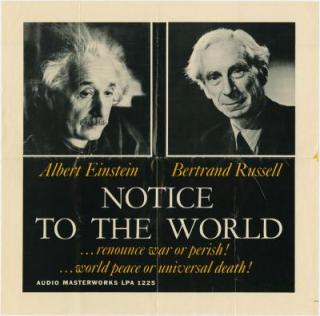
In 1955, Albert Einstein signed a letter calling on the world to renounce nuclear weapons.

The 00001219Russell-Einstein manifesto was endorsed by the smartest scientists of the generation, including several Nobel Prize winners. … As a result of the manifesto, the scientists formed Pugwash, an organization of scientists devoted to a political project: preventing nuclear war. Joseph Rotblat was a founder of the organization and when the New York Times invited him to write on the 50th anniversary of the manifesto, he said: “We took action then because we felt that the world situation was entering a dangerous phase, in which extraordinary efforts were required to prevent a catastrophe.”
Rotblat and Pugwash shared the Nobel Prize for peace, and he is a hero of mine for showing that scientists can be passionate moral leaders and still retain their integrity. The work done by scientists through Pugwash helped make the world a safer place. Their work contributed to the key international agreements on weapons of mass destruction, including the Partial Test Ban Treaty of 1963, the Non-Proliferation Treaty of 1968, and the Biological Weapons Convention of 1972.

(Image via McMaster University)

Face Of The Day

by Chris Bodenner

NEPAL-SOCIETY-ELDERLY-AVIATION

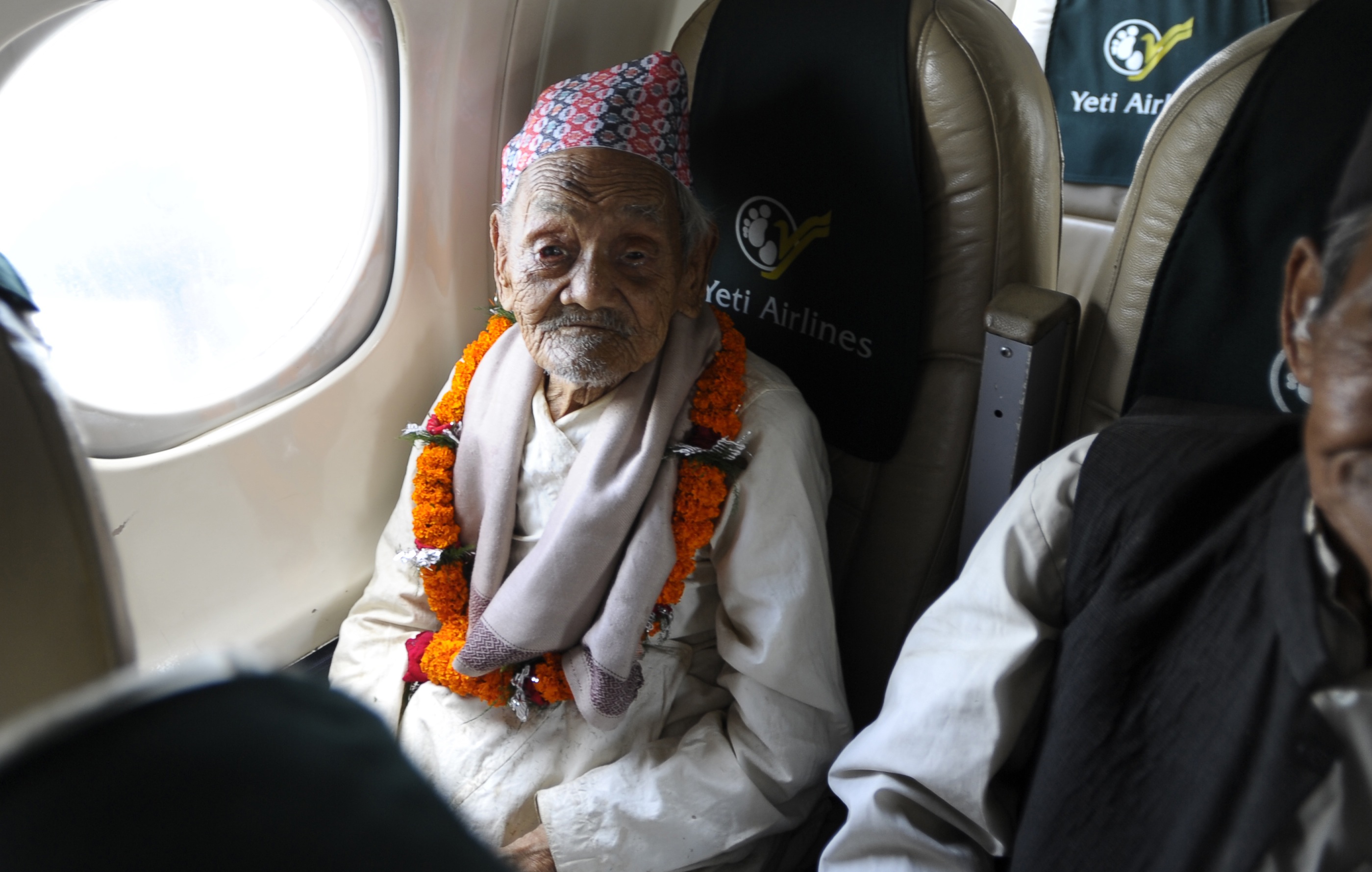
Nepalese man Bote Rai, 106, is pictured in his window seat of a Yeti Airlines aircraft after flying for the first time during his arrival at the Kathmandu airport on August 20, 2013. Airline officials said they sponsored Rai’s flight after reading in a local Nepali newspaper about his wish to fly on an aircraft. Rai, who has hearing problems and lives with his 75-year-old niece in remote Dhankuta district in eastern Nepal, will spend a day in Kathmandu and visit the Pahsupatinath Temple before flying out to Biratnagar, the nearest airport from his home. By Prakash Mathema/AFP/Getty Images.

Dick Pics On Display

By Tracy R. Walsh

If you’ve anonymously shared a crotch shot over the past few months, your junk may soon be part of an exhibit:

Four artists interested in feminism, the Internet, sex, porn, and power have decided that the dick pics they’ve gathered are important enough to share with the public. Over 300 men who have engaged in a little harmless online exhibitionism sending this summer may be surprised to learn that their members will mounted, framed, and put on display on August 23 at a Brooklyn gallery space by an artist collective known as Future Femme.

The artists collected the photos through social media and dating sites. The unwitting models apparently don’t have much legal recourse:

It’s true that if your dick appears in the show and you were misled about the solicitor’s true identity you have a chance at legal retribution. Because one of the artists posed as someone else [on Grindr] she’s liable to be sued for internet impersonation, a class A demeanor in New York that caries a $1,000 fine and up to a year in prison. But unless any of these users walk into the Bushwick exhibit and recognize themselves, they’ll never know more than one stranger saw their dicks. But if a dick pic gets shown in a public space and the dick’s owner doesn’t know, is it moral? Is it right?

Jessica Roy is uneasy:

It’s pretty obvious what the outrage would look like were the genders in this story reversed, and revenge porn–the practice of publishing naked photos of someone online without their consent–is ethically unacceptable no matter your gender. But in response, the artists claim they’re doing it as a reaction to the feelings of assault women can feel when they randomly receive an unsolicited dickpic. They’re also posting each framed penis photo next to a picture of their own genitals, and there will be no names or faces that will make it possible to identify the dick owner.

Eric Shorey is one of the few men to have offered his opinion:

The art project, while licentious and shocking, could certainly be thought of as an interesting exploration of gender, sexuality, and predation in the age of the Internet. Or, conversely, it could be thought of as some horny girls having a laugh at the expense of men. Either way, the art piece is sure to start some much needed conversations about hook-up culture and the digital mating patterns of our fellow human beings.

Al-Jazeera Arrives

by Brendan James

Nikki Usher wonders whether Al-Jazeera America — which debuts today — will be “must-watch-TV or not watched at all”:

AJAM’s promise boils down to more hard news: 14 hours of daily live news, news updates at the top of every hour, documentaries, investigative reports, eight to twelve-minute news pieces, and fewer commercials. But is this what Americans want? Some defenses of AJAM forget that PBS (and the BBC) already exists and is not thrillingly popular among American TV households. NPR has its own oligopoly on serious radio news. If this new channel is basically Al Jazeera English tailored for the PBS/NPR audience, we can expect a left wing approach on foreign affairs, where the U.S. Syrian rebels are activists and the Arab Spring is an unalloyed good.

What makes AJAM truly odd and unpredictable, though, is that nobody knows what its metrics of success will be, because its success is not riding on market viability. It’s riding on Qatar’s approval. The financial well for coverage of uncovered issues, the money to hire talent, the desire to keep open bureaus – all of this depends on the good will of a benefactor whose intentions are still inchoate.

Despite the expected hyperbole regarding the network’s foreign owners, Jeff Jarvis worries the network won’t stand out enough:

Here’s what concerns me about Al Jazeera America: They hired people straight out of traditional TV news; they tried hard not to hire foreigners. But what I was hoping for was a new form with new perspectives. Instead, on On the Media, the producer of the evening news, Kim Bondy, said: “It has some of the sensibility of CBS Sunday Morning. It should also look a little bit probably like Rock Center. And we’re stealing a couple of pages out of Real Sports with Bryant Gumbel.” NO! This is your chance to reinvent TV news, not copy it! I’d rather they listed lots of shows and then said, “Ours will look and sound nothing like them!”

Meanwhile, Debra Kamin profiles Israel’s first international channel, i24news, which is looking to push back against AJ in English, French and Arabic:

It’s a mix that, by leaving out Hebrew, immediately signals i24’s ambition to speak to viewers beyond Israel’s borders. While English and French were obvious choices, the network’s founders say the decision to broadcast in Arabic was taken consciously to build an audience in parts of the world most hostile to Israel. “People will watch us because they hate us, and they will watch us through curiosity,” said Frank Melloul, the network’s Swiss-born 39-year-old CEO, who says he believes he can eventually compete with CNN, the BBC and Al Jazeera for viewers. “They will see how we cover the 70 percent of international news, and if they can trust that, then they will also trust how we cover Israeli news.”