Fighting Over The First Americans

by Matt Sitman

Michael Lemonick profiles the work of archaeology professor James Adovasio, whose excavations of the Meadowcroft Rockshelter in western Pennsylvania helped upend our ideas about the peopling of North America:

A young archaeologist at the University of Pittsburgh, he intended to use Meadowcroft to train students. But what he found here helped demolish his colleagues’ long-held ideas about the timing of humans’ first steps in the New World. Since the nineteen-thirties, the conventional wisdom had held that humans crossed over into North America from Siberia around thirteen thousand years ago, then spread over the next five hundred years through North and South America—wiping out mammoths, mastodons, and other large mammals as they went. This hypothesis became known as the “blitzkrieg model” of species extinction.

But Adovasio, now a professor at Mercyhurst University, in Erie, Pennsylvania, discovered evidence that humans had camped at Meadowcroft, under a protective rock overhang, sixteen thousand years ago—a few thousand years before the Siberian crossing.

Adovasio at least partly blames old-fashioned prejudices for the persistence of the theory he rejects:

In part, he attributes the longstanding acceptance of this implausible story to the fact that, until relatively recently, most archaeologists were men. “I mean, who but a male would think that the ancestors of modern Native Americans sprinted to South America and killed everything in their path?”

If the first immigrants did arrive much earlier, the ice-free corridor through the glaciers wouldn’t have been available. But there’s an alternate route: they could have travelled down the coast in boats. “The colonization of Australia occurred even earlier,” Adovasio said. “It’s, in my opinion, simple racism that we never recognized before that the earliest populations in the Americas were capable of building boats.”

The Best Of The Dish This Weekend

photo

Five must-reads: Isaac Asimov, proving our almost instinct is almost true; Francis Spufford’s guide to how to pray to the God who loves; George Orwell’s quotidian and sometimes funny private life; A.O. Scott’s definition of “strained pulp“; and the Burka-clad super-heroine!

Quote for the day: “Every angel is terror.”

The most popular posts since we went independent are “The Saddest Map In America” and “Two Popes, One Secretary” with “The GOP Calls Its Own Fiscal Bluff” and “Noonan Just Loses It,” coming up from behind. Our three biggest referrers were Google, Twitter and Facebook in that order. Over the same seven months, we sent the most Dish traffic to The Atlantic, Slate, and TPM.

I’m starting my annual fortnight August vacation tomorrow, going off-grid for a week, and then off-off-grid. I leave you in the extremely capable hands of the Dish editorial team: Patrick, Chris, Jessie, Matt, Alice, Chas, Tracy and Brendan. It’s easily the best team we’ve ever assembled in this spot – and they have more than carried this blogazine to places and topics and debates and photos and tweets and videos no single person could ever reach on his own. I’m so grateful to them, and so much better a blogger because of them.

Which means, of course, a debt of gratitude to you too, Dish readers and subscribers. This summer, for the first time, I’m taking a vacation from, er, myself and my two partners in Dish Publishing LLC, Chris and Patrick. It was by no means a sure thing. Since last August, we didn’t just produce the Dish every day, we also moved the Dish from the Beast to our new, independent platform, financed entirely by howler beaglereaders. Figuring that business model out, finding Tinypass, our meter-partner, designing a new page, with a new search function, figuring out taxes and legal stuff and health insurance and payroll … it’s been quite a learning curve for us. And easily the most exhausting as well as exhilarating year in the Dish’s life.

But looking back, it may well have been one of our best years ever. Jessie’s return has paid massive dividends every day; Alice’s poetry selection is the best on the web; Matt’s coverage of religious and cultural debates has brought the weekends new sophistication; Chas has been integral to every new technological challenge and, with Brendan, a master of Twitter. Tracy may be the best single intern we’ve ever had. Our new general manager, Brian Senecal, has been a godsend for dealing with the myriad practical things we need to get done and organized. Patrick and Chris remain, of course, the prime movers behind all of this. I couldn’t begin to name their contributions because they are so legion. Let’s just say that running a business while also producing up to 50 posts a day and dealing with me is not something for the fainthearted. But they did it – with aplomb.

The Dish now has close to 30,000 subscribers. We’ve raised revenue of $743,000 toward our year-end goal of $900,000 by next February.

None of this would have been possible without your subscriptions and support and countless communications with us every minute of the day and night. We know that our core strength is our readership – the single best readership online, IMHO. And so, before I hand over the sandbox, I just wanted to say personal thanks to all of you who placed your faith in us and subscribed. We hope to add some features this Dusty in ivyfall to enhance your subscriber experience some more. And on a personal note, the emails about Dusty were overwhelming in their tenderness and empathy. People say the web is for haters. Not here. Not in the Dish community.

And for the 11,000 of you who have used up all your meter allowances and still haven’t subscribed, [tinypass_offer text=”please do”]. If you were all to subscribe, we would have no worries for the future and could plan confidently for Year Two. The price is only $1.99 a month/$19.99 a year – or more if you want. So take a minute to ask yourselves if the work we all do each day is worth that to you. If it is, please [tinypass_offer text=”take two minutes”] to get off the fence and [tinypass_offer text=”subscribe”]. If you want online, truly independent journalism to survive, we need your help. Eschewing advertisers for now gives us a much higher signal-to-noise ratio and makes us much more independent of corporate pressure than much of online media – and enables us to push the envelope on topics most big advertisers would run from. But we cannot keep this up unless we get more new subscribers.

So help out and [tinypass_offer text=”subscribe!”] And see you in a couple of weeks.

Pogonophiliacs Unite!

GERMANY-MEDIA-CINEMA-AWARD-CLOONEY

Here’s a great little essay in defense of beards. I’ve made its core argument before, of course. But it’s worth making again:

The mystery of beards altogether is that it’s the growers of them who are questioned as to their motives. Given that a beard will happen of its own accord, shouldn’t it be those who interfere in the process that we ought to be interrogating? Not why do you grow, but why do you shave? I grow because I can’t bear the fag of shaving. Now you explain yourself. We will very quickly, I suspect, find vanity at the root of clean-shavenness, or if not vanity neurosis. All that work for what? To look like David Beckham who reputedly shaves every other inch of his person as well? And having shaved himself to resemble a muscular baby, gets someone else to draw on him with a needle. Tell me that’s not sick.

Esau, you will remember, was a hairy man. You will also remember that it was his brother Jacob, a smooth man, who soft-talked his way into Esau’s inheritance. The smooth do that. For all their hard-scraped air of transparent affability, it is they, not the bearded, who have something to hide.

Amen. Don Draper anyone? Richard Nixon – who fought against debilitating five o’clock shadow much of his life? You betcha. But Howard Jacobson also offers an affirmative beards-are-good argument as well:

It was said of me by my enemies when I first taught at a university that I grew a beard because D H Lawrence had one. Nothing could be further from the truth. I didn’t like Lawrence’s beard. It was too sexuo-spiritual for my taste. There was too much intent and pedantry about it, and finished too far from his chin. You can always tell an erotic disciple-seeker’s beard: it doesn’t know when to stop. Had I wanted to model my beard on any novelist’s it would have been Joseph Conrad’s  – a melancholy, well-traveled, utterly unillusioned seaman’s beard. Or the one Henry James sported for a while –  the beard of a man who thought he hadn’t lived enough but was prepared to die trying. A beard should be accepting of human limitations, skeptical but sympathetic, and a little sad.

The beard is … Oakeshottian!

And scene.

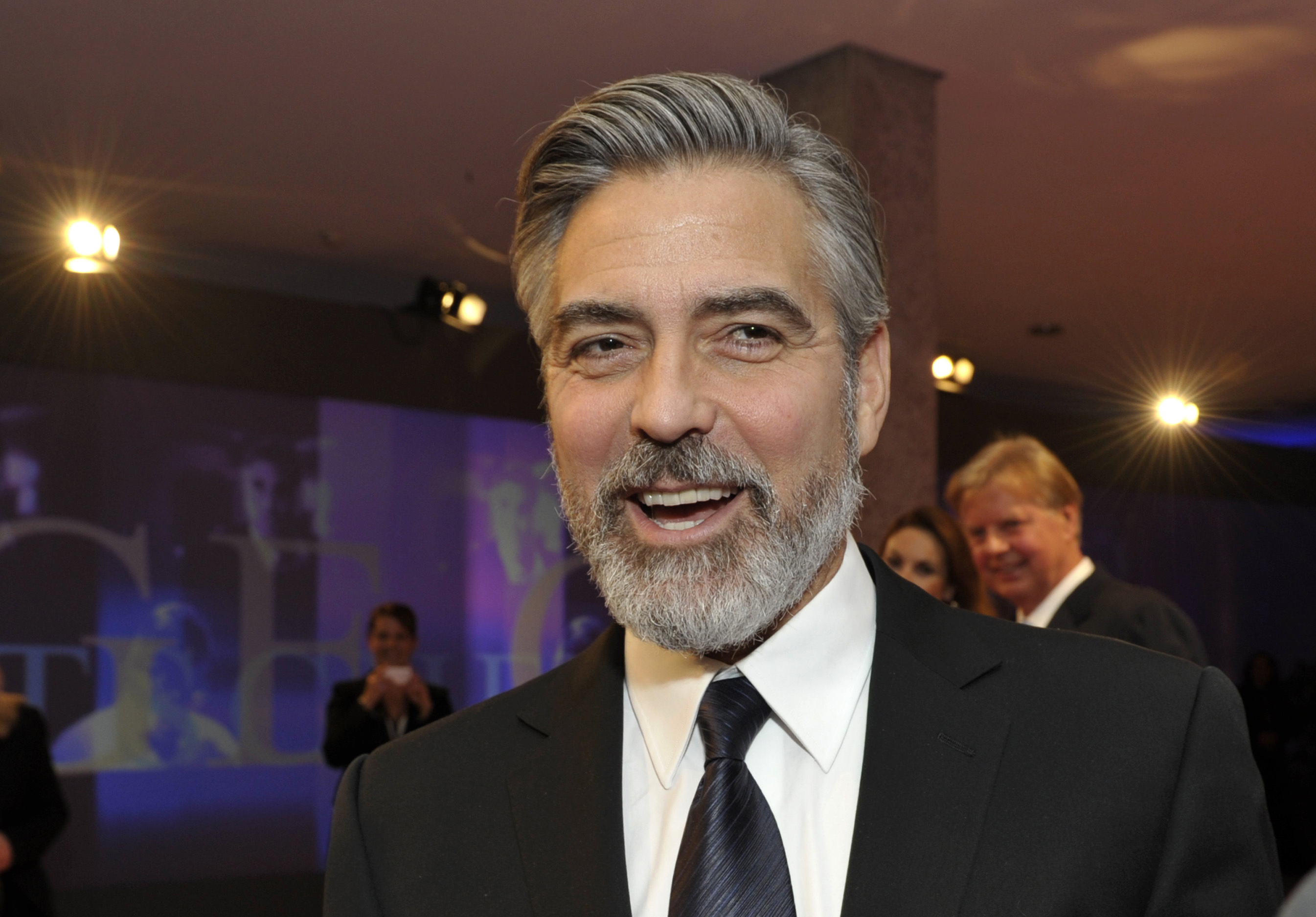
(Photo: US actor George Clooney smiles as he arrives for the German Media Award in Baden-Baden, southern Germany, on February 26, 2013. Clooney is awarded for his humanitarian commitment. By Thomas KienzleAFP/Getty Images.)

The Other One

eddy-dusty-rocks

Today’s post on the grieving of animals truly hit home for me. Since Dusty’s death, her canine companion of seven years, Eddy, is showing what seem to me at least intimations of grief. At first: nada. Yes, she was howling when we came back to our house after putting Dusty to sleep. But that was because, we assumed, the two of us almost never leave the house with Dusty and without Eddy. She felt left out of something – and, of course, she was right.

Then she seemed almost giddy with excitement and high spirits. She could finally eat her food without having Dusty inhale her own bowl in around 30 seconds and then hover behind Eddy waiting to eat hers as well. For seven years, Eddy had to eat the food right away or guard it. Most of the time, she was forced to eat it very quickly or starve. So the day after Dusty was no longer in the house, Eddy left her food in the bowl for eddysun.jpghours. She’d take a nap or go for a little walk-around, blissfully liberated from the food stealer.

When we prepared to take her out for a walk all by herself, she would do a full body-wag even more enthusiastically than usual, jumping into the air in little spasms of joy. Trips we hadn’t made before because Dusty was too debilitated or boisterous, we now could make with Eddy by herself. So she became completely besotted with one of my best friend’s boat, running into the bay in order to jump up on it, sitting upright in it, her nose twitching with the sea breezes. For days, she seemed extremely happy.

And then, after a week or so, something changed quite suddenly.

Her demeanor shifted to sadness and quiet. She didn’t just leave her food around to eat at leisure; she stopped eating in the morning altogether. It was almost as tough as getting her to eat in the evening as well. On walks, she trailed behind, moving slowly, tugging at the end of a long leash, as if not really wanting to go anywhere. It happened after about a week – perhaps because that was when it became unmistakable that Dusty wasn’t just away for a bit – but was, in fact, never coming back.

Is this grief? We cannot ever know. But it sure feels like it. They were never that close, because Dusty was never very close with any other earthly being, including me. But the time spent together adds up – and Eddy was always a pack animal, much happier when we four were all together than when one of us went missing. Now, one part of that family is missing for good. And I’m not the only one still aching at the sight of one crate where there only recently were two.

Cameron Proves Greenwald Right

David Cameron Meets With The King Of Bahrain At Downing Street

Readers know I have been grappling for a while with the vexing question of the balance between the surveillance state and the threat of Jihadist terrorism. When the NSA leaks burst onto the scene, I was skeptical of many of the large claims made by civil libertarians and queasily sympathetic to a program that relied on meta-data alone, as long as it was transparent, had Congressional buy-in, did not accidentally expose innocent civilians to grotesque privacy loss, and was watched by a strong FISA court.

Since then, I’ve watched the debate closely and almost all the checks I supported have been proven illusory. The spying is vastly more extensive than anyone fully comprehended before; the FISA court has been revealed as toothless and crippled; and many civilians have had their privacy accidentally violated over 3000 times. The president, in defending the indefensible, has damaged himself and his core reputation for honesty and candor. These cumulative revelations have exposed this program as, at a minimum, dangerous to core liberties and vulnerable to rank abuse. I’ve found myself moving further and further to Glenn’s position.

What has kept me from embracing it entirely has been the absence of any real proof than any deliberate abuse has taken place and arguments that it has helped prevent terror attacks. This may be too forgiving a standard. If a system is ripe for abuse, history tells us the only question is not if such abuse will occur, but when. So it is a strange and awful irony that the Coalition government in Britain has today clinched the case for Glenn.

A disclosure upfront: I have met David Miranda as part of a my friendship with Glenn Greenwald. The thought of his being detained by the British police for nine hours because his partner embarrassed the American government really sickens me at a gut level. I immediately think of my husband, Aaron, being detained in connection to work I have done – something that would horrify and frighten me. We should, of course, feel this empathy with people we have never known – but the realization is all the more gob-smacking when it comes so close to home. So of course my instinct is to see this exactly as Glenn has today.

But put that instinct aside for a moment. David was detained under an anti-terrorism law:

Section 7 of the British Terrorism Act allows the authorities to detain someone for up to nine hours for questioning and to conduct a search of personal items, often without a lawyer, to determine possible ties to terrorism. More than 97 percent of people stopped under the provision are questioned for under an hour, according to the British government.

David was detained for nine hours – the maximum time under the law, to the minute. He therefore falls into the 3 percent of interviewees particularly, one assumes, likely to be linked to terrorist organizations. My obvious question is: what could possibly lead the British security services to suspect David of such ties to terror groups?

I have seen nothing anywhere that could even connect his spouse to such nefarious contacts. Unless Glenn is some kind of super-al-Qaeda mole, he has none to my knowledge and to suspect him of any is so close to unreasonable it qualifies as absurd. The idea that David may fomenting terrorism is even more ludicrous.

And yet they held him for three hours before informing his spouse and another six hours thereafter. I can see no reason for those extra six hours (or for that matter the entire nine hours) than brute psychological intimidation of the press, by attacking their families.

More to the point, although David was released, his entire digital library was confiscated – including his laptop and phone. So any journalist passing through London’s Heathrow has now been warned: do not take any documents with you. Britain is now a police state when it comes to journalists, just like Russia is.

In this respect, I can say this to David Cameron. Thank you for clearing the air on these matters of surveillance. You have now demonstrated beyond any reasonable doubt that these anti-terror provisions are capable of rank abuse. Unless some other facts emerge, there is really no difference in kind between you and Vladimir Putin. You have used police powers granted for anti-terrorism and deployed them to target and intimidate journalists deemed enemies of the state.

You have proven that these laws can be hideously abused. Which means they must be repealed. You have broken the trust that enables any such legislation to survive in a democracy. By so doing, you have attacked British democracy itself. What on earth do you have to say for yourself? And were you, in any way, encouraged by the US administration to do such a thing?

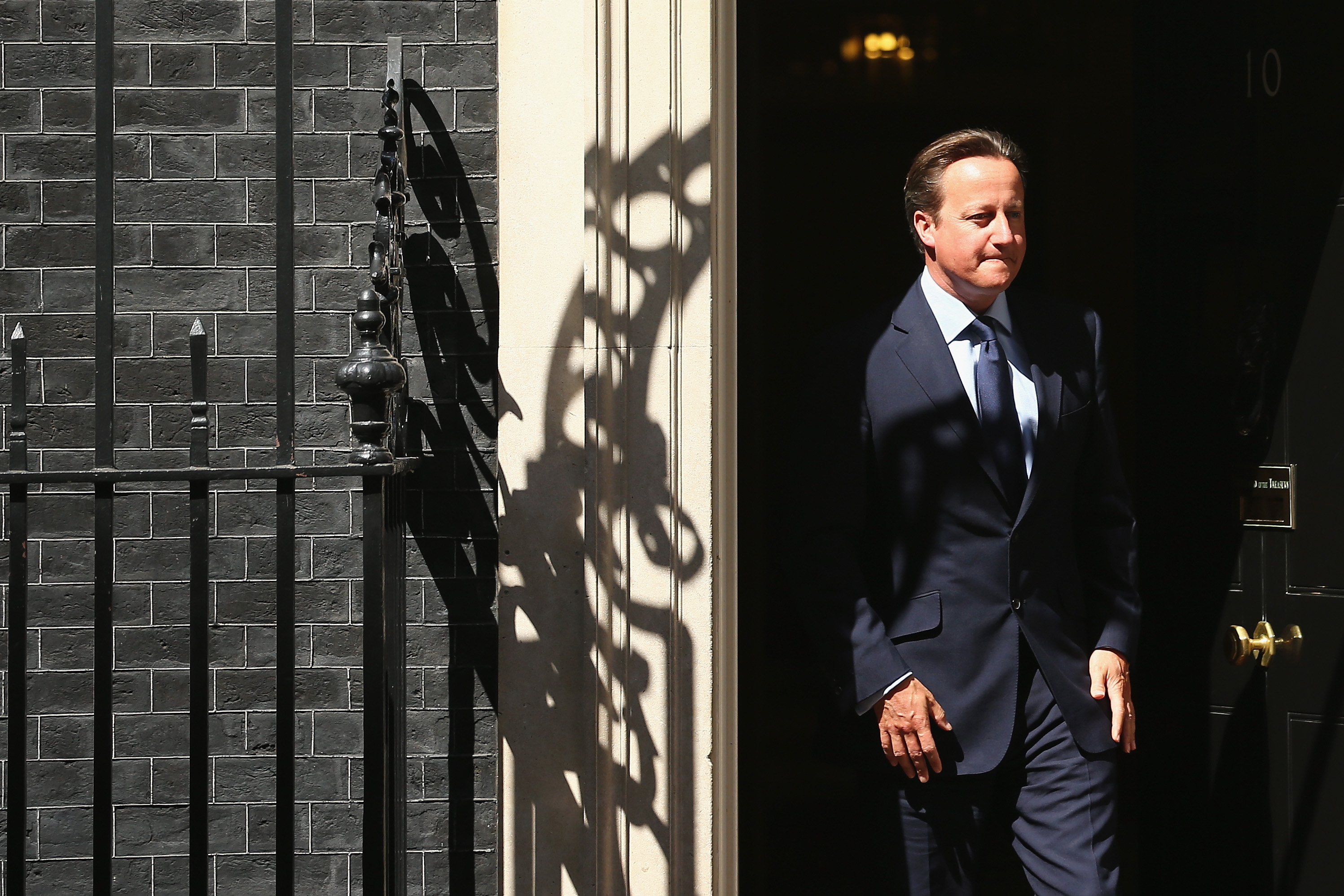
(Photo: Dan Kitwood/Getty.)

Quote For The Day

dish_sky

“The soft bonds of love are indifferent to life and death. They hold through time so that yesterday’s love is part of today’s and the confidence in tomorrow’s love is also part of today’s. And when one dies, the memory lives in the other, and is warm and breathing. And when both die — I almost believe, rationalist though I am — that somewhere it remains, indestructible and eternal, enriching all of the universe by the mere fact that once it existed,” — Isaac Asimov, It’s Been a Good Life.

(Photo by Flickr user kronerda)

(Hat tip: Maria Popova)

Are Religious People Less Creative? Ctd

Mark Oppenheimer complicates the discussion, arguing that being religious dampens creativity only if it “makes you less fun or irreverent”:

[T]he strictures of religion can paradoxically make you fruitful, but not if they are so strict or rigorous—so orthodox—that you become a pill. Not if you can’t take a joke, about your religion or about anything else. Not if you become so uptight that you can’t abide profanity, heresy, or apostasy.

If your religion prohibits you from using profane words, it might make you more creative, because you have to find fresher and better ways to say what you are trying to say, rather than falling back on hackneyed profanities. But if your religion has so straitjacketed your thought that you can’t even think profane thoughts, then of course it has made you less creative. One might almost say that a huge part of creativity involves lusting in your heart, then finding ways to make art of that lust; but if some brand of orthodox religiosity has worked you over too well, and you can’t even admit your heart-lust to yourself, then as an artist you are probably screwed.

Punctuality Puritanism

Kevin Williamson declares that “[w]asting somebody else’s time is a great sin”:

New Yorkers, contrary to the popular belief, are not on the whole rude people. But their characteristic pedestrian habits — avoiding eye contact, marching through scenes of pathos or comedy as though they had seen nothing at all — give that impression. That impression is belied when a tourist stops to ask for directions, at which point New Yorkers become as briskly helpful as Americans of any other city, explaining for the eleventh time this year that the Lexington Avenue subway line does not follow Lexington Avenue below Grand Central, its entrances being found on Park Avenue, that, yes, Saks is in fact on Fifth Avenue, that the Statue of Liberty is not within easy walking distance of Times Square, etc. The no-eye-contact thing is not about denying the fundamental humanity of fellow pedestrians — it is about not wasting their time. Ignoring you is a New Yorker’s way of being considerate.

If you happened to be walking down the street some afternoon in downtown Amarillo, Texas, you might very well make eye contact with a passing pedestrian, perhaps even offering a nod, simply because passing a pedestrian is an unusual occurrence. Likewise, the single-finger wave (no, not that finger) that Texas drivers offer each other on country back roads is an acknowledgment that there are, after all, not a hell of a lot of people out there. Doing that in Manhattan would make you crazy, and make everybody else crazy, too. There is a reason that doffing one’s hat to ladies went out of style.

What Spurred Secularization?

Julia Shaw praises Mary Eberstadt’s How the West Really Lost God, especially the book’s rejection of “traditional narratives about secularization” that “see world-historical events or broad intellectual movements as silver bullets killing God.” Instead, Eberstadt connects the decline of the family to our loss of faith:

Family life is not an outcome of belief but a conduit to religious faith. Eberstadt compares learning religion to learning a language. She argues that “trying to believe without a community of believers is like trying to work out a language for oneself.” Eberstadt’s theory explains the communal way in which individuals “think and behave about things religious—not one by one and all on their own, but rather mediated through the elemental connections of husband, wife, child, aunt, great-grandfather and the rest.”

Her theory is unique. Most secularization narratives ignore the family’s role in religious formation or see familial decline as a result of secularization: people stopped believing in God and then they stopped having families. But Eberstadt turns this simple, direct relationship on its head.

Jordan Hylden isn’t so sure, arguing that Eberstadt’s focus on our domestic arrangements offers too narrow an explanation for such sweeping changes:

[T]he church all too often allied itself with fading political regimes, discrediting it in the eyes of many. The First World War’s senseless violence shattered for a generation the old Christendom synthesis of church and state, and Europe’s churches have never been the same. The church held on in America, since the war did not shatter us like it did the Europeans, and because our churches were not in any case allied so tightly with the state. But the 1960s began to change that, as the civil rights movement and Vietnam began to topple the confidence of many in the American Establishment, and insofar as the “mainline” churches were viewed as part of the status quo. The American social imagination split in two, and ever since then has been characterized by culture wars, with most of religion on the conservative side.

By not telling this story, Eberstadt has left out the lion’s share of “how the West really lost God.” No doubt, her “family factor” played its part, and she is at her most convincing when she shows how family decline was part of a broader trend toward modern individualism. She never claims that family decline is solely responsible, but she claims far too much for it. It is an odd story of Western secularization that leaves to one side most of what Western culture has thought and imagined in its common life about God.