Beard Of The Week

by Chris Bodenner

grass beard

A reader writes:

Over the weekend I was in Montreal, where I happened to stumble across a spectacular exhibit promoting urban agriculture and horticulture. The event dates back to 1998 and has shown every few years since in different cities around the world. One of the exhibits stood out to me as possible beard of the week material. I humbly submit to you, “grass beard”.

Previous honorees here and here.

Why Is The Anti-War Movement AWOL?

by Patrick Appel

Rosie Gray reports on the subject:

“The Democrats are missing in action because of course the president is a Democrat,” said David Swanson, a longtime antiwar activist and author of War Is a Lie and When the World Outlawed War, who works with Roots Action, a progressive nonprofit. “That’s the biggest factor, I think. What’s tamping down the activism is partisanship.”

Reihan subscribes to this theory. Keating pushes back:

First, there’s the issue of timing. At the time of the largest Iraq protests, war talk had been growing steadily for months and the actual invasion wouldn’t happen for another few weeks. In this case airstrikes didn’t seem likely until last Friday and will probably come in the next few days. That’s not much time to mobilize anyone beyond Code Pink’s existing membership.

Second, a major premise of the anti-Iraq movement was that the Bush administration was hyping the intelligence on weapons of mass destruction. Yes, Saddam Hussein had also used chemical weapons (with the U.S. government’s knowledge), but that was years earlier. In this case the attack happened last week and the photos of its aftermath are still being plastered on the news. You can argue that Assad’s use of chemical weapons is a bad reason to attack, but it’s harder to argue that the Obama administration is simply inventing a reason to invade a country it has been wanting to invade for years.

The NFL Tackles The Greatest Threat To Its Survival

by Patrick Appel

NFL Head Injuries

Yesterday, the NFL settled the head injuries lawsuit brought against it by thousands of former players. Jonathan Mahler thinks the settlement is puny:

It was inevitable. Of course, the National Football League wasn’t going to enter into a lengthy discovery process in which it would have to tell the world what it knew — and when — about the dangers of playing professional football. Of course, the NFL wasn’t going to risk a multibillion-dollar verdict. Of course, the NFL wasn’t going to go into another season with this massive lawsuit — featuring at least 10 members of the Hall of Fame as plaintiffs — still hanging over its head.
What is surprising is the paltry size of the settlement that the NFL has gotten away with. The lawyer for the plaintiffs, Christopher Seeger, has said that avoiding litigation will allow players and families in need to get urgent medical care sooner rather than later. Fair enough. But it’s still a sweetheart deal for the NFL: just $765 million, paid out over 20 years. To put that figure into context, the NFL’s 2012 revenues totaled $9.5 billion. Better yet, the league’s estimated revenue for 2025, when it will still be handing out loose change to the families of players who committed suicide after suffering from chronic traumatic encephalopathy, are projected at $25 billion.

Ben McGrath makes related points:

The rough per-capita payout—given that all of the N.F.L.’s current retirees are eligible for compensation, and that it is estimated that there could be as many as twenty thousand of them—could come to less than forty thousand dollars, to be disbursed over a period of a couple decades.

(And not all of the money is actually going to compensation—$75 million will be spent to pay for medical exams, and $10 million is earmarked for research and education. The $675 million that the players will receive won’t be distributed equally; some will get more, up to a maximum of $5 million—others, presumably, much less.) No, it’s not “chump change,” but neither is it much of a hit to the bottom line of the world’s most profitable sports league, an organization that was being sued by almost a quarter of its former athletes. The rights to televise “Monday Night Football” alone are worth one and a half billion dollars a year to the N.F.L., or about twice the size of the settlement. The league’s annual revenues approach ten billion dollars. What’s more, in settling early, the league escaped discovery and depositions that might have revealed more about what it knew, and when. The terms are explicitly agnostic on the subject of whether the plaintiffs’ injuries were caused by football; the N.F.L. admits no liability. What concussion crisis?

Sean Gregory explains why the NFL’s players accepted the settlement:

“[The NFL] is going to say, ‘did your brain damage come from your college hits?’” says Christopher Seeger, co-lead counsel for the plaintiffs.  ”From your pro hits? Do you have a documented history of concussion? Can you prove you were concussed? Can you prove concussions even caused your neurological problem?” In this settlement, players just have to show signs of impairment in order to receive a payout. “They don’t have to prove any of those things,” says Seeger.

Daniel Engber wishes more money had gone to research:

In the past few years, the NFL has disbursed more than $100 million on concussion research, and the Player’s Association has been spending money, too. Still, it’s troubling that as part of its final deal with plaintiffs, the league set aside just $10 million more for purposes of “research and education.” We’re talking about barely more than 1 percent of the total pot, and not all of it will go towards doing science. According to the settlement, that fund will also pay for outreach projects such as one promoting “safety initiatives in youth football.” In light of what we know—and don’t know—about concussions, these are almost guaranteed to be a waste of money. You can’t promote “safety” in football, youth or otherwise, until you understand—scientifically—how dangerous it really is.

And Travis Waldron wonders what the NFL will do next:

While it’s a small step forward, larger questions remain about the future of the game. The NFL has taken significant actions in recent years to help reduce concussions and brain injuries in its game, changing rules, requiring evaluations from independent doctors, and improving testing and treatment procedures. It has couched much of that in gibberish as it refused to explicitly acknowledge the dangers of concussions, but perhaps the absence of major litigation will now allow it to speak frankly about the need to make its game safer — and about the need to improve safety at the college, high school, and youth levels too.

The Dish’s thread on pro-sports head injuries is here.

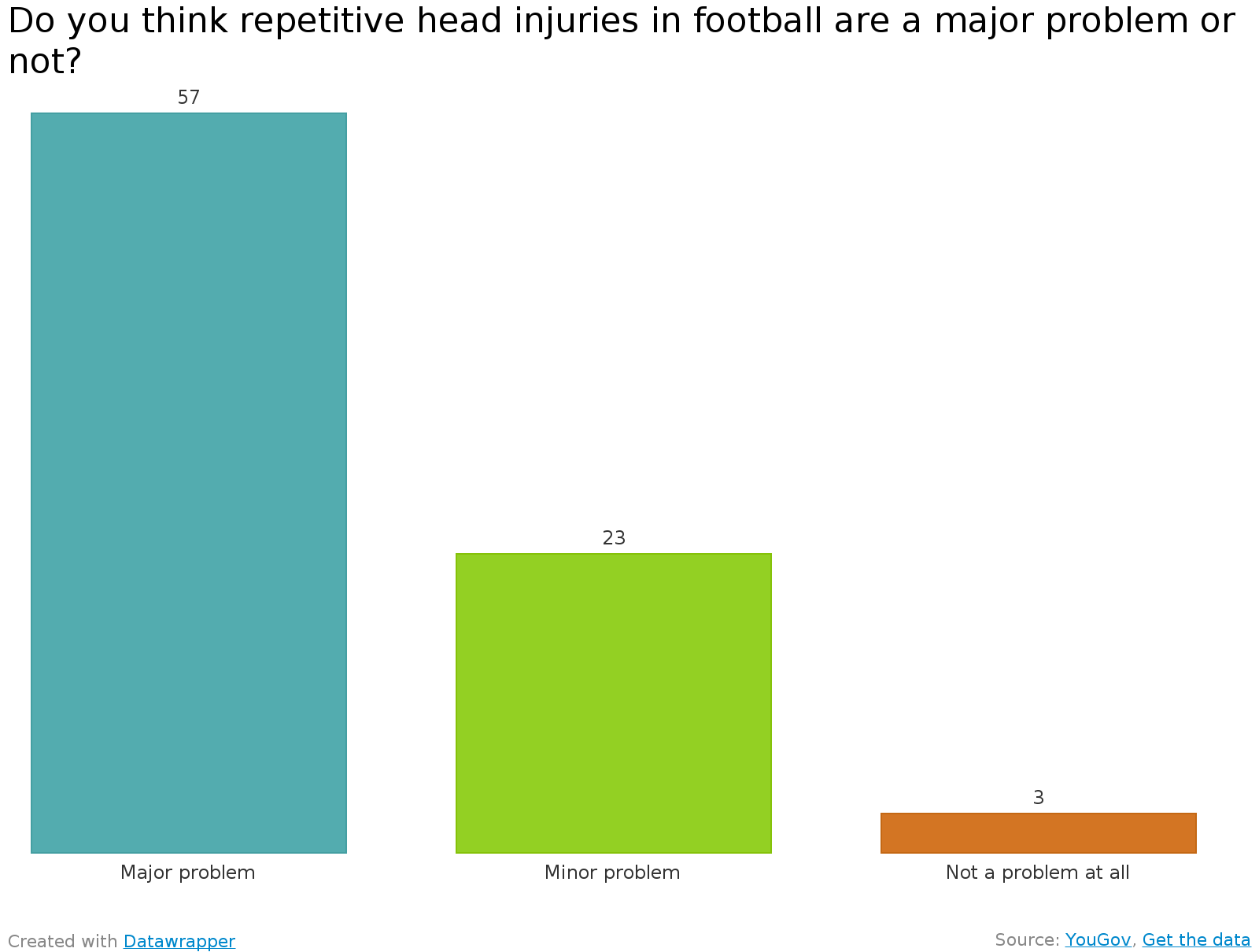
(Chart from YouGov)

The Embarrassing Lead-Up To War

by Patrick Appel

Gregory Djerejian’s denunciation of the Obama administration deserves to be read in full. It begins:

Several days ago I wrote I was extremely conflicted on the question of punitive action in Syria, but no longer. I am now staunchly opposed having better detected an utter lack of true seriousness by the Obama Administration. The myriad leaks around what type of mission, the palpable trigger-happiness among some, the British debacle (they won’t even have their poodle this time, the cat-calls will ring!) and the ‘shot across the bow’ nonsense showcases an Administration unready for an invigorated course correction of its flailing Syria policy. Frankly, I am astonished by the lack of seriousness and mediocrity on display.

The UK Won’t Touch Syria

by Brendan James

Yesterday, as we noted, the House of Commons voted down David Cameron’s motion for intervention in Syria 285 votes to 272. It can safely be said that the parliament delivered the will of the people, with British public opposing strikes two to one. Pascal-Emmanuel Gobry sees this as “an example of democracy actually working, and in the best sense of the word”:

The neocons urging Cameron to ignore the vote since it was non-binding are missing the point. And David Cameron gets it. Britain’s Parliament, its House of Commons, spoke. And the Prime Minister has to yield. There is no law that says that in this specific instance the Prime Minister should do that–but no matter. The United Kingdom has centuries of tradition of the highest respect for the will of its Parliament, and so there really was no other option for David Cameron.

Larison expects the US to go it alone:

The defeat for Cameron makes it that much more likely that Obama will proceed while ignoring Congress, since he won’t want to risk the same rebuke from our representatives. In truth, that rebuke would probably not be forthcoming, but it’s a chance that Obama isn’t going to want to take at this point. Despite the embarrassment for both Cameron and Obama that this vote represents, it is hard to imagine the administration won’t proceed with the attack because of this. This is good news for Britain, but regrettably won’t have much effect here except to cause a lot of whining about the state of the U.S.-British relationship.

Jack Goldsmith suggests Obama is now going full-Dubya:

The President is way out on a limb, by himself.  Independent of legality, unilateral military intervention in these circumstances is extraordinarily imprudent, and it is hard to fathom that it is being considered by the man who based his case for the presidency in 2008 on his commitment to domestic and international legality, and on opposition to imprudent wars.

Flattery Is A Winning Argument

by Patrick Appel

According to science:

One line of research has found that self-affirmation—a mental exercise that increases feelings of self-worth—makes people more willing to accept threatening information. The idea is that by raising or “affirming” your self-worth, you can then encounter things that lower your self-worth without a net decrease. The affirmation and the threat effectively cancel each other out, and a positive image is maintained.

A 2006 study led by Geoff Cohen, for example, found that when pro-choice people had their partisan identities made salient, affirmation made them more likely to compromise and make concessions on abortion restrictions. Similarly, a study by Joshua Correll found that affirmation led people to process threatening political arguments in a less biased way. More recently, research by Brendan Nyhan and Jason Reifler (PDF) found that self-affirmation made people who supported withdrawing from Iraq more likely to agree that the Iraq troop surge of 2007 saved lives, and made strong Republicans more likely to agree that climate change is real. The takeaway from all three studies is that information is more likely to have the desired effect if, on net, it doesn’t lower a person’s self-worth.

Why Do Chinese Tourists Have Such A Bad Rep? Ctd

by Chris Bodenner

New York City scenes

I’m surprised a dissent like this one didn’t come sooner:

This thread has gotten really ugly really fast. Your blog is now (once again) becoming a place for undiluted bigotry. There are BILLIONS of Chinese people. Is it really proper to tar that whole group with a broad brush because a small number of Chinese tourists have acted badly? (I’m glad my ethnic heritage allows me to be coy about my nation of origin; if I want to pretend I’m Canadian overseas to avoid anti-American bigotry, I have that option.)

A reminder that all the anecdotes from Dish readers are based in a broader reality, not mere stereotype:

Recent examples [of Chinese tourists behaving badly], which have sparked a firestorm of commentary in both Chinese and Western media, include a group of snorkelers who caught and ate endangered sea creatures off the Paracel Islands, visitors to North Korea who threw candy at North Korean children as if they were “feeding ducks”, swimmers who took pictures with a dying dolphin, and a teenage boy from Nanjing who scratched graffiti on a 3,000 year-old relic while touring Egypt with his parents. In response, Chinese officials are making a concerted effort to improve the behavior of Chinese travelers abroad, issuing a list of guidelines that include no spitting, cutting lines, or taking your shoes and socks off in public. Vice Premier Wang Yang has stated that “improving the civilized quality of the citizens” is necessary for “building a good image” for the country.

As the thread has shown repeatedly, the perceived rudeness of Chinese tourists is a symptom of the PRC’s rapid ascension as a wealthy nation – a nation that now has the disposable income to enable a middle class to join the global tourism market in droves. So the thread, in a way, is actually a tribute to China. Its newly-prosperous people, like others before them, just need time to acclimate to the etiquette of traveling abroad. And after all, as our first post pointed out, “Americans are still widely viewed as the world’s most obnoxious tourists.”

Back to the thread: Many readers are recommending a wonderful essay by Evan Osnos, who accompanied a Chinese tour group through Europe a few years ago:

Until recently, Chinese people had abundant reasons not to roam for pleasure. Travelling in ancient China was arduous. As a proverb put it, “You can be comfortable at home for a thousand days, or step out the door and run right into trouble.” Confucius threw guilt into the mix: “While your parents are alive, it is better not to travel far away.” Nevertheless, ancient Buddhist monks visited India, and Zheng He, a fifteenth-century eunuch, famously sailed the emperor’s fleet as far as Africa, to “set eyes on barbarian regions.”

Over the centuries, Chinese migrants settled around the world, but Mao considered tourism anti-Socialist, so it wasn’t until 1978, after his death, that most Chinese gained approval to go abroad for anything other than work or study.

First, they were permitted to visit relatives in Hong Kong, and, later, to tour Thailand, Singapore, and Malaysia. In 1997, the government cleared the way for travellers to venture to other countries in a “planned, organized, and controlled manner.” (China doles out approvals with an eye to geopolitics. Vanuatu became an approved destination in 2005, after it agreed not to give diplomatic recognition to Taiwan.) Eighty per cent of first-time Chinese travellers went in groups, and they soon earned a reputation as passionate, if occasionally overwhelming, guests.

Back to the inbox, a reader underscores a cultural rift between people from Hong Kong and those from mainland China:

Oof, your thread hits really close to home for me. I suspect that you guys have been getting droves of emails with horror stories about badly-behaved Chinese travelers blazing paths of destruction all around the world. While I don’t have any novel reasons about why some Chinese tourists behave so badly, I wanted to share my perspective as a Hong Konger who encounters many mainlanders daily (I live right next to a mid-market shopping outlet which has become a popular tourist destination).

As a former British colony, Hong Kong already has a complicated enough relationship with its current overlord. Political differences aside, though, a whole lot of Hong Kongers truly resent the increasingly heavy presence of the mainland Chinese here. There is a perception that they are responsible for (or exacerbate) many of the city’s social ills: wealthy mainlanders snapping up new apartments in HK as real estate investments and thus driving up housing costs for everyone; “parallel traders” who travel from China to Hong Kong every day and buy out entire stores’ worth of infant milk formula (a good that is much more expensive on the mainland than in Hong Kong, so a tidy profit can be made by reselling it across the border), leading to a shortage of formula for HK mothers; pregnant mainland women entering Hong Kong on tourist visas to give birth in Hong Kong hospitals, etc, etc.

And then there are the mainland Chinese tourists.

Unlike the parallel traders and the nouveau riche apartment collectors, who are largely seen as takers but not contributors to the city, Hong Kong benefits from the money of Chinese tourists (who accounted for a whopping 72% of HK’s tourists in 2012) – but very, very begrudgingly so. (Irony #1.) The reason for the animosity? There is a concept in the Chinese language called “公德心” (pronounced gong duk sum in Cantonese, gong de xin in Mandarin, and many Cantonese blogs and forums also write it this way: “公得心”), which roughly translates into “consideration for the public.” This concept acknowledges that every individual is ultimately part of a collective, and as such we each have the responsibility to take good care of the collective. In practice, someone who has 公德心 is always aware of the effects of his/her behavior on others who share our public spaces, and is careful to respect the way those spaces should look/sound/smell. Now, this isn’t an idea that is exclusive to Hong Kong, but a common refrain among its denizens is that the majority of mainland Chinese tourists simply do not have 公德心 when they should.

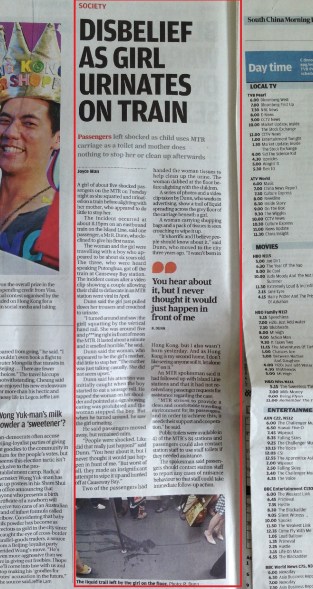
When we say that mainlanders lack 公德心, it means that they talk too loudly in public, spit on our sidewalks, push and shove on public transportation, and jump queues (this last one is IMG_3129especially infuriating because there is always a sizable line for anything you want to do in Hong Kong, whether it’s for McDonald’s or tickets to see the Big Buddha or adding more money to our Octopus cards). Where things should be orderly, people without 公德心 bring chaos. Just a couple of weeks, ago, the South China Morning Post published an article entitled “Disbelief as Girl Urinates on Train” – along with a reader-submitted picture, no less! – about an unidentified mainland child who with the permission of her mother pulled down her pants and peed in a MTR (subway) carriage. Funnily enough, the collective disdain for the ill-mannered mainland Chinese rube has fostered not only a sense of anti-mainland prejudice but a sort of Hong Kong “pride” (Irony #2): many think (whether rightly or wrongly) of Hong Kongers as being more polite, cultured, classy–a better strain of Chinese people overall. We cluck our tongues when even North Korea shakes its head at Chinese tourists; we feel validated whenever some other country’s citizens point out how rude they can be.
Of course, the kicker is that even while many Hong Kongers agree with the stereotypes and feel superior for being from Hong Kong, they are also terrified of being mistaken for mainlanders when they travel overseas. (Irony #3.) It was mentioned in this thread that mainland Chinese tourists often join together in big group tours because it is easier to get visas and easier to navigate cultural/linguistic barriers; Hong Kongers often do the same thing for the same reason. I myself am traveling to the East Coast with my mother and my 79-year-old Malaysian great-aunt in September to visit my brother. All three of us speak English fluently, but even my normally mild-mannered and even-keeled mom has voiced concerns about how we can best avoid looking like mainland tourists and what to do if someone hurls anti-Chinese slurs at us. So I suppose this is just one more grievance Hong Kongers have against the impolite mainland tourist: they make the rest of us ethnic Chinese look bad, too. (But we’ll gladly take their dollars.)

It’s a catch-22: we can’t live with them, and we can’t live without them.

Finally, I just wanted to respond quickly to your reader’s story about the older Chinese couple traveling to Adelaide: it may be the case in Chinese culture that the young are hesitant to criticize the old, but a grown child should not be allowing his parents to perform all the physical labor, either. True filial piety would have dictated that an able-bodied adult son pick up the luggage off the carousel at the direction of his parents. My mom probably would have smacked me if I’d let her struggle and fall all over the bags while I watched from the back.

(Photo: Chinese tourists take photos on Wall Street near the New York Stock Exchange, NYSE, on April 11, 2013 in New York, New York. The growing affluence and openness in China allows the Chinese to travel. By Melanie Stetson Freeman/The Christian Science Monitor via Getty Images)

Deconstructing Photography

by Jessie Roberts

dish_photography

Marvin Heiferman thinks we shouldn’t call photography a “universal language”:

People talk about photography being a universal language but really it’s not; it’s multiple languages. The dialogues you can have with neuroscientists about photographic images are as interesting and as provocative as the dialogues you can have with artists. People have wildly different contexts in which they use photographs — different criteria for assessing them, reasons for taking them, priorities when looking at and evaluating them. It creates incredible possibilities for dialogue when you realize the medium is so flexible and so useful.

How we should think about photography:

Galleries and museums have spent the last 30 or 40 years trying to say this is art. Yes it is, but on a bigger level it’s life. Photography is all about life. You can have a philosophical conversation about a red light photograph that you got a parking ticket for as much as you can over something you see in a museum. We need a broader appreciation of photography as it comes to play a more central role in our lives; it shapes our imagination; it shapes our values; it shapes our activities. We have to understand that better.

(Photo by Flickr user Kelly Hofer)

Investing In Sensible Sex Ed

by Tracy R. Walsh

graphs

Sarah Mirk welcomes the news that, between 2007 and 2011, “the teen birth rate nationwide dropped a whopping 25 percent.” Mirk credits a change in how the government funds sex education:

Instead of betting all its money on abstinence-only education, since 2010, reproductive health advocates pushed federal policy to instead favor “evidence-based” teen pregnancy prevention programs—meaning rigorous research has shown they’re actually effective. Or, as Katy Suellentrop of the National Campaign to Prevent Teen and Unplanned Pregnancy puts it, “The biggest policy change in teen pregnancy was in 2010 when there was a focus on using programs that work.” From 1998 to 2010, the federal government spent over a billion dollars on abstinence-only sex education. During that same time, the teen birth rates slowed, flat-lined, then actually began to increase in 2006, and then declined again. Now, the government sets aside $190 million to fund “evidence-based” teen pregnancy prevention programs like the ones working with Multnomah County’s Latino youth.

The birth rate for 15- to 19-year-olds reached a record low of 31.3 per 1,000 in 2011, according to the CDC.

Finding Your Baby On A Dating Site

by Chris Bodenner

Daisy Buchanan praises Babyklar.nu, or “Baby Ready Now”:

[Site founder Emmanuel Limal] revealed that men make up 53% of the site’s membership. This seems surprising – in the media it is often suggested that women are the ones who are most keen to procreate. If we’re single, we’re meant to be sobbing into our white wine and worrying that there aren’t enough shoes in the world to fill our baby void, while our male counterparts are meant to be staring into the distant mountains with nothing but a fringed leather jacket for company, like the Marlboro Man.

But I know plenty of men, single and in relationships, who plan to start a family either “some day” or in the immediate future. And I know plenty of women, myself included, whose answer to the baby question is either “no” or “not sure”. Getting married and having children is no longer more or less inevitable for everyone. And when something so big can cause such a difference of opinion, doesn’t it make sense to be sure when you’re setting off on the path to happiness that it’s with someone who’s on the same page as you?