Animal Skyways

Canada’s most-travelled highway tears through the country’s oldest national park, imperiling both humans and wildlife. But park administrators came up with an inspired solution:

They look, for the most part, like typical pedestrian infrastructure: elliptical or boxy concrete culverts under the highway high enough for a human to pass through, or overpasses that would look entirely familiar to the vehicles passing below. All this highway engineering, though, is meant for the benefit of bears. And cougars, and wolves, and elk. …

[O]ver the years, critics and transportation planners, even some environmentalists have groused about the idea: Taxpayer money, building overpasses for bears? Is that really necessary? Would they even use the things? Researchers have been methodically studying the crossings since 1996 to answer this. And it turns out that, yes, animals deterred by fencing that now runs the full 70-kilometer [43.5-mile] length of the highway in the park actually cross the road an awful lot like a rational pedestrian would. It takes them a while, though, to adapt to the crossings after a new one is constructed: about four to five years for elk and deer, five to seven years for the large carnivores.

Under The Cloud Of The NSA Scandal

Derek Mead discovers that the Snowden leaks will cost American tech companies cooperating with NSA between $21.5 billion and $35 billion over the next three years:

The United States, serviced by giants like Google and Amazon, has until now spent more money on cloud computing than the rest of the world combined, but that gap has closed considerably, with Western European markets expected to grow heavily in the next few years. While Europe in particular has been open about trying to spur local cloud efforts, American firms still had a great opportunity to dive into a budding market. But with the US’s great cloud computing secret now out in the open—American servers can be tapped whenever, in secret, with secret court orders—those firms are going to have a much more difficult time competing with upstarts like Iceland, where strict privacy laws have fostered growth in cloud computing and hosting services.

That the US’s intrusions into data would have chilling effects on the data economy is no surprise. “It is often American providers that will miss out, because they are often the leaders in cloud services,” Neelie Kroes, European commissioner for digital affairs, told the Guardian in July. “If European cloud customers cannot trust the United States government, then maybe they won’t trust US cloud providers either.”

The Best Of The Dish Today

For our on-going social media coverage of the murderous day in Egypt as it unfolded, the key posts are from here (2.29 am), here (9.27 am), here (12.09 pm), and here (8.58 pm).  Read them in that order for the full story. My call for the US to cut off aid is here.

I weighed the costs and benefits of stop-and-frisk here; and defended myself from two readers’ criticism on the roots of rape here.

An internal Pentagon email that brought a lump to my throat here; and a devastating takedown of the Obama administration’s position on the NSA here.

The most popular post of the day was “Peering Into The Rotting Entrails Of The Intellectual Right.” Can you tell how much I enjoyed myself coming up with that headline? The second was my blogger mashnote to Glenn Greenwald.

My post on Maureen Dowd on Obama is now by far the most popular post of the last week. Oh, and Beard Of The Week!

See you in the morning.

(Video: The McLaughlin Report after the Congressional elections of 1994, featuring the legendary journalist, Jack Germond, who died today. Some tweet appreciations of the Fat Man In The Middle Seat here.)

Egypt Is Erupting Again, Ctd

What many are calling the iconic image of the past 24 hours:

EGYPT-POLITICS-UNREST

From the Getty description of the scene captured by Mohammed Abdel Moneim:

An Egyptian woman tries to stop a military bulldozer from hurting a wounded youth during clashes that broke out as Egyptian security forces moved in to disperse supporters of Egypt’s deposed president Mohamed Morsi in a huge protest camp near Rabaa al-Adawiya mosque in eastern Cairo on August 14, 2013. The fate of the young man is not certain, but at the time of taking these photos he was seriously injured having been shot by birdshot. For further information refer to this link.

For more, photojournalist Mosa’ab Elshamy has published a powerful gallery of images he took during today’s crackdown. Below are some additional tweets since our last update:

The Night Sky Is Still Alive

Phil Plait reports that, contrary to popular belief, most of the 6,000 stars visible from Earth are still burning strong:

Even the most luminous stars, which use up their core fuel far more quickly, can live for 1 million years or more. That means the odds of a star happening to die while its light is already on its way to Earth are very small; in terms of the star’s lifetime, a few thousand years is the blink of an eye. A star would have to be very, very near its own death for this to happen after a very, very long life.

I can think of very few exceptions, though Eta Carinae fits the bill. It’s on the edge of exploding; in the 1840s it underwent a massive paroxysm that was just short of a supernova event. It may not go off for another 50,000 years, but it might tonight. And at a distance of less than 10,000 light years, those are not terrible odds that, in a sense, it’s already gone and we just don’t know it yet. But that’s the exception, with the vast majority of stars still merrily fusing away, lighting up the galaxy.

What’s So Bad About Booker?

Corey Booker Thanks Constituents After Winning Primary

Most Americans haven’t heard of Cory Booker, who is almost certain to be New Jersey’s next Senator. Pareene provides an unflattering introduction:

In many ways, Booker is perfectly suited for the United States Senate. He won’t be expected to accomplish anything. He will have so many more opportunities to spend time with even more rich people with elite backgrounds and worldviews similar to his. He will have much more access to television studios and Sunday shows and cable news cameras. He will, in short, be the worst kind of senator. The kind that has no power and no real desire to exercise power on behalf of the people the senator ostensibly represents, but the kind that always expresses opinions on television about whatever national issues people on television care about that day.

Enten thinks that Booker will “probably be right in the middle of the Democratic caucus” and places him “slightly to the right of then junior Senator Barack Obama of Illinois“:

That said, it isn’t Booker’s style to stay quiet. He isn’t likely to put his nose to the grindstone and table pieces of legislation that please your tax accountant and nobody else. This is a man who thrives on the affection of fans on Twitterwho runs into buildings that are on fire, who likes to be heard.

So, if Booker isn’t going to make very liberal comments or pass very progressive legislation, then how will he make his presence felt? He’ll do what Obama promised to do when running for president: reach across the aisle.

Weigel is surprised that “that no Democrat ever scored a hit on the guy, who is loathed by some progressives in a way that’s only now being noticed”:

How often do Republicans toss out a conservative for a “gosh, guy, I want to cut deals” moderate? The only progressive argument for Booker, honestly, is that there have been only four African-Americans ever elected to the U.S. Senate, and from only three states, and that the long-term interests of a party that depends on huge minority turnout adding to white liberal turnout are served by promoting nonwhite stars.

Scott Lemieux doesn’t understand what all the fuss is about:

[I]f I’m going to be sold on the idea that he’s some kind of unique threat to the Democratic Party, I’d like someone to name one issue on which he’s to the right of the prohibitive frontrunner for the Democratic nomination in 2016.

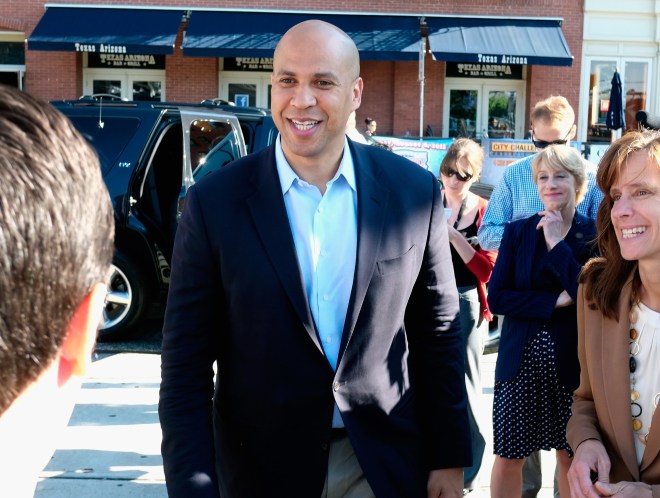
(Photo: Newark Mayor Corey Booker greets people along with Hoboken Mayor Dawn Zimmer (R) at the Hoboken PATH station after winning the Democratic primary for U.S. Senate on August 14, 2013. Booker will face off in a special October election against former Bogota, NJ mayor Steve Lonegan to fill the empty Senate seat left formerly held by Frank Lautenberg, who died on June 3rd. By Michael Bocchieri/Getty Images)

Face Of The Day

Volunteers Raise Abandoned Seals, Return Them To The Wild

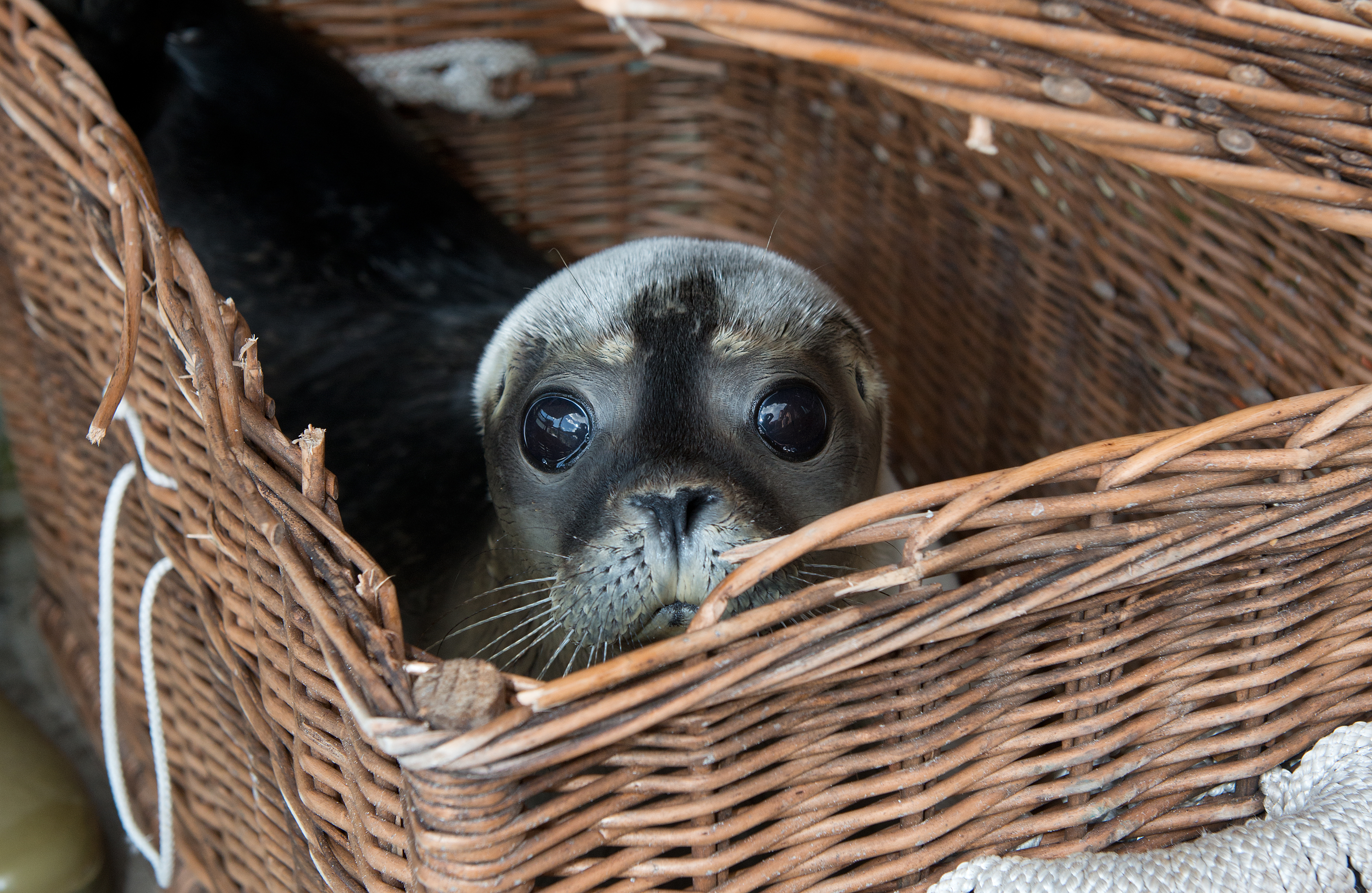
A young seal named ‘Helene’ watches out a basket at the Seehundstation Norddeich on August 14, 2013 near Norddeich, Germany. The Seehundstation Norddeich is a facility for raising young seals who were separated from their mothers due to storms, disease or human disturbance and who would otherwise have little chance of survival. Volunteers collect about 90 young seals a year from the North Sea German coast and care for the pups until they weigh about 25 kg before releasing them back into the wild. Sponsors pay for the costs of caring for the seals and get to name them. By David Hecker/Getty Images.

Why Hollywood Is Always Saving The World

Script doctor Damon Lindelof talks to Vulture about the challenges of blockbuster screenwriting:

“Once you spend more than $100 million on a movie, you have to save the world,” explains Lindelof. “And when you start there, and basically say, I have to construct a MacGuffin based on if they shut off this, or they close this portal, or they deactivate this bomb, or they come up with this cure, it will save the world—you are very limited in terms of how you execute that. And in many ways, you can become a slave to it and, again, I make no excuses, I’m just saying you kind of have to start there. In the old days, it was just as satisfying that all Superman has to do was basically save Lois from this earthquake in California. The stakes in that movie are that the San Andreas Fault line opens up and half of California is going to fall in the ocean. That felt big enough, but there is a sense of bigger, better, faster, seen it before, done that.”

“It sounds sort of hacky and defensive to say, [but it’s] almost inescapable,” he continues. “It’s almost impossible to, for example, not have a final set piece where the fate of the free world is at stake. You basically work your way backward and say, ‘Well, the Avengers aren’t going to save Guam, they’ve got to save the world.’ Did Star Trek Into Darkness need to have a gigantic starship crashing into San ­Francisco? I’ll never know. But it sure felt like it did.”

Captive To The Commune

Mark Lilla reviews Paul-Julian Robert’s My Fathers, My Mother, and Me, a new documentary about Friedrichshof, an infamous Austrian commune that was once the largest in Europe. The commune, where the filmmaker was raised, was founded by Otto Mühl:

Films of the earlier years make the place seem idyllic. But over the years Mühl became increasingly dictatorial and in the Eighties it came to light that he was sexually abusing some of the children. The commune was dissolved, and in 1991 he was convicted of pedophilia and spent seven years in prison. He died this past May at the age of eighty-seven.

The mystery at the heart of the film:

[W]hat drew so many young people to this sociopath and kept them with him for so many years? Why did they adore him? Why did they turn a blind eye to the way their children were treated?

To Robert’s evident frustration, his mother is unable to enlighten us. She is neither defensive nor flighty, just very adept at keeping reality at bay. One feels sorry for her, too. She tears up occasionally and says her son has the wrong picture of what it was like. Mühl was not so important, she says; we made our decisions together. The children seemed happy and they were saved from the stifling, soul-destroying childrearing practices of the middle classes. But she has no answers, and isn’t eager to find any. She is old now, nicely dressed, soft-spoken and all suffering. One sees that she has trouble digesting her son’s revelations and confessions; she genuinely has no idea how the experience scarred him. It’s not evident that the son understands that, or sees that she, too, suffered from the collapse of her illusions. He’s a sensitive but pitiless young man, which is what makes this such an extraordinarily gripping film.

Time To Cut Off Cairo’s Aid, Ctd

Larison seconds the idea:

The U.S. can’t constructively influence what the Egyptian military and its interim government do, and it should stop pretending that it can. [Cutting off aid] isn’t going to remedy any of Egypt’s ills, but it would be the first step in acknowledging that it is beyond the ability of the U.S. government to remedy them. In the meantime, it does nothing but harm America’s reputation to be backing a coup government that kills civilian protesters in the streets. It costs the U.S. very little to end that support, and it gains the U.S. nothing but grief to continue the status quo.

Ali Gharib joins the chorus:

Reconciliation now seems hopeless; Egypt is shattered.

The Washington Post editorial board, with whom I frequently disagree, correctly noted that the Obama administration’s actions make it “complicit in the new and horrifyingly bloody crackdown.” At least one liberal, the Egyptian politician Mohammed El Baradei, resigned the position he took as vice president after the coup. There can be no justification for America and its leaders in the Obama administration to not also resign its role as the military regime’s funder.

Bloomberg’s editorial agrees:

Egypt’s generals must be made to understand that the kind of brutality that took place today in Cairo has consequences.