How Border Enforcement Backfired

A 2007 paper by Douglas Massey argued that undocumented immigrants have responded to increased border security “by hunkering down and staying once they had run the gauntlet at the border and made it to their final destination.” Ezra finds that the “data support Massey’s thesis”:

In 1980, 46 percent of undocumented Mexican migrants returned to Mexico within 12 months. By 2007, that was down to 7 percent. As a result, the permanent undocumented population exploded.

The militarization also had another unintended consequence: It dispersed the undocumented population. Prior to 1986, about 85 percent of Mexicans who entered the U.S. settled in California, Texas or Illinois, and more than two-thirds entered through either the San Diego-Tijuana entry point or the El Paso-Juarez entry point. As the U.S. blockaded those areas, undocumented migrants found new ways in — and new places to settle. By 2002, two-thirds of undocumented migrants were entering at a non-San Diego/El Paso entry point and settling in a “nontraditional” state.

Steven Taylor adds:

I will say that I think that dispersal of migrants is also attributable to increasing demands for labor in agriculture across the country (such as working in poultry in Alabama or in labor-intensive crop-picking jobs across the southeast).  However, the hypothesis makes sense:  if one cannot return home without risking trouble with la migra, then it is best to look stay put (not to mention to get away from places where border enforcement is being intensely focused).

Ask Kate Bolick Anything: What If You’re Single And Get Sick?

In our first video from Kate, she explains how getting married isn’t the only way to ensure you have someone to take care of you when you face health challenges or get older:

Last week, PBS took a look at the seniors organization Kate refers to in the video:

[Beacon Hill Village] is a nonprofit membership organization that provides free or low-cost services to seniors who have chosen to live in their own homes. The services include social clubs, weekly exercise classes and lectures, transportation to doctors’ offices and grocery stores and access to reduced-fee home medical care and home repair services.

[The organization] now boasts 400 members and the concept has spread to other communities across the country. There are about 100 “villages” to date, with another 200 in development, according to the national organization that helps establish these networks. Each one is formed and governed locally, tailored to the specific needs of that community.

Kate is currently working on her first book, Among the Suitors: On Being a Woman, Alone, to be published next year by Crown/Random House. She is also a contributing editor for The Atlantic and writes regularly for ElleThe New York TimesThe Wall Street Journal, and Slate. Her 2011 Atlantic cover story, “All the Single Ladies”, addressed why more and more women are choosing, as she did, not to get married. The Dish debated the piece here and here. Our full AA archive is here.

Introducing The Snowden Prize!

Balko believes that, if “we really value whistleblowers, we need to provide them with a bit more incentive” to come forward:

A series of prizes for government employees who risk their livelihoods to shed light on government abuse might be one way to provide an incentive for more whistleblowing. It needn’t just be one big prize. Think about a foundation that might give out multiple prizes, at all levels of government.

Yes, it would need to be pretty well funded. The idea here would be to give out prizes significant enough to compensate for the losses of income, the foregoing of careers, and potential legal expenses. But it seems to me that there are enough people — and enough affluent people — concerned about NSA spying, police abuse, and government waste to make something like this happen. In fact, there needn’t even be just one foundation, or one series of prizes. Perhaps conservatives aren’t eager to reward someone like Edward Snowden, or have no interest in compensating a cop who exposes racial profiling or spying on protest groups. Fair enough. A conservative-oriented whistleblower prize, then, could reward government employees who expose waste, fraud, and politically-motivated regulation or application of the tax laws. Perhaps the foundations themselves could eventually be staffed and run by whistleblowers — a way to provide them with continued meaningful employment in public service.

Is Driving With A Cell Phone Really That Dangerous? Ctd

A reader is encouraged by this study:

At last! If cell phone use and texting were such great risks to safety, there would be carnage in the streets. But there’s not. No statistical correlation that I’ve seen.

Am I a shill for the cell phone companies? No. The reason for the lack of carnage is that the specific distraction of communicating (by whatever means) is offset by an overall increase in attentiveness. Think of doing a long-distance drive. It’s easy to be sleepy or inattentive. Your senses are at a low. But if you have a task – practically any task – you are more generally aware. Your mind is functioning at a higher level. So that’s why the streets aren’t littered with bodies. For every bus driver who plows into the back of someone’s car while texting, I’d suggest that there are several who understand the risks of what they’re doing and are concentrating hard to counteract the distraction.

Which raises the question: How could we raise everyone’s overall attentiveness without the negatives inherent to cell phones? That’s what we should be asking.

Another points out:

The study you link to only studied voice calls while driving, not texting.  Further down in the link it reads:

Our study focused solely on talking on one’s cellphone. We did not, for example, analyze the effects of texting or Internet browsing, which has become much more popular in recent years. It is certainly possible that these activities pose a real hazard.

And, to answer your question, texting while driving is dangerous.

Another elaborates:

What the LSE study totally misses is how consumers are using their phones today. From 2002 – 2005, I bet the primary usage of mobile phones was still to talk to somebody, so the only time somebody should look away from the road is while dialing or answering their phone. Today people are texting, tweeting, and reading emails etc.; smartphone technology has provided a huge increase in the visual experience of using a phone, which means more reasons and more time looking away from the road.

I used to ride a motorcycle to work. Cyclists and motorcyclists are extremely aware of driver behavior because we’re so much more vulnerable than drivers if we crash. I can tell you from personal experience that the amount of distracted driving going on now has just become too much; its gotten much worse in the past five years as mobile technology has become more advanced and more engaging. If I saw a distracted driver, 95% of the time if I would also see that little bright phone screen being held and read. I had one too many close calls even as a very defensive rider, so I just stopped and today I take the bus.

Obama Begins To Undo The Drug War?

It couldn’t be true, could it? Nicole Flatow summarizes Holder’s announcement:

Holder will order all federal prosecutors to avert drug charges that carry mandatory minimum sentences for low-level offenders, by omitting the quantity of drugs when charges are filed, according to excerpts of the speech obtained by the New York Times. The measure, which would avert harsh sentences that start at five or ten years in prison regardless of an individual’s role in a drug offense and cannot be reduced by judges, is one of several Holder may announce today at an address to the American Bar Association’s annual meeting in San Francisco.

Ambers sees this as only a first step:

Of a million things President Obama could use his second term in office to fix, he has maybe 10 slots — 10 real chances to advance the debate about a topic, even to advance policy, even while Washington is at its sclerotic worst. Drug law reform has always been on the president’s to-do list. This I know from a series of conversations with some of his senior policy advisers during the first term.

Matt Welch thinks that “this has the makings of a key moment in beginning to undo the disastrous war on drugs”:

An important test going forward will be public opinion in the next couple of days, particularly from quarters that have historically been “tough on crime.” My prediction, and fervent hope, is that there won’t be much opposition at all. Then the real work of drug-war reform—including, hopefully, an announcement from Holder that the administration will no longer be raiding state-legal marijuana operations—can begin.

Dana Liebelson expects the reforms to save taxpayers money:

Based on how Republicans have reacted to sentencing reform efforts in the past; it shouldn’t take long for conservative lawmakers to start spreading the word that the sky is falling. But as we reported last week, sentence reductions have already been retroactively applied to crack cocaine offenders—and  the US Sentencing Commission has found the program to be a success. At least 7,300 prisoners sentenced under mandatory minimums have had their sentences reduced by an average of 29 months, saving taxpayers an estimated $530 million. Given that the Associated Press found that US federal prisons are 40 percent over capacity, advocates say reform can’t come soon enough.

But Joyner is uncomfortable with the way these reforms are being implemented:

Holder and I are in fundamental agreement on what our policy should be. If anything, I’d like to go further, decriminalizing whole categories of behavior and shifting into a treatment and education rather than criminal justice approach. But it should be accomplished by the president taking his case to the public and getting the law changed, not an imperial executive deciding it doesn’t have to enforce the law.

“Imperial” is not an adjective I’d attach to an administration refusing to keep nonviolent drug-offenders in jail for ever. But, yes, this would be better done legislatively. But if that means it will not get done at all because of the opposition’s unprecedented obstruction of a re-elected president, a president will consult his legal, executive branch options. Prosecutorial discretion is an exercize of legitimate power, not a new power-grab.

Francis’ Sunlight, Ctd

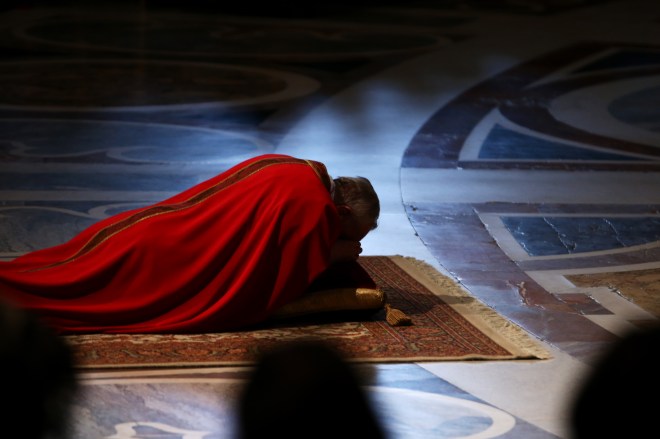
Pope Francis Attends Celebration Of The Lord's Passion in the Vatican Basilica

There was a real debate about how to interpret the Pope’s recent conciliatory tone toward gay people. Many, like me, saw the tone as substance, seeing no massive overhaul in doctrine, but a revolution in emphasis that necessitates an eventual change in doctrine. By choosing to emphasize the humanity and dignity of gay people seeking God in good faith – “Who am I to judge?” – this Pope was shifting gears away from the counter-revolution of John Paul II and Benedict XVI against the liberation of modernity. Others insisted there had been no change at all – and that the idea of one was a deliberate or misinformed misreading of the Pope’s comments by the secular press.

Well, we could go back and analyze every sentence of the impromptu press conference – as some have done with surprising results:

He did not say that “homosexuals should not be marginalized.” He said “these persons should not be discriminated against, but welcomed (accolte).” He is citing the words of the Catechism here.

And he did not regurgitate other language from the Catechism about gays’ “objective disorder” or “just” and “unjust” discrimination against them. He ignores the former language and expunges the latter. In fact, the more you examine the presser, the more radical its implications seem.

But now we have more confirmation that this was not a gaffe but a strategy. Well, confirmation might be a bit strong – but one of the American cardinals tapped for Francis’ new, reformist group of eight cardinals is Boston Cardinal Sean O’Malley. He has clearly been in touch with the new pontiff and just gave a speech which confirms the theocons’ worst nightmare. It was at the annual Knights of Columbus convention in San Antonio. K-Lo was there and didn’t see anything but the attendants’ desire to evangelize in the developing world and roll back Obamacare, marriage equality, alleged religious repression, and abortion rights. In fact, her opening paragraph is about the Catholic importance of denying gay couples civil equality. Funny that, isn’t it?

But O’Malley’s speech was an eye-opener to anyone who hasn’t decided to be blind for a while.

The context is worth revisiting. It comes after the American hierarchy has insisted that the issues of contraception, marriage equality and abortion are central to religious freedom and to the Catholic faith. American nuns have also been subjected to an inquisition because they were insufficiently vocal about these issues and preferred service to the poor and needy. The inquisition is not over, but its guiding philosophy appears to have been up-ended:

“Some people think that the Holy Father should talk more about abortion,” O’Malley told approximately 2,000 attendees, according to a copy of the remarks posted online. “I think he speaks of love and mercy to give people the context for the Church’s teaching on abortion,” he continued. “We oppose abortion, not because we are mean or old fashioned, but because we love people. And that is what we must show the world.”

In this picture, it is hard not to see Francis’ challenge to the theocons as a version of Jesus’ rebuke of the Pharisees of his day. It’s a return toward humility and service, and away from the authoritarian control and doctrinal obedience mandated by Ratzinger and Wojtila. It’s a recognition that if Christianity’s global reputation is framed as hostile to gays, women and the marginalized, its doctrinal arguments will never succeed, because the only basis for any Christian argument is love. If Christians are seen as haters or discriminators or wielders of government power to enforce their doctrines, they will not only betray their core, but also fail at reaching the people of modernity.

Yes, the arrival of this new Pope increasingly appears as a watershed in the life of the Church. And not a moment too soon.

(Photo: Getty Images)

Look Away!

Greenwald targets his ire at … Bob Schieffer. Which is a bit like mugging your grandma – but more entertaining. And Glenn sure has a point about Michael Hayden. A man who secretly implemented a clearly illegal wire-tapping program at the behest of the executive branch alone, and who has ties to companies that benefit from the national surveillance state, has no business going on Sunday talk-shows as an objective source of reliable judgment.