When Help Is Not A Choice

Hope Reese interviews Dr. Christine Montross, author of Falling Into the Fire, about the ethics of mandatory psychiatric treatment:

Kendra’s Law, enacted in several states after an untreated schizophrenic man pushed a woman to her death on a subway platform in New York, is a controversial measure that makes outpatient treatment mandatory. What do you think of the ethics here?

Taking away someone’s autonomy is always an uneasy balance. Nonetheless, in my work with the chronically and persistently mentally ill, I’ve all too often seen how periods of treatment nonadherence can extend patients’ symptoms and suffering, and can sometimes put them in real danger. I’ve treated many patients who have been tormented by paranoia or besieged by hallucinations, and without treatment their symptoms simply do not remit. Once court-ordered treatment is implemented, I see people begin to emerge from deep distress, often with great relief because their fear-inducing symptoms diminish, their quality of life begins to increase dramatically. I write about this in Falling Into the Fire in terms of involuntary hospitalization. Compelling patients to obtain treatment is a tool we must use sparingly and only when appropriate to do so. But refusing to ever compel treatment is short-sighted, as doing so can allow a patient’s illness and suffering to persist under the guise of preserving autonomy.

Charting City Lit

dish_chart

Using data from Google N-Gram, the largest database of digitized books, Edgard Barbosa created the above graphic illustrating the frequency of city names over the last two centuries. Kelsey Campbell-Dollaghan comments:

First, the obvious: That English-language books tend to feature English-language cities, like New York and London. But beyond that, things get more interesting. For example, Rome starts off strong—thanks to its strong hold on the Victorian-era imagination—and peters out in contemporary times. Meanwhile, Beijing and Mumbai are nearly absent (with the exception of a few blips during the peak of Britain’s colonial reign) from the 19th century, but explode over the past two or three decades.

In another Google N-Gram study, a scholar has found that the rise of individualistic words and phrases parallels increasing urbanism over the last 200 years:

Use of the words “individual,” “self,” and “unique” all steadily rose over the course of the two centuries, while “obedience,” “authority,” “belong,” and “pray” all gradually declined. The use of the words “feel” and “emotion” also increased, reflecting “the growing importance of psychological expression,” she writes.

Greenfield does not see this as evidence of our ethical decline, but rather an entirely logical shift that reflected the realities of our new environments. In her view, a mindset that values “choice, obtaining things for oneself, child-centeredness, psychological mindedness, and the unique, individual self” is one that is more likely to thrive in an urban area.

In Praise Of Pocket Paperbacks

Dan Kois finds them perfect for summer reading:

There was a time when I spurned mass-market paperbacks. They’re small and flimsy, unbefitting real literature. They’re cheap, and their disposability invites a certain unseriousness in the reader. Whenever I had the chance (and the funds), I replaced the mass-markets in my collection with hardcovers, or at least larger-sized trade paperbacks.

It’s funny how the things that once seemed like bugs now seem like features. Especially that wonderful disposability! If I’m just not that into a book, I want to be able to ditch it. I don’t want to feel beholden to a bad novel just because I spent $35 on the gorgeous hardcover, or because it’s so large and heavy that I couldn’t bring a backup book with me. At 38, with two kids and limited brainpower and scores of shelf-feet of unread books in my house, I am looking for books that I can cast aside without a care if it things don’t work out. On the beach this afternoon, this happens twice. Luckily, I’ve got backups.

Is Driving With A Cell Phone Really That Dangerous?

Werner Herzog has released a 35-minute film, “From One Second to the Next,” about the dangers of driving while texting:

http://youtu.be/_BqFkRwdFZ0

Herzog explains why he wanted to work with AT&T on the project:

“What AT&T proposed immediately clicked and connected inside of me. There’s a completely new culture out there. I’m not a participant of texting and driving — or texting at all — but I see there’s something going on in civilization which is coming with great vehemence at us. … This has nothing to do with consumerism or being part of advertising products. This whole campaign is rather dissuading you from excessive use of a product. It’s a campaign. We’re not trying to sell anything to you. We’re not trying to sell a mobile phone to you. We’re trying to raise awareness.”

Meanwhile, a new study contradicts previous research suggesting that cell phone use while driving increases the risk of accidents:

For the study, Bhargava and the London School of Economics and Political Science’s Vikram S. Pathania examined calling and crash data from 2002 to 2005, a period when most cellphone carriers offered pricing plans with free calls on weekdays after 9 p.m. Identifying drivers as those whose cellphone calls were routed through multiple cellular towers, they first showed that drivers increased call volume by more than 7 percent at 9 p.m. They then compared the relative crash rate before and after 9 p.m. using data on approximately 8 million crashes across nine states and all fatal crashes across the nation. They found that the increased cellphone use by drivers at 9 p.m. had no corresponding effect on crash rates.

Additionally, the researchers analyzed the effects of legislation banning cellphone use, enacted in several states, and similarly found that the legislation had no effect on the crash rate.

(Hat tip: Engadget)

“Are You Still Writing?”

Saying that to Danielle Steele is one way to rile her up:

What [that question] does is that it immediately puts my writing into the category as a hobby. As in, are you still taking piano lessons, doing macrame, have a parrot? … The comment is an immediate put down. It is a way of suggesting that what I do is really not very important. Women NEVER ask me that question. But SOME men do. The men who do, I find, are VERY uncomfortable about my success at what I do, and VERY annoyed by it. … I never say to guys, “So are you still a lawyer? … A doctor? … A brain surgeon?” They would think I’m nuts if I did. But men who are annoyed by women’s success in business have to find a way to put them down. And what better way to insult someone than minimize what they do, imply that it’s really insignificant, and inquire if they’re still doing it?

(Hat tip: Annalisa Quinn)

The Best Of The Dish This Weekend

Clouds

We broke bad before Breaking Bad. A young Mormon woman came to terms with masturbation; and young black Londoners tried to live in their community as atheists.

A Catholic woman recommends prayer as refreshingly as Pope Francis. And Gandhi reminds us of the joy and importance of slow reading.

If you read one quote about the after-life this weekend, the late Robert Bellah provides it. If you read one poem, Yusef Komunyakaa writes it.

The most popular post of the weekend was this heart-breakingly poignant love-letter on Craigslist; followed by the reflections of a “Molly Mormon“.

A personal thank you for the hundreds and hundreds of emails commiserating with me for the loss of Dusty. They meant a huge amount and really helped. I cannot answer every one, so beg your forgiveness. But one of the wonders of running this blog is realizing how many friends you have – especially in the bleaker moments. Thank you.

And see you in the morning.

(Photo by Kamil Porembiński)

MoDo’s Pure Washingtonism

Maureen Dowd Hosts Party For Gioia Diliberto's New Book "The Collection"

Yes, of course it’s the same column. It has a touch of Wieseltieritis:

[Obama] smoothly glided from his previously unassailable position on the matter of surveillance to his new unassailable position on the matter of surveillance.

It couldn’t possibly be that a Democratic president, always liable to be deemed “weak” on terror, waited for domestic opinion to shift before restraining the least ineffective and counter-terrorism strategy, could it? Nah. He’s just “aloof”. That’s been the story-line from long before Day One, when MoDo was giving bad conventional advice to candidate Obama, and she’s sticking to it. More Leonism:

There is no moral high ground that he does not seek to occupy. As with drones and gay marriage, he seems peeved that we were insufficiently patient with his own private study of the matter. Why won’t the country agree to entrust itself to his fine mind?

Oh, please. The first was wound down once it had achieved its primary objective and had begun to become counter-productive. The second was a politician bullshitting a little in order to expedite a civil rights revolution, by taking himself out of the front lines until the critical end-game. And if you don’t regard these political stratagems as a function of Obama’s alleged moral snootiness, but as pragmatic adjustments to shifting objectives, they look a little different, don’t they? Five years into Obama’s term and the entire Afghan al Qaeda franchise was taken out. As for his pathetic weakness on gay rights, he has presided over the end of the military ban – brilliantly maneuvered through Congress by Admiral Mullen – and federal recognition of marriages for gay couples. I’m not sure even being Tip O’Neill could have succeeded more powerfully, do you?

Then MoDo’s warning – even after 2008! – that Obama is not tough enough to counter the malign and crafty Clintons. Now I am second to none in maligning the Clintons. But what Obama grasps and MoDo doesn’t is that politics need not always be zero-sum.

It is not, for example, a threat to Obama that Hillary is already up to her neck in campaign machinations and shenanigans. This is the Clintons’ natural state of rest: machinations and shenanigans in the seeking and holding of power and money. And there is no cost to Obama if Hillary is campaigning to complete Bill’s third term. If she succeeds, then a great deal of Obama’s legacy is secure, and part of it could be the final humiliation of the GOP at his successor’s hands. If she doesn’t succeed – and she has never won a race outside the super-safe New York Senate seat she was bequeathed by her marriage – then …  the story is all about the Clintons’ failure, not Obama’s. The president’s current strategy gives him a chance of winning either way. It’s not high-minded. It’s the most nakedly political position there is.

And what, anyway, is MoDo’s alternative strategy? Win over Eric Cantor with a few Martinis? When Mitch McConnell is fighting for his electoral life because of threats from his right, does MoDo honestly believe Obama’s Capitol Hill schmoozing would help? If John Boehner cannot control the House GOP, is it really the president’s back-slapping skills that are at fault? This is 2013. We could wish the GOP were the same as it was in the 1980s but it ain’t. Then MoDo stumbles onto the truth … and leaves it lying there on the sidewalk:

His White House runs on the idea that if you are virtuous and true and honorable, people will ultimately come to you. (An ethos that sometimes collides with political success.)

That “sometimes” is a classic. It almost reminds me of the Monty Python Life of Brian skit about “what the Romans ever did for us”. Obama’s political style is useless, apart from becoming the first black president,  saving the US from another Great Depression, succeeding at getting universal healthcare, rescuing the American auto industry, presiding over a civil rights revolution, ending two failed wars, avoiding two doomed others (against Syria and Iran), bringing the deficit down while growing the economy, focusing the executive branch on climate change, and killing bin Laden. Yes his ethos “sometimes” “collides” with political success.

But no, he has never obsessed about whom the capitol is buzzing about – i.e. boomers and their Clinton obsession. Which is proof enough of his transformation of American politics. He has transformed it so much that MoDo cannot even understand how he has been so successful.

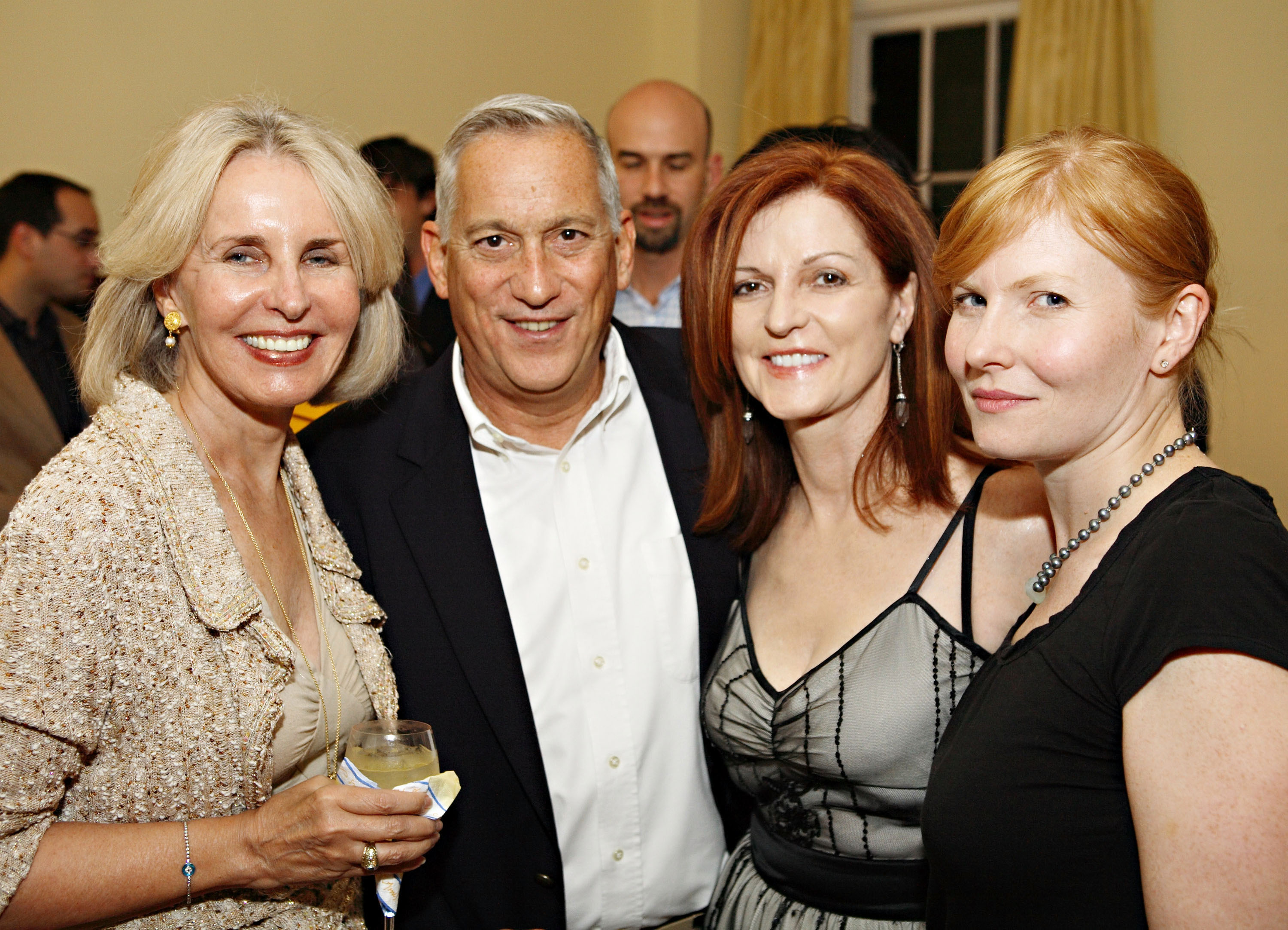
(Photo: Sally Quinn, Walter Isaacson, Maureen Dowd and Ana Marie Cox at the book-signing and reception for Gioia Diliberto’s new book ‘The Collection’ at a private residence on September 15, 2007 in Washington, DC. By Paul Morigi/Wire Image.)


That Metaphor You Were Searching For

Every now and again, a writer needs to find a new way of expressing the notion that fundamentalism is not actually faith, but a neurosis built on misunderstandings and leading nowhere. And then you just read the AP:

A northern Arizona family that was lost at sea for weeks in an ill-fated attempt to leave the U.S. over what they consider government interference in religion will fly back home Sunday. Hannah Gastonguay, 26, said Saturday that she and her husband “decided to take a leap of faith and see where God led us” when they took their two small children and her father-in-law and set sail from San Diego for the tiny island nation of Kiribati in May.

But just weeks into their journey, the Gastonguays hit a series of storms that damaged their small boat, leaving them adrift for weeks, unable to make progress. They were eventually picked up by a Venezuelan fishing vessel, transferred to a Japanese cargo ship and taken to Chile where they are resting in a hotel in the port city of San Antonio.

Add your own punch-line. It’s too easy.

“All Bad Things Must Come To An End”

Andy Greenwald has a theory about why, despite living in the Golden Age of television dramas, he’s seen great shows struggle with their finales:

In retrospect, I think what confounded and disappointed loyal obsessives of The Wire and The Sopranos wasn’t the specific ways they chose to go out but that the endings had to be specific at all. Both shows transcended their settings to become wide-ranging, rewarding hobbyhorses for the men behind the curtain. Putting a fulfilling period on such magnificent, digressive sentences proved to be nearly impossible. How do you condense the life and death of a major American city into a montage? How to cram the banality and barbarity of modern life into a close-up and an order of onion rings?

Why he believes Breaking Bad will come to a better end:

Breaking Bad, to its enormous credit, isn’t about everything. It’s about one thing and always has been: Walter White’s calamitous path not from Mr. Chips to Scarface but from homeroom to the gates of hell. This framework has provided creator Vince Gilligan with a relentless, furious focus usually only possible after a few hits of the blue. Everything that we’ve seen these past five seasons, from airplane collisions to cartel killings, has spun out from Walter’s initial decision to edge up to the line separating legal from illegal, good from truly awful, and then run right over it behind the wheel of a hideous, taupe, SUV. And every step he has taken — from half-measures to full-on slaughter — we’ve taken right alongside him. We know exactly where we’re going because we’ve never lost sight of where we’ve been.

Miracle Works

dish_notgoya

 
Reviewing a history of art forgery, Charles Hope explains that authenticity had a different meaning in the Middle Ages:

What mattered about objects such as these was not so much whether they were originals or copies, whether they were old or modern, as whether they worked miracles. In this respect they were like relics, for which there was also an enormous demand, met in part by the production of fakes. Such forgery required no technical skill, since what was most often required was a fragment of bone, supposedly human. The church was of course alive to the danger of forgery, and had an elaborate procedure for establishing the authenticity of relics, described in fascinating detail by [author Thierry] Lenain in Art Forgery.

Various types of evidence were used. These included any label attached to the supposed relic, the length of its known history, its source, the beliefs of the local clergy and congregation, and, most important of all, the relic’s ability to work miracles. Apart from this last criterion, these types of evidence have something in common with some of the categories of argument used today to establish the authenticity of works of art. In both cases much weight is given to provenance and to such written evidence as old labels and other documents; and in the case of relics the role of the clergy is comparable to that of art historians, with much importance given to the views of the majority and to tradition.

Even the supposedly miraculous power of the relic has a surprising parallel in discussion of the status of works of art. For the potency of the relic was thought to be generally due to some physical connection with a saint, whether because it was part of his or her body, or had touched a part of the body or some other relic. In much the same way, as Lenain explains, it is widely believed today that an authentic work of art contains in itself some trace of its maker, in a way that a copy, however accomplished, never can.

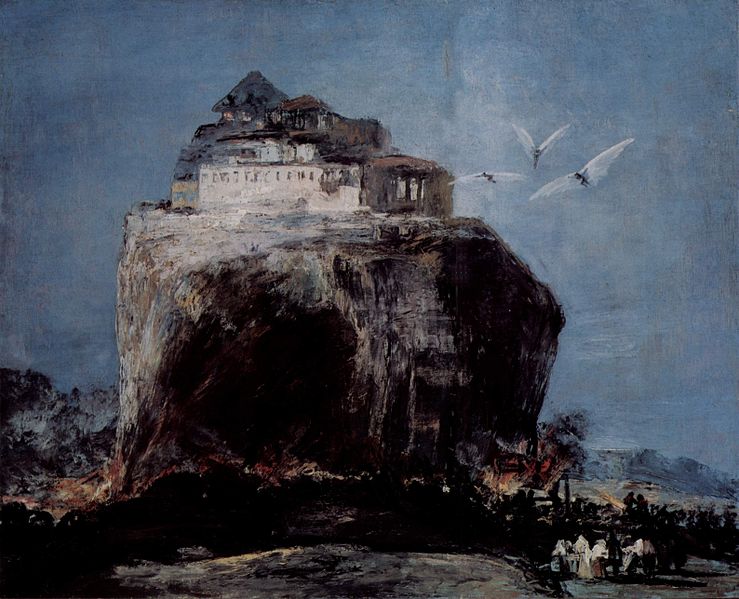
(Image: A City on a Rock, once attributed to Francisco de Goya and now considered the work of his follower Eugenio Lucas, via Wikimedia Commons)