Why Do Chinese Tourists Have Such A Bad Rep?

Defacing ancient ruins and defecating in public doesn’t help:

Another reason could be that the Chinese lack a guidebook culture:

The Chinese have gained wealth so quickly that they have become thrust into global tourist culture without the time to create guideposts that other nationalities might enjoy. For instance, there is no Chinese equivalent of Lonely Planet, encouraging young Chinese to go explore the world and respect the cultures and communities they enter.

Plus, bureaucratic and language barriers encourage group travel:

In many countries, Chinese are still viewed with suspicion during visa review processes. Chinese tourists always seem to travel in huge packs because joining a tour group makes getting a visa easier. Finally, tourism sites across the world have learned to accommodate the language needs of the English speaking world, but Chinese tourists are rarely fluent in English or the language of the country they’re visiting, leaving many opportunities for miscommunication and misunderstanding.

Another reason why Chinese tourists are so unpopular:

[O]ne thing many Chinese vacationers don’t want to do with their money is tip – a custom in some places which many have ignored, Wang said. Though most travel agents in China would educate their clients about tipping in a foreign country ahead of their trip, most people ended up tipping very little or none. Some are not used to the idea of tipping, and they fail to understand that staff working at the Maldives resorts, who usually earn a meagre salary, rely heavily on tips, Wang said. This has created increasing tensions between the Chinese and their hosts. Staff would naturally prefer serving guests from countries with a tipping culture. Other staff have gone after Chinese clients and asked openly for tips, a rare thing for them to do in the past.

Of course, having access to guidebooks is no guarantee of good manners; Americans are still widely viewed as the world’s most obnoxious tourists.
Girls Don’t Want To Read Faulkner Anymore

DegreePercent

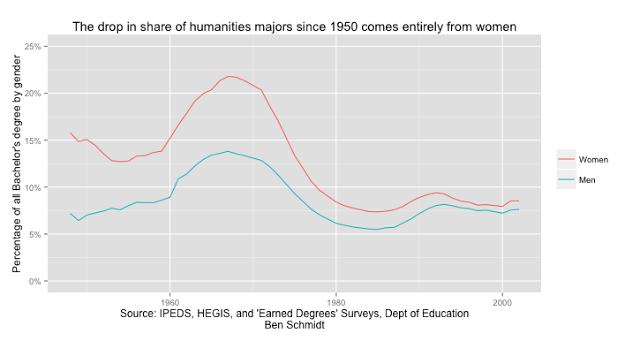
Benjamin Schmidt thinks the “crisis in the humanities” is simply the result of today’s women having more educational options. Nora Caplan-Bricker explains:

Before second-wave feminism and the major civil rights legislation of the early ’70s ushered women into business and law firms, medical schools, and the like, nearly every college student with two X chromosomes majored in education (about 40 percent) or in the humanities (close to 50 percent). In 1966, on the cusp of major changes, under 10 percent of pre-professional degrees went to women. As social movements opened doors outside the academy, a landslide occurred within it. The number of women majoring in the humanities dropped by half between the mid-’60s and early-2000s. The flip side is that today, women make up about half of all pre-professional degrees. “You’d have to be pretty tone-deaf to point to [women’s] ability to make that choice as a sign of cultural malaise,” Schmidt observes.

Allie Jones adds:

In other words, the supposed decline of the humanities may be little more than an increase in choice for women, who may well want to become doctors instead of, say, English teachers. There seems to be very little troubling about that.

Colleen Flaherty notes that the share of women earning undergraduate degrees in education has also plummetted since the mid-’60s, from 40 percent in 1965 to about 10 percent today. Previous Dish on the state of the humanities here.

(Chart: Benjamin Schmidt)

Vietnam’s AWOL Press

Tom Gallagher gives high praise to Nick Turse’s Kill Anything That Moves, a “history of the Vietnam War that finds the My Lai massacre more the rule than the exception.” Gallagher describes an American press that shrank from the truth:

In 1968, in terms of press coverage, even Ramparts, arguably the most radical mass-market publication in the nation, refused to run a war-crime story by a veteran who had witnessed the crime. But after My Lai became public knowledge, Turse asserts: “It was almost as if America’s leading media outlets had gone straight from ignoring atrocities to treating them as old news.” In 1972, Newsweek’s departing Saigon bureau chief filed a story about an operation called “Speedy Express,” in which he concluded that “thousands of unarmed, noncombatant civilians have been killed by American firepower. They were not killed by accident. The American way of fighting made their deaths inevitable.” His editors, however, argued that running the story would constitute a “gratuitous attack” upon the Nixon Administration, which had just taken such a hit over My Lai.

Henry Kissinger once told Richard Nixon, “Once we’ve broken the war, no one will care about war crimes.” And as the US turned the bulk of the war over to its South Vietnamese government allies to lose, Kissinger proved right. In the tremendous research effort that produced this book (including many interviews of Vietnamese and American soldiers), Turse finds that, “The scale of the suffering becomes almost unimaginable,” but not as “unimaginable as the fact that somehow, in the United States it was more or less ignored as it happened, and then written out of history even more thoroughly in the decades since.”

What Trillion Dollar Deficit?

Budget Deficit

The part of Josh Green’s interview with Rand Paul that’s getting the most attention:

You know, the thing is, people want to say [my budget is] extreme. But what I would say is extreme is a trillion-dollar deficit every year. I mean, that’s an extremely bad situation.

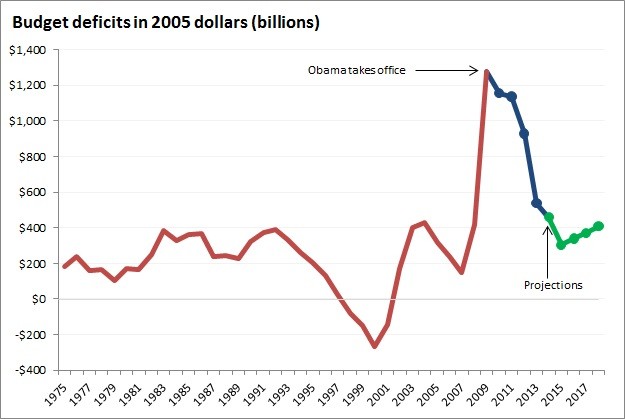
Waldman counters with the above chart:

Actually, according to the latest Congressional Budget Office (CBO) figures, the deficit for 2013 will be $642 billion. That’s a lot of money to you and me, but it isn’t a trillion dollars, and it’s the lowest deficit since 2008. The CBO is also projecting that in 2014 the deficit will fall to $560 billion, and in 2015 it will fall further, to $378 billion.

Those projections will inevitably be revised over time. Maybe the deficit will actually be larger, or maybe it will be smaller. One thing we can say for sure though, is that for the moment at least, there are no more “trillion-dollar deficits,” not every year, and not any year. In fact, the reduction of the deficit over Barack Obama’s term has been nothing short of stunning.

Chait is unsurprised by Paul’s ignorance:

For Rand (and Ron) Paul, the dread specter of fiscal collapse and hyperinflation is more of a generalized fact of life than something that depends on particular “numbers.” The whole political rise of the Pauls since 2008 owes a great deal to the economic crisis and the resulting spike in the deficit, which drove large numbers of people to join the freak-out bunker where the Pauls have resided all along. Of course Rand Paul isn’t going to notice the apocalypse is receding — its imminent appearance is a fixed piece of his worldview.

Krugman wonders what the public believes:

Larry Bartels likes to cite a 1996 poll in which voters were asked whether the deficit had increased or decreased under Clinton (it had, in fact, fallen sharply). A plurality of voters — and a heavy majority of Republicans — thought the deficit had gone up.

So I’d love to see a comparable poll now — asking, say, what has happened to the deficit since 2009. (It has actually been cut more than 50 percent). My bet is that it would look like that 1996 poll.

“We’ve Been Systematically Misled For Nearly 70 Years” Ctd

A reader writes:

First, I want to thank Dr. Gupta for his change of heart and welcome his support. However, it is mind blowing to hear this: “I mistakenly believed the Drug Enforcement Agency listed marijuana as a schedule 1 substance because of sound scientific proof.”

This is ridiculous because there was a supreme court case not long ago (Raich vs. Ashcroft / Gonzales, shortly before Roberts was nominated) where the sole outcome of the ruling was to affirm Congress’ right to ignore and even fabricate “scientific evidence” as they see fit. Interestingly it was one of the few cases where Scalia and Thomas disagreed.  I remember it well because the speculation at the time was that Scalia was siding in favor of the war on drugs because voting in favor of ending the drug war might knock him out of the running for Chief Justice.

Another reader:

While I’m grateful for Dr. Gupta’s about-face on cannabis and hopeful that it accelerates the mainstream acceptance of prohibition’s demise, I was also struck by something in that interview: both he and Piers Morgan admitted to smoking weed “a long time ago”.  I’m not saying either is lying, but it does seem like temporal distance has become the new “I didn’t inhale”.  It’s okay to admit you smoked, but make sure to relegate that experience to a past life.  It’s a sign of both how far we’ve come and how far we still have to go. When a respected member of the mainstream news media (and I use the words “respected” and “news” loosely in regards to Morgan) admits to current or even recent use, that’s when we’ll know the door to the cannabis closet has been fully torn off its hinges.

Another:

Quick anecdote that may be of interest: Back when I was at the Marijuana Policy Project, Dr. Gupta wrote a column for Newsweek opposing marijuana legalization measures on the Colorado and Nevada ballots in 2006, and I emailed him to complain of what I considered faulty logic and incomplete facts.

I was polite, but pretty firm that I thought he was profoundly missing the point in failing to consider the harm prohibition does when evaluating the pros and cons of legalization. To his great credit, he picked up the phone and called me, and we had a respectful but spirited conversation for a good 20 minutes.

That in itself is extraordinarily rare for a national TV personality responding to a totally un-famous stranger. I didn’t convince him at that point and he actually seemed pretty locked into his viewpoint, but he engaged with me and came across as a guy truly wanting to do the right thing. I like to think that I helped plant the seeds of his eventual rethinking in that conversation, though of course I have no way of knowing.

When he took the first steps toward acknowledging possible medical value to cannabis a couple years later, I wrote him again to express thanks for his willingness to keep an open mind, and got a thoughtful and appreciative email back. So I think we should bear in mind that things about cannabis and cannabis laws that seem obvious to us seem much less so to people who’ve been immersed in drug war groupthink all their lives – and, at least at the time Dr. Gupta was in med school, anything medical students were taught about marijuana was mired in that groupthink (and after all, if you’re selective enough with your evidence, it’s not hard to make a plausible-sounding case against the stuff).

So I end up being really impressed with Dr. Gupta. He had semi-informed opinions that turned out to be mostly wrong, and took a lot of criticism for them (and I can tell you positively that some of the responses he got were far nastier than mine), but instead of getting his back up and circling the wagons, he kept studying, thinking and learning and publicly admitted a mistake. That’s pretty classy, and not exactly common in the cable news universe. I wish more of our public commentators behaved like that.

Readers are also sounding off at our Facebook page.

Dolphin BFFs

4881676285_f98cea8b76_b

The jury is still out on whether dolphins communicate by name like humans do, but Megan Garber spotlights a study showing how the animals possess “the most durable social memory ever recorded for a non-human”:

[Biologist Jason Bruck] studied dolphins from six breeding facilities that rotate the animals among themselves — and, in the process, keep detailed records of which dolphins shared tanks, and when. There were more than 50 animals in all. Bruck first recorded each dolphin’s unique whistle. And then he played it back to the dolphins’ former tankmates using underwater speakers. … The point? To test whether the dolphins would recognize each others’ whistles, even after years-long stretches of separation.

The findings? The dolphins did, indeed, seem to remember each other. The whistles of the dolphins’ former tankmates resulted in the dolphins doing things like purposely bumping into a speaker, or (even more sadly) whistling at it — “trying,” Nature notes, “to make it whistle back.”

And that recognition behavior held, even more interestingly, no matter how long a pair had been separated. A dolphin named Bailey had been living apart from a former tankmate, Allie, for more than 20 years. Yet Bailey, in Bruck’s experiment, seemed to recognize Allie’s “name” — her signature whistle — despite the temporal distance.

(Photo by Patrik Jones)

Scientific Breakthrough Of The Day

Scientists have produced a vaccine for malaria. Nathan Olivarez-Giles summarizes the results of the small study:

The vaccine, which is made using a weakened form of the disease, was administered in varying doses to a group of more than three dozen volunteers. Six people, each of whom were given a full five doses of the vaccine, were unable to contract malaria when exposed to the disease, the study says. This is the first time any vaccine has achieved 100% effectiveness in any trial, researchers report. Nine others were given four doses of PfSPZ, three of whom became infected in the trial. Of another 12 who took part in the trial but weren’t given the vaccine, 11 contracted malaria, the study says.

Ashley Feinberg explains how the vaccine is made:

[P]art of the reason it’s taken so long to get to this point is that the process of actually making the vaccine is incredibly difficult and complex. First [head researcher Stephen Hoffman] had to raise mosquitoes in sterile conditions “on an industrial scale.” He would feed them blood that had been infected with the malaria parasite and then exposed to radiation to so that the parasite would weaken. That way, the body would recognize its presence without being infected with the actual disease.

Next, billions of these parasites were harvested from the mosquitoes’ salivary glands, purified, and cryopreserved. And while all this was happening, most researchers in the field were expecting him to fail. They didn’t think it would be possible to mass-produce this virus in a way that passed the highly strict quality and safety standards that human medicine must undergo. And now, as [director of the US National Institute of Allergy and Infectious Diseases Anthony] Fauci mentioned to Nature, “To my amazement, Hoffman did it.”

Jason Koebler qualifies the successful trial:

The NIH trial is not without red flags, however. The vaccine was barely effective in smaller doses, which means booster shots or larger doses will need to be administered, which can drive up cost and decrease enrollment. Secondly, the vaccine needs to be injected directly into the bloodstream. That’s not a problem if you’re getting it in a hospital or clinic, but that means whoever is giving the vaccine will need to be specially trained. Self administration, at this point, is not an option.

But the fact that the NIH and the U.S. Department of Defense are behind this, and malaria’s long list of deep-pocketed enemies, make it unlikely that funding will be an issue going forward.

Why this development is such a big deal:

No effective malaria vaccine is available at present. The World Health Organization has set a target to develop a malaria vaccine with 80% efficacy by 2025, but until now, says [Anthony Fauci, director of the US National Institute of Allergy and Infectious Diseases], “we have not even gotten anywhere near that level of efficacy.”

How Green Is Your Car?

It depends on your state:

In 26 states, a plug-in hybrid is the most climate-friendly option (narrowly outperforming all-electrics in 11 states, assuming 50:50 split between between driving on gas and electric for the plug-in hybrids), and in the other 24 states, a gas-powered car is the best.

Drum explains the variation:

If you live in, say, Washington or Vermont, where most of your electricity comes from hydropower or nuclear, an electric car is pretty carbon friendly. If you live in Kentucky, where your power mostly comes from coal, an electric car isn’t such a good choice. But there’s more. You also need to account for the carbon emissions it takes to build the car in the first place. And since battery manufacturing is pretty carbon intensive, a car with a big battery starts out with a big carbon deficit to make up.

A Mini Military-Industrial-Complex, Ctd

While discussing his new book, The Rise Of The Warrior CopBalko explains how SWAT became ubiquitous:

Sarah Stillman reviews the numbers:

In 1972, America conducted only several hundred paramilitary drug raids a year, according to Michelle Alexander’s “The New Jim Crow: Mass Incarceration in the Age of Colorblindness.” By the early nineteen-eighties, there were three thousand a year; by 2001, Alexander notes, the annual count had skyrocketed to forty thousand. Today, even that number seems impossibly low, with one annual count of combat-style home raids hovering around eighty thousand.

The ACLU has requested “information from law-enforcement agencies and National Guard offices on how federal funding has helped to drive the militarization of local and state police departments”:

Kara Dansky, the senior counsel of the A.C.L.U.’s Center for Justice, told me that the resulting data has just begun to pour in, and many agencies have proven to be coöperative. The biggest surprise thus far, Dansky says, is how little uniformity and clarity there is about when officers are advised to use extreme SWAT tactics, particularly in cases where mentally-ill or suicidal individuals are their targets. “One major trend that we’re seeing is that police departments across the country vary tremendously in terms of how, if at all, they document information pertaining to their SWAT deployments,” Dansky said. “We have very little doubt that there are circumstances where the use of military tactics or equipment would be an appropriate response to a domestic law-enforcement situation.… But there aren’t always clear standards in place for when certain tactics are appropriate.”

Earlier Dish on police militarization here, here, and here.