Engineering Makes Perfect? Ctd

In an interview with Slate, David Epstein, author of The Sports Gene, argues that downplaying the genetic aspects of athletic talent is harmful:

I think it’s become really detrimental, because now there’s this early hyperspecialization in sports, and there are very few sports where the science shows that actually helps and others where it shows it’s detrimental. What the more recent science is suggesting is that you should have a sampling period, when you find what activity and training fits your genome best before you specialize in your mid-teen years. And so I really think we’re doing some athletes a disservice with that message, but some of the scientists, sports psychologists particularly, have felt like saying, “Well, you can achieve anything,” is the message you should put forward. Well, the converse of that is, if you didn’t get to the NBA, it’s because you didn’t work hard enough. It’s a theme which maximizes the sort of “free will” message, and it’s self-helpy, which is why people enjoy it, even when most people in the back of their head realize that they have proclivities which make them better at one thing than another.

Razib Khan enjoyed Epstein’s interview with NPR:

[Epstein] reports that 17 percent of men over the the height of seven feet (2.14 meters) between the ages of 20 and 40 in the United States are playing in the NBA!

Obviously there is no gene which is guaranteed to make you an NBA star, but having the allelic profile which predisposes you to being seven feet tall obviously helps. It also illustrates the ridiculousness which the “10,000 hour rule” has been taken to in popular culture. Practice matters, and, talent matters. At extremely high levels of performance one often needs to have focus to engage in repetitive tasks over and over. But, one also likely needs a preternatural complement of genes. Most of the children of NBA players do not become professional basketball players, but the probabilities are far higher. Epstein outlines these sorts of facts in a breezy and concise manner in the interview, as well as dismissing the infantile disorder of genetic determinism which results in the purchasing of DNA kits which will tell you if your child is an athlete or not.

In an interview with The Atlantic, Epstein explains how the field of genetics is already being used to improve athletic performance:

I think genetically tailoring your diet is already a thing; for example, one of the doctors I talked to for the book also does genetic testing for retired athletes. And he knows who’ll respond better to fish oil supplements for brain health, things like that. I think we’ll start to see more of that.

One other thing that’s happened organically is individualized training. Great coaches sometimes do this intuitively: They have these intuitions about genetics, in that they recognize that certain athletes are responding to certain types of training while others aren’t. There’s one scientist I talked to who actually takes biopsies, so that he has the muscle-fiber types of athletes—percentages of fast-twitch and slow-twitch, stuff like that—and develops training regimens for them accordingly. Most athletes are recreational and won’t be getting muscle biopsies, but hopefully we can start paying more attention to what individuals respond to.

Earlier Dish on Epstein’s book here.
One Book, One Year

Wallace Yovetich fondly recalls taking an entire year to finish reading a single book:

I’ve never again taken that long to finish a book. There hasn’t been the need, which solidifies this book as important to me and as one of my favorites. It means more to me than just the story between the covers because it holds the story of that entire year of my life. When I see it now on my shelf I am taken back in time – I remember the relationship that started that fall as I started the book, that faltered as many times as I put the book down, and that was picking up speed again as I picked up speed in the reading. I can remember the events of the world from that winter as I distracted myself with the story, and the promotion at work that spring that kept me busy and away from the book. I remember the planning of that particular summer trip to Europe, and the choosing of the book. I can even remember which train, plane, and country I was traveling on and through during different points of the plot.

I haven’t re-read the book, though I think about doing so from time to time. I wonder to myself if the magic would be gone; if it was just the right book at the right time; if I want to paste over the memories that are embedded in the pages with new ones. I’m not ready to find out the answers.

I’m purposefully not telling you the name of this book, because this anecdote isn’t about how fantastic this particular story was (though, it was pretty great). It’s about honoring the time we spend in what we are reading, why some books last in our minds and others don’t, and how sometimes a really great book can make for a really interesting year.

Obama Cancels On Putin, Ctd

Julia Ioffe supports the president’s cancellation of the impending Moscow summit, but nevertheless lays the blame with Obama for letting things reach this point:

You can’t back Putin into a corner and leave him no options. If you are a world leader worth your salt, and have a good diplomatic team working for you, you would know that. You would also know that when dealing with thugs like Putin, you know that things like this are better handled quietly. Here’s the thing: Putin responds to shows of strength, but only if he has room to maneuver. You can’t publicly shame him into doing something, it’s not going to get a good response. Just like it would not get a good response out of Obama.

The Obama administration totally fucked this up. I mean, totally. Soup to nuts. Remember the spy exchange in the summer of 2010? Ten Russian sleeper agents—which is not what Snowden is—were uncovered by the FBI in the U.S. Instead of kicking up a massive, public stink over it, the Kremlin and the White House arranged for their silent transfer to Russia in exchange for four people accused in Russia of spying for the U.S. Two planes landed on the tarmac in Vienna, ten people went one way, four people went the other way, the planes flew off, and that was it. That’s how this should have been done if the U.S. really wanted Snowden back.

Samuel Charap expects Russia-reset skeptics like McCain to now “seize on Obama’s decision in order to proclaim that they were right all along”:

Obama’s Russia policy did produce a long list of important results, from the New START agreement, which verifiably reduced both countries’ nuclear arsenals, to Russian WTO membership, which signaled Russia’s integration into the global economic order. And while the space for pluralism in the Russian public sphere has narrowed significantly since Putin’s return to the presidency, Russia is not North Korea — or even neighboring Belarus.

And despite notable differences over issues like the conflict in Syria, Russia has actually been a crucial partner for achieving U.S. objectives internationally. Just take the agreements Obama reached with then Russian President Dmitry Medvedev in 2009 that allowed for overflights and rail-based transit through Russia to support the U.S. mission in Afghanistan. Without that northern route, it’s hard to imagine the U.S. risking closure of the other major transit route — through Pakistan — with the operation to take out Osama bin Laden.

Drezner downplays the chill in relations:

Essentially, each government got what they wanted from the other — arms control, WTO accession, Afghanistan — a few years ago.  Besides counter-terrorism, there ain’t much left on the table where there is any kind of bargaining core — and neither country matters all that much to other for core issues.  The question going forward is whether the lack of agreement about future issues will compromise existing cooperation.  My hunch is that it won’t, and that the tit-for-tat ends here.

A High-Speed Bus System

Yglesias thinks it’s doable:

Buses often fall down on the job—not because they’re buses, but because they’re slow. Buses are slow in part because city leaders don’t want to slight anyone and thus end up having them stop far too frequently, leaving almost everyone worse off. Buses also tend to feature an inefficient boarding process. Having each customer pay one at a time while boarding, rather than using a proof-of-payment where you pay in advance and then just step onto the bus, slows things down. That can generate a downward spiral of service quality where slow speeds lead to low ridership, low ridership leads to low revenue levels, and low revenue leads to service that’s infrequent as well as slow. Closing the loop, a slow and infrequent bus will be patronized almost exclusively by the poor, which leads to the route’s political marginalization.

Worst of all, even though a bus is a much more efficient use of crowded space than a private car, it ends up stuck in the same traffic jam as everyone else.

The Demand For Journalists

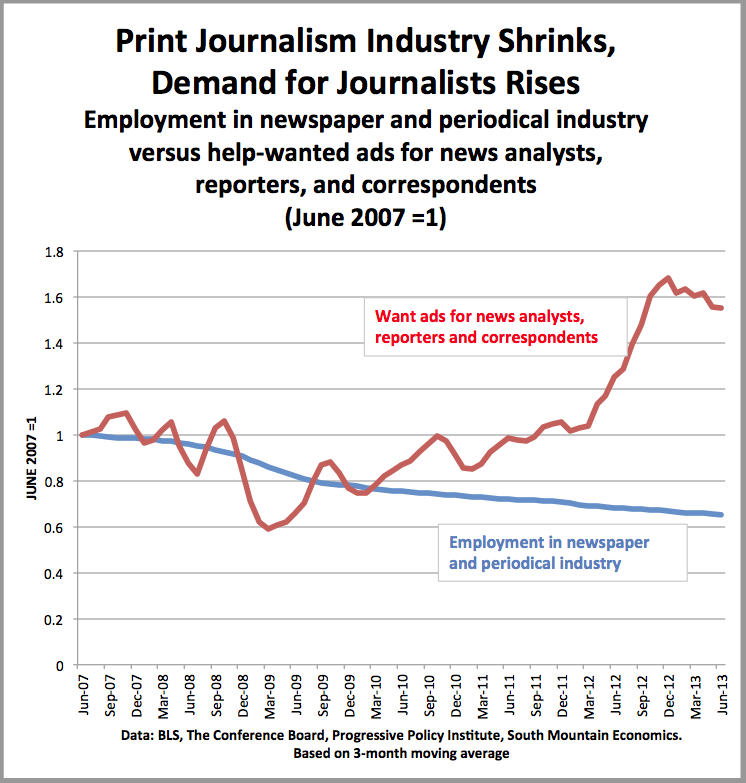
journalism demand

Michael Mandel finds evidence that it’s growing:

I’m not saying that the true demand for journalists doubled between the beginning of 2009 and today, although given that no one was hiring in the depths of the recession, that statement might be literally true. In fact, the help-wanted series is an example of naturally-generated ‘big data’, meaning that it can be affected by changes in business practices, such as the way jobs are posted. The nature of journalism jobs may also be changing.

However, there seems little doubt that technology and innovation in journalism is creating new jobs in different industries even as the old companies and old industries are being undermined. I’m pretty sure that jobs at Politico are not being reported in the same industry as jobs at the Washington Post, even if Politico hires a WaPo reporter to cover more or less the same things.

A Bishop’s Resignation

Happens a lot these days – usually because of the child-rape conspiracy or financial shenanigans. But this time, it happened just after Pope Francis said conciliatory and Christian things about gay people. The resignation? From one of the most virulently homophobic bishops on the planet, Bishop Simon Bakot of Yaoundé, former president of the National Bishops’ Conference of Cameroon. The resignation was announced by the Vatican:

Bishop Bakot did not resign for reason of age as Catholic bishops are required to do when they reach 75; he is only 66. Nor is he known to have been in ill health or under scrutiny for financial reasons or his own sexual misconduct. The sole reason he is famous is for his staunch opposition to gays. He lumps them with pedophiles and practitioners of bestiality and calls them an affront to God’s creation. He threatens to ‘out’ clergy he opposed by revealing their sexual orientation. He has even been a vocal public supporter of Cameroon’s national day of hatred of gays. The fact that his resignation was accepted the day after Francis’s now famous utterance casts new light on the Vatican’s stance toward gays.

Bakot has described marriage equality as “a serious crime against humanity. We need to stand up to combat it with all our energy.” Once in the vanguard of the Catholic hierarchy’s shift toward the far right, he now seems somewhat stranded.

Know hope.

“We’ve Been Systematically Misled For Nearly 70 Years”

This embed is invalid


As more and more evidence emerges that medical cannabis can transform some debilitating diseases in children – preventing seizures, for example – Dr. Sanjay Gupta does more than an about face, he acknowledges his past error:

I apologize because I didn’t look hard enough, until now. I didn’t look far enough. I didn’t review papers from smaller labs in other countries doing some remarkable research, and I was too dismissive of the loud chorus of legitimate patients whose symptoms improved on cannabis. Instead, I lumped them with the high-visibility malingerers, just looking to get high. I mistakenly believed the Drug Enforcement Agency listed marijuana as a schedule 1 substance because of sound scientific proof. Surely, they must have quality reasoning as to why marijuana is in the category of the most dangerous drugs that have “no accepted medicinal use and a high potential for abuse.”

They didn’t have the science to support that claim, and I now know that when it comes to marijuana neither of those things are true.

What’s staggering to me is that anyone who has access to the Internet could believe for one second that what the federal government says about marijuana is true. It’s a self-evident, massive lie, incapable of being defended, and asserted by some kind of fiat. Just watch this pathetic spectacle. It’s like something out of the late Soviet Union, in which an apparatchik is forced to lie to conform to an obviously untrue ideology. This is not science:

This embed is invalid


That the Obama administration has done nothing to reclassify the drug to conform to minimal medical standards of accuracy can only be called extreme cowardice. At some point, in my view, this president needs to say about marijuana what he said about marriage equality: that he’s for legalization, taxation and regulation. But Gupta is a helpful stepping stone – a mainstream celebrity acknowledging that the US government is engaged in misleading and lying repeatedly to the American people. Gupta spells out the empirical reality:

It doesn’t have a high potential for abuse, and there are very legitimate medical applications. In fact, sometimes marijuana is the only thing that works. Take the case of Charlotte Figi, who I met in Colorado. She started having seizures soon after birth. By age 3, she was having 300 a week, despite being on seven different medications. Medical marijuana has calmed her brain, limiting her seizures to 2 or 3 per month.

I have seen more patients like Charlotte first hand, spent time with them and come to the realization that it is irresponsible not to provide the best care we can as a medical community, care that could involve marijuana. We have been terribly and systematically misled for nearly 70 years in the United States, and I apologize for my own role in that.

Alex Moore thinks Gupta’s support could prove significant:

The fact is, no matter what category they represent, celebrities tend to cauterize our opinions. It’s not their fault—it’s just how work as a society. Mario Batali, Jamie Oliver and Top Chef come to define how we think of good cooking, and the opinions of celebrity doctors like Sanjay come to represent the “medical mainstream.”