The ultimate action-movie mashup:
ETERNA from Behind The Epic on Vimeo.
Reviewing David Epstein’s new book The Sports Gene, Reeves Wiedeman explores the idea of breeding superstar athletes:
The technology is on the not-too-distant horizon: scientists have produced fertile eggs from mouse stem cells, allowing for the possibility that, one day soon, humans will be able to engineer their children to receive specific traits and not others. Give him my wingspan, but not the vertical leap. The big hope for these technologies is that they will help deal with debilitating diseases, but big-money sports are inevitably going to get involved. …
There are, by Epstein’s count, around a hundred thousand “naturally fit” Americans between the ages of twenty and sixty-five—those whose genetic makeups predispose them to being in shape. The book is rife with such genetic advantages that find their ways into different populations. Members of a particular ethnic group in Kenya, in addition to living at altitude, have thinner legs, which makes the pendulum effect necessary for distance running that much easier to create. An outsized number of Jamaicans from Trelawny, a region in the island’s northwest, have become world-champion sprinters. Redheads from everywhere tend to have greater tolerance for physical pain.
But the disappointing reality Epstein most often presents is that there are no answers, or at least not definitive ones, to the questions of what genetic traits will guarantee athletic success, or whether training can truly overcome inborn limitations. Take ACTN3, a gene that allows for the production of alpha-actinin-3, a protein found in the fast-twitch muscles of almost every top sprinter who has ever been tested for the gene. But a properly functioning ACTN3 is not a golden ticket, merely a prerequisite for entry.

Architects are converting unprofitable shopping malls into New Urbanist developments:
Ellen Dunham-Jones, architecture professor at the Georgia Institute of Technology, and June Williamson, associate professor of architecture at the City College of New York, have documented this phenomenon in their book, Retrofitting Suburbia: Urban Design Solutions for Redesigning Suburbs, a comprehensive look at efforts to retool, reinhabit, or return to nature abandoned suburban forms. In some cases, this means turning gargantuan forgotten malls into hip, urbanized residential villages.
One such experiment is under way in Lakewood, Colorado, an affluent suburb west of Denver. The former Villa Italia shopping mall, a 1.2-million-square-foot indoor mall built in 1966 that had fallen on hard times, has been turned into Belmar, 104-acre pedestrian-friendly community that has apartments, condos, town houses, office space, artists’ studios, and a shopping and entertainment promenade on 22 walkable, urbanized blocks.
More Dish on the tragedy of malls here, here, and here.
(Inside Virginia’s abandoned Cloverleaf Mall circa 2011. The mall has since been torn down, and 600 apartments are planned for the site. Photo by William Fisher.)
A reader writes:
I never imagined that I would someday be in a position where I personally know someone in solitary confinement, or that I would be able to confirm what Atul Gawande wrote in The New Yorker about solitary confinement: “Whether in Walpole or Beiruit or Hanoi, all human beings experience isolation as torture.” I have been writing to a long-term prisoner since September, 2004. In early 2009, she was placed into solitary confinement, where she remains today, four and a half years later. Our correspondence has continued throughout.
She is an outgoing, social person, and four-plus years of solitary confinement has been particularly hard on her.
For the first year or so, she was in a cell that had an inner door of bars, which remained closed all the time, and an outer solid door which she could slide open, allowing her to talk with other prisoners in nearby isolation cells. Then she was moved to a cell with a door that stays closed all the time. The lights in her cell are left on 24 hours a day. When she leaves her cell, it’s in full irons, with her ankles shackled and her wrists chained to her waist. The guards aren’t allowed to talk to her, except to give her commands. All her visits are non-contact. She loves long hugs, but hasn’t had a hug of any kind in almost five years. Even when her mom and dad visit, she only talks to them over a phone, through a glass window.
The effects of solitary confinement – especially depression and loneliness – are obvious from her letters. She spends much of her day sleeping, and only gets limited time outside her cell for exercise and a shower. Guards are not allowed to talk to her, except to issue commands. To me, the effects are obvious. She wrote regularly; she was optimistic and curious. Today she writes sporadically and fights a never-ending battle with depression. She deals with the depression with prescription drugs, prescribed by the prison psychologist.
Now that I’ve seen the effects of long-term solitary confinement on someone I know, I can say with certainty: it’s torture.
A reader writes:
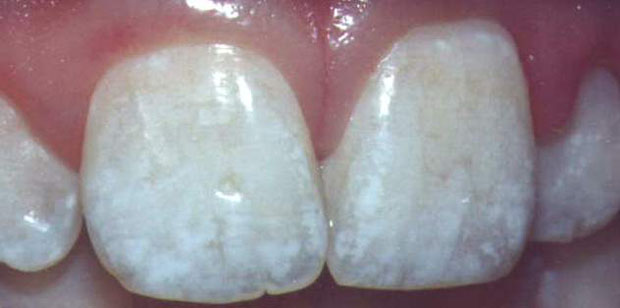
As a former resident of Portland, I’ve followed the fluoridation debate lightly without much of an opinion, but have dug into it some more with the unfurling of this thread. I tip my cap to the reader who linked to the anti-fluoride site. I, for one, have been trying to figure out what’s wrong with my teeth for some time, with no leads (even from dentists) until I saw the pictures of dental fluorosis:
I grew up in Lawrence, KS which had fluoridated water, and my teeth look like those with mild dental fluorosis. (But I also had no cavities while growing up.)
Overall, I thought that some of the arguments made on the site were compelling, some less so. But the reflexive cries of “whack-job” by readers in the following post made me cringe. In addition to providing zero links to their claims of pseudo-science for others to evaluate, there’s a rich irony lost on the responders.
Oppenheimer’s article wasn’t about fluoridation or organic food; it was about the aggressive purification of the left betraying the fundamental values of classic liberalism and subverting its societal priorities. That those readers imagine that they’re proving Oppenheimer’s point by citing Western medicine is laughable. There is perhaps no better example of “liberal” ideological purity and certainty than mainstream Western medicine, which dismisses all forms of knowing that can’t been “proven” in a lab.
A reader with a long-term illness writes:
I couldn’t resist responding to this statement: “Ignorance of science and medicine is a luxury that is great so long as you’re basically healthy. When you’re really sick, however, you’d better toss all that alternative crap out the window.” What upsets me most is the either/or attitude the reader advocates. I think this mindset permeates our culture. I think it’s completely unproductive and does nothing but produce self-righteous justification for one’s current beliefs.
I was raised holistically by both my parents.
On the rare occasions me or my brother did get sick my parents used homeopathy and other alternative methods and home remedies to treat us. When we had colds, it was honey / lemon / cayenne pepper tea, and onion cough syrup. If you look either of the home remedies up you will see that they are very old and have been used for many generations. Neither of us ever had bronchitis, tonsillitis, strep throat or other common childhood illnesses. We had our regular check ups and yes we got our required shots. We were the healthiest kids in our class and of most of our friends.
However, that changed for me around 10-12 when I got bit by a tick. I didn’t know it at the time, but I had contracted Lyme disease. My lyme would go undiagnosed for close to 20 years until I reached 30. In my early 20s I developed very severe endometriosis. After much searching and many visits to various doctors and specialists over a 3.5 year period, I was properly diagnosed and had two surgeries for it. The first was diagnostic but didn’t fix the pain. The second was done two years after my first by a surgical specialist and I was finally on the mend – or so I thought. I was diagnosed with chronic and untreated lyme disease two years after my second surgery. (Before any of your skeptics chime in on my lyme diagnosis, my diagnosis was confirmed based on the CDC guidelines for diagnosing Lyme, even though my bite occurred almost 20 years prior, and I never had any of the initial symptoms of a bull’s eye rash, fever or flu like symptoms.)
I write this brief history to note that I am exactly the type of kid the reader was referring to. But you know what ultimately got me better? BOTH alternative therapies and Western medicine. During the two years between my first and second surgeries, I used prescribed drugs by my gynecologist but I used acupuncture and Chinese herbs to support my system. This kept my nausea and fatigue at bay and was very helpful in lowering my pain. I also used a long list of other therapies, including medical marijuana. My Lyme treatment started with herbs for the first 1.5 years followed by a solid year of long-term antibiotic therapy. During this I worked closely with a kinesiologist that my Lyme doctor (yes, a regular MD) sent me to in order to tweak my supplements and antibiotics as needed.
Without using both holistic and allopathic medicine, I don’t think I would be as healthy and thriving as I am today. My Lyme is in remission and my endometriosis is under control. I still have mild symptoms that are controlled with herbs and supplements in addition to progesterone therapy, and a diet focused on whole foods, fruits and veggies. I think it’s incredibly narrow minded to dismiss the “alternative crap” as “ignorance of science”. I needed the drugs and the surgery, and I was perfectly willing to admit that and to use them as needed. But I wasn’t about to dismiss other treatments I’ve used preventatively my entire life that helped to sustain me and move me through my medical issues in a gentler way.
Update from a reader:
“There is perhaps no better example of ‘liberal’ ideological purity and certainty than mainstream Western medicine, which dismisses all forms of knowing that can’t been ‘proven’ in a lab.” I have my issues with liberal dogma (which most certainly does exist), but if one cannot prove something in the lab, then it isn’t “known” – it is rumor. Worse yet, such logic leads to homeopathy, healing crystals, and other bunk.
True, some herbs have medicinal properties, but unless one has run a double-blind test, then you truly don’t know if the herbs do anything beyond the placebo effect. The US government has spent over a billion dollars trying to prove non-Western medical claims, and guess what? The herbs and other items very rarely do anything positive, occasionally show mild effects, and often have undocumented side effects.
Wanting things that have been proven in the lab might be something many liberals want, but that want is based on what science has done for us, while the dismissal of the scientific method by your reader in nothing short of scientific denialism that is also the father of global warming denying, anti-vaccination movements, and other kinds of crazy.
Benjamin Wallace-Wells profiles Chris Christie:
We have never had a president as outwardly angry as Christie, but then this country has rarely been as angry as it is now. In the tea-party era, conservative anger has often been channeled by figures such as Michele Bachmann and Ted Cruz into a hysteria over very abstract and inflated threats: health-care death panels, the national debt, the specter of a country overrun by illegal immigrants. Christie’s use of anger is very different: It is much more targeted, and therefore potentially much more useful. …
What Christie is doing when he starts arguments with other Republicans—and it is telling that what looks very much like a presidential run has begun with a sequence of fights—is offering his party the chance to preserve its anger, while trading in its revolutionaries for a furious institutionalist.
Alastair Cooke sizes up Fritsch’s piece:
The colour of the rooster, reminiscent of the iridescent, otherworldly pigment patented by the French artist Yves Klein, offers a surreal, comical contrast to the drab bronze statuary and buttoned-up grey facades of the grand buildings nearby. More importantly, the double entendre of its title is fully intended: with his stiff, punk-like coxcomb and jowly wattle, this puffed-up cockerel is meant to appear pompous and ridiculous. I particularly enjoyed his magnificently rumpled tail feathers. There’s something deliberately deflating about the manner in which they droop, so that the cockerel has the bleary aura of a whoring-and-roistering old rogue, worse the wear from drink, still strutting despite being unable to perform in the bedroom.
Here, then, is a sally by a female artist against the many vainglorious monuments commemorating self-important men that have been erected all over the world.
The reasons RR Reno worries about it:
First, religiosity now strongly correlates with partisan loyalty. Nones are overwhelmingly Democrat. Regular churchgoers, especially but not exclusively Evangelicals, trend Republican. This politicizes religion. Second, religious people are becoming more and more dependent on the Republican party to protect their interests (religious liberty, for example). We could easily become a taken-for-granted base largely irrelevant to the party’s larger policy debate, as African-Americans often are in the Democratic party. Third, religion, especially orthodox Christianity, may end up implicated in the inevitable failures and corruptions of the Republican party. We may be in danger of recapitulating in some ways the disastrous alliances of the Catholic Church with the European right in the nineteenth and early twentieth centuries.
Douthat wonders if Pope Francis could help Christianity avoid this fate:
I think this analysis suggests a positive case, in the American context at least, for a papacy that simultaneously calls U.S. Catholics away from a too-close entanglement with the fortunes and platform of the Republican Party, and that consistently reminds non-Catholics and non-Christians that there is more to Christianity than the particular set of issues that have (understandably) kept many American believers in a right-of-center political orbit.
Is anyone suprised at all?! A week after relaunch of peace talks, Israel to begin new construction in East Jerusalem. http://t.co/n7pXx4BLvs
— Ibrahim Kalin (@ikalin1) August 6, 2013
As 104 Palestinian prisoners are set to be released from Israeli jails with Netanyahu’s approval, Abraham Katsman still puzzles over why the PM opted for this as a precondition for peace talks:
Israel has taken a diplomatic beating lately, including the E.U. decision to ban financing and cooperation with Israeli institutions in all territory captured in 1967 (including Jerusalem’s Old City). Netanyahu may feel compelled to take some heat off Israel by entering talks even at this painful price, while being confident that the Palestinian leadership will reject any reasonable Israeli offer. If Netanyahu can widen the perception that the absence of peace is due to unreasonable Palestinian demands and intransigence, that may ease the building diplomatic pressure on Israel.
That’s not a bad bet. First, Abbas set an acrimonious tone by this week by restating that no Jewish Israeli —soldier or civilian—could live in his future Palestinian state. Love is not in the air.
Yousef Munayyer doubts Israel has any reason to worry about its image, which is part of the problem:
Israel is pleased with negotiations for negotiations’ sake.
If they can, along with the United States, impose their will on the Palestinians and get them to accept a deal that leaves them with an impractical and indefensible demi-state of Bantustans, they might come to an agreement. If they can’t force such an agreement on the Palestinians, they will likely blame the Palestinians for the failure of the talks and key pro-Israel figures in the U.S. will support this narrative as well, allowing Israel to argue that it did all it could do and to effectively buy more time for the occupation.
To break this cycle, the U.S. must do something they have never been able to do in the peace process before: credibly and resolutely pressure Israel to comply with international law to achieve a just settlement. If Washington cannot do that, then the negotiations that they have convened merely support an Israeli public relations campaign aimed at convincing the world that they are on their way out of the West Bank while they only entrench themselves deeper in it.
More Dish on the current round of talks here, here and here.
Gingrich recently admitted that the GOP should reexamine its foreign policy:
I am a neoconservative. But at some point, even if you are a neoconservative, you need to take a deep breath to ask if our strategies in the Middle East have succeeded. … It may be that our capacity to export democracy is a lot more limited than we thought.
Jacob Heilbrunn sees Newt’s reversal as “a further sign that the old consensus in the GOP is fraying”:
Gingrich has long had an astute sense for the pulse of the GOP. He may well believe—and his belief may be justified—that the party is at a turning point when it comes to examining its stands on foreign policy. The GOP has yet to undertake a real reckoning with the policies of the George W. Bush and Dick Cheney.
Larison doesn’t buy the change of heart:
It’s interesting that Gingrich is saying these things at a time when most hard-liners and hawks in the party are reaffirming their support for the ideas behind failed Bush-era policies, but I’m doubtful that Gingrich’s “change of heart” is all that significant. As a sign that hard-liners continue to lose ground in the party, it could be a welcome development, but it is just as easy to see Gingrich’s remarks as an effort at damage control. It seems to me that Gingrich isn’t saying these things because he wants to abandon neoconservatives, since he still claims to be one, but because he recognizes that their dead-ender defenses of extremely unpopular wars and attacks on Rand Paul are not having the desired effect.
 The Dish