The Best Of The Dish Today

This is what happened.

Putin stuck his fingers into America’s eye-sockets by giving Edward Snowden asylum for one year, but leading Christianists loved him anyway because he opposes freedom of speech and assembly for gay people. A Prohibition Rubicon was crossed when Uruguay became the first entire country to legislate a legal, regulated market for marijuana. The New York Times’ company’s subscription revenue grew by 5.1 percent as its online ad revenue fell 5.8 percent. Now you know why the Dish plumped for the subscription model as a first step, not a last one. Subscribe [tinypass_offer text=”here”]! Latest Dish-model data here.

In politics, it became clearer that the House GOP is incapable of actually cutting any spending which might hurt white people in their own districts. And good news: the prevalence of infant male genital mutilation in America is fast declining.

The most popular post of the day – by far – was “The GOP Calls Its Own Fiscal Bluff“. The second most popular was “What’s So Wrong With Virtual Sex?” By far our biggest referrer was the Huffington Post (to the GOP bluff post).

Over the last month, the site we referred the most people to was our old home at the Atlantic, followed by the NYT, Slate and The American Conservative.

See you in the morning.

What Is Sex?

A reader explores the seemingly simple question:

Your post on The Chastity Fallacy reminded me of a discussion I took part in once at a party. The guests were mostly lesbians and the topic was “How do you define sex?” For straight couples, “sex” is usually synonymous with “penis-in-vagina intercourse”.  If a straight girl asks her friend if she and her new boyfriend have “had sex”, that’s usually what is meant.

This leaves a multitude of other sexual activities that are not considered sex in the strictest sense. Dry humping, heavy petting, fingering, hand jobs, and often oral sex are thought of as “messing around” and not “real sex”.  This comes into play when people try to take inventory of their sexual past and figure out how many people they’ve “slept with”.

whats-so-wrong-about-virtual-sex-SDFor lesbians, the line between “messing around” and “having sex” is almost non-existent. Lesbian sex doesn’t have to involve a strap-on or even penetration of any kind.  Sexual activity that’s considered “messing around” for straight couples is “going all the way” for a lesbian couple.

I think at the end of the discussion, the best all-inclusive definition of “sex” we could come up was something like: “Stimulation of another person with intent to cause orgasm”.  Note that nobody has to actually achieve orgasm, and neither party has to be naked at the time of the stimulation.  Under this definition, humping another person’s leg while fully clothed would qualify as having sex.

If straight people counted even half of the things that lesbians consider sex, I suspect they’d have much higher sexual partner totals.

So sexting is the same as sex? And Bill Clinton wasn’t lying?

(Photo by Mathieu Grac, from his fantastic collection of “Amusing and Poignant Photos of Social Media Self-Portraits in Progress.”)

A “Small Meaningless Rebellion” Ctd

Readers sound off on musicians protesting the small royalty rates that Spotify pays out:

I have no tolerance for big time artists like Thom Yorke complaining about Spotify. Granted it was largely (though not entirely) record companies that screwed up the business by fighting the digital revolution every step of the way, and artists like Yorke are now “paying” for it.

Fortunately, it’s the record companies that will ultimately get screwed, as technology has made recording vastly less expensive, and the digital revolution – combined with services like Spotify – has made distribution basically free. At most, record companies will serve as a launching platform for new artists, who will then go “independent” after their initial contracts run out. The fact that big-time artists are still tying themselves to record companies is just emblematic of their own shortcomings.

Ultimately, however, the bulk of musicians’ salaries will come from touring, and to a lesser extent, merchandise. This doesn’t strike me as the least bit unreasonable. I went to college (and now go to graduate school) in order to secure a job where I can work to make an income. Similarly, musicians will go to the recording studio in order to make enough income by touring (i.e. working).

And yet Spotify still isn’t, you know, profitable, which helps dramatize the disruption that online streaming has created in the music world. A working independent musician nonetheless gripes:

I’m in an indie pop band from Kansas City, MO, and we’ve had our songs played about 82,000 times on Spotify.  We’ve been paid $422 for those plays.  That adds up to about a half a cent per play.

If Spotify would just bump that up to a measly 2 cents per play, we could easily have paid for the gas we spent over the last two weeks touring the East Coast.  As most know, it’s increasingly difficult to get people to pay for music these days so revenue streams consist mainly of selling merchandise or licensing your songs to commercials/TV shows/movies (that is, until you build up enough of a following to where door/ticket sales becomes your main source of income).

If Spotify could just adopt more of a nurturing role to small-time artists, we wouldn’t have to spend time devising crowd source campaign strategies or marketing our music.  We could, you know, concentrate on making music.

And yes, I realize that this is the new reality and that every band must become its own small business to some extent.  My point is that Spotify can make that a lot easier on artists, whether they’re great at the business aspect or not.  The fact that it appears most of the money is just going to wealthy shareholders is quite discouraging.

Another reader is conflicted:

I get that Spotify pays artists almost nothing for your music, and that sucks. But revenue is not measured in commissions alone. I’ve gone to see several bands live (and dragged several friends) that I would have never heard of if not for Spotify. And I’ve gone out and paid for a digital download of an album because I heard it on Spotify.

But here’s the thing: most of the time I never actually downloaded the album. It was an act of support, a reverse Kickstarter if you will. How many people out there on Spotify are like me? How many small artists get screwed out of royalties but play well-attended shows in Houston as a result of Spotify’s exposure? How many Spotify listens lead to an actual album purchase? Or a blog post? Or some viral Facebook/Twitter love? How much is that worth? How do you measure it?

Bursting The Beanie Bubble

The above short documentary, Bankrupt by Beanies, is the strangely compelling story of a family that got caught up in the 1990s Beanie Baby craze – to the tune of $100,000. Chris Robinson, the filmmaker as well as a member of the family, spoke to Dazed Digital’s Trey Taylor about their ill-advised scheme:

DD: Are you still in the process of trying to sell the Beanies?

Chris Robinson: We actually never really tried selling them. We just collected them for a few years, finally saw the error in our ways, and then packed them away in hopes that maybe someday they’d rebound and we could get some money back. The plan going in was for them to pay for our college tuition, but it became pretty clear that wasn’t going to happen for us. Maybe by the time our kids graduate high school they’ll have made a comeback. Or we can just burn them for warmth in the event of the Apocalypse.

DD: What are your feelings towards beanie babies now?

Chris Robinson: I’m mostly just apathetic to them at this point. I see the whole time period as one of bonding with my family, despite it being an extraordinary waste of money that would have been better spent on pretty much anything else. It was fun while it lasted, but then it was over and we got on with our lives.

(Hat tip: Gawker)

The Tao Of The Conductor

James McConnachie, in a review of Christopher Seaman’s Inside Conducting, gets to the heart of the question: What do conductors actually do?

Getting started is one answer — and it’s about more than just giving a big downbeat (in the right bar). ‘Your whole personality (especially your face and eyes) has to give the sense of assurance and expectancy that inspires an orchestra to play.’ Controlling tempo and dynamics is another answer. Baroque ensembles can get away with having no conductor, Seaman argues, but the 80-odd musicians of a modern orchestra could never agree on the shape of a Romantic rubato (‘robbed time’, a kind of lingering that’s paid for later) without a conductor to describe it in the air for them.

The conductor’s work is not often discussed in such plain detail. Conducting is ‘like riding a horse not driving a car’. A tighter grip on the baton produces a harder tone. Keeping the arms moving upward very slowly can restrain an audience’s desire to rush to clap after a quiet ending. In a revealing chapter (the chapters are very short) on why orchestras can seem to play late, rather than with the baton, Seaman asserts that the opening chord of Mozart’s Magic Flute overture ‘has more majesty and radiance if I allow an orchestra to place it slightly after the beat’.

Why The Christianist Right Loves Putin

Because he’s targeting gay freedom of expression and assembly:

“You admire some of the things they’re doing in Russia against propaganda,” said Austin Ruse, president of the U.S.-based Catholic Family and Human Rights Institute. “On the other hand, you know it would be impossible to do that here … We want to let them know they do in fact have support among American NGOs (non-governmental organizations) on social issues,” he said.

Among others commending Russia’s anti-gay efforts was Peter LaBarbera of Americans for Truth About Homosexuality. “Russians do not want to follow America’s reckless and decadent promotion of gender confusion, sexual perversion, and anti-biblical ideologies to youth,” LaBarbera said on his website.

I love that wistful line: “you know it would be impossible to do that here.” Damn that pesky First Amendment! Ruse, meanwhile, defends Putin at The Daily Caller. Richard Bartholomew has a must-read on the Orthodox-Christianist alliance for the fusion of church and state. Kirchick adds more detail:

“In an ironic reversal in time, as America has declared war on the church and Christians, Russians have come back to the church,” the Reverend Austin Miles wrote on the website of the Christian Coalition. “While America has allowed itself to be kicked into the gutter, Russia, the former Communist Soviet Union, has picked up the baton, rapped some knuckles and proclaimed sternly: ‘Do not foul religion or the church.’” What he and other defenders of Putin forgot to mention, however, was that the Pussy Riot protest was specifically aimed at the Church’s open and unapologetic collaboration with an undemocratic and oppressive regime.

So the next time you hear an American Christianist bemoaning gay freedom in this country, I suggest an old, familiar response to offer them: “Why don’t you just go to Russia? You’d love it there.”

A Prohibition Rubicon

dish_marijuana

An entire country – Uruguay – is now poised to end prohibition of a plant much less dangerous to your health than alcohol or nicotine:

Under the legislation, Uruguay’s government would license pot-growers, sellers and consumers, and update a confidential registry to keep people from buying more than 40g a month. Carrying, growing or selling marijuana without a licence could bring prison terms, but licensed consumers could grow up to six plants at a time at home. Growing clubs with up to 45 members each would be encouraged, fostering enough marijuana production to drive out unlicensed dealers and draw a line between marijuana smokers and users of harder drugs.

That makes it the first country to allow free cultivation of marijuana for recreational use and the first to set up a legal and regulatory framework to manage it. A lot rides on the outcome, but Tim Padgett was optimistic only recently:

Uruguay over the past decade has proved to be one of Latin America’s more competent states. (A few years ago, in fact, a U.S. diplomat told me, “It’s a shame Uruguay’s Presidents don’t head a bigger country.”) It has one of the strongest economies on the continent as well as one of the highest rankings on the U.N. Human Development Index and Transparency International’s corruption gauge. And as the pragmatic [President José] Mujica pointed out last week, experiments like this are often best undertaken by smaller nations like Uruguay and Portugal, which can serve as more-controlled laboratories for larger countries to study.

Sadly, the US is leading globally from behind on this (via Washington and Colorado). But the direction across South America is becoming quite clear. The prohibition of marijuana is now a much bigger problem than marijuana itself. If you really want to tackle the chaos of the drug cartels, reduce their range of products.

The Meter vs Ads

The NYT has reported slowing subscription sales, but only from a truly remarkable increase from a low base. But the striking thing to me is that the meter is now bringing in $150 million a year to the NYT:

To put that $150 million in new revenue in perspective, consider that the Times Company as a whole will take in roughly $210 million in digital ads this year. And that $150 million doesn’t capture the paywall’s positive impact on print circulation revenue. Altogether, the company has roughly $360 million in digital revenue. Digital ads were again the weak spot (beyond print ads, which goes without saying). They declined 3 percent in the quarter—something that has to be turned around somehow.

The percentage increase in subscription revenue is exactly the same as the percentage drop in ad revenue:

Circulation revenues in the second quarter of 2013 rose 5.1 percent over the same period the year before, a company earnings report says. Advertising revenue fell 5.8 percent over the same period. Overall, revenue was down by .9 percent.

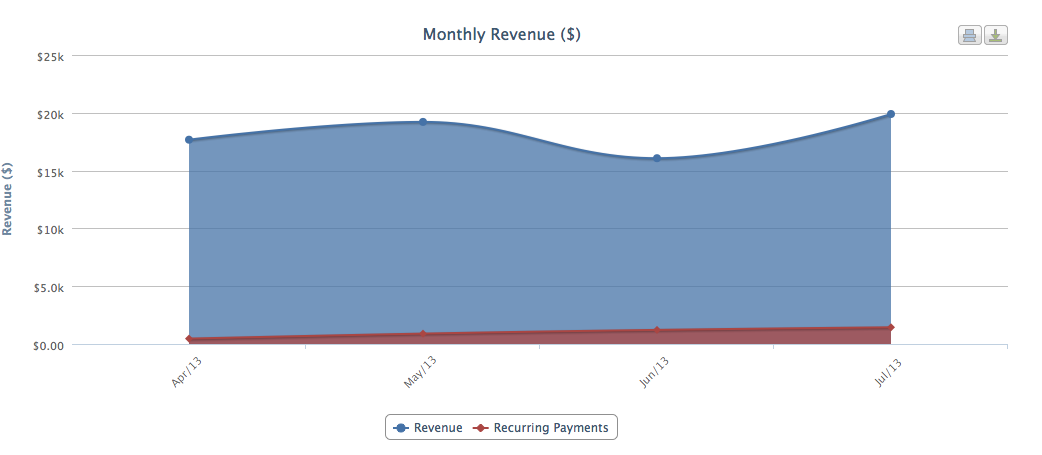
As for the Dish, only seven months into a subscription model, we’re seeing steady increases in subscriptions since the big bang of subscriptions that happened when we went independent in February. Here’s the graph for subscription revenue since the end of March:

Screen Shot 2013-08-01 at 5.38.57 PM

We still have the tough problem of getting all our original January – March 2013 subscribers to renew next year, since we couldn’t put you on auto-renewal when we launched the new site because we were still on the Daily Beast platform, and we had yet to develop the full subscription system that is now in place for all new Dishheads. So the beginning of next year may be a little nerve-wracking – even though I’m pretty confident that our earliest strongest supporters are the most likely to renew of anyone.

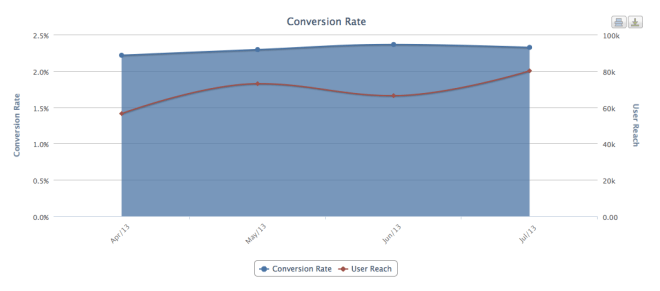
As for total revenue, we’re now at $736k toward our original goal of $900k by next February 1 ($900k being the total budget we had at the last year at the Beast). If subscriptions keep coming in at the current rate, we look set to come close. Conversion rates (the percentage of total readers who choose to subscribe) look pretty steady too at around 2.3 percent, a smidgen higher than the industry average:
Screen Shot 2013-08-01 at 5.45.24 PM

The total number of subscribers is now 28,271 as of 5.45 pm today. 11,000 more of you are now on expired meters – having used up all your read-ons. If you all decided to [tinypass_offer text=”subscribe today”], we’d be able to make some serious, solid plans for future investment in the site. So [tinypass_offer text=”please do”]. If you’ve clicked through to the max on all your devices, you really are a Dishhead. The cost is only $1.99 a month or $19.99 a year as a minimum. And if more of you [tinypass_offer text=”subscribe”], we may even be able to avoid advertizing altogether – meaning more signal and less noise to your website.

Subscribe [tinypass_offer text=”here”]. It takes [tinypass_offer text=”two minutes max”]. And [tinypass_offer text=”help shift”] the direction of new media toward quality rather than ad-driven pageviews.