Shadows Of The Fallen

The Fallen

A powerful and impressive project:

In a tribute to International Peace Day (September 21st), British artists Jamie Wardley and Andy Moss of Sand in Your Eye took a team of 60 volunteers to Normandy beach over the weekend to sketch the outlines of 9,000 soldiers figures into the sand. The installation was created to commemorate the people who lost their lives on June 6th, 1944 and is appropriately titled “The Fallen 9,000.”

According to design website Colossal, what started with the artists and 60 volunteers grew to an effort including 500 local residents who jumped in to help after seeing what was going on.

More images here.

The Courageous Friends We Are Abandoning, Ctd

Afghan Janis Shinwari served as an interpreter for the US Army for seven years. George Packeer deplores the revocation of Shinwari’s visa:

There are thousands of cases of Iraqis and Afghans who risked their lives for the U.S., only to have their chance at an American visa endlessly delayed or denied. Shinwari’s story struck me as particularly unjust, because of his extraordinary record of service, and because he had actually received his visa a few weeks ago, only to have it revoked on Saturday, just after he had quit his job, sold all his possessions, and was preparing his family to start a new life in Virginia.

It’s a maddening feature of these cases that life-changing determinations are made by unknown officials operating under the cloak of the empty but omnipotent phrase “national security.” No one is even sure which agency of the U.S. government has made the decision. Afghans (and Iraqis) are left to face death threats and despair in their own country without a clue as to the reason they’ve been left behind. It’s a little like being arrested and imprisoned without knowing the charge or ever appearing before a judge.

Recent Dish on visas for Iraqi and Afghan allies here.

From Tweet To Tsunami

Kevin Drum traced one of this week’s biggest memes – “the media is hopelessly biased because it treated Wendy Davis’ abortion filibuster more sympathetically than Ted Cruz’s kinda-buster on Obamacare” – to its source:

A guy in Kentucky with 187 followers on Twitter [responding to Jennifer Rubin] got retweeted by Laura Ingraham, and by the next morning his tweet had morphed into a media bias meme that went viral. Congratulations, Chad! You won the Internet today. Isn’t social media remarkable?

Treated Like An Intellectual Virus

The way in which Catholic Providence College first invited, then dis-invited, now re-invited the scholar John Corvino has been an almost gratuitous piece of gracelessness. You can read his account here of the various d0wnright discourteous snubs of him, and the transformation of what was first a lecture followed by questions and answers, into a talk with a respondent and now into a full-scale debate. The Provost apologizes to everyone for the kerfuffle, apart from the gay man, who is handled with what appear to be tongs of disdain. John writes:

Yesterday a friend asked me how I was doing, and I responded that the media attention was exhausting. “Yes,” he pressed, “But how are you doing? You were uninvited to speak. That seems hurtful, even if not intentionally personal.”

The truth is that it’s difficult not to feel as if the Providence College administration regards me as a sort of virus, which might infect students if not blocked by some administration-approved surgical mask. This feeling is sadly familiar, to me and to any gay person. It is the malaise of the closet, the notion that some features of oneself are unspeakable. I am the Other. And if I feel that way, I can only imagine how young gay, lesbian, bisexual, or transgender Providence College students must feel. It is for them that I remain most concerned.

And it is for them that he should seize this opportunity and give the argument of his lifetime.

Words Hidden In Plain Sight

This embed is invalid


Kyle Vanhemert shares a new typeface designed to be unreadable by character-recognition software:

Optical character recognition, the same stuff that Google uses to scan the world’s books, can turn real, physical documents into more grist for the data mill with astonishing accuracy. Sang Mun, a designer who has previously worked with the NSA during his time in the Korean military, came up with a clever way to fight back: He made a typeface that’s unparsable to computers, but legible to human eyes.

ZXX, as the typeface is called, comes in four flavors, each exploiting a different weakness in existing OCR tech. The “Camo” style obscures letterforms with camoflage-style blobs. “Noise” splatters them with digital graffiti. “X’ed” just lays a big, crisp X over each letter, and “False” adorns each letter with another tiny, secondary letters. With each–or better yet, a mix of them all – Mun shows how it’s still possible to print a message that can’t be snooped on by some camera peeking over a shoulder.

The GOP’s Declaration Of Total War On Our System Of Government, Ctd

Beutler thinks the Republicans’ demands are designed to produce “a bunch of campaign fodder”:

What’s missing [from the GOP’s demands] are the big ticket items they don’t actually want to vote for in a real legislative negotiation. Medicare privatization. Chained CPI. Those didn’t make the cut. Instead, it’s all stuff they want and stuff they know some Democrats have a hard time opposing. If they send a bill like this over to the Senate — there’s reason to believe this bill won’t clear the House — it looks an awful lot like Dems will be able to strip all of the riders using the same majoritarian process they’re currently employing to hive Obamacare defunding off of the government spending bill. That will require asking vulnerable Dems to vote against things that might cause them problems in their states.

Steinglass asks why Republicans taking the economy hostage is more acceptable than Democrats doing so:

If either party can take advantage of this sort of doomsday threat, it should be clear that neither can. To underline that fact, Mr Obama ought to counter the Republican threat not to raise the debt ceiling, with a threat of his own to veto a raise in the debt ceiling. Republicans may demand the postponement of Obamacare in exchange for a debt-ceiling hike. Mr Obama can demand passage of an immigration-reform bill including a path to citizenship in exchange for a debt-ceiling hike. … [T]he whole idea that Mr Obama would threaten to tank America’s credit rating and the global economy in order to achieve his legislative agenda is just nuts. Whereas Republicans, well, you just have to expect them to pull that sort of stunt, because…because why again?

Can Polls Of Iranians Be Trusted?

Trita Parsi says yes, and that Iranians are actually far, far more enthusiastic survey participants than Americans are:

To wit, some key points from a recent poll:

59% of Iranians expressed hope that President Rouhani would improve Iran’s relations with the international community.

And that data point would seem to back up what Parsi had to say about Iranians’ feelings about Syria:

In Iran, those who would support Bashar al-Assad’s removal from power if it would end the Syrian crisis outnumber those who would oppose it 37% to 21%. Counting only those who expressed an opinion, nearly 60% would favor Assad’s removal to end the crisis. … [And less] than one third of Iranians approve of their government’s economic support for the Assad regime while one quarter disapprove.  While those Iranians who disapprove of Bashar al-Assad’s handling of the Syrian uprising outnumber those who approve of it 25% to 24%.

However, only 13% of those polled believed Assad was behind the chemical weapon attacks, while more than half remained undecided or not sure.

The UN Won’t Harsh Your Mellow

Keith Humphreys answers questions about international law as it applies to pot legalization:

Is the U.S. currently in violation of the UN treaties it signed agreeing to make marijuana illegal? No. The U.S. federal government is Kush_closea signatory to the treaty, but the States of Washington and Colorado are not. Countries with federated systems of government like the U.S. and Germany can only make international commitments regarding their national-level policies.

Constitutionally, U.S. states are simply not required to make marijuana illegal as it is in federal law. Hence, the U.S. made no such commitment on behalf of the 50 states in signing the UN drug control treaties.

Some UN officials believe that the spirit of the international treaties requires the U.S. federal government to attempt to override state-level marijuana legalization. But in terms of the letter of the treaties, Attorney General Holder’s refusal to challenge Washington and Colorado’s marijuana policies is within bounds.

So when are we going to grasp the real weed and start the debate to repeal or amend that silly treaty? I guess when most of our current Senators are dead.

Compromise Is A Conservative Virtue

c37617-6

Jon Rauch delivers a reality check:

Playing hardball in politics is not unhealthy. Hardball is often necessary and important, and many who complain about it should pay more attention to getting better at it. Madison’s framework does not require or desire that individuals should all be moderates. But to valorize hardball for its own sake is unhealthy, and even more unhealthy is to veto a compromise simply because it is a compromise. There is no contradiction between compromise and political principle, or at least no necessary contradiction. Nor is compromise at odds with constitutional principle. Just the reverse: Compromise is the most essential principle of our constitutional system. Those who hammer out painful deals perform the hardest and, often, highest work of politics; they deserve, in general, respect for their willingness to constructively advance their ideals, not condemnation for treachery.

No one is saying, of course, that anyone should support anything only because it is a compromise, any more than that he should oppose something only because it is a compromise. The point, rather, is that compromise is a republican virtue. It endows the constitutional order with stability and dynamism. It not only tempers the worst in us; it often brings out the best. It is patriotic, not pathetic, and it deserves to be trumpeted as such.

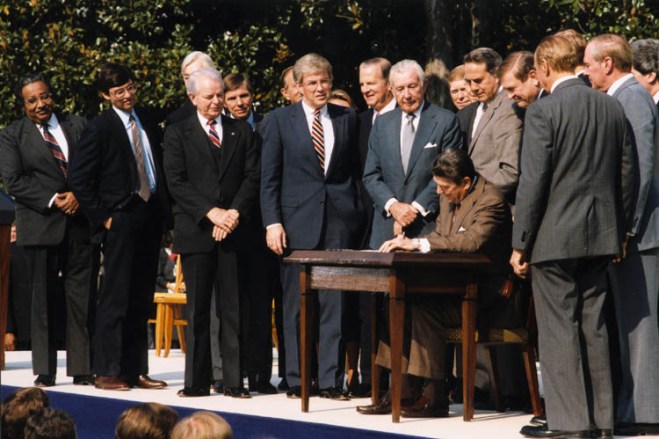
A reminder of a president the Tea Party would despise if he were currently in office:

The enactment of Reagan’s monumental tax cuts in 1981 caused huge deficits, forcing both parties to scramble to hold them in check. The next year Democratic and Republican negotiators from Congress and the White House reduced deficits by cutting spending and increasing revenue. Democrats urged Reagan to allow a three-month delay in a tax cut scheduled for 1983 as the price of them agreeing to spending cuts. He accepted that, but refused a demand that he reduce the cut from 10% to 5%. Reagan said, “you may make me crap a pineapple, but you won’t make me crap a cactus.”

The final deal was a carefully balanced package of provisions that one side or the other detested. The essence of compromise is giving up something you care about to gain something else more important. Reagan understood this, but he realized that his supporters would understand that in compromising he had not turned his back on his ideals.

(Photo via Wiki: “Referred to as the second of the two “Reagan tax cuts” (the Kemp-Roth Tax Cut of 1981 being the first), the Tax Reform Act of 1986 was also officially sponsored by Democrats, Richard Gephardt of Missouri in the House of Representatives and Bill Bradley of New Jersey in the Senate.)

Praying On Their Feet

Justin Hawkins finds constructive Christian engagement with the world to be at the heart of Ronald H. Stone’s new intellectual biography of Reinhold Niehbur and Paul Tillich, who “were far from the bespectacled, portly library-dwellers one might suspect”:

[T]he fact that Christian theology has much to say to the practical affairs of the world is an unmistakable facet of Stone’s narrative.

And though one might reasonably disagree with the substance of either Niebuhr or Tillich’s theological systems, they knew quite acutely that the exigencies of their day required them to plumb the resources of the Christian faith in response. Even more impressively, they did not make religion subservient to previously-determined political convictions, a charge which might legitimately be leveled against many political activists today. As an example, Niebuhr, when convinced that the pacifism required by his Christian socialist party membership was neither wise nor Christian, resigned his membership and his prominent standing there.

Niebuhr and Tillich knew the Christian faith was more than merely a private affair; indeed, one might perhaps even say that they overemphasized the communal, social aspect of the faith (one anecdote hold that H. Richard Niebuhr once had to remind his brother that “Individuals are sinful too, Reinhold!”). But the notion that religion is what one does when alone in one’s room was beyond their comprehension, and that for good reason. If Christ is involved in “making all things new,” then good, faithful Christians might disagree about the substance of that revivification of creation (as Tillich and Niebuhr occasionally did), but they cannot hold that God’s redemption of the world necessarily excludes certain portions of society.