Lauding Auden

Alexander McCall Smith considers why W.H. Auden’s poetry endures:

Auden had an ear for the rhythmic possibilities of English – at one dish_auden time or another he used virtually every metre available to a poet writing in English. It is the syllabic verse, though, that he consistently used for so many of his later poems that has the strongest and most consistent appeal. It appears effortless – rather like the steady flow of a clever lecture – but it is really very skilfully constructed and has an extraordinary capacity to resonate with the reader.

Yes, we think. This is exactly how it is. This is true.

There is also an intense humanity about Auden’s poetry. He comes across as a man of great sympathy, kindness and understanding. He is forgiving; he knows that we are rather weak, frightened creatures, afraid of the dark, but we need not be frightened, he says, because we can create for ourselves the just city for which we yearn. In his earlier work, he believed that this could be done by political engagement. He travelled to wars, to Spain and to China, witnessing the unfolding tragedies of fascism and militaristic aggression. Later, though, he eschewed politics and became something of a Horatian poet, celebrating the importance of the local, the domestic, the personal domain of culture. In that sense, there are several different Audens and one can take one’s pick according to one’s mood and needs.

Not to mention Auden’s great contribution to our understanding of Christianity in modernity. In that area, I believe, the power of his intellect has yet to fully sink in.

Previous Dish on Auden here, here, and here.

(Photo via Wikimedia Commons)
Saint Stephen The Ironist, Ctd

Do yourself a favor and watch at least part of this epic Catholic throwdown between Stephen Colbert and Jack White. I’m as appalled by White’s misunderstanding of the Immaculate Conception as I am by Stephen’s total FAIL on the Ascension and the Assumption. (Not to brag, but I was highly competitive in this quiz, but then I was a very precocious Catholic kid in a Protestant high school.) Enjoy:

A Catholic reader writes:

I am so glad you brought up Stephen Colbert’s impact on American Catholicism. He is one of the most significant reasons as to why I have not left the Church entirely.

My non-Catholic husband has always been confused as to why I still identify with a religion most closely associated in the media with bigotry and child rape. When he insisted years ago that we not raise our future children Catholic, I couldn’t help but agree that I did not want any child of mine raised in the atmosphere of judgment and exclusion that seems to permeate the Church hierarchy. When we discussed Stephen Colbert, however, it was the first time he was able to see that Catholicism could be good and beautiful. And now, with Pope Francis, he has actually been willing to reconsider the Catholic Church as a possibility as we wait for the birth of our first child.

I know my faith should be strong enough to thrive without examples like Stephen Colbert. But when you have doubts, and there are no admirable people to learn from or follow (especially the leadership of your faith), what do you do?

You watch Comedy Central religiously, that’s what you do.

Face Of The Day

Boehner, House Leaders Speak To Press After Republican Conference Meeting

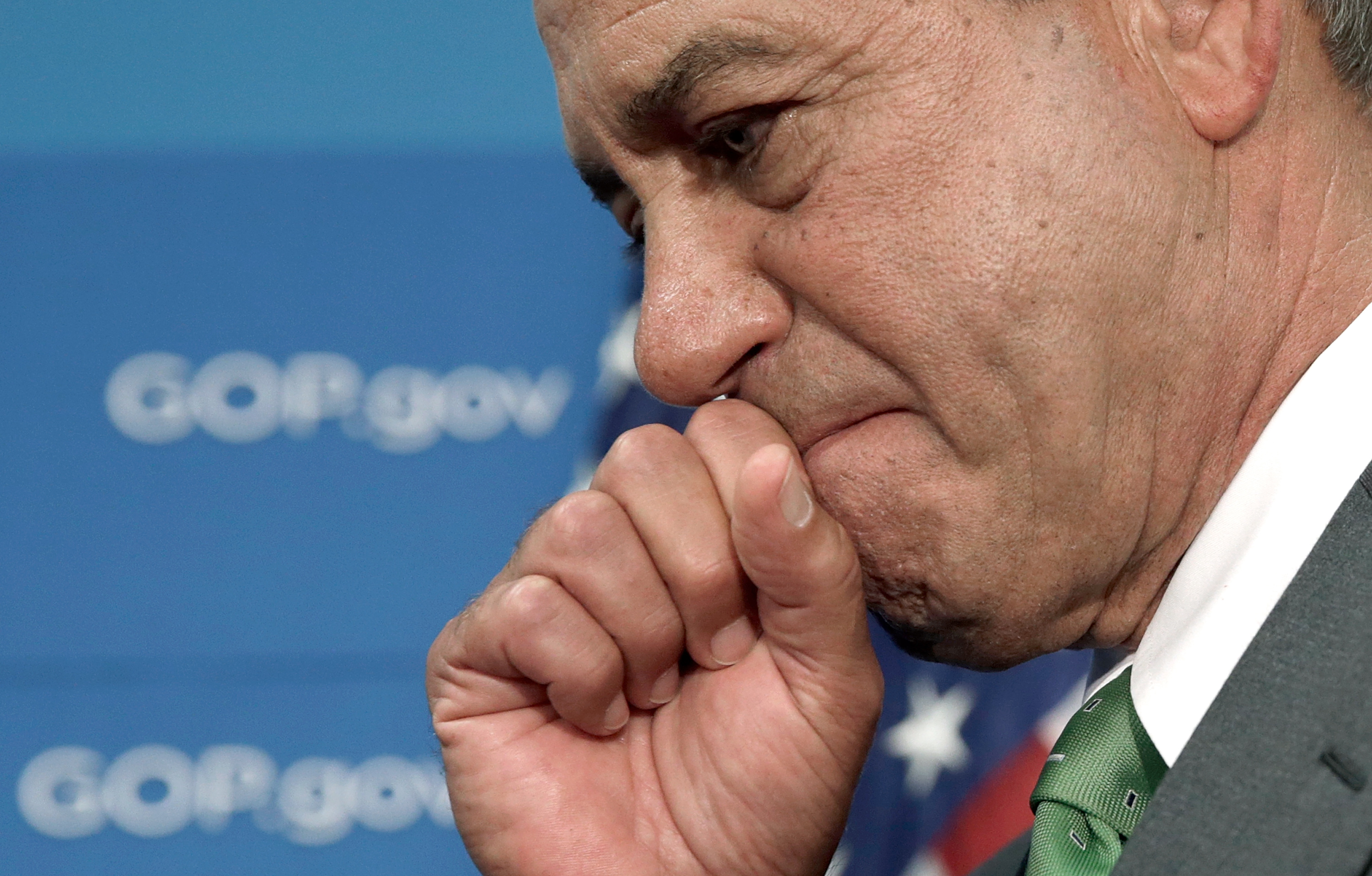
U.S. Speaker of the House John Boehner listens to House Republican colleagues speak at a press conference at the U.S. Capitol September 26, 2013 in Washington, DC. Boehner signaled that he is urging Republican colleagues to remain flexible in negotiations to avert a governmental shutdown when federal funding runs out next week. By Win McNamee/Getty Images.

What The Obamacare Skeptics Are Saying

Suderman puts a negative spin on the Obamacare premium numbers:

The White House is happily declaring that the premiums are “lower than expected.” And multiple news reports on the numbers are following suit, running headlines on the “lower than expected” premiums coming under Obamacare.

But “lower than expected” is, of course, not the same as lower than they are currently. That’s not the comparison the administration wants to make. “Because of the Affordable Care Act, the health insurance that people will be buying will actually cover them in the case of them getting sick. It doesn’t make sense to compare just the number the person was paying, you have to compare the value people are getting,” HHS official Cohen told the Journal. Accordingly, there are no comparisons in the report to current premiums. All that lower than expected really means, then, is that premiums won’t go up as much as the Congressional Budget Office initially estimated.

But surely today’s bare-bones health insurance premiums give an individual far, far less care than even a bronze-level Obamacare policy. It really is apples-to-oranges. And, of course, that’s counting those young people who already have bare-bones insurance, while so many have none at all. And aren’t the subsidies going to make them affordable? Avik Roy claims not:

Remember that nearly two-thirds of the uninsured are under the age of 40. And that young and healthy people are essential to Obamacare; unless these individuals are willing to pay more for health insurance to subsidize everyone else, the exchanges will not serve the goal of providing coverage to the uninsured.

Ramesh adds:

Costs are lower than expected — not lower than they were. They’re way higher than Obama promised: Families were supposed to save $2,500 in premiums, you may recall.

The White House’s response to these types of complaints:

White House spokesman Jay Carney said [yesterday] that contrasting insurance premiums before and after Obamacare is not an “apples-to-apples” comparison. Why? Because “it’s an apple full of worms compared to an apple that’s fresh and delicious,” he said, referring to the mandated benefits and guarantees attached to post-Obamacare plans.

Methinks he needs a better analogy. And the Obama administration needs much better messaging, or the Party of Sabotage will strike again to prevent any attempt at universal coverage at all.

Neocon FAIL Update

SYRIA-CONFLICT-NUSRA

Remember the debate the Iraq War alliance of neoconservatives and liberal interventionists wanted over Syria? Either we back democratic forces ousting Assad or we are complicit in mass-murder. As with Iraq, they wanted no debate about what might happen after Assad was gone, because that might prompt memories of what happened the last time a Baathist dictator fell in a country riven by sectarianism.

And they were always a little hedgy when it came to the nature of the forces fighting Assad. They ignored the deep sectarian grievances (as they did in Iraq); they spoke of “democracy” as an alternative, even as the exile groups and the Free Syrian Army were unable to muster the kind of intensity and fighting skills of Sharia-law Sunni Jihadists. And now, just a few weeks after the neocon-liberal interventionist chorus demanded we aid the rebels as quickly as possible, we discover the following:

11 rebel groups issued a statement [Tuesday] declaring that the opposition could be represented only by people who have “lived their troubles and shared in what they have sacrificed.” Distancing themselves from the exile opposition’s call for a democratic, civil government to replace Mr. Assad, they called on all military and civilian groups in Syria to “unify in a clear Islamic frame.” Those that signed the statement included three groups aligned with the Western-backed opposition’s Supreme Military Council … “We found it was time to announce publicly and clearly what we are after, which is Shariah law for the country and to convey a message to the opposition coalition that it has been three years and they have never done any good for the Syrian uprising and the people suffering inside,” said [Mohannad al-Najjar, an activist close to the leadership of one of the statement’s most powerful signers, Al Tawhid Brigade].

So Leon Wieseltier and Christiane Amanpour were unwittingly arguing only a couple weeks ago for giving arms to groups increasingly indistinguishable from those determined to impose Sharia law in Syria. It took several years for the errors of that very same pro-war coalition to realize that their equally admirable goals in Iraq were completely overtaken by reality (and I was one of them). It has taken just a couple of weeks for the same kind of brutal reality to bite in Syria.

Can you imagine the pickle we’d be in right now if we’d been aiding the opposition for as long as John McCain wanted? In a civil war, the extremists always gain the upper hand. And we’d have given serious arms – even indirectly – to forces bent on the most brutal methods of Jihad.

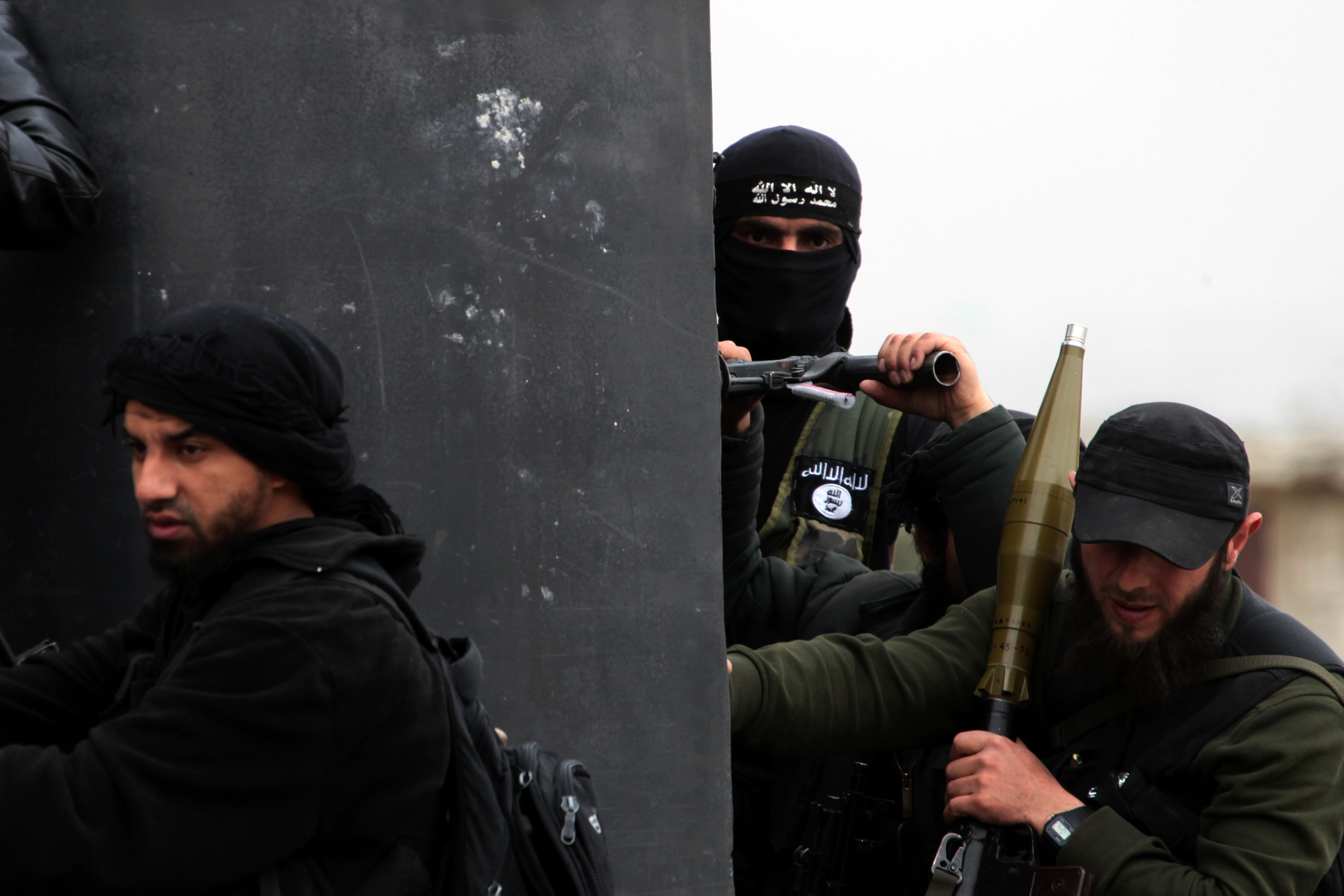
(Photo: A Turkish fighter of the jihadist group Al-Nusra Front, bearing the flag of Al-Qaeda on his jacket (C-back), holds position with fellow comrades on April 4, 2013 in the Syrian village of Aziza, on the southern outskirts of Aleppo. By Guillaume Briquet/AFP/Getty Images.)

Rouhani’s Holocaust Bullshit

What the Iranian president said in his interview with Amanpour:

“I have said before that I am not a historian, and that when it comes to speaking of the dimensions of the Holocaust it is the historians that should reflect on it … But in general I can tell you that any crime that happens in history against humanity, including the crime the Nazis committed towards the Jews, as well as non-Jewish people, was reprehensible and condemnable as far as we are concerned.”

Fisher analyzes:

For some in the West, Rouhani’s condemnation of the Holocaust was a remarkable step forward from 10 years of Ahmadinejad, and a significant gesture from a president who still has to answer to the hard-line supreme leader, Ali Khamenei, no friend of Israel and ultimately Rouhani’s boss. For others, though, his apparent deferral to Holocaust revisionists was a sad reminder of the degree of hostility toward not just Israel but Jews entrenched in the Iranian political system – and a sign that Rouhani is still of that system.

Marc Tracy accuses Rouhani of perpetuating Holocaust denial:

Imagine that a company or some other kind of organization with a history of believing that the world is flat appoints a new CEO who is more open to alternative beliefs about the shape of the world. “The world is not flat,” he says. But he doesn’t then say: “In fact, the world is a globe with a circumference of 24,901 miles.” He says: “I don’t know whether it is a globe. Maybe it is. Or maybe it is curved. Maybe it is jagged, like one of its many mountain ranges. Maybe it dips, like a crater. Maybe it is a series of steps hurtling through the cosmos. I am not qualified to judge.” Would you say that this person has come to hold the mainstream view on the shape of the world?

But again, obviously the remark is embedded in the difficult task Rouhani has in both getting a deal with the West, while not provoking insurrection from his more reactionary, hateful colleagues in the Iranian political system. Moynihan’s view:

It’s important to remember that the skilled Holocaust denier parses, dissects, and molests language, quibbling with the word “denial”—they typically acknowledge that many Jews died, but were victims of various typhus epidemics—and wondering why shadowy forces are hamstringing dissenting historians.

Jonathan Tobin piles on:

That these stands are calculated to convince Western elites that Rouhani is a decent person while still giving him cover at home is a tribute to the cleverness of the Iranian tactic. After all, contrary to some other statements uttered during the charm offensive, there is more to Iranian anti-Semitism than just Ahmadinejad’s personal obsessions. Iranian TV often broadcasts material that merges the two topics by claiming that Jews have exaggerated the extent of the Holocaust in order to “steal” Palestine from the Arabs and hoodwink the United States out of money. Rouhani’s mention of the doubts about how many Jews died is a signal to Iranians and other Islamists that he is very much on the same page as Ahmadinejad but knows how to talk to Westerners.

How do we know that it isn’t the opposite: a signal to the West that he is very much on the same page as indisputable, mainstream history, but knows how to handle Iranian domestic factions? It seems to me that this is a more plausible explanation.

All this debate on these principles is well and good, but it’s important to remember that the test, right now, is not whether Iran’s theocracy will suddenly become like the West, but whether we can do business with them on their nuclear ambitions – and whether Rouhani can effectively deliver his far right the way Obama will have to deliver the AIPAC-influenced Congress.

The Sabotage Party

crashing-elephant-thumb

Derek Thompson worries about hitting the debt ceiling:

Besides Denmark, no other country I know of asks legislators to vote to pay for something they’ve already voted to pay for. The debt ceiling should not exist. But now that it does exist, it must be said again and again that it does not create new laws. It just affirms that we will pay for old laws. It’s not a smart scalpel for shaving the deficit, it’s a guillotine hanging over the head of the head of the country.

Even when the blade doesn’t fall, it can still have consequences. The Summer 2011 showdown that nearly resulted in default cost taxpayers $19 billion this decade in elevated interest rates as investor panic began to build. That’s the price of playing with the full faith and credit of the United States.

Just imagine what the “largest self-imposed financial disaster in history” would cost us.

Of course, I agree. Unlike today’s GOP, I actually think that fiscal conservatism means adjusting taxes and spending to lower the deficit and debt in the usual budgetary process. Unlike today’s GOP, I believe a fiscal conservative also pays the bills on loans he has already decided to spend. Call me crazy, but that’s where I am. And I sure don’t think that’s somehow not conservative.

Nonetheless, we shouldn’t get carried away and argue that the debt ceiling has never been used as political blackmail. In fact, the Democrats were the first to play this game:

In 1973, when Richard Nixon was president, Democrats in the Senate, including Sen. Edward Kennedy (D-Mass.) and Sen. Walter Mondale (D-Minn.), sought to attach a campaign finance reform bill to the debt ceiling after the Watergate-era revelations about Nixon’s fundraising during the 1972 election. Their efforts were defeated by a filibuster, but it took days of debate and the lawmakers were criticized by commentators (and fellow lawmakers) for using “shotgun” tactics to try to hitch their pet cause to emergency must-pass legislation … [Subsequently], major changes in Social Security were attached to the debt bill; another controversial amendment sought to end the bombing in Cambodia. [Political Scientists] Kowalcky and LeLoup list 25 nongermane amendments (pdf) that were attached to debt-limit bills between 1978 and 1987, including allowing voluntary school prayer, banning busing to achieve integration and proposing a nuclear freeze.

Of course, the brinksmanship now, in a still sluggish economy and with the deficit already falling fast, is playing with economic catastrophe, as Ezra notes:

Let’s say the Obama administration couldn’t get around the debt ceiling and the U.S. government could suddenly only spend as much as it received in taxes. Then outlays would have to fall immediately by 32 percent in October. That would be a huge, sudden shot of austerity and could put a big dent in the economy.

It’s also unclear what would happen if the U.S. government defaulted on a bond payment. Back in January, Michael Feroli, the chief economist of JP Morgan, told me that this scenario ”would be like the financial market equivalent of that Hieronymus Bosch painting of hell.” The global financial markets are structured around the notion that U.S. Treasuries are the safest asset in the world. If that assumption were ever called into question, havoc would ensue.

Barro isn’t sweating the debt ceiling:

Boehner knows that hitting the debt ceiling is a political disaster for Republicans. That’s why he backed down on his debt ceiling demands the last time, and the underlying political dynamic hasn’t changed.

Sometimes, Boehner is forced by his caucus’s unreasonableness to court disaster. But most House Republicans will be grateful if Boehner saves them from a debt ceiling crisis, so his speakership won’t be in danger for averting one—even if House Republicans feign outrage over his cutting a deal with Minority Leader Nancy Pelosi to do so.

Drum suspects that Obama will act unilaterally, if need be:

[I]f the debt ceiling showdown lasts more than a couple of weeks, it’s likely that President Obama will simply order the Treasury to start auctioning bonds regardless. Maybe under the authority of the 14th Amendment, maybe under his authority as commander-in-chief. Maybe he’ll declare a state of emergency of some kind. Who knows? But eventually this is how things will work out, with Obama acting because he has to, and because he knows that courts will be loathe to intervene in a political dispute between the executive and legislative branches.

(Photo by Tony Karumba/AFP/Getty Images)

Will Francis Empower Women?

800px-Tolentino_Basilica_di_San_Nicola_Cappellone_14

Sister Simone Campbell hopes so:

I must confess that I am a little nervous about what will happen. Currently there are no women in significant decisionmaking positions in the Vatican. There are few in dioceses around the world. Our church has lagged in the acknowledgment of the role of women in shaping faith traditions and as leaders of prayer. In that institutional lag, many of us in religious life and our nonvowed sisters have found ways of supporting each other. The fact is that women are leading by example and witness to the Gospel in their lives and not within the formalized power structure, and that power structure has lost out from not having significant contributions of women. It is difficult for me to believe that women in significant leadership roles would have tolerated the sexual-abuse cover-up.

The question becomes, Will Pope Francis follow through by actually including women in the decision-making as he moves ahead with reforms?

Of course I devoutly hope so, if Francis’s view of the “genius of women” reflects the actions of Jesus who, radically for his time, treated women as equals, outrageously consorted with women such as Mary Magdalen, former prostitute, sided with an adulteress over an all-male stoning squad, and even stayed overnight as a single man with his dear friends, Mary and Martha.

Women, remember, were the most loyal of all his followers. Women, not men, were at the foot of the Cross, as he died. The men were too afraid or too cowardly to be there. Women, not men, were the first to witness the resurrection. One woman, his mother, represents the apex of human acceptance of the divine in Catholic theology. No man comes close to her example.

It therefore pains me deeply that this half of humanity is still treated as some kind of second-class group in the church of Jesus. For me, the ban on female priests is simply absurd, as well as antithetical to the message of the Gospels.

Of course the tradition of a male-only priesthood is entirely a function of the social structures of the past. That’s clear when you hear the ludicrous theological argument in defense of this institutionalized sexism: the disciples were all men, therefore we cannot have women priests. Seriously, that’s it? Yep, that’s it.

The Church will not turn quickly – and it shouldn’t. But one of the great errors of the Ratzinger-Wojtila era was to insist that such matters cannot even be discussed in Catholic universities, seminaries and churches. What Francis should do first of all is allow that conversation to proceed, to explore explicit ways to include the “genius of women” in the Church that do not consign them to mere adjuncts. The Church will never treat men and women as identical – because they are not. But there must be a way to treat men and women as fundamentally equal in the eyes of God. Because

There is neither Jew nor Greek, there is neither bond nor free, there is neither male nor female: for ye are all one in Christ Jesus.

Know hope.

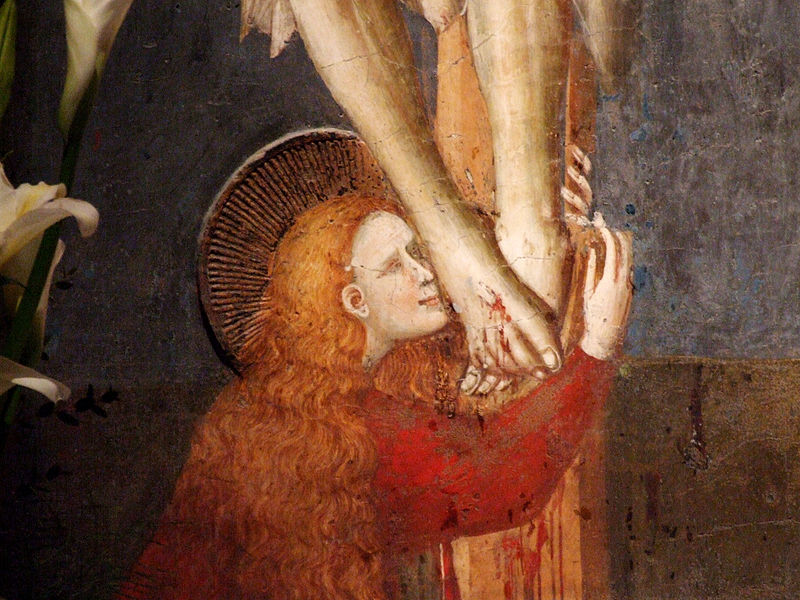
(Painting: Detail of Mary Magdalen kissing the feet of the crucified Jesus, Italian, early 14th century. Via Wiki.)