Masterpiece Lost

Toby Lichtig considers when it is acceptable to destroy works of art:

For [Lost, Stolen or Shredded author Rick] Gekoski, there are no simple answers. He considers Graham Sutherland’s portrait of Winston Churchill, a commission by Churchill’s kinkade-drone1parliamentary colleagues on the occasion of his eightieth birthday, in 1954, which the British Prime Minister despised (“it makes me look half-witted, which I ain’t”) and which was later destroyed at the request of Churchill’s wife, Clementine. Gekoski notes that Lady Churchill had form in this area, having demolished portraits of her husband by Walter Sickert and Paul Maze, and argues, unconvincingly, that the Churchills had “ample justification” for their actions because the painting was commissioned “to honour [Churchill], and it didn’t”. One wonders how the public would now react if Prince Philip decided to feed Lucian Freud’s portrait of the Queen to the Windsor hearth.

It is for quite another reason that Gekoski finds it “hard to regret the destruction of [Philip] Larkin’s diaries”, by Larkin’s lover Monica Jones – and that is because they were never “meant” for public consumption in the first place. But the real explanation is that the contents were likely to be so distasteful. There are some things, it seems, Gekoski would rather not know (the revelations about the private life of Eric Gill have “ruined” Gill’s art for him). It is easy to disagree with him on this point – surely our understanding of an author better informs the work – but Gekoski is correct that our view of Larkin “is probably more sympathetic” as a consequence, and this undoubtedly helps us to focus on the poetry. And whereas we may mourn the “extra badness” lost to history in the untold stories of Lord Byron’s incinerated memoirs, “there is nothing attractive about the extremes of the Larkinian”.

Of course some works of art, such as the Kincaid seen above, are more expendable than others.

(Illustration by Anthony Freda)

How Many Syrian Rebels Are Terrorists? Ctd

Jamie Dettmer summarizes a new report that sheds light on the question:

IHS Jane’s Charles Lister, an insurgency expert and author of the analysis, estimates that around 10,000 are jihadists fighting for al-Qaeda affiliates (the Islamic State of Iraq and the smaller Jabhat al-Nusra), while another 30,000 to 35,000 are hardline Islamists, who have less of a global jihad vision but share a focus on establishing an Islamic state to replace Assad. Another 30,000 or so are more moderate Muslim Brotherhood Islamists. He estimates that moderate nationalist fighters number only about 20,000, with the Kurdish separatists being able to field only 5,000 to 10,000. …

On his Twitter feed, Lister concedes that it is a “rough science” to estimate rebel numbers and assess their ideological coloring, but he says he has based his calculations on open sources as well as intelligence assessments, and on interviews with opposition activists and militants. He notes that while the al Qaeda affiliates don’t have the largest numbers, “they they have the most resources and best weapons, and they have very good organization.”

Eli Lake reports on fighting amongst the rebels:

The same day the United States and Russia announced a plan to disarm Bashar al-Assad of his chemical weapons, a fresh round of fighting erupted along the Syria-Iraq border. This time, it was rebel versus rebel—specifically, al Qaeda-linked rebels against the more moderate elements of the opposition. … [T]his weekend’s clashes—which came after a Sept. 12 messagefrom al Qaeda leader Ayman al-Zawahri instructing his followers in Syria not to collaborate with the FSA councils—could mark a more violent stage for the opposition’s fractured ranks.

Earlier analysis here.

Chart Of The Day

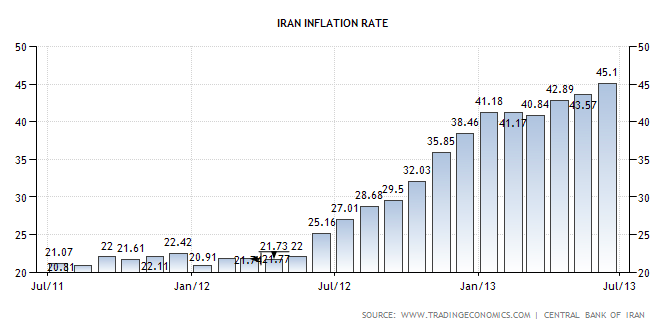
Perhaps one of the more salient factors behind Rouhani’s new outreach to the US on nuclear development:

Screen Shot 2013-09-17 at 12.21.10 PM

The sanctions have worked, the Iranian economy is in free-fall, and the regime desperately needs a better relationship with the world as a result. If the account in Der Speigel about plans for opening up Fordo for international inspection is correct, then this underlying economic crisis helps reveal that this new opening is not a function of generosity for Iran, but of dire necessity. What we have to do is be patient, listen carefully, and hope.

Israel And The NSA’s “Memo Of Understanding”

Glenn’s latest Snowden scoop from last week is a memo between US and Israeli intelligence agencies outlining a broad agreement to share information, reported to include “intercepted communications likely to contain phone calls and emails of American citizens”:

The five-page memorandum, termed an agreement between the US and Israeli intelligence agencies “pertaining to the protection of US persons”, repeatedly stresses the constitutional rights of Americans to privacy and the need for Israeli intelligence staff to respect these rights. But this is undermined by the disclosure that Israel is allowed to receive “raw Sigint” – signal intelligence. The memorandum says: “Raw Sigint includes, but is not limited to, unevaluated and unminimized transcripts, gists, facsimiles, telex, voice and Digital Network Intelligence metadata and content.” …

Although the memorandum is explicit in saying the material had to be handled in accordance with US law, and that the Israelis agreed not to deliberately target Americans identified in the data, these rules are not backed up by legal obligations.

You can read the memo here. Matthew Brodsky isn’t too alarmed by the story:

Absent is the crucial fact that the MOU lays out the terms of the sharing agreement, recognizing the need for more procedures to minimize any information on American citizens. It obligates the NSA to perform routine checks on the program to measure the quality and fidelity of the information being shared and it places a similar obligation on the Israeli Signit National Unit to identify, exclude, and destroy any information it finds about US citizens.

But, according to the Guardian, the memo allows Israel to retain “‘any files containing the identities of US persons’ for up to a year. The agreement requests only that the Israelis should consult the NSA’s special liaison adviser when such data is found”. So another government has the ability to spy on American citizens and retain that information for up to a year, and need merely consult with the NSA afterward. Effectively it fuses US intelligence with Israel’s – with respect to spying on Americans. I have to say I am not terribly thrilled by the idea of having my phones tapped by the Israelis in concert with the NSA. Joshua Foust unloads on the Guardian report, pointing out that the memo, from 2009, gives no idea of “how much, if any, American information actually gets passed along”.  He also notes the following unanswered questions in Greenwald’s story:

What the final version of this MOU says;
Whether it changed after minimization rules strengthened later in 2009;
What those “additional procedures” to minimize American citizen information are;
How much, if any, American information actually gets passed along;
What the periodic, annual reviews have said;
What the two biannual program reviews have said;
If the program is even ongoing; or
What the actual implementation of this program looks like

Still, giving this level of access to a foreign government that is, in some cases, clearly at odds with US foreign policy, seems like an awful amount of trust to me. And this reassurance does not reassure:

The truth is that the US probably did not sign a binding document with Israel with official “teeth” because it does not need to. Israel is on a very short list of countries which receive massive intelligence information from the NSA. If Israel abuses the relationship, the US can just turn off the faucet. The one extra-legal scenario which still would likely not be covered would be where the NSA is winking at Israel to look under a rock which the NSA itself is not allowed to check.

The View From Your Window Contest: Winner #171

Screen Shot 2013-09-14 at 4.43.27 AM

A reader writes:

It looks to me like the view of Holy Cross in Worchester, MA. I’ve never been to the campus, but the picture reminds me of what I’ve seen from the MA Pike when driving by.

Another:

I can’t fine the exact location, but this looks a lot like Charlottesville, Virginia. Tons of red brick.

Another:

Kansas City, MO? Took my first trip to Missouri this past June. The foliage and rolling hills sure bring that to mind.

Another:

Seattle, Washington? My guess is based on the Four Seasons Cleaners, with the coastline nearby.

Another:

It’s obviously the US, thanks to the RVs. All the Four Seasons Cleaners that came up on Bing were on the West Coast, except for one in Pittsburgh, so Pittsburgh it is.

Another:

Looking at the picture, I was immediately struck by how much it reminded me of the view from the hospital window when my twins were born 13 years ago. From there it was a simple matter of Googling “Four Seasons Cleaners” in the general vicinity.  That was two hours wasted. Turns out I wasn’t even close.

By then I was invested, so I peered at the picture. I could make out that the “For Lease” sign on one of the buildings said “Martens Real Estate.” A quick Google search told me that Martens is a commercial real estate firm operating in Topeka and Wichita Kansas. They have their listings online, so it was a simple matter to go through their listings looking for a building that matched the one with the for lease sign. Finding nothing, I Googled “Four Seasons Cleaners” in Topeka and Wichita. Another two hours wasted.

However, for reasons that are known only to Google, searching for “four seasons dry cleaning Topeka” returned Four Seasons Dry Cleaning of Northwest Arkansas. They have three locations, and the first one is the one shown in this picture of Fayetteville.  Google Street View showed me the Arvest sign on the building across the street, the Arvest website gave me the address: 75 N East Street. (Google Street View also told me it’s Mathias Real Estate, not Martens!)

Very close, but another reader gets the exact location:

Wow! I thought you guys were giving us an easy one this week with the name of a Four Seasons Cleaners in clear text. But do you know how many freaking Four Seasons Cleaners there are?

Lots! I tried all sorts of Google searches – cleaners near bakeries, near a “Bob’s Photography” (another clear text that resulted in NOTHING! (thanks a lot!)). Nada, zilch, zero, time wasted, etc.

Finally, I tried to see if there was a web site for the cleaners and sure enough, I found the store in Fayetteville! Yippee! The shot was from the Chancellor Hotel on 70 North East Ave in Fayetteville, Arkansas. A place I’ve never been to. The shot is from – and I’m sure it will be the tie breaker – the third or fourth floor. Well, if I don’t win this time, at least it counts as a close and correct entry for me, no?

Actually a correct entry is only counted towards future tiebreakers if the contest is difficult – specifically, a contest with 10 or fewer correct answers. This week there were hundreds of entries for The Chancellor. A reader send a view of the hotel:

hotel

Another reader:

The Chancellor Hotel has quite the history! Construction began in 1978, originally a Hilton Inn when construction was completed in 1981, and renamed as a Radison in 2001. The hotel has a long standing association with the University of Arkansas. It shares access with a pair of University facilities and is popular with visitors to the University. The Chancellor has survived several now failed hotel development projects in the area. The most recent renovation was in 2011, a massive update of the landmark building.

Another sends an aerial view of the area:
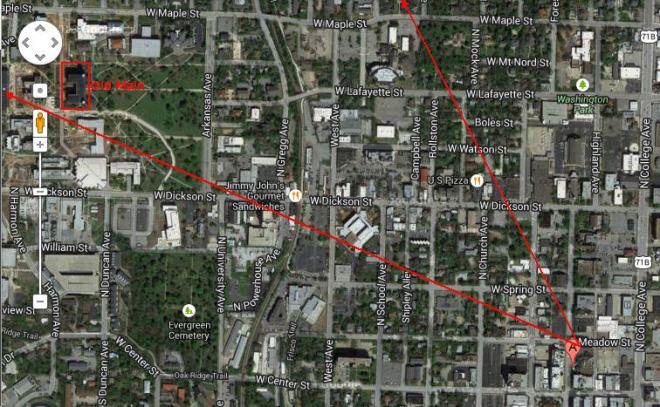
Fayetteville_overhead

Another reader:

This view was taken from the 9th floor of The Chancellor Hotel in Fayetteville, AR, from a window facing north. I think this is my second time guessing but it’s the first time I’m really certain about the city and the hotel. Thank you to the source who gave us so generously The Four Seasons Cleaners. I came to the contest late this time because of Yom Kippur. Maybe you made it easier this week because you knew your Jewish readers would need a break. I appreciate it.

Another:

I can’t believe I almost missed this one because of a three-day weekend!  I saw it when I got up this morning but forgot that today is Tuesday and was almost too late!

Any student from the University of Arkansas Screen Shot 2013-09-17 at 12.27.05 PMat Fayetteville will instantly recognize the uneven towers of Old Main, the original building of the University.  The easily recognizable buildings from campus easily put us East of the University.  My first instinct was nearby Mount Sequoyah, but when I googled Four Seasons Cleaners or bob’s photography, I realized it was too far.  Fortunately, street view made this one pretty easy once I got that far.

As a Fayetteville native, I’ve never stayed at the Chancellor Hotel (or in its former incarnations as the Radisson Hotel or the Cosmopolitan Hotel), but I’ve had to go for a few meetings in the past.  I have no idea how other people can tell which floor or window, but I’ll guess it has to be one of the north-facing windows on about the 6th floor, probably the westernmost one.

It’s also worth noting that, luckily for everyone looking for this window, Google updated their images for Fayetteville in May this year.  It might have been a bit trickier with the old images, which were more than a couple of years old.

Another:

The VFYW contest has been eerie in that a number of recent views have been of places where I misspent various parts of my youth. On the chance that the contest is a front for a round-up of miscreants with dubious travel patterns, I’ve dialed back participation. But since this view actually includes a former abode, hidden there among the trees just below the window, I felt compelled to at least throw in a howdy-do:

VFYW Fville

I doubt I have enough difficult solves to my credit to give me a win. And that cleaners sign will make this an easy one, beyond all the Arkies who’ll recognize the view immediately. For tie-breaking precision, I’ll take a guess and say this is the corner room on the fifth floor.

It’s actually the seventh floor – room 708 to be exact. No one guessed the correct room, but many guessed the correct floor. Only two of those readers have correctly gotten a view in the past without yet winning. One of those Correct Guessers has participated in eight total contests, but the following reader edges him out with ten:

You’ll probably receive a lot of correct guesses this week because the “Four Seasons Cleaners” is such an easy landmark for a Google search. Or perhaps your readership includes quite a few fans or alumni of the University of Arkansas. I have no local knowledge, so count me in the Google column.

The photo was taken from The Chancellor Hotel at 70 North East Avenue, Fayetteville Arkansas, looking northwest towards the University of Arkansas. I believe the photo was taken from westernmost window on the north side of the seventh floor. (The westernmost window would be farthest to the right as you look at the north face of the hotel.) I don’t know the room numbering system in the hotel, so I cannot guess the exact room.

I’ve had several correct guesses in the past, but have yet to win. Hope springs eternal that all of the better (or more prolific) guessers will eventually win their books and finally clear the way for me.

Wait no longer!

(Archive)

And Then There Were Six

President Obama's Official Visit To Israel And The West Bank Day One

Given Syria’s public agreement to sign the Chemical Weapons Convention, it’s worth looking at the rogue countries who remain outside this norm. There are six of them, many highly predictable: Angola, North Korea, South Sudan, and Burma. Then we come across two startling exceptions: US allies, Egypt and Israel. As president Obama has said, almost 98 percent of the world’s population live in countries who have signed the Convention. But of the six countries representing 2 percent of the world’s population, two continue to receive military aid from the US.

How credible is it for the US to take such a strong stand against the possession and use of chemical weapons – even threatening war – while actually sending aid to two non-compliant countries? Could not further military aid to those countries be premised on full acknowledgment of their stockpiles and a commitment to their destruction? If not, why not? And I do not mean with respect to the interests of Israel; I mean with respect to the interests of the United States.

And if we are also about to go head-to-head with Iran over its nuclear program, how bizarre is it that Israel’s arsenal of nuclear warheads be completely ignored as well?

After all, one of Iran’s strongest arguments for developing nuclear weapons is deterrence against Israel. If we could insist on Israel’s decommissioning of its nukes, wouldn’t our case be much, much stronger with Iran? And wouldn’t a successful outcome render Israel’s multiple nukes redundant?

There is, of course, no way the Israelis will give up their nukes or chemical weapons (the Israelis treat such international conventions as definitionally not applying to them) – but the US president has every right to note and criticize the possession of such stockpiles, especially as we are decommissioning them right next door in Syria.

Or to put it another way: Why are the standards for Israel so much lower than for Assad?

(Photo by Marc Israel Sellem-Pool/Getty Images)

Ready For The Next Government Shutdown? Ctd

Collender sees little chance for compromise because the “budget fight isn’t really about the budget: It’s about ObamaCare”:

It’s one thing if the debate is just about coming up with a spending cap or deficit limit. If, for example, one side wants spending at $20 and the other wants $10, there should be some number between those two that eventually will make a deal possible. But what happens when, like now, the budget is the legislative vehicle but the real debate is over something else entirely?

What Cohn is hearing:

[A]ccording to a somebody who speaks with both the White House and Democratic leadership in Congress on a regular basis, even backroom talks have stopped. “The breakdown is more extensive than you’ve heard,” this person told me. “There is no discussion going on at all at this point.” I asked the source how this breakdown compares to the state of discussion prior to the other confrontations.

“Nobody knows how this will end,” the person said. “I’m not sure I remember a time when sides were as far apart as this.”

Earlier shutdown speculation here.

Men Aren’t Making The Grade

Percent Degrees Females

Christina Hoff Sommers worries about the higher-education gender imbalance:

Women in the United States now earn 62 percent of associate’s degrees, 57 percent of bachelor’s degrees, 60 percent of master’s degrees, and 52 percent of doctorates. College admissions officers were at first baffled, then concerned, and finally panicked over the dearth of male applicants. If male enrollment falls to 40 percent or below, female students begin to flee. Officials at schools at or near the tipping point (American University, Boston University, Brandeis University, New York University, the University of Georgia, and the University of North Carolina, to name only a few) are helplessly watching as their campuses become like retirement villages, with a surfeit of women competing for a handful of surviving men.

She wants America to wake up:

Young men in Great Britain, Australia, and Canada have also fallen behind. But in stark contrast to the United States, these countries are energetically, even desperately, looking for ways to help boys improve. Why? They view widespread male underachievement as a national threat: A country with too many languishing males risks losing its economic edge. So these nations have established dozens of boy-focused commissions, task forces, and working groups. Using evidence and not ideology as their guide, officials in these countries don’t hesitate to recommend sex-specific solutions.

(Chart from the Department of Education (pdf))

How Important Is Process?

Tomasky wants more focus on results:

Washington is a place where most people care far, far more about process than results. The reasons for this should be obvious. The process is the game. It’s what is ongoing and visible, so it’s the part that people get to judge and assess and gossip about and declaim on. And most people love to make snap judgments, and the more dramatic the better, because that gets you more hits and tweets and so on. I suppose I’m hardly immune to this, being a little cog in this machine myself, but at least I have the ability to step back and observe it and see that it exists and understand that I’m a part of it.

So what happens is, these narratives (Syria is a disaster) get etched into the stone during the process part of the story, before the result even happens.

But McArdle argued last week that judging the process is valid:

Human beings tend to judge failure or success by outcome, rather than process. It’s an easy heuristic, but as in so many things, the easy way out is often disastrous. Having unprotected sex with a short-term partner isn’t a good idea just because you didn’t get pregnant last month, and neither is launching a space shuttle with faulty O-rings because hey, the shuttle didn’t explode last time. In an uncertain world, good decision-making heuristics sometimes have bad outcomes (people get pregnant even if they are using birth control perfectly); bad decision-making heuristics sometimes — maybe even often — produce perfectly fine results. A doctor or nurse who doesn’t wash his or her hands consistently will usually not kill the patient. But failing to wash your hands consistently will kill many patients every year.

It Was Assad

U.N. Report on Chemical Attack in Syria by Robert Mackey

This embed is invalid


The UN’s report on the use of chemical weapons in Syria is above. Fisher observes that, while “the investigation was barred from assigning blame, a number of details in the report seem to strongly suggest that the government of Syrian leader Bashar al-Assad was likely responsible.” Among other evidence:

The U.N. investigators analyzed 30 samples, which they found contained not just sarin but also “relevant chemicals, such as stabilizers.” That suggests that the chemical weapons were taken from a controlled storage environment, where they could have been processed for use by troops trained in their use. This would seem to downplay the possibility that the chemical weapons were, as some speculated, fired by rebels who had stolen them from government stockpiles.

Moses Brown likewise thinks the evidence points to the Assad regime:

You have claims the attacks were faked, the victims being Alawite hostages from Latakia, that were somehow driven through hundreds of miles of contested and government controlled territory to Damascus.  There’s claims that this was some sort of accident involving Saudi supplied chemical weapons, which fails to explain how one incident could effect two separate areas.  Other claims centre around the opposition having sarin, based off reports in Turkey in May, where it was reported Jabhat al-Nusra members were arrested with sarin.  The “sarin” was later reported to be anti-freeze, and only this week some of the members are being prosecuted for trying to make sarin, having only a shopping list of ingredients, rather than actual sarin.  It seems to me, that compared to the evidence of government responsibility for the attacks, the evidence of opposition responsibility seems very poor.

Peter Bouckaert is on the same page:

The various theories claiming to have “evidence” that opposition forces were responsible for the attack lack credibility. This was not an accidental explosion caused by opposition fighters who mishandled chemical weapons, as claimed by some commentators online. The attacks took place at two sites 16 kilometres apart, and involved incoming rockets, not on-the-ground explosions. This was not a chemical attack cooked up by opposition forces in some underground kitchen. It was a sophisticated attack involving military-grade Sarin.

C.J. Chivers weighs in:

Put simply, viewed through a common-sense understanding of the limits and conditions of the battlefield, the rebels could not have done this. Claims of rebel culpability are now specious; technically and tactically implausible, they are too outlandish for even a sci-fi script.

Drum adds:

Added to all the other intelligence pointing in the same direction, there’s really no longer any case to be made that this was some kind of false-flag rebel operation. It was a chemical weapons attack mounted by the Assad government.