Why Russia Resists American Wars

Michael Crowley gets inside Putin’s head:

Less widely understood than Putin’s concerns about Iraq, Syria and Libya is his anger over U.S. actions closer to his borders. Putin believes America helped defeat a Moscow-backed candidate in Ukraine’s 2004 presidential election, partly by sending millions of dollars to pro-democracy activists there. He hated George W. Bush’s courting of the former Soviet republic of Georgia, where a U.S.-backed president was defying Moscow’s longtime influence. (After a 2008 military clash between Russia and Georgia, McCain declared that “today, we are all Georgians.”) And he surely remembers well the U.S.-led NATO bombing campaign in the 1990s—which Russia also bitterly opposed—that led to the ouster of Serbian leader Slobodan Milosevic.

“If you look at events over the past 20 years from the Kremlin’s perspective, you see a consistent pattern of U.S. and western behavior amounting to a policy of regime change across Eurasia,” says Matthew Rojanksy, director of the Kennan Institute at the Woodrow Wilson Center.

“Putin asks, if Washington can use force to topple regimes in Iraq, Afghanistan, or Libya, and can sponsor regime change by other means in Serbia, Georgia, and Ukraine, why wouldn’t Belarus or Kazakhstan or even Russia itself be next? Putin has to draw his own red line, and Syria is a good place to start doing so.”

Dmitri Trenin makes related points:

I think Putin believes that an inertia can be created that would lead to progressively more and more U.S. actions around the world which might collide at some point with Russia’s core interests, to use a Chinese expression. They want to stop the use of force by the United States outside of the U.N. Security Council framework. They’re trying to keep a hold on the use of force internationally.

Where’s The Line On Intervention?

A reader writes:

I have watched a bit of Anderson’s new show, and I am so excited to see you on as a regular guest. The revelation for me so far (with my limited viewing) is Christiane Ahmanpour. I’ve not known her as an opinion journalist, but she is quite compelling to watch. Might I add that she is not the least bit intimidated by her male counterparts at the table, which I love. I saw a clip of her very emotional appeal for Syrian intervention (which, by the way, I think is perfectly fine as long as it is coupled with the kind of intellectual heft and reflection that someone like Ahmanpour can bring to bear), and I think it raises a legitimate question that I have posed here before. Where is the moral line for humanitarian intervention? Does a situation have to reach Holocaust proportions or are we talking Srebrenica before we act?

America is arguably the world’s only superpower. There are obligations that come with that privilege, and we now live in an era in which that is simply not a welcome burden thanks to the abuses of the Bush/Cheney years. Why am I not hearing this obligation being debated? Isn’t there a line out there that we don’t want crossed for myriad reasons? Where is that line?

Christiane’s passion is admirable and I respect her enormously. But of course, our decision matrix on whether to intervene to stop moral atrocities has to take into account the cost, context, and consequences of such a decision every time we approach it. The impulse to intervene in Somalia was a decent and good one, for example, just as Christiane’s impulse to stop these horrifying attacks is a good and decent one. But it led to a military and strategic disaster which forced us to leave in a hurry. Ditto the moral impulse to save tortured children in Saddam’s Iraq. But does the gravity of the crime matter? Of course it does, as Reuel Marc Gerecht pointed out.

To be honest, as a function of being on vacation when the attack happened, I did not experience the shock that many experienced in real time. That may have made me seem more callous than I am. I also have to say that the images of the slaughter I subsequently watched affected me deeply, as they would anyone with a heart or soul. I shifted a little because of it. But I insist nonetheless that unless there is a way to prevent that kind of horror without intervening in Syria’s civil war, we shouldn’t intervene. Maybe Obama’s “unbelievably small but not a pinprick” strike could do that, and I was open to persuasion. But now that Assad has caved on that specific issue with no missiles fired, the issue for me now is moot. If he attacks with poison gas again, we may have to reassess.

There is no eternal line defining when or when we should not intervene in these circumstances. We have to judge each incident as it occurs. Christiane and I have different judgments about that. It’s up to readers and viewers to decide which one makes the most sense to you. That’s the messy way we do it in democracies – but it’s better than any moral “red lines” without any practical consideration of the costs involved.

Dead Children As Talking Points, Ctd

SYRIA-CONFLICT

A reader writes:

The card Obama didn’t play“?  Then what does this passage from Obama’s national address mean?

But when, with modest effort and risk, we can stop children from being gassed to death and thereby make our own children safer over the long run, I believe we should act.

It certainly isn’t as brazen as “fight em there so we don’t fight em here,” but it’s a difference of degree and emphasis, not kind.

I don’t care about the arguing over whether Obama bumbled here or there, and it’s tilting at windmills for me to be offended by using the good old “it’s for the children” emotional manipulation. But Obama still hasn’t explained how this enforcement of international norms is going to be upheld with some targeted bombings. In a specific way, this reminds me of the Bush justifications for Iraq: throw out every justification you can, see which one people will buy, and pretend that was the real reason all along.

Another reader:

I get Fallow’s point about using the emotionally-charged imagery of murdered children as talking points, but when it comes to Obama, I honestly doubt this is some mere political strategy. It seems to me that, as with gun control and Newtown, nothing so affects Obama as the murder of children. I think of his statement after Newtown and how raw and emotional he was.

His adoration for his own children can’t be denied, and a simple Google search can return a myriad of pictures of Obama interacting with children. Sure, these are photo ops, but time and again you can see an easiness, something that the aloof Obama doesn’t always achieve easily with adults.

He likes kids. I think above all things he considers himself a father. I think the preventable harm of children motivates him above all else. So I don’t think these are mere talking points to him.

I don’t either. But it should not have overwhelmed his strategic sense. Tough, I know. Almost inhuman. But that is what a moral man in an immoral society sometimes has to accept.

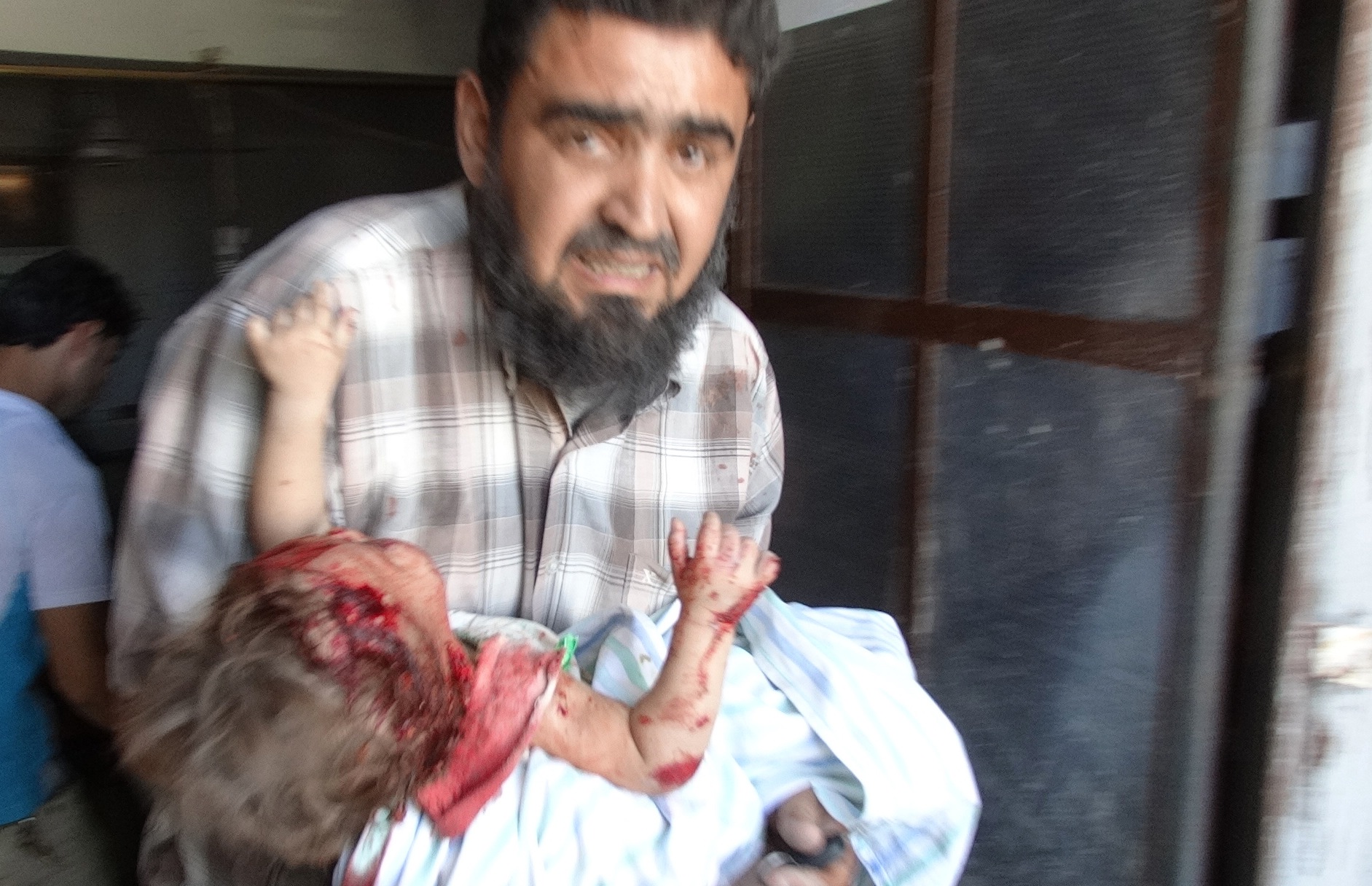
(Photo by Abu Amar Al Taftanaz/Getty. It was our Face of the Day last Thursday, a reminder that the Dish hasn’t looked away from the heartbreaking violence in Syria.)

Hathos Alert

Alexander Nazaryan also face-palms:

In 1930, future Nobel Prize winner William Faulkner published As I Lay Dying, a multi-vocal novel about the death and burial of a matriarch. Some eighty years later, Yale graduate student James Franco decided to make a film from that novel. Inevitably, a movie tie-in version of the novel would be reissued. That was expected. The look of that reissue, however, was not.

“Syria Is Not A Country” Ctd

A reader writes:

Wow. You’ve really dug yourself into a deep hole. The country of Syria was given its name by the Greeks before Alexander, and aside from its shifting borders, Syria has remained constant from Greek toRoman to Umayyad to Abbasid to Ottoman to Arab to French to Syrian rule. There 655px-mpk1-426_sykes_picot_agreement_map_signed_8_may_1916as even a Syrian Roman emperor in 244. If Syria isn’t a country, then neither is Turkey, the UK, or any other country. A few seconds on Wikipedia or with the classics confirms all this, with ancient maps of Syria that are as close to modern Syria as is Sykes-Picot’s or T.E. Lawrence’s maps. Compare the map of Roman Syria from the first century BC to the 19th century map of Ottoman Syria. Aside from Palestine, they’re the same province, which is now the same country.
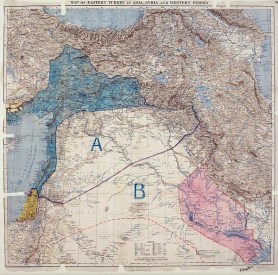
And the theory (which is yours) that the Ottomans gave the minority Shia and Christians “pools of self-governance” and that modern Syria “was precisely constructed to pit a minority … against the majority” is all absurd non-history. Both the Ottomans and the French protected their minority sects, but neither gave them self-governance or control over the majority. The straight line you draw from Sykes-Picot to brutal al-Assad rule does not exist. What’s more, and ironic for your argument, the very name of the al-Assad family comes from Hafez’s father’s opposition to modern Syria! The Syrian military coups that happened 40 years later that ultimately led to Alawite dominance have nothing to do with Sykes-Picot.

There are of course excellent reasons to avoid a foreign entanglement in a sectarian civil war, but unfortunately you’ve badly mangled history and logic to make this point.

It is not “absurd non-history” to note that modern Syria is comprised of a complex mix of extremely different sectarian and ethnic groups who have fought each other for a very long time, and that under French colonial rule, the Alawites were the favored sect. In independent Syria, the Alawites gained real power especially through the military, and ran the country under the Assad dynasty as a deeply sectarian, Shi’a force against the majority Sunni. That also explains their alliance with Iran, the region’s major Shiite power, if you don’t include post-Saddam Iraq. That dynamic means that Syria as a modern state is inherently unstable, unless sectarian identity recedes (fat chance after two years of brutal civil war), and was designed to be inherently unstable. Again, my point was not that Syria is not a name that was attached to the entire region, but that as a unitary state, in its current borders, it is a colonial contraption unfitted to multi-sectarian self-government.  Another informed reader:

I have a Ph.D in anthropology and spent decades working in Syria both with archaeological projects (for fun) and as a researcher in social anthropology studying contemporary society in Syria. I was also a Fulbright Fellow there. Anyway, I have not only read immense amounts of Middle Eastern history but lived at archaeological projects out in the Syria Jazeera as well as done ethnographic research in Damascus. I stumbled on this insight as a grad student (and as some one who had to take long-haul buses around the country). I largely agree with your post on Syria.

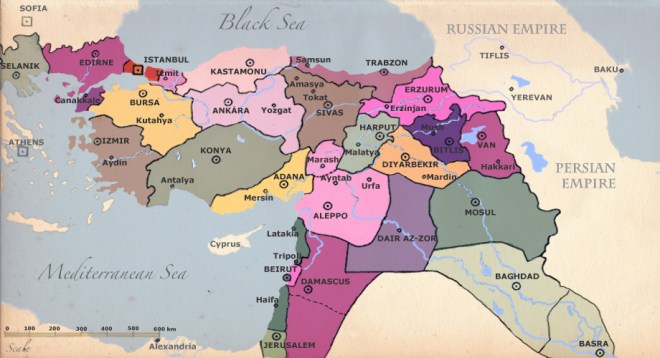
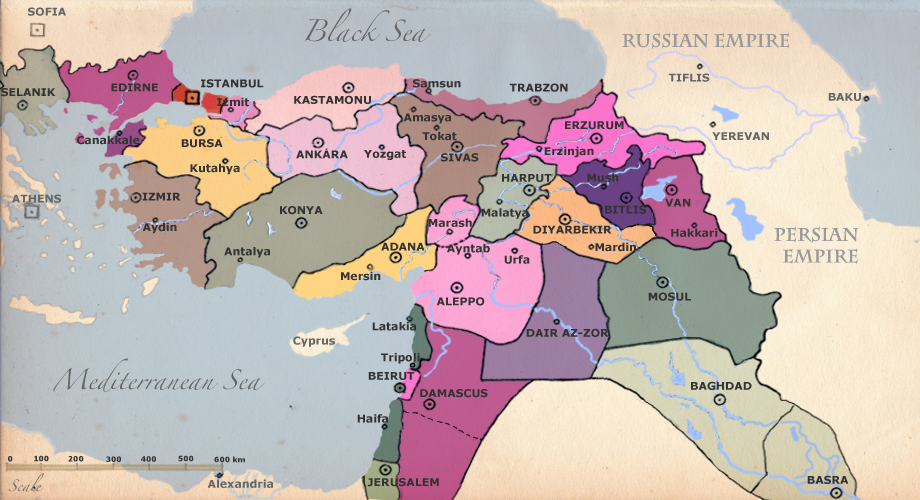
Any potential natural “nations” (of course, all nation states are largely imaginary) of the Middle East can best be found in the old Ottoman provinces, which were much more closely aligned with communities of common interest than the Sykes-Picot nation-states. Of the course the Brits/French pissed all over those separations and alliances. Which is the problem.

You should get some true Ottoman scholars to chime in – I am not an Ottoman expert. Also, it’s hard to find a good online map with the detail needed. Perhaps unsurprisingly, the best I found is from an Armenian advocacy group which has a vested interest in understanding the administrative units of the Ottoman Empires:
Mapa_osmanian_empire_22_02

But the Ottomans ran a big empire and the provinces were created to make administration easier. So they tended to fall along natural lines of communication with rivers, mountain passes, changes in elevation or whether or not the land was agricultural or only suited for grazing determining what was part of one province and what areas belonged to another. The Ottoman Empire was in existence for a long time and the provincial borders were fluid and changed over time and were often subdivided into smaller units and these sub-units often had governors drawn from the local population. So the province of Mosul was always quite independent, more likely than not to have locals in administration. Before naval power made control of harbors key, the Ottoman province of Basra might have had a local Arab leader. Once the British peeled away Kuwait in 1899 when it became a protectorate, then Basra became more important to the Ottomans and had rulers sent directly from the capital.

Anyway, the Sikes-Picot treaty collected the Ottoman provinces of Basra, Baghdad, and Mosul into Iraq. Just the part of Mosul that possibly had oil made it into Iraq. Much of its hinterland was sliced away and left in what would become Syria. What is now northeastern Syria – and seems to be largely under the control of the Syrian Kurds at the moment – largely traded with Mosul and Aleppo to the east and west with some trade down the Khabur river to Deir-ez-Zor. These are areas that have been linked by trade since the empires of ancient Mesopotamia! These areas have always contained tremendous ethnic and religious diversity (Arab Sunni Muslim, Arab Shia Muslim, Chaldean and Assyrian Christian, Jews – of both Arab and Kurdish ethnicity – Armenian Christians, Yazidis, as well as tribal structures that often divided and reunited these areas in surprising ways) but the natural landforms united these areas as trading partners. You can see this in the patterns of the Akkadian and Babylonian Empires as well as in the route of the Berlin-Baghdad Railroad!

Notice the southern part of the route with stations in Aleppo, Nusaybin, Mosul, Baghdad, then Basra. That’s the unit in which common economic interest and trade patterns allowed diverse populations to work together. That’s what Sikes-Picot cut apart. Notice also that Damascus, Jerusalem, Beirut, Latakia are not part of that economic/trade cluster at all. Damascus (es-Sham) and its immediate countryside was cut off from the broader territory that made up the Ottoman province of es-Sham by Sikes-Picot too. Even in the 1990s, many more buses ran each day from el-Hasake to Aleppo than from el-Hasake to Damascus, and the bus would only fill up after reaching Deir-ez-Zor.

The Ottoman provinces make more sense because pre-modern limits of communications divided the territories not European interests. The diversity of the population within the Ottoman provinces were often able to work together peacefully because they shared a common economic interest. Sikes-Picot severed and distorted those ties. One quick example, the division of Nisibis, an ancient and prosperous city, into the Turkish city of Nusaybin and the Syrian city of Qamishli. Read its history. The idea that Turkish or Syrian nationalism is strong enough to pull this city apart into two nations is laughable. Yet an international border divides it.

The terror (and the hope) of the civil war in Syria has always been that the country would come apart and with it the punishing dividing lines of Sikes-Picot.

That may be necessary for the Middle East to recover from the toll of colonialism. But it will take a lot of time and probably a lot of blood. It seems insane to me that a distant super-power should be involved in mediating something we cannot even begin to fully understand, let alone control. That fact alone buttresses the case for leaving it to its own devices.

Update from a reader:

I’ve been following the debate with interest. It seems to me that is the perfect opportunity to have someone who REALLY knows this history weigh in. In particular my good friend Scott Anderson, author of Lawrence in Arabia: War, Deceit, Imperial Folly and the Making of the Modern Middle East, currently on the NYT bestseller list. Scott has fascinating stories to tell, as the many amazingly great reviews have noted [here, here, here].
Why Syria Could Be Another Iraq

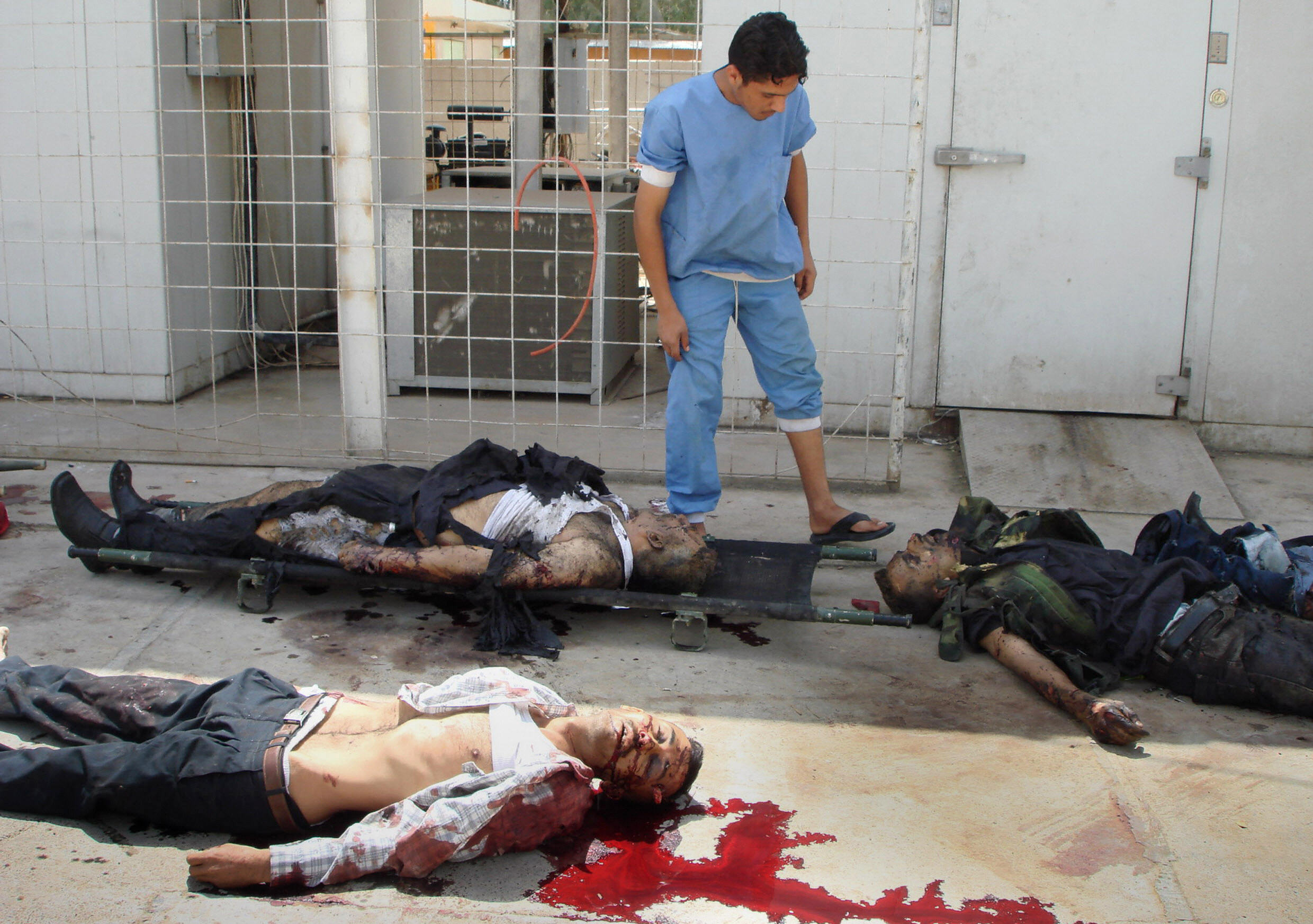
An Iraqi hospital worker inspects burned

Robert Kaplan considers the parallels:

The supporters of robust military intervention are not sufficiently considering how things could become even worse after the demise of dictator Bashar al Assad, with full-scale anarchy perhaps in the offing; how Assad might still serve a cold-blooded purpose by containing al Qaeda in the Levant; how four or five steps ahead the United States might find itself owning or partially owning the situation on the ground in an anarchic Syria; how the American public’s appetite for military intervention in Syria might be less than they think; and how a long-term commitment to Syria might impede American influence in other regional theaters. The Obama administration says it does not want a quagmire and will avoid one; but that was the intention of the younger Bush administration, too.

He admits that “each war or intervention is different in a thousand ways than any other” and that “Syria will unfold in its own unique manner.” But he can’t help but see the similarities:

[A] happy outcome in Syria usually requires a finely calibrated strategy from the beginning. The Bush administration did not have one in Iraq, evinced by the absence of post-invasion planning. And, at least as of this writing, the Obama administration seems to lack one as well. Instead, it appeared until recently to be backing into a military action that it itself only half-heartedly believes in. That, more than any of the factors I have mentioned above, is what ultimately gives me pause.

The key issue to me is what plan do we have for the demise of Assad? None, so far as I can see. Bob is absolutely right to see anarchy as the most logical result.

And it’s truly outrageous for unrepentant supporters of the Iraq war to make the very same mistake as they did last time – not thinking through the full consequences of action. If you remove a Shiite dictator who has run a brutally sectarian regime against a Sunni majority – after the kinds of atrocities we have seen so far – you will get a cycle of massive revenge. You will get ethnic cleansing of the Alawites; mass murder of Christians; and appalling violence. In that climate, Sunni Jihadists will thrive. I simply cannot see how any political resolution is possible in a country designed to make such resolutions impossible. Which is why, not deposing or helping to depose Assad is, it seems to me, the least worst option for the foreseeable future.

And this is the conservative position. History matters; culture matters. You cannot by force of arms undo decades of history or centuries of religious conflict. We saw that so plainly in Iraq. And yet some seem criminally blind to it now – and dare to call themselves conservatives.

(Photo: An Iraqi hospital worker inspects burned bodies outside the morgue of a hospital in the restive Iraqi city of Baquba, northeast of Baghdad, 23 April 2007. The victims were killed when a bomber exploded his car near the city council building, killing four policemen, police Lieutenant Ahmed Ali from Baquba said. The attack wounded another 25 people, many of them policemen, he added. By Ali Tueijri/AFP/Getty Images.)

Was Matthew Shepard’s Murder A Hate Crime?

In today’s video, Stephen Jimenez, author of The Book Of Matt: Hidden Truths About the Murder of Matthew Shepard, considers the role that homophobic hatred played in Matthew Shepard’s murder and whether the brutality of the crime is consistent with other cases of meth-related violence:

A reader counters a previous one:

The gratuitous brutality of the torture and murder is more consistent with anti-gay violence than most drug-related violence – at least in this country. These things should be acknowledged first and last.

This is exactly the issue with these hate crime laws. They make it not about the torture and murder, but about the motivation. If gratuitous brutality, torture and murder are the problem, we have enforceable laws for that. Putting together the specious correlation above, and then using the moral weight borrowed from the claimed correlation to justify the thought-crime, it’s utterly backwards. Hate is a sin, but it cannot be a crime. Justice cannot be objective if it is asked to judge souls, and it must be objective; it’s too corruptible otherwise.

We saw with the Trayvon Martin case the problem we get into when the criminal code ends up resting on what story people attach to the facts. There are always other stories that can be fit on. If we care about the law, we can’t let it rest on something as thin as motivation.

Another:

Regarding the reader who said he was done with you over the Jimenez videos, I can understand where he is coming from; I can feel the pain and fear that the unspoken circumstances surrounding the horrific murder might change opinions about Matthew.

The fact is, a lot of people expect victims to be perfect or else their victim status is suspect, like the idea of rape not being rape if the woman is wearing a short skirt and thereby “asking for it.” And the reader’s fear will probably be right for a percentage of those getting the fuller picture. Adding drugs and bisexuality can negate empathy, especially for those uncomfortable with those issues in the first place.

However, nothing will ever get better if we don’t live with reality as it is. Matthew’s history leading up to his death does not change the fact that his murder was horrific and should never have happened. As much as I understand the reader’s perspective, keeping the truth hidden is not the answer. The reason I subscribe and usually check this blog several times a day comes from the fact that you do deal with reality, showing more than one side or perspective on the topics you cover. I may not always agree, but I sure enjoy the debate.

The Book Of Matt comes out September 24 and you can pre-order it here. Kirkus’ summary of the book:

An award-winning journalist uncovers the suppressed story behind the death of Matthew Shepard, the gay University of Wyoming student whose 1998 murder rocked the nation. Jimenez was a media “Johnny-come-lately” when he arrived in Laramie in 2000 to begin work on the Shepard story. His fascination with the intricate web of secrets surrounding Shepard’s murder and eventual elevation to the status of homosexual martyr developed into a 13-year investigative obsession. The tragedy was “enshrined…as passion play and folktale, but hardly ever for the truth of what it was”: the story of a troubled young man who had died because he had been involved with Laramie’s drug underworld rather than because he was gay.

Drawing on both in-depth research and exhaustive interviews with more than 100 individuals around the United States, Jimenez meticulously re-examines both old and new information about the murder and those involved with it. Everyone had something to hide. For Aaron McKinney, one of the two men convicted of Shepard’s murder, it was the fact that he was Shepard’s part-time bisexual lover and fellow drug dealer. For Shepard, it was that he was an HIV-positive substance abuser with a fondness for crystal meth and history of sexual trauma. Even the city of Laramie had its share of dark secrets that included murky entanglements involving law enforcement officials and the Laramie drug world.

So when McKinney and his accomplices claimed that it had been unwanted sexual advances that had driven him to brutalize Shepard, investigators, journalists and even lawyers involved in the murder trial seized upon the story as an example of hate crime at its most heinous. As Jimenez deconstructs an event that has since passed into the realm of mythology, he humanizes it. The result is a book that is fearless, frank and compelling. Investigative journalism at its relentless and compassionate best.

Steve’s previous videos are here and here. Our full video archive is here.

Republicans Are Holding America Hostage Again

The House GOP is demanding that, in order to fund the federal government and raise the debt ceiling, Democrats agree to defund Obamacare. Chait contextualizes the threat:

Boehner isn’t proposing to attach a perfunctory debt-ceiling hike to “bipartisan solutions,” as has happened in the past. He is proposing that the opposition party extract unacceptable conditions as the price of lifting the debt ceiling. That is an unprecedented demand. Under the Bush presidency, Democrats objected that tax cuts had created [an] unsustainable fiscal position for the government, but it never even occurred to them to threaten to trigger a debt default to force Bush to repeal his tax cuts. Before 2011, the debt ceiling was an occasion for posturing by the out-party and was sometimes raised in conjunction with mutually agreeable policy changes, but the opposition never used the threat of default as a hostage.

Ezra hopes that House Republicans will opt for a government shutdown rather than a default on the nation’s debt:

If the GOP needs to lose a giant showdown in order to empower more realistic voices and move forward, it’s better that showdown happens over a government shutdown then a debt-ceiling breach. A government shutdown is highly visible and dramatic, but it won’t actually destroy the economy. So an “optimistic” case might be that there’s a shutdown for the first few days of October, the GOP gets creamed in public opinion, the hostage-taking strategies of the party’s right flank are discredited, and Washington is at a much better equilibrium by the time the debt ceiling needs to be raised.

And yes, I realize that naming that tornado of lunacy the “optimistic” outcome is enough to make anyone pessimistic about the state of American politics. Good. You should be pessimistic about the state of American politics.

Barro notes that Republicans could defund Obamacare if they didn’t care about the consequences:

Establishment Republicans point out that the “defund Obamacare” strategy is doomed. If Republicans shut down the government over a demand that Obamacare be defunded, they’ll become hugely unpopular, and then they’ll eventually “have” to reopen the government on Democrats’ terms, with Obamacare still going into effect and more money being spent across the government than Republicans could have otherwise demanded.

But why does becoming hugely unpopular mean you have to fold? If House Republicans are really and truly willing to die on the hill of defunding Obamacare, they can do it. Nobody can make them bow to popular opinion and pass a continuing resolution that funds Obamacare implementation. House Republicans can shut down the government all the way to January 2015 and force a default on government bonds if they have the resolve to do so. They would tank the economy and lose the 2014 elections in the process, but the important victories do not come without costs.

Cohn focuses on the Republican leadership:

Conservatives seem determined to provoke a crisis, whether it’s over funding the government past September 30 or increasing the Treasury’s borrowing limit. If that happens, Boehner will face a choice. He can stand by while government services and the economy suffer—or, as Greg Sargent recently suggested, he can “cut the Tea Party loose, and suffer the consequences.” Yes, the consequences might include Boehner losing his job as speaker. Those are the kinds of risks real leaders take, in order to serve the public.

Yglesias expects crisis the pass but not before much damage is done:

[E]ven under that relatively rosy scenario where nothing shuts down and nobody defaults on any payments we’re talking about a protracted months-long period of political crisis that could badly hurt consumer confidence and other areas of the economy.

Sponsored Content Watch

Screen Shot 2013-09-12 at 2.12.42 PM

A reader writes:

Huff post currently has a sponsored post about PRO-natural gas. They are always posting anti-natural gas stuff on the website, and that’s clearly where they stand. But they still accepted sponsorship for something that goes against their supposed values.

Maybe that’s a brilliant new ad strategy: take a position, unnerve your opponents, and then get them to pay you to run their views in a form that looks almost exactly the same as regular editorial copy. The only flaw in this strategy is running your own position in the first place without getting money for it. Maybe the next phase of sponsored content will go to the next level: websites entertaining bids for paid “articles” for any point of view whatsoever. Then you can let the editorial staff go. The business side can always manage the pro and con paid pieces … and would anyone notice anyway?

Do Syrians Support A Strike?

YouGov finds little reason to believe so:

More opponents of the regime strongly disapprove of a U.S. military strike than favor it. 81 percent of government supporters, as well as 56 percent of those who prefer not to say. There’s little evidence that ordinary Syrians favor an attack.

In fact, distrust of America is nearly unanimous among Syrian poll-takers. Only 7 percent of those interviewed thought that the U.S. government was “a friend of the Syrian people.” There wasn’t much disagreement on this point among supporters and opponents of Assad. 79 percent of supporters, 61 percent of opponents and 57 percent of non-aligned said the U.S. was “an enemy of the Syrian people.”