Clarity Through Dark Comedy

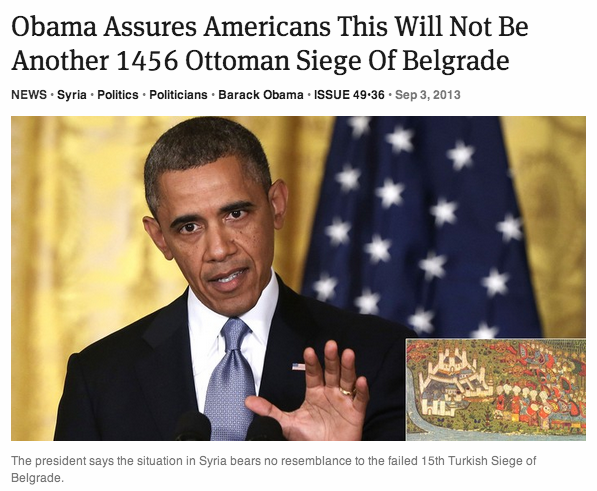
Screen Shot 2013-09-11 at 4.26.50 PM

Kabul-based journalist Tom A. Peter contends that The Onion has published some of the best commentary on Syria in recent weeks:

It can be exasperating playing it straight when you write news about a situation that regularly produces absurd scenarios. The Onion’s format allows its writers to plainly make sense of ridiculous situations that can be difficult to explain or fully appreciate in a normal news article.

During many of the trips I made into Syria, I met conservative people who supported the insurgents who used to fight Americans in Iraq, yet these same people were now calling for the same U.S. soldiers they wanted to kill six or seven years ago in Iraq to come to their aid with an intervention in Syria. Meanwhile, as of at least March, the CIA has been compiling a list of targets for potential future drone strikes inside opposition-controlled Syria, according to the Los Angeles Times. The Onion managed to explain this dark, complicated reality in just one fake headline: “Target Of Future Drone Attack Urges American Intervention In Syria.”

Head writer Seth Reiss discusses the site’s approach:

I think one thing we have tried to do with our content is humanize the Syrian people. For example, this piece isn’t calling for U.S. intervention so much as it’s saying that these are people with mothers and fathers and sons and daughters who, obviously, value their lives and relationships. It would be too easy and doing a disservice to the issue to stake out some sort of hardline resolute position i.e. “We should not intervene!” or “We should intervene!” It’s murkier than that. And in that murkiness there is comedy. Dark comedy, but comedy nonetheless.

(Screenshot from this Onion story. Recent Dish on the satire site here.)

Assad’s Terms

In an interview about the destruction of Syria’s chemical weapons, Assad declared that, “When we see the United States really wants stability in our region and stops threatening, striving to attack, and also ceases arms deliveries to terrorists, then we will believe that the necessary processes can be finalized.” Ezra focuses on Assad’s demand that America stop arming the rebels:

Assad is demanding the U.S. choose between its goals of enforcing the ban against chemical weapons and getting Assad out of power.

Right now, Assad’s got the upper hand in Syria’s civil war. The U.S. could change that in two ways. One is directly bombing Assad’s military assets. The other is aggressively training and arming the opposition — something we’re really only just beginning to do.

The discussion around the Syria disarmament deal has mostly focused on defusing the U.S.’s threat to bomb Assad. But what Assad is saying here is that’s not good enough: The U.S. also needs to stop arming his enemies. That means the real cost of destroying Assad’s chemical weapons is watching him crush the opposition and retain power.

“Syria Is Not A Country”

That phrase passed my lips last night on “AC360 Later”, in a heated and, I thought, really interesting discussion. I was pounced on as prejudiced or misinformed or even channeling neoconservatism. So I thought I’d take this opportunity to explain what I mean by that.

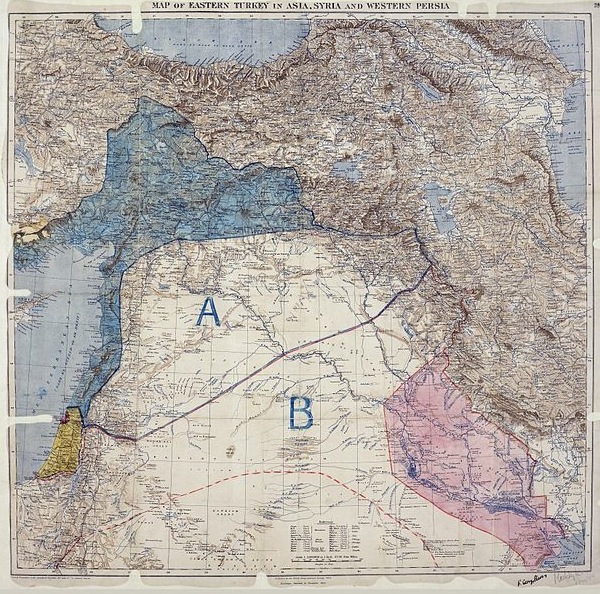
Syria as we now know it was created by one Brit, Mark Sykes, and one Frenchman, Francois Georges-Picot in 1920. Originally, it included a chunk of Iraq (another non-country), but when oil was discovered there (in Mosul), the Brits wanted and got it. With that detail alone, you can see how valid the idea is of a Syrian “nation” is. Certainly no one living in Syria ever called the shots on the creation of the modern 655px-mpk1-426_sykes_picot_agreement_map_signed_8_may_1916state. More to the point, it was precisely constructed to pit a minority group, the Shiite Alawites, against the majority, Sunni Arabs, with the Christians and the Druze and Kurds (also Sunnis) as side-shows. Exactly the same divide-and-rule principle applied to the way the Brits constructed Iraq. But there they used the Sunni minority to control the Shiite majority, with the poor Kurds as side-kicks again.
You can see why colonial powers did this. How do they get a pliant elite of the inhabitants of their constructed states to do their bidding? They appeal to the minority that is terrified of the majority. They give that minority privileges, protection and military training. That minority, in turn, controls the majority. It’s a cynical policy that still reverberates today: the use of sectarianism as a means to maintain power. Over time, the Alawites in Syria and the Sunnis in Iraq entrenched their grip on the state and, as resentment of them by the majority grew, used increasingly brutal methods of oppression to keep the whole show on the road. You can see how, over time, this elevates sectarian and ethnic loyalties over “national” ones. Worse, it gives each group an operational state apparatus to fight over.

The only time of relative long-term stability in the area we now call Syria was under the Ottoman empire which effectively devolved government to local religious authorities. The empire was the neutral ground that kept the whole thing coherent – a monopoly of external force that also gave the Shia and the Sunnis and the Christians their own little pools of self-governance.

Remove that external force and create a unitary state and you have the recipe for permanent warfare or brutal, horrifying repression. It is no accident that two of the most brutal, disgusting dictators emerged in both countries under this rubric: Saddam and Assad.

Now check out Syria’s history after it gained formal independence from the French in 1936 and operational independence after the Second World War in 1946:

There were three coups in the first ten years and with each one, the power of the military (dominated by Alawites) grew. Then in 1958 Syria merged with Egypt – to create the United Arab Republic. One test for how viable and deeply rooted Syria is as a nation? It dissolved itself as such as recently as six decades ago.

When Syria quit the merger with Egypt in 1961, yet another coup soon followed, later followed by another coup in 1970 that brought the Assad dynasty to power. The brutality of that dynasty kept the Sunnis under control, but not without a serious revolt from the 1970s on that eventually resulted in the 1982 massacre in Hama – a bloodletting of unimaginable proportions. Assad killed up to 40,000 Syrians in that bloody rout.

The point I’m making is a simple one. The reason we have such a brutal civil war right now is the same reason we still have a brutal civil war still going on in Iraq. The decades’ long, brutal oppression of a majority group has finally broken with the Arab Spring. All the tensions and hatreds and suspicions that built up in that long period of division and destruction are suddenly finding expression. Inevitably, this will mean much more sectarian bloodletting in the short, medium, and long run. It may mean an endless cycle of violence. The idea that these parties can reach a political agreement  to end the civil war in the foreseeable future is as plausible in Syria as it was in Iraq. It still hasn’t happened in Iraq – after over 100,000 sectarian murders and an exhausting civil conflict – and after we occupied it for a decade and poured trillions of dollars down the drain.

Any political solution to Syria is more than a heavy lift. It’s an impossible one. Only the parties involved can make it happen and none of them is anywhere close to that right now. For the US to take responsibility for this mess, to take on the task of finding a negotiated settlement, would be as quixotic as it would be bankrupting – of both money and human resources. By luck or design, Obama has now handed that responsibility to Putin. He’s welcome to it.

America, the anti-imperial nation, has no business trying to make British colonial experiments endure into the 21st Century. No business at all. It’s a mug’s game – and no one in the region will ever, ever give the US credit or any tangible benefits for the Sisyphean task. We will be blamed for trying and blamed for not trying. We will be blamed for succeeding and blamed for failing.

Which is why, absent the threat to the US of the chemical weapons stockpiled in that “country”, the United States must resist any inclination to get involved or take responsibility. That’s why the CIA’s arming of the rebels is so self-destructive to this nation. Once you arm and train a foreign force, you are responsible in part for its fate. And that kind of responsibility – for a bankrupt America, with enormous challenges at home – is one we should pass to others. Which we have. What we need to do now is grasp the Russian offer with both hands and slap the CIA down. No responsibility doesn’t just mean no war. It also means no covert war.

Is that something the president truly grasps? I sure hope so.

(Illustration: Map of Sykes–Picot Agreement showing Eastern Turkey in Asia, Syria and Western Persia, and areas of control and influence agreed between the British and the French. Signed by Mark Sykes and François Georges-Picot, 8 May 1916.)
The Next Generation Comes Of Age

Beinart emphasizes the importance of the Millennial vote:

If Millennials remain on the left, the consequences for American politics over the next two decades could be profound. In the 2008 presidential election, Millennials constituted one-fifth of America’s voters. In 2012, they were one-quarter. In 2016, according to predictions by political demographer Ruy Teixeira, they will be one-third. And they will go on constituting between one-third and two-fifths of America’s voters through at least 2028.

This rise will challenge each party, but in different ways.

In the runup to 2016, the media will likely feature stories about how 40-something Republicans like Marco Rubio, who blasts Snoop Dog from his car, or Paul Ryan, who enjoys Rage Against the Machine, may appeal to Millennials in ways that geezers like McCain and Romney did not. Don’t believe it. According to a 2012 Harvard survey, young Americans were more than twice as likely to say Mitt Romney’s selection of Ryan made them feel more negative about the ticket than more positive. In his 2010 Senate race, Rubio fared worse among young voters than any other age group. The same goes for Rand Paul in his Senate race that year in Kentucky, and Scott Walker in his 2010 race for governor of Wisconsin and his recall battle in 2012.

One reason for this disconnect:

Even if they are only a decade older than Millennials, politicians like Cruz, Rubio, and Walker hail from a different political generation both because they came of age at a time of relative prosperity and because they were shaped by Reagan, whom Millennials don’t remember. In fact, the militantly anti-government vision espoused by ultra-Reaganites like Cruz, Rubio, and Walker isn’t even that popular among Millennial Republicans. As a July Pew survey notes, Republicans under 30 are more hostile to the Tea Party than any other Republican age group. By double digits, they’re also more likely than other Republicans to support increasing the minimum wage.

Email Of The Day

Screen Shot 2013-09-11 at 12.33.02 PM

A reader writes:

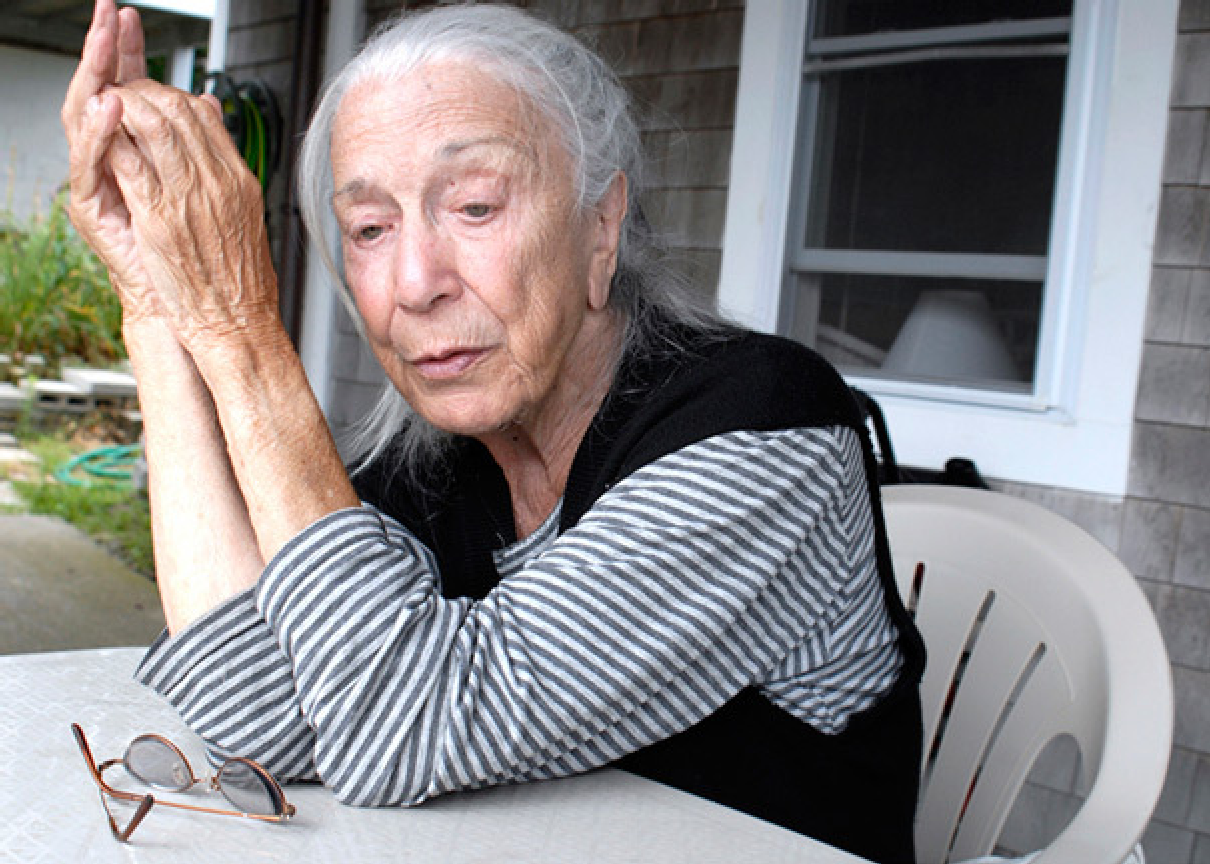
I recently read your note about the passing of Norma Holt through her Facebook Memorial page and there was the link to what you wrote about her in January.  It had a profound effect on me, which is why I’m writing to you. I can’t stop thinking about it.

Norma was an influential person in my life from the time I was 14 until about 24.  She was my dad’s on-again, off-again lover during those years (1962-1972). It was a very tumultuous romance and pretty ill-fated from the beginning.  We lived in a small town in PA where she didn’t fit in and didn’t want to. Her attitude and caftans didn’t cut it in suburbia!  And my dad wasn’t about to move to NYC. He had a business and two daughters he was raising on his own and wasn’t quite as free-spirited as Norma. They eventually parted ways and my dad ended up marrying someone else.

After the breakup, my sister maintained more of a relationship with Norma than I did. My sister actually visited her at the end of June in a rehab facility after her bout with pneumonia.  Norma was 94 and very tired. Her will to live was certainly indomitable until then.  Last week my sister said she tried to call Norma and the line was disconnected.  I was sure she had passed away so I googled her and that led me to the Facebook Memorial, which led me to your piece.

I had so many mixed feelings about Norma.  She was not the right woman to come into a troubled and vulnerable adolescent’s life (mine), but she was there and a commanding presence, as you know. She was a great photographer (she did two full albums of my sister and me), but definitely not a great mother substitute. She was fascinating and exciting, but I always felt I had to protect a part of me from her. Your description of her was amazing because you so accurately and precisely portrayed her.  I felt her spirit in your piece.

And I was laughing when you wrote about her forcing you into the cold bay water.  That was Norma!

It was a summer hemmed in by grief. We will spread Norma’s ashes and commemorate her life in Provincetown at the end of next month.

(Photo by Jane Paradise. See more of Norma in Paradise’s booklet “When I Was Young I Was Considered Beautiful,” which you can purchase here.)

The State Of The Displaced

Syrian Refugees Arrive In Germany

Chris Bertram uses the anniversary of the Chilean coup to evaluate changing attitudes toward refugees:

One thing that has changed greatly since 1973 is the sense of obligation of states in the “West” to the victims of persecution. However many Brothers are slaughtered in Egypt, they will find it very difficult to make their way to the United Kingdom in order to claim asylum. Certainly, no British government will be making it easy for them, just as they have taken steps to prevent the arrival of Syrians. Should any “Chileans” of today arrive in a boat in Australia they will not be able to make a new life, but will be sent to rot in a camp in Papua New Guinea.

Matt Lister complicates this argument:

I’m not sure how useful it is to talk about “western” attitudes towards refugees here in this period. There’s too much variation, going in different ways. The U.S. and Canada, for example, mostly got better on refugees after the late 70′s, though there are still lots of problems. Australia got worse, and Germany got worse, though for rather different reasons and in different ways, and at somewhat different times. I expect that we’d see other trends in different countries. But, talking about “western” attitudes here is just too broad to be useful.

(Photo: A young Syrian refugee peers out of the window of an airplane after arriving at Hanover Airport in Hanover, Germany on September 11, 2013. One hundred and seven Syrian refugees arrived in Hanover from refugee camps in Lebanon as part of a resettlement program that will allow them to stay in Germany for two years. They are the first group of refugees who have been offered asylum in Germany after being deemed vulnerable by the United Nations High Commissioner for Refugees, having escaped the ongoing conflict in Syria. By Alexander Koerner/Getty Images)

Does Education Decrease Terrorism?

It depends on the state of a country’s economy:

Terrorist groups are more likely to want to recruit people with useful skills, in other words those with more education and success in the labor market. But it become easier for them to do so during economic downturns, when there are fewer non-terrorist opportunities available.

And indeed, a 2011 study using microlevel data on the Palestinian economy found “evidence of the correlation between economic conditions, the characteristics of suicide terrorists, and the targets they attack. High levels of unemployment enable terror organizations to recruit better educated, more mature, and more experienced suicide terrorists, who in turn attack more important Israeli targets.” A recent country-level analysis by three German economists found evidence that “education may fuel terrorist activity in the presence of poor political and socio-economic conditions, whereas better education in combination with favorable conditions decreases terrorism.”

Previous Dish on the terrorism and education here.

The Role Of Meth In Matthew Shepard’s Murder

In our second video from Stephen Jimenez, author of The Book Of Matt: Hidden Truths About the Murder of Matthew Shepard, he explains what he discovered regarding Shepard’s involvement with crystal meth and the drug trade:

A reader comments on the previous video:

Maybe I’ll read Jimenez’s book; maybe I won’t. But neither Mr. Shepard’s involvement with drugs nor any potential sexual relationship with one of the perpetrators of his murder reduces, let alone excludes, the likelihood that his murder was fundamentally an act of horrific anti-gay violence.

The research on the relationship between male (closeted) bisexuality and anti-gay attitudes and anti-gay violence is limited but nevertheless compelling. At least one study is I believe referenced in the Forrest Sawyer documentary on anti-gay violence. Research volunteers had sensors attached to their penises and were shown heterosexual as well as homosexual pornography. My recollection is that there was a substantive correlation between bisexual arousal and anti-gay affect (as represented by their responses to questions about homosexuality and gay people). The gratuitous brutality of the torture and murder is more consistent with anti-gay violence than most drug-related violence – at least in this country. These things should be acknowledged first and last.

Update from Jimenez:

The purpose of the book is not to say hate wasn’t involved; it’s to examine the complex human factors that resulted in such a grotesque murder, and how that murder was reported and perceived. Once they read the book, some readers might still conclude the crime was motivated by hate – but not of the “gay panic” variety that we have come to associate with Matthew’s murder.

Below is more background on The Book Of Matt, which comes out September 24 (pre-order here):

An award-winning journalist uncovers the suppressed story behind the death of Matthew Shepard, the gay University of Wyoming student whose 1998 murder rocked the nation. Jimenez was a media “Johnny-come-lately” when he arrived in Laramie in 2000 to begin work on the Shepard story. His fascination with the intricate web of secrets surrounding Shepard’s murder and eventual elevation to the status of homosexual martyr developed into a 13-year investigative obsession. The tragedy was “enshrined…as passion play and folktale, but hardly ever for the truth of what it was”: the story of a troubled young man who had died because he had been involved with Laramie’s drug underworld rather than because he was gay.

Drawing on both in-depth research and exhaustive interviews with more than 100 individuals around the United States, Jimenez meticulously re-examines both old and new information about the murder and those involved with it. Everyone had something to hide. For Aaron McKinney, one of the two men convicted of Shepard’s murder, it was the fact that he was Shepard’s part-time bisexual lover and fellow drug dealer. For Shepard, it was that he was an HIV-positive substance abuser with a fondness for crystal meth and history of sexual trauma. Even the city of Laramie had its share of dark secrets that included murky entanglements involving law enforcement officials and the Laramie drug world.

So when McKinney and his accomplices claimed that it had been unwanted sexual advances that had driven him to brutalize Shepard, investigators, journalists and even lawyers involved in the murder trial seized upon the story as an example of hate crime at its most heinous. As Jimenez deconstructs an event that has since passed into the realm of mythology, he humanizes it. The result is a book that is fearless, frank and compelling. Investigative journalism at its relentless and compassionate best.

Our full video archive is here.