The Giant Sucking Sound Of Government Jobs

Public Sector Jobs

Derek Thompson explains a key element of our jobless recovery – the public sector’s “unprecedentedly bad post-crash performance”:

The public sector collapse was not Obama’s plan. It is not his fault, really. It is scarcely his responsibility, since the vast majority of government jobs — and of government jobs lost — have been at the state and local level. The recession devastated state tax revenue, and states cannot borrow from international lenders like Washington. So most had no choice but to cut workers. The stimulus delayed, but did not indefinitely defer, the blood-letting. And, since Congress refused to extend support even as interest rates clung to historically low levels, it’s been brutal.

If we held government employment perfectly steady since Day One of Obama’s presidency — not one more government job, nor one less — job creation would have seen a 25 percent boost. Instead, Obama’s legacy will include an historically strange post-recession collapse in government unemployment — and a powerful lesson in the limits of presidential power.

Update from a reader:

Derek Thompson’s post about the recovery is correct to note that the plummet in government jobs largely explains the lackluster recovery, and for that piece of information it is really Bill McBride at Calculated Risk who should be thanked. But when Mr Thompson says “The recession devastated state tax revenue, and states cannot borrow from international lenders like Washington. So most had no choice but to cut workers,” he makes a series of errors and gross misrepresentations.

States can and do borrow from foreign sources in exactly the same way the Federal government does, which is by selling their bonds to foreign buyers. Not only was Mr Thompson wrong about that, but he implies that Federal borrowing is that Federal borrowing comes from a “lender,” which makes it sound like going to a bank for a mortgage. But that is not right. The “borrowed” money comes from bond buyers.

What States generally cannot do is engage in deficit spending. They have balanced budget laws to follow. States also cannot print money or engage in quantitative easing. These are all things that the Federal government can do. Mr Thompson gets this all wrong.

And then there is Mr Thompson’s most pernicious error. He claims that Federal “borrowing” comes from foreign “lenders,” and that is a damnable misrepresentation. Most US Treasury Bonds are held by US citizens and US-based financial entities. The debt we owe is largely to ourselves.

Getting all of this right is crucial for understanding how and why the implementation of austerity and campaigns demanding austerity (like Simpson-Bowles) have been so damaging to the economy during the recession and nascent recovery.

This Bud’s For You

According to a 136-page book of regulations that Colorado released yesterday (pdf), the state plans to regulate marijuana ads much like alcohol ads:

Ads will be allowed on TV, newspapers, and radio as long as the advertisers have “reliable evidence” that fewer than 30 BDv4xQsCAAAwyjFpercent of the expected audience is under 21 years old. So the newspaper ad pictured at right would be OK. But public weed ads – like billboards and park benches, and other stuff visible from the street – will be prohibited. … It seems the same would go for this billboard outside of the Denver Broncos’ NFL stadium during a game last Thursday night. This more aggressively anti-alcohol, pro-weed message would be hard for anyone to miss. Note how the billboard uses classic beer-drinking imagery to pitch marijuana to a wider audience. Colorado’s advertising regulations mark the beginning of the creation of what will someday be tedious weed advertising tropes. What’s the marijuana version of the beer ad girl? Who will become the Most Interesting Man in the Weed World?

The Untruth At The Heart Of Prohibition

Here’s a short recap of one moment in a day in Washington when the insanity of the war on pot was actually discussed:

Marijuana’s status as an illegal drug “isn’t based on a whim,” Mr. Grassley said. “It’s based on what science tells us about this dangerous and addictive drug.”

Just. Not. True.

Marijuana is one of the safest substances ever to open up the human mind and relax the human psyche. It is far less dangerous and far less addictive than alcohol – and yet it is classified as no different than heroin by the federal government. The feds absurdly claim that there is no medical use whatsoever for this drug – while children with epilepsy are finally getting some desperate relief and as countless patients testify for cannabis’s benefits in tackling nausea, glaucoma, and neuropathy, among many other conditions. We’re all entitled to an opinion. But no one is entitled to say things that have been proven demonstrably false. And Grassley is no minor figure: he’s the ranking Republican on the Judiciary Committee. He needs to be called out – not least by the Obama administration.

More Money, More Children

The old relationship between class and birth rates has been inverted:

Increased prosperity used to lead to a decline in the fertility rate as parents did not need children SDT-2013-05-fertility-education-01as an insurance policy for their old age; and indeed, the modern child is very expensive to bring up. But now better-off people seem to be having more children; in the U.S., the fertility rate of wives whose husbands are in the top decile of income is back where it was a century ago. Having a lot of children may be a sign of status – [BCA Research] dubs this the “Brangelina effect” – or it may be that better-off women can afford the childcare help (and increased housing space) that children necessitate.

Interestingly, the proportion of childless highly-educated American women (those with Ph.Ds) aged 40-44 was just 23 percent in 2006-08, down from 34 percent in 1992-94. There was a similar (if less marked) fall in childlessness among those with a master’s degree. … [But] while better-off women may be having more children, that’s not true of the poor; 15 percent of those failed to graduate high school are childless in their 40s, compared with 9 percent 20 years ago and even high school graduates have seen a rise in childlessness from 13 percent to 17 percent. There are a lot more women in those categories than there are Ph.Ds.

(Graph: Pew Research Center)

Monetary Policy In The Gray

Matthew Boesler points to evidence that central banks have less influence in countries where the population skews old:

In [a] paper titled “Shock from Graying: Is the Demographic Shift Weakening Monetary Policy Effectiveness,” IMF economist Patrick Imam links aging populations in countries like the U.S., U.K., Japan, Germany, and Canada to empirical evidence that monetary policy has become less effective. “Based on the life-cycle hypothesis, we would expect older societies to typically have a large share of households that are creditors, and to be less sensitive to interest rate changes, while younger societies would typically have a larger share of debtors with higher sensitivities to monetary policy,” says Imam. And “with fertility rates plummeting around the world – often below replacement rate – including in low-income countries,” the IMF economist writes, “the world is going through an unprecedented demographic shift that is leading to a rapidly graying world.”

Neil Irwin elaborates:

What’s the theory? To start with, monetary policy works by changing the cost of borrowed money.

When growth is weak, a central bank cuts interest rates, which in turn makes spending, consumption, and investment more attractive. You’re more likely to buy a house or a car if the interest rate is 3 percent than if it’s 5 percent, for example. But crucially, the use of borrowed money is a crucial way that these lower rates translate into higher economic growth.

But borrowing money is disproportionately an activity of the young. Economists call it “life cycle hypothesis of saving” – people use credit to smooth out what they can consume over the course of their lives. When just embarking on a career, a young person might take out major loans for education and for buying a house and car. As they reach middle age, they will tend to have paid down some of that debt while also building savings. By the time they hit retirement age, they should be net creditors, with significantly more savings than they still owe in debt.

That would imply that in an older society fewer people are actively using credit products. Which should in turn imply that a central bank turning the dials of interest rates will be less powerful at shaping the speed of the overall economy.

Drum adds:

I can tentatively buy this. In fact, I’d toss out another possible channel for this effect as well: the elderly often live off investments, which means that their incomes fall as interest rates go down. So the bigger the proportion of elderly in a country, the more people you have who are forced to consume less because of low interest rates and the fewer people you have who are motivated to consume more by low borrowing rates.

“If Only …”

A reader writes:

You wrote: “If only such an offer had been possible in Iraq in 2003.”

Not only was it possible but it actually happened. I’m astonished at how many people forget that In late 2002 Saddam Hussein, in a letter to Hans Blix, invited UN weapons inspectors back into the country. I remember thinking at the time that we didn’t have to go to war and that this had been all brilliantly played by the Bush administration. This turned out to be quite a naive thought.

Then we went to war anyway.

If Obama exercises restraint here, then we have insight into how he would have handled Iraq in 2003 and it would have been taking yes for an answer when Saddam Hussein capitulated.

I stand corrected.

America’s Recovery Is In Full Swing

0d1805c459724f83b12bdb956c441036_623x512

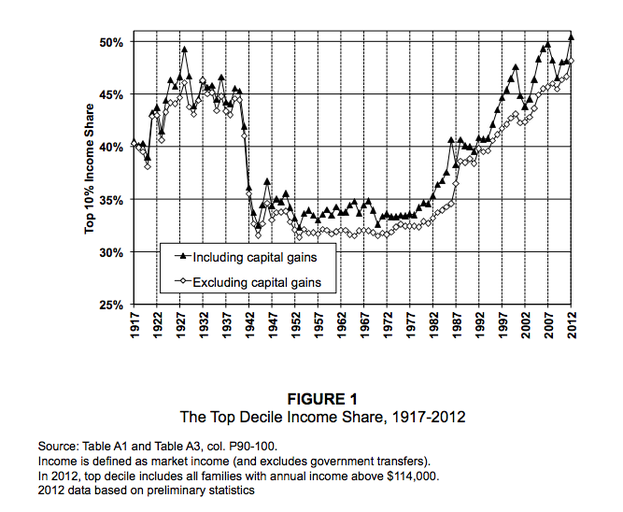
If you’re rich. According to a new annual report, the top 10 percent of earners took in over half of the nation’s total income in 2012, while the top 1 percent collected one-fifth of all income:

The income share of the top 1 percent of earners in 2012 returned to the same level as before both the Great Recession and the Great Depression: just above 20 percent, jumping to about 22.5 percent in 2012 from 19.7 percent in 2011. That increase is probably in part due to one-time factors. Congress made a last-minute deal to avoid the expiration of all of the Bush-era tax cuts in January. That deal included a number of tax increases on wealthy Americans, including bumping up levies on investment income. Seeing the tax changes coming, many companies gave large dividends and investors cashed out. …

Allie Jones points out that this is a record gain for the upper income bracket, edging out the Roaring Twenties:

You can see that in 2012, top 10 percent income share creeps above 50 percent for the first time … Senior Brookings Institution fellow Justin Wolfers notes from the study that in the years since the crash (2009-2012), the average income of the top one percent has risen 31.4 percent, while the average income of the other 99 percent has risen only 0.4 percent.

Drum anticipates a counterpoint:

Now, I imagine that apologists for the rich are going to point out that their recent winnings still don’t make up for their losses during the Great Recession. And that’s true. … [S]ince the 2007 peak the rich have suffered an average income loss of 16.3 percent. The rest of us have done better: our incomes are down only 11.2 percent.

But this is meaningless. For starters, an 11.2 percent drop for someone making 15 bucks an hour is a helluva lot more painful than a 16.3 percent drop for a millionaire.

The Difficulty Of Destroying Chemical Weapons

Keating underscores it:

Both Russia and the United States have more than 20 years of technical experience in chemical weapons destruction, but as I noted yesterday, both countries’ efforts to destroy their Cold War-era stockpiles have been years behind schedule. Sometimes these delays are political—public protests in the United States prompted a shift from incineration to chemical treatments at several U.S. facilities—but often they’re due to the understandable technical challenges of disassembling some of the deadliest weapons ever created.

Mark Thompson goes into detail on US efforts to dispose of its own CW stockpiles:

It has taken the Pentagon far longer (the original completion date was 1994), and cost far more money (the original estimate was between $1 billion and $3 billion), to destroy its chemical weapons.

To date, the U.S. has destroyed, primarily by burning, 89.75% of the arsenal at seven of those nine [chemical weapons] sites: Johnston Island in the Pacific; Anniston, Ala.; Pine Bluff, Ark.; Aberdeen, Md.; Umatilla, Ore.; Newport, Tenn.; and Tooele, Utah. The remaining 10% is slated to be neutralized using new techniques. Current plans call for the 8% of the original stockpile remaining at Pueblo, Colo., to be rendered safe using a biotechnological process by 2019, while the 2% at the Blue Grass, Ky., is scheduled to be to be neutralized using what the Pentagon calls “super-critical water oxidation” by 2023.

Yochi Dreazen looks at how hard destroying CWs has been in Libya:

[Cheryl Rofer, who supervised a team responsible for destroying chemical warfare agents at the Los Alamos National Laboratory,] noted that Syria has far more chemical weapons than Libya, so getting rid of them could take even longer. “I wouldn’t be surprised to see this last as long as ten years,” she said.

If the U.S. and Syria came to a deal — a very, very big if — there would still be one major wrinkle. Rofer said that the only two organizations who really know how to get rid of chemical weapons are the Russia and American militaries. Given the amount of time it would take to build and then operate the disposal facilities, those specially-trained troops would need to stay in Syria for years. In a war-weary U.S., keeping that many boots on the ground for that long would be an extremely hard sell.

Larison agrees:

When we consider how adamant most Americans and even most members of Congress have been that the U.S. avoid sending ground forces into Syria, it is obviously a non-starter in Congress and with the public to suggest that American soldiers be sent into Syria for years as part of a weapons disposal effort. Such a scenario disturbingly echoes the mistakes of the Lebanon and Somalia missions. Then again, why would the Syrian government accept American soldiers on its territory for any reason? Considering how ineptly the administration has justified its proposed attack on Syria, I don’t see how they could possibly persuade Congress or the public to support what would prove to be a much longer, more significant commitment than the “unbelievably small” attack they had been advocating earlier.

The Journalistic Ethics Of The WSJ Op-Ed Page, Ctd

The latest on Elizabeth O’Bagy, the lobbyist for the pro-war Syrian Emergency Task Force:

The Syria researcher whose Wall Street Journal op-piece was cited by Secretary of State John Kerry and Sen. John McCain during congressional hearings about the use of force has been fired from the Institute for the Study of War for lying about having a Ph.D., the group announced on Wednesday. “The Institute for the Study of War has learned and confirmed that, contrary to her representations, Ms. Elizabeth O’Bagy does not in fact have a Ph.D. degree from Georgetown University,” the institute said in a statement. “ISW has accordingly terminated Ms. O’Bagy’s employment, effective immediately.”

And scene.