The Risks Of Rushing To War

Kerry And Hagel Testify Before House Foreign Affairs Committee On Syria

National Review continues to support war with Syria. Jim Manzi dissents:

[F]orcing Assad from power represents a far larger and more uncertain undertaking than has been publicly discussed.

This is the course of action advocated by the editors: “a broader, longer-term plan to topple Assad and defeat his allies.” Those are smooth words for a rough job. How would we accomplish this? How many people would we kill, and how much public money would we spend? Why do we believe that the rebels would form a government that would not be worse for us? How would Iran attempt to counter such an intervention, since they have an extremely strong interest in the outcome? And so on. The litany of costs and dangers ought to be familiar to anybody after Iraq and Afghanistan. Would you voluntarily take on one-tenth the cost in deaths and money of either of those wars to replace Assad with whatever is likely to follow him? Wandering into that kind of a commitment based on what has been presented to the American people so far would be extremely rash.

(Photo: A protester holds up her hand, which is covered in red paint, as U.S. Secretary of State John Kerry testifies during a hearing on “Syria: Weighing the Obama Administration’s Response” before the House Foreign Affairs Committee on September 4, 2013. By Alex Wong/Getty Images)

Making It Harder To Adopt, Ctd

A reader goes against the grain:

Wow – what a topic. I can not agree more with the ideas of the “anti-adoption movement” … and I’m the mother of four children, two of whom are adopted, openly. Adoption is not easy, for any of the parties involved. Adoption does start with a tragedy; a child and his/her biological family lose the opportunity to grow up together. That is a real loss, and it’s unfortunate that many families who look like mine don’t acknowledge it. From my perspective, my kids need the opportunity to grieve that part of their life, confidently and safely. We grieve with them; it is sad. And at the same time we are so grateful for these beautiful gifts. Adoption is part of who we are as a family and it’s a part of who they are, which is why open adoption is beautiful – hard, but beautiful.

The two people I love almost as much as my children and my husband are the two beautiful women who chose me to be the mother of their children, my children. There is no greater gift. They are amazing women and we honor them every day. This is why women should absolutely not be paid, why open adoptions are essential, why birth families should have a reasonable amount of time to make the decision, and why long-term support for birth and adoptive families is a must.

My husband and I chose the adoption agency we did – The Cradle, in Evanston, Illinois – for exactly that reason. The Cradle provides education and support across both families throughout the lifetime. Birth families choose to place or choose to parent. There is no abandonment – not for the children, not for the birth families, and not for the parents. In truth, adoption work doesn’t end on your child’s “Gotcha Day”; it just begins.

Another:

As an adoptive parent, my views on this subject are hardly unbiased. After going through the adoption process, there are many reforms that I would certainly advocate.

One would be to reduce the incentives for the people making a lot of money off of couples who are desperate for a baby. And it is the baby market (as opposed to the toddler market) that is driving this rent-seeking industry. Most couples, my wife and I included, wanted a new-born and we paid heavily for that privilege.

But where did the money go? Some small part of it went to provide for the birth mother and her other children during the last months of the pregnancy. And I have no problem with that. Most of it went to the facilitator and the adoption agency who both provide services but at a hefty price. The going rate for finding a pregnant birth mother was about $25,000 when we adopted our son 12 years ago. Who knows what it is now? And there were a lot of other fees and expenses on top of that.

At one point during this three-year long process and after several trips that ended in heartbreak and frustration, I somewhat seriously told my wife that it would be a superior moral choice for us just to drive to Mexico find a poor unmarried girl with a new-born and pay her $20,000 to take the baby. I didn’t really mean that, but it was an indicator of my frustration with the process. There has to be a better way to match birth parents and adoptive parents than paying some woman in Seattle $25,000 to give you a name.

All of this considered, I am still strongly pro-adoption. For anyone come out with a strict anti-adoption stance is just denying reality. It sounds clichéd, but there are kids out there who need good homes. When I consider where our son could have been – with a birth mother who I am sure would have loved him but who has had incredible troubles that don’t need to be discussed here – sometimes I just want to cry.

As it stands, we have a great son whom I could not love any more if he was my own flesh and blood. Sometimes I think I love him more because he is not and because he made us a family. There is nothing wrong with adoption, but there is something wrong with our current system.


Faces Of The Day

Tony Abbott Set To Become Australian PM As Campaign Draws To A Close

Shadow Treasurer Joe Hockey kisses a puppy at Kew Guide Dogs on September 6, 2013 in Melbourne, Australia. With just one day left in the campaign, the Liberal-National Party coalition had one of their first stumbles, by releasing a policy to implement an opt-out Internet filter but then abandoning it within hours. The conservative Liberal-National Party coalition looks set to form government in tomorrow’s federal election. By Lisa Maree Williams/Getty Images. A reader recently wrote:

I love the coverage you give to right-wing parties that are not Republicans, contrasting British and Canadian Conservatives with American Reactionaries. However, I’m Australian, and I don’t see any comparisons made with the Australian Liberal and National parties. On the GOP, you wrote the following in a post last year called “America’s Tory President“:

Of which other Western right of center party could the following be said: it holds that man-made climate change is a hoax and that more carbon energy is harmless and indeed vital. On immigration, the party supports a vast wall across the Southern border, and eventual deportation by attrition of 11 million illegal immigrants. On the deficit and debt, the GOP is the only party in the West that refuses to raise any revenues to close the gap, even as revenues are at 60 year lows. On social issues, the GOP would ban any recognition for gay couples, including civil unions and would criminalize abortion in every state by constitutional amendment.

In the last three years the Australian Liberal/National coalition has been a shadow of the GOP.

The Liberal leader, Tony Abbott, has called climate change “crap” and vowed to repeal the government’s tax on greenhouse emissions. The Liberal/Nationals have nourished xenophobia by branding migrants who seek refugee status in Australia “illegal” (despite Australia being signatory to the UN Convention on Refugees, which explicates that seeking refugee status is not illegal), and it has constructed a tortuous immigration processing network outside the jurisdiction of Australian courts with the intent of deterring refugees. Although Australia has very healthy levels of public debt (only 11.6% of GDP), the Liberals have promised large cuts to taxes and spending. The Australian News Ltd press is a Fox-lite spokesman for Liberal/National politics. On social views, a couple weeks ago a bill to recognise same-sex marriage was defeated by the Liberals and Nationals; a Liberal senator likened same-sex marriage to bestiality and polyamory; and, the Liberal Opposition leader has called a woman’s virginity ”the greatest gift you can give someone”.

Although it’s great to see conservative parties in Canada, New Zealand and the UK bucking the GOP’s reactionary trend, right-wing parties like the Australian Liberals and Nationals are following the GOP’s lead. I can only hope that exposing this madness to the scrutiny it deserves will restore pragmatism and sanity to the American and Australian polities.

Going To War Over A Gaffe

Walter Mead panics that a “no” vote on Syria will destroy US credibility in one fell swoop:

Foreigners will no longer know when and whether to take anything this President says as representing American policy rather than his own editorial opinions. We hate to say it, but that is so dangerous that there’s a strong argument for Congress to back the Syria resolution simply to avoid trashing the credibility of the only President we’ve got.

Ezra is skeptical:

[N]o one — not Assad, not Iran, not North Korea — has any confusion about what would happen if they deployed chemical weapons against our troops or embassies, or if they handed them to terrorists who used them to attack us. They would be annihilated. And our credibility on this score is overwhelming: After 9/11, we invaded Afghanistan, which had given safe harbor to al Qaeda, and then we also invaded Iraq — just because we were so angry. Pinprick strikes against Assad change nothing about the incentives of using chemical weapons against the United States.

Shibley Telhami likewise denies that a strike will bolster US credibility:

Despite the talk of not being taken seriously, America remains a feared superpower in the Middle East, and Washington’s hand is seen in almost everything big and small. For Arabs in Syria, Egypt, and elsewhere, the problem is not American credibility on the use of force; rather, they have a deep mistrust of U.S. aims.

How Hyperinflation Happens

Syria Inflation

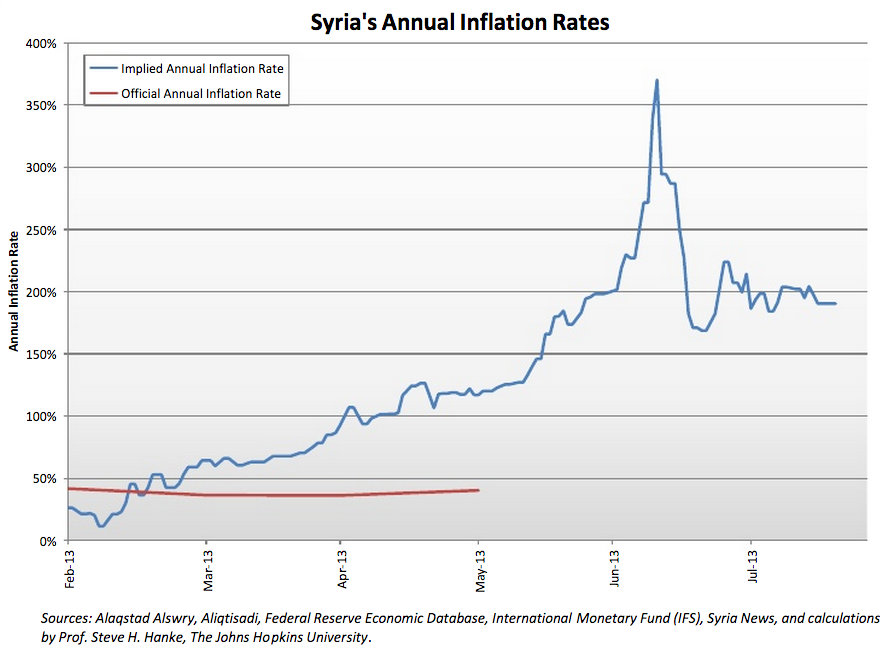
Matthew O’Brien highlights Syria’s hyperinflation:

It turns out you can’t have much of an economy when your country is a war zone, and the regime is attacking civilians. But functioning economy or not, the government still has to pay its bills. So what does it do when there’s nothing to run or tax? Easy: It prints what it needs. That’s what the pariah Assad regime has done to cover the difference between what it has to pay, and what its few remaining patrons have paid it. The predictable result of all this new money chasing fewer goods has been massive inflation.

This is in keeping with the history of hyperinflation:

Hyperinflations tend to happen following wars or revolutions. Now, Weimar Germany and Zimbabwe look like exceptions to this rule, but they’re not really – the former’s resistance to reparations, and the latter’s botched land reform halted economic activity as much as any conflict.

Has The GOP Left Corporate America Behind?

Eduardo Porter thinks so:

From overhauling immigration laws to increasing spending on the nation’s aging infrastructure, big business leaders have seemed relatively powerless lately as the uncompromising Republicans they helped elect have steadfastly opposed some of their core legislative priorities. The rift is not only unusual in light of the tight historical alignment between the business community and the GOP, but it is also outright incomprehensible after the Supreme Court’s Citizens United decision, which allowed companies to spend unlimited amounts from their corporate treasuries on the 2010 and 2012 elections.

Kevin Drum objects:

The business community has three big issues it cares deeply about: low taxes, reduced regulation, and the demise of labor unions. Those things overwhelm every other desire, and the Republican Party is satisfyingly adamantine on all of them. What’s more, the Tea-Party-ized GOP is, if anything, even more rock solid on them.

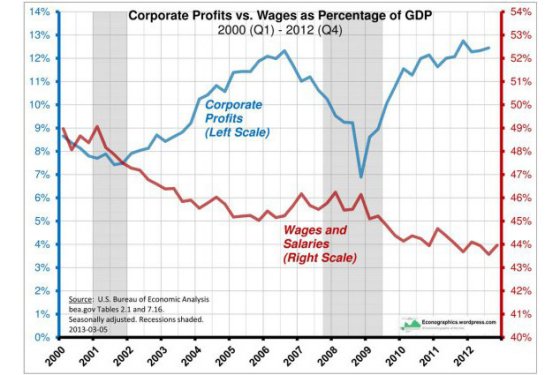
Chait, also skeptical, points to a chart:

Less government sabotage would mean faster economic growth. But it’s not as if the status quo is terrible for businesses. The status quo, while painful for most people, remains pretty good for owners of capital:

a_560x375

So what we’re looking at is a Republican Party that’s somewhat harmful to the overall business climate but helpful to the issues that most businesses care about. If the chaos gets completely out of hand – if, say, Republicans trigger a debt default crisis – then the calculation may change. In the meantime, the House Republicans are the business lobby’s sole bulwark against the Democratic-controlled government that steamrolled through the laws the business lobby is fighting to repeal or weaken.

Greg Sargent adds:

I also feel compelled to remind folks that business leaders knew what they were getting when they helped bankroll the ascension of Tea Partiers to Congress in 2012. They did exactly the same thing in 2010, spending huge sums to help elect Tea Partyers in that cycle, too, only to be rewarded by a debt ceiling crisis staged by the Congressional GOP that they viewed as reckless, dangerous, and potentially harmful to the bottom line. That didn’t stop them from doing the same in 2012.

In response to critics, Porter points out the differences between companies’ political donations and those by their executives.

Great News: College Enrollment Is Down

It’s true:

New Census Bureau estimates published Tuesday point to a record drop in college enrollment after years of steady growth. Total enrollment dipped 467,000 last year, about a 2.3 percent decline from 2011. While it might not seem high, the number represents a significant reversal: It’s the largest year-over-year decline since the Census Bureau began estimating enrollment in 1955.

Nick Anderson celebrates:

Dig into the data, and you’ll find that number of undergraduates 24 or younger shrank by about 122,000 students from 2011 to 2012. The 25-and-older cohort shrank by about 332,000. Older students accounted for nearly three-fourths of the shrinkage — even though older students only make up about a quarter of the undergraduate population. Why is this important? Because older students are plugged into the workforce much more than younger students. So, if the economy is stabilizing after the 2008 financial crisis, making the job market more attractive than it was a few years ago, then our inference is that there will be a significant effect on the college-going decisions of the 25-and-older crowd.

Terry Hartle of the American Council on Education is also heartened by the news:

Higher education enrollment has risen over the last 20 years, Hartle says, but the trend is counter-cyclical. During bad economies, people rush to finish a degree or pick up new skills. That’s why 2007 and 2008 saw a 13 percent increase in enrollment, the biggest jump in 25 years. The half-a-million person drop sounds big, he says, but it’s really just a return to normalcy. “Enrollment tends to level off or fall when the economy is improving,” he says. “Given how much enrollment surged during the economic downturn, a reduction was inevitable.”

What’s more, enrollment by Hispanics jumped by nearly 450,000, reaching an all-time high:

For the first time, a greater share of Hispanic recent high school graduates are enrolled in college than whites. According to the Census Bureau, 49 percent of young Hispanic high school graduates were enrolled in college. By comparison, 47 percent of white non-Hispanic high school graduates were enrolled in college. These findings reflect those of a May Pew Research Center report that showed the share of Hispanic high school graduates enrolled in college immediately after high school surpassed whites in 2012.

FT-hispanic-enrollment-01