Ezra parses recent polling on the shutdown:
No one involved in this mess is particularly popular. But a two-party political system with first-past-the-post elections is a zero-sum affair. And Republicans are not only less popular than Democrats, their popularity isfalling faster than Democrats’. They are, in other words, losing, and badly.
Sides counters:
[T]he Post’s numbers suggest this: if Republicans and Republican-leaning independents in the electorate approved of congressional Republicans as much as Democrats approve of Obama (71% do), congressional Republicans would be no less popular than congressional Democrats are.
Why does this matter? Because the politics of these approval numbers do not suggest that the GOP’s disadvantage would redound to the Democrat’s advantage in the midterm election in any clear zero-sum fashion. As Lynn Vavreck and I noted in our piece for CNN, party identification predicts the vote in congressional elections very well. The Republicans who don’t approve of the GOP’s handling of the budget negotiations aren’t likely to go vote for a Democrat.
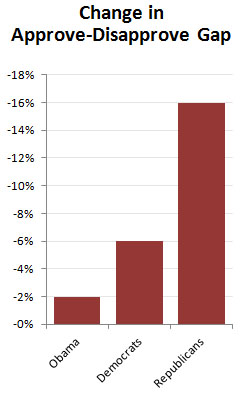
How Masket understands the political impact of the shutdown:
If you want to do something with a bit lower profile, like changing logging rules or greenhouse gas regulations in order to satisfy some of your activist base, go for it. Most voters will never hear about it, and the people who do already have their mind made up about you anyway. But start a war, try to create or kill a piece of the social safety net, raise taxes, or shut down the government and its major services, and people will definitely notice, and they may punish you for it. That’s way outside of the blind spot, and if you operate there, you’re courting a reprisal. (Another way to operate outside the blind spot is to shrink it by drawing attention to what you’re doing, as Senator Ted Cruz did during his marathon Senate speech.)
But another thing to keep in mind is that voters are notoriously myopic. To the extent that they punish officeholders for their behavior, it’s usually for things that happened very recently. Sam Wang draws upon recent public opinion polls to find that the Democrats’ chances of taking back the U.S. House next year have gone from 13 percent to 50 percent, but that election is still more than a year away. (It’s not a coincidence that this standoff is happening now, and the last debt ceiling standoff occurred in 2011—both off-years for elections.) Lots of other things that voters may care about will happen between now and then. Congressional elections will also be affected somewhat by the economy, but voters will be evaluating an economy that doesn’t yet exist. Basically, they’ll be looking at economic growth in early 2014.
 The Dish