Is Obamacare Too Complex To Work?

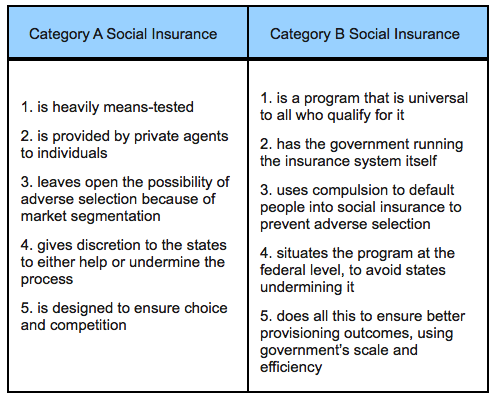
Mike Konczal blames Obamacare’s technical problems on the law’s design. He contrasts Obamacare’s form of social insurance, which he labels “Category A,” with previous forms of social insurance, such as Medicare and Social Security, which he labels “Category B”:

What we often refer to as Category A can be viewed as a “neoliberal” approach to social insurance, heavy on social_insurance_categoryprivate provisioning and means-testing. This term often obscures more than it helps, but think of it as a plan for reworking the entire logic of government to simply act as an enabler to market activities, with perhaps some coordinated charity to individuals most in need.

This contrasts with the Category B grouping, which we associate with the New Deal and the Great Society. This approach creates a universal floor so that individuals don’t experience basic welfare goods as commodities to buy and sell themselves. This is a continuum rather than a hard line, of course, but readers will note that Social Security and Medicare are more in Category B category rather than Category A. My man Franklin Delano Roosevelt may not have known about JavaScript and agile programming, but he knew a few things about the public provisioning of social insurance, and he realized the second category, while conceptually more work for the government, can eliminate a lot of unnecessary administrative problems.
Drum pushes back:

If I had my way, we’d have a fairly simple, universal, single-payer health care system in the United States. It would work better; provide broader coverage; and probably be cheaper than what we have now. But countries like Switzerland and the Netherlands demonstrate that an Obamacare-like system can work reasonably well too.

Konczal is certainly right to mock conservatives who don’t seem to understand that Obamacare is fundamentally a pretty conservative design for national health care—which means that if it fails, it will hardly be a failure of old-school liberalism—but I think he goes too far when he tries to blame the rollout problems on that design. There was never any realistic hope of wiping out the entire private insurance industry and instituting a single-payer system anyway, which makes this all a bit academic, but even if Obamacare is a second-best design, it’s still one that other countries have shown can be implemented effectively. I imagine that, over time, the same will be true here.

Douthat complicates Konczal’s argument:

If the Obamacare exchanges are a mess and the individual market is facing cost spirals, then conservatives are going to face some understandable skepticism (more even than usual!) from voters if they talk up the virtues of free market health care and the individual marketplace in 2016 and beyond. But in principle, the distinction between Obamacare’s approach to health policy and the conservative version of means-testing, block-granting, and competitive marketplaces is clear enough. That’s because while Obamacare may be using neoliberal rather than New Deal-style means, it’s still chasing essentially left-of-center ends: It seeks a level of universality and comprehensiveness that conservatives don’t think is necessarily worth pursuing. And it’s that quest, those goals, that require the complicated mandate-regulate-subsidize combination that could undo the individual marketplace if the enrollment isn’t where it needs to be and the subsidies and fines and regulations aren’t successfully fine-tuned.

In other words, pace Konczal, the potential problems with Obamacare aren’t necessarily “driven by means-testing, state-level decisions and privatization of social insurance.” They’re driven by the law’s attempt to employ these (notionally) decentralized means while still seeking essentially centralized ends.

Reihan thinks health reform should have had a default option:

The idea of a default option comes to mind in light of the difficulties facing the new health insurance exchanges. Even in the absence of technical difficulties, I’m starting to wonder why anyone thought that a substantial majority of healthy young people would sign up for coverage, including heavily subsidized coverage. The threat of a penalty is one obvious reason. Yet the Obama administration and its allies have been reluctant to emphasize the punitive dimension of the individual mandate, for obvious political reasons. Rather than using the threat of a penalty to spur enrollment, coverage expansion advocates have emphasized the benefits of insurance, hence the (apparent) reluctance of the architects of the exchanges to expose consumers to the full, unsubsidized cost of the new insurance options.
Don’t Judge A Restaurant By Its Line

They’re often not worth the wait, according to Tyler Cowen, author of An Economist Gets Lunch:

Let’s say a restaurant allows a line to form outside the door. Why don’t they just raise their prices?  Well, for one thing the line, and the accompanying difficulty of getting a reservation, is a way of marketing the restaurant to potential customers. Which means the place needs marketing in some manner, which means its audience is in some way not so well-informed about where they ought to be eating.  They tend to be trendy people who follow… lines. Conformists, in other words.

A lot of places with lines are quite good, but when they fall, they fall hard. In the meantime, the presence of a line indicates the place extracts consumer surplus in some fairly inefficient ways, so why should you go, especially if you are not a conformist?

You are better off going to an empty Caribbean joint:

[Ethnic restaurants] may make their livings doing catering or weddings. In those cases, emptiness is often a sign of quality. It means they make their food for truly demanding customers who demand the best for ceremonial purposes. It means they have not learned how to sell out or dumb down their food, and they just don’t have enough compatriots in the neighborhood to put many people in the seats on a regular basis (for these reasons, emptiness is not a good sign in say the Eden Center, where the number of Vietnamese diners is quite high, or say in Mexican restaurants on Kedzie Street in Chicago, and so on). Very often empty restaurants come from cultures where consumption is intensely seasonally cyclical, and that is positively correlated with food quality.

For more dining tips from Cowen, check out his Ask Anything series.

The Rape Double-Standard, Ctd

A reader keeps the thread going:

All of your reader stories are very sad, especially so the men describing life inside abusive relationships. Our culture definitely has difficulty understanding male victims, not just of sexual assault. It’s one of the causes of damaging silence about child abuse, which helps make prevention and justice close to impossible in far too many lives.

But I really can’t let pass the notion that if the genders were reversed, the perpetrators would go to jail for a long time – which more than one reader mentioned. This just isn’t true, and people who say it is make me doubt their motives. Women have a difficult enough time reporting rapes that fall very far outside the gray areas of abusive relationships and bad sex – ones that fall very squarely in the black and white world of being raped while unconscious or physically assaulted by acquaintances. And if they do report, prosecutions are difficult and often end up being trials about victims instead of rapists – with few of them ending in convictions. What would happen if a woman who was raped in the more gray areas mentioned in your reader stories reported her experiences to law enforcement? I think we know: she would be dismissed, just as these men would be. There is no prosecutorial double-standard.

On that note, if you haven’t yet caught wind of the rape story out of Maryville, Michael Shaffer sketches out the main details:

Last Sunday, a New York Times reporter visited Maryville, Missouri to report on the existence of a grave threat to the town’s bucolic, Real-America essence: “Ever since The Kansas City Star ran a long article last Sunday raising new questions about the Nodaway County prosecutor’s decision to drop charges against a 17-year-old football player accused of sexually assaulting a 14-year-old girl, the simplicity of small-town life here has been complicated by a storm of negative attention.” …  There are two ways the town could have lived up to the Times’ rose-colored description of its status quo ante:

1. Beforehand, by not sexually assaulting ninth-graders, videotaping the incident, and leaving a victim asleep on her front lawn in freezing weather.

2. After the fact, by not ostracizing the victim’s siblings, firing her mom from her job, dropping the case inexplicably, and burning the family’s house down.

A reader backs up the first one:

As a former prosecutor who has handled a fair share of sexual assault cases, I’d like to clear up a misconception that seems very widespread in this discussion. Several readers have described being sexually assaulted by a female, and many of them have said something like “If the situation were reversed, I would have been in jail.” That isn’t necessarily true.

The kind of case that is being discussed would be extremely difficult to prosecute regardless of the gender of those involved. Juries, in my experience, are very reluctant to convict people of sexual assaulting an adult unless they are absolutely certain that the sex wasn’t consensual. Basically, if a defense attorney can give them any remotely plausible reason to believe that the sex might have been consensual, then they are probably not going to convict.

In the cases your readers have described, there are many such reasons: the defendant and the victim are in a relationship together; they willingly sleep in the same bed; they begin a relationship after the sexual assault occurs. Any one of those facts would make a conviction unlikely and might even be enough for a prosecutor to decline the case. Sometimes even the fact that the defendant and victim have a history of flirting with each other can doom a case.

You might say that’s unfair: surely a young woman should be able to go to sleep with her college boyfriend without giving up her right to say no. Well, yes. But convicting the guy if he subsequently decides to have sex with her while she’s asleep in going to be very difficult.

I want to be clear that I am not saying that any of this is good or bad, or that female on male sexual assault is any less serious or traumatizing than the reverse.  I only want to make clear that the reason that the women in these stories were not convicted of rape is not necessarily because they are women, but rather because proving an adult rape charge is much more difficult than society in general seems to think.

Social Media Is Old News

Justin Peters is intrigued by Tom Standage’s Writing on the Wall: Social Media – The First 2,000 Years, which argues that “modern users of Twitter and Pinterest are ‘the unwitting heirs of a rich tradition with surprisingly deep historical roots.'” Andrew Hill elaborates:

Letters used to be exchanged with the regularity of email, with messages sometimes sent and received many times daily. In 1910, each person in Britain sent on average an extraordinary 116.7 items of mail. What we think of as a 21st-century phenomenon – social media – is rather “a return to the way things used to be”, claims Tom Standage in Writing on the Wall. … In his account, Cicero’s letters survived because they were copied and passed on to others. “Cicero and his web of contemporaries became so used to exchanging information by letter, with messengers coming and going throughout the day, that they considered it an extension of spoken conversation,” Standage writes.

The parallels with modern social media are clear.

“How Luther Went Viral” is the title of the chapter about how Martin Luther’s 95 theses were circulated, at a time when the number of editions of pamphlets was the equivalent to “the number of Likes, retweets, reblogs, +1s, or page views” a piece of content generates online today. The social networks of the past, such as the coffee-houses of London in the 18th century, had their critics, who condemned them in strikingly similar terms to those used by 21st-century sceptics, for “distracting people and encouraging them to waste time sharing trivia with their friends when they ought to be doing useful work”. Standage makes a strong case that the 150 years or so when mass media – from newspapers to television – centralised opinion and news and peddled it to passive readers and viewers were an aberration in the long historical domination of social media.

The Branding Of Coursework

Political scientist Amanda Murdie suggests that it makes a big difference:

Before coming to Mizzou, I taught in Kansas State’s Security Studies program. The program was mainly comprised of Army officers from the Command and General Staff College at Fort Leavenworth. The first time I taught a grad course on government repression, I called the course “Global Human Rights.” Not a single soldier signed up. The second time I taught the course I called it “Human Security.” The course maxed out and most of the enrollees were active-duty military. The content of the course was exactly the same.

But civilian academia appears just as biased:

My coauthors and I submitted a paper to a human rights journal last fall where I used a human security frame. The content of the paper concerned how military interveners and NGOs influence government respect for freedom from torture, political killings, etc. – clearly a traditional human rights topic. It also focused on how outside interveners influenced development and health outcomes, which are also both human rights and human security concerns. The paper was rejected based solely on a referee report that stated that our use of the “human security” frame meant that we didn’t know the existing human rights literature.

Update from a reader:

When I was in college at Columbia in the early 1990s, I signed up for a class called “Utopias: Quest and Community” in the religion department. On the first day, four other students showed up. The professor (Gillian Lindt) was shocked. “I taught the exact same class last year, and over 100 students signed up.” The year before it was titled “Cults.”

Behold The Flying Car

Meh:

Tuan C. Nguyen also shrugs at the Aeromobil:

No amount of camera tricks can conceal the fact that the Aeromobil looks downright unsteady as it struggles to keep its balance while gliding barely a few meters off the ground. The clip then ends with an oddly ominous quote from automotive pioneer Henry Ford in which he states, “Mark my word: A combination airplane and motorcar is coming. You may smile, but it will come.” I know the crescendo nature of the presentation was obviously meant to kindle a soul-affirming kind of excitement, but I can’t help but feel an unnerving sense of doubt (especially considering that the project has been in development for about 20 years).

[T]rying to hybridize a car and airplane can be akin to figuring out how to cross-breed a catfish with an eagle. The point being that they’re two completely different animals and the unique attributes that serve particular functions make it trickier to incorporate others. As evidenced by Aeromobil’s video, one of the most vexing issues is coming up with an adequate control and stability system in what’s primarily a road vehicle.

“Most prototype flying cars lack two key ingredients needed for success: They don’t look very good, and they fly even worse,” writes Stephen Pope of Flying magazine. “The new Aeromobil 2.5 out of Slovakia at least has overcome one of these shortcomings. From certain angles, the styling of this flying sports car is simply stunning. Unfortunately, based on the video of its maiden flight, it would seem that stability in the air continues to be a major challenge for roadable aircraft.”

A Land War In America

Lindsey Catherine Cornum offers measured praise for Thomas King’s The Inconvenient Indian, writing that “while King’s history is unique in that it is an Indian history actually written by an Indian, it repeats familiar colonial moves—it is still very obviously intended for settlers to read”:

Unlike narratives such as [Dee Brown’s] Bury My Heart, King works to make clear that the injustices of American and Canadian settlement on this continent are not some distant tragedy but a continual process of dispossession and assimilation that continues to the present-day. In general, King is opposed to the word tragedy, perhaps the most common descriptor of Indian history and people. Tragedies are exceptional events, and King pushes the reader to see the injustices committed on behalf of settler governments not as aberrant but necessary to their structure as settler institutions. He presents the catalog of injustices, from the massacres and broken treaties to the residential schools and sexual assaults, but unlike white historians such as Brown, he does not leave them in the past. …

Yet even though King has shown Indians to be more than a collection of past tragedies, there is still very little about his narrative that offers Indians much agency.

King himself notes, “Native history in North America as writ has never really been about Native people. It’s been about Whites and their needs and desires.” It’s unclear whether King is self-consciously describing his own work or not. But most of The Inconvenient Indian is spent exploring images imposed on Indians, laws applied to Indians and horrible acts committed against Indians, and very little on Indian resistance movements. It seems he may have fallen into the same trap. This may be a genuine reflection of what it means to be an Indian. The Indian was born at the moment of contact with whites, and for a long time Indians have been caught in that gaze. King’s book, in fact, recreates some of that gaze to narrate a convenient story to a white audience. But what might an inconvenient Indian do to break from this whiteness and create a truly Indian history?

Reflecting on his book, King summed up his philosophy of inquiry:

Whenever I travel around on book tours and speaking engagements, one of the questions I get asked all the time is, what do Indians want? I’ve never had a good answer for that question, and I must say that this has bothered me. And then one day I realized that it was the wrong question to ask. I realized that if you want to get to the heart of Native/non-Native history, the question you have to ask is, what do Whites want?

His answer? “Land. Whites want land”:

Sure, Whites want Indians to assimilate, and they want Indians to understand that everything that Whites have done was for their own good because Native people, left to their own devices, couldn’t make good decisions for themselves. All that’s true. From a White point of view at least. But it’s a lower order of true. It’s a spur-of-the-moment true, and these ideas have changed over time. Assimilation was good in the 1950s, but bad in the 1970s. Residential schools were the answer to Indian education in the 1920s, but by the twenty-first century governments were apologizing for the abuse that Native children had suffered at the hands of Christian doctrinaires, pedophiles, and sadists. In the 1880s, the prevailing wisdom was to destroy Native cultures and languages so that Indians could find civilization. Today, the non-Native lament is that Aboriginal cultures and languages may well be on the verge of extinction. These are all important matters, but if you pay more attention to them than they deserve, you will miss the larger issue.

The issue that came ashore with the French and the English and the Spanish, the issue that was the raison d’être for each of the colonies, the issue that has made its way from coast to coast to coast and is with us today, the issue that has never changed, never varied, never faltered in its resolve is the issue of land. The issue has always been land. It will always be land, until there isn’t a square foot of land left in North America that is controlled by Native people.

Previous Dish on The Inconvenient Indian here. Update from a reader:

I always looked on America’s guilt over the native Americans as an odd accident of history.  Since the dawn of man, tribes have driven other tribes off of their land, killing each other in the process.  One can look pretty much anywhere to see this throughout history.  The land that makes up Israel has to be the example that most Christians at least know best. How many different groups have come in a taken that land at the point of a sword and killed or driven out the people that were there?

The native Americans were killing each other over land before the Europeans arrived and continued to do so after the Europeans arrived.  So why is there so much guilt over it?  I’d claim there are two factors.  1) The government that was responsible is still in power.  Unlike other places in the world, people can claim that they were always there (they weren’t) or that was several revolutions ago; the current government would never do something like that.  2) It was so one sided.  The native Americans never really had a chance.  They had no written language(s), not even Bronze Age technology.  Their numbers were their only real advantage and even that was diminished by diseases they had no immunity to brought by the Europeans.  We cannot even claim that it was a fair fight.

That all being said I’m with Spike on this one:

When Will Most Sign Up For Obamacare?

mass_enrollment

Jonathan Cohn defends Obamacare’s disappointing initial sign-up numbers by looking at Massachusetts’s experience:

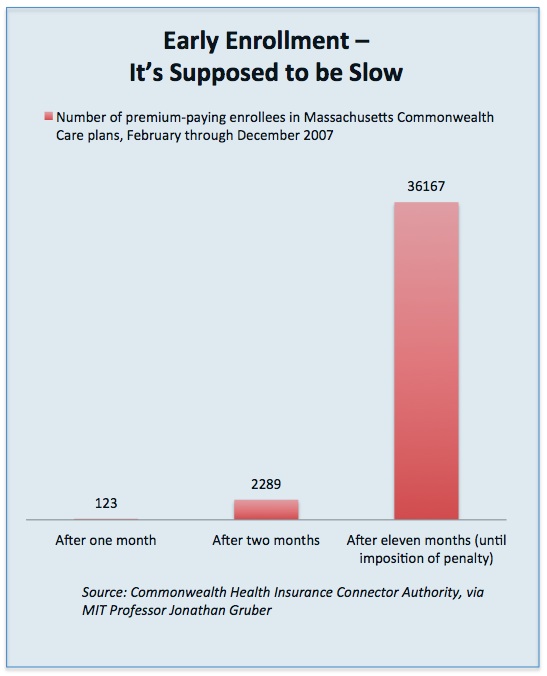
If you want to get a real sense of enrollment patterns among people choosing to shop and buy plans, it’s better to exclude the people getting free care. (In the Massachusetts plan, that would mean people who ended up enrolling in what were called “Type I” and, with some exceptions, “Type IIA” plans.) Jonathan Gruber, the MIT economist who was an architect of the Massachusetts health reforms, has provided me with those numbers. The results? Of the 36,167 people who eventually enrolled in premium-charging plans from Commonwealth Care, 123 signed up in the first month. That’s right—one hundred and twenty-three, or about 0.3 percent. Over the first two months, the number was a bit larger—2,289. But that’s still just 6.3 percent.

The analogy to Obamacare is far from perfect, in that Commonwealth Care didn’t include wealthier people who didn’t qualify for subsidies. (In the Massachusetts scheme, they essentially had a separate exchange—and enrollment there began half a year later.) Also, the Massachusetts open enrollment period was twice as long. So it’s reasonable to expect that, with a fully functional website, early enrollment in Obamacare private plans would be higher than those numbers above suggest. But the general point stands. Very few people sign up for insurance in the first few months. Most wait until much later in the game.

Given Healthcare.gov’s back-end problems, the low number of sign-ups might be better than the alternative. Kliff introduces us to the 834 form:

It is a technical, back-end reporting tool that consumers never see. It is meant to be read by computers, not human beings. It’s the form that tells the insurer’s system who you are and what you need. And it might be the new health-care law’s biggest problem. … Some in the industry believe HealthCare.gov’s traffic problems have been a blessing-in-disguise for the program: If applicants were being able to sign up easily but the 834 forms were coming in with this many errors the results could be disastrous.

Robert Laszewski explains why the 834 forms must be fixed before other parts of the website:

I almost have the sense that HealthCare.gov is in de facto shutdown. Here’s why: Government has to fix the back end before the front end. The demand here is real. I don’t think anyone can dispute that millions of people want to sign up. So if they fix the front end for consumers and thousands of people or hundreds of thousands of people being enrolled before they fix the back end, we’ll have a catastrophic mess.

When insurers are getting 10 or 20 or 50 enrollments a day they can clean the errors up manually. But they can’t do that for thousands of enrollments a day. They have to automate at some point. So I think the Obama administration doesn’t want to cross the red line to shut the system down, but I think this is effectively a shutdown in which they don’t say they’ve shut it down but it basically is shut down.