My mom just said that the Red Sox look like Andrew Sullivan.
— Nate Silver (@fivethirtyeight) October 20, 2013
I guess I can die now.
My mom just said that the Red Sox look like Andrew Sullivan.
— Nate Silver (@fivethirtyeight) October 20, 2013
I guess I can die now.
Will Hines explains how improv comedy can become an ascetic, almost religious pursuit:
The most popular improv advice sounds like spiritual challenges. “Follow the fear” — without even considering if that’s actually practical advice for an improvised comedy scene, you want to believe that. You’ve been hungry to have someone tell you to follow the fear. You find a way to make that advice true. You may come to improv because you like comedy, but if you stay, it’s because all this advice challenges you in a way that you’ve been hungry for. You want this to be a more interesting world, and you want to be a braver person, and then in a dingy improv classroom someone is saying it to you. It’s why you don’t mind not being paid, because you are learning. You’re growing as a person, so it seems just that you pay for it. Your shows are not a place where you give your services, but are a place where you are being taught by an audience how to be spiritually and philosophically more bold.
We believe that these improv classes are going to burn away the parts of our personality that we don’t like and leave in its place a braver, more bold person. There is no one more ready to flagellate than a newly excited improv student. “Call me out on my bullshit,” they say. “I like this teacher because they didn’t let me get away with shit.” It’s almost sado-masochistic, their desire to be corrected and fixed. But it’s because they sense a spiritual perfection. The wording of improv lessons baited them into it, and now they want it.
In an interview with the novelist and essayist Marilynne Robinson, Robert Long asked her about the too-frequent identification of Christianity with the religious right in America. She doesn’t hold back:
Well, what is a Christian, after all? Can we say that most of us are defined by the belief that Jesus Christ made the most gracious gift of his life and death for our redemption? Then what does he deserve from us? He said we are to love our enemies, to turn the other cheek. Granted, these are difficult teachings. But does our most gracious Lord deserve to have his name associated with concealed weapons and stand-your-ground laws, things that fly in the face of his teaching and example? Does he say anywhere that we exist primarily to drive an economy and flourish in it? He says precisely the opposite. Surely we all know this. I suspect that the association of Christianity with positions that would not survive a glance at the Gospels or the Epistles is opportunistic, and that if the actual Christians raised these questions those whose real commitments are to money and hostility and potential violence would drop the pretense and walk away.
Ross Andersen ponders how generations of people have come to terms with the vastness of the sky:
When we peer into the sky’s abyssal recesses, its blank blues and deep starlit voids, we
catch a glimpse of infinity, and, as [philosophy scholar Thomas] McEvilley says, ‘the finite mind has difficulty processing infinity.’ The psychology of this phenomenon was described best by Pascal, the 17th-century mathematician who said the starry sky made him think of time’s crushing enormity. It made him see that human life is a microsecond, beset by two eternities, past and future. ‘The eternal silence of these infinite spaces frightens me,’ he said. And who can blame him? To look at the sky is to be reminded that oceans of space and time lie beyond the reach of our minds. Who can help but feel small under it? By showing us the true scope of the unknown, the sky forces us to confront the mysterious nature of human experience. It puts us face to face with the most basic of truths — that we are all, in some sense, existentially adrift.
Humans have devised several strategies to tame this unnerving quality, none more popular than worship. It’s easy to see why.
Making the sky into a humanlike God is a shortcut to making it legible. If you believe that there is a man in the sky, you can interpret its unpredictable cinema, its colour shifts and stormy whims, as symbolic messages, communications from the cosmic creator. You can graft human traits and desires onto the sky’s impenetrable infinities, and soothe yourself with the comforting notion that the great unknown resembles you in some important way. This philosophical trick is hard for the order-seeking mind to resist, because it leads to a coherent picture of the world. And so, since antiquity, sky gods have gushed from the human imagination, and several of them survive to this day.
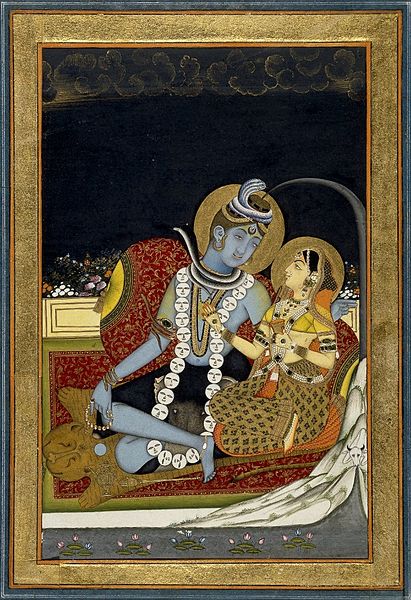
In the West, this practice goes back to the dawn of civilisation, to the Sumerians, whose most exalted deity was the sky god Anu. The Ancient Greeks followed suit by putting Zeus, the sky-father, atop Mount Olympus, and so did the Romans, who worshipped Jupiter for centuries before converting to Christ. Eastern polytheisms had their sky gods, too. Shiva, the supreme god of Shaivism, one of Hinduism’s most ancient denominations, is often described as ‘the cosmic man’. He is typically depicted wearing a crescent moon on his head, an ornament meant to symbolise the waxing and waning of creation during time’s eternal cycles. He wears, in other words, a talisman of infinity.
(Image: Shiva with Parvati, c. 1800, via Wikimedia Commons)
The Economist expands the definition to include the experiences of those in the secular West:
Every natural disaster, forest fire, major accident or terrorist attack has its martyrs, insofar as rescuers knowingly incur mortal danger to help victims. I don’t just mean people doing dangerous jobs, but people who knowingly face specific risks to save others. For many people, the martyrs of 9/11 were the fire-fighters who were killed in the Twin Towers, including their remarkable chaplain, Father Mychal Judge.
Our news-gathering business has its martyrs too, sung and unsung. When a reporter for a leading newspaper or network perishes in the line of duty, the world usually hears about it; but most news-reporters who die on the job, bearing witness to some awkward truth, are natives of the benighted countries where they work, often as freelancers, and they lack the insurance policies, flak jackets and diplomatic protection which make the life of a rich-world reporter a bit easier.

Cambridge, England, 12 pm
In an overview of Judaism and Christianity, Kenan Malik contrasts their understandings of evil and sin:
The story of Adam and Eve, and of the serpent in the Garden of Eden, was, of course, originally a Jewish fable. But Jews read that story differently to Christians. In Judaism, Adam and Eve’s transgression creates a sin against their own souls, but it does not condemn humanity as a whole, and nor does it fundamentally transform either human nature or human beings’ relationship to God. In the Christian tradition, God created humanity to be immortal. In eating the apple, Adam and Eve brought mortality upon themselves. Jews have always seen humans as mortal beings.
In the Garden, Adam and Eve were as children. Having eaten of the Tree of the Knowledge of Good and Evil, they had to take responsibility for themselves, their decisions and their behaviour. This is seen not as a ’fall’ but as a ‘gift’ – the gift of free will. As the Hertz Chumash, the classic Hebrew-English edition of the Pentateuch and Haftorahs, observes, ‘Instead of the Fall of man (in the sense of humanity as a whole), Judaism preaches the Rise of man: and instead of Original Sin, it stresses Original Virtue, the beneficent hereditary influence of righteous ancestors upon their descendants’.
The story of Adam and Eve was initially, then, a fable about the attainment of free will and the embrace of moral responsibility. It became a tale about the corruption of free will and the constraints on moral responsibility. It was in this transformation in the meaning of the Adam and Eve’s transgression that Christianity has perhaps secured its greatest influence. The true legacy of the doctrine of Original Sin is not as an explanation of evil, but rather as a description of human nature, a description that came to dominate Western ethical thinking as Christianity became the crucible in which that thinking took place.
A drummer tries to keep up with an auctioneer:
In recent years, a handful of popular books have been published urging a more robust and radical expression of the Christian faith. I heartily amen the desire to take one’s faith seriously and demonstrate before the watching world a willingness to be more than just Sunday churchgoers. The unintended consequence of this push, however, is that we can give people the impression that Christianity is first and foremost about the sacrifices we make rather than the sacrifice Jesus made for us – our performance rather than his performance for us. The hub of Christianity is not “do something for Jesus.” The hub of Christianity is “Jesus has done everything for you.” And my fear is that too many people, both inside and outside the church, have heard our “do more, try harder” sermons and pleas for intensified devotion and concluded that the focus of the Christian faith is the work that we do instead of the work God has done for us in the person of Jesus.
Furthermore, too many churches perpetuate the impression that Christianity is primarily concerned with morality. As my colleague David Zahl has written, “Christianity is not about good people getting better. It is about real people coping with their failure to be good.” The heart of the Christian faith is Good News not good behavior. When Sunday mornings become one more venue for performance evaluation, can you blame a person for wanting to stay at home?
Sam Harris believes that Islamic violence is more troubling than violence carried out by sadists or the mentally ill:
Take a moment to consider the actions of the Taliban gunman who shot Malala Yousafzai in the head.
How is it that this man came to board a school bus with the intention of murdering a 15-year-old girl? Absent ideology, this could have only been the work of a psychotic or a psychopath. Given the requisite beliefs, however, an entire culture will support such evil.
Malala is the best thing to come out of the Muslim world in a thousand years. She is an extraordinarily brave and eloquent girl who is doing what millions of Muslim men and women are too terrified to do—stand up to the misogyny of traditional Islam. No doubt the assassin who tried to kill her believed that he was doing God’s work. He was probably a perfectly normal man—perhaps even a father himself—and that is what is so disturbing. In response to Malala’s nomination for the Nobel Peace Prize, a Taliban spokesman had this to say:
Malala Yousafzai targeted and criticized Islam. She was against Islam and we tried to kill her, and if we get a chance again we will definitely try to kill her, and we will feel proud killing her.
(Video: A clip from a 2011 interview with Malala, prior to her attack. If you missed Jon Stewart’s remarkable interview with her last week, go here.)
 The Dish
_BM.jpg)